8x8 vs Grasshopper 2026: Which Phone System Wins?
8x8 vs Grasshopper compared on pricing, features, call quality, and team scale. A neutral 2026 buyer's guide for sales teams choosing a business phone system.
8x8 vs Grasshopper 2026: Which Business Phone System Actually Fits Your Sales Team?
TL;DR
- 8x8 is a full UCaaS platform built for mid-market and enterprise teams that need contact-center features, global calling, video, and analytics in one stack.
- Grasshopper is a virtual phone overlay for solopreneurs and small teams who want a business number on top of personal phones, with no PBX, no analytics depth, and no contact-center module.
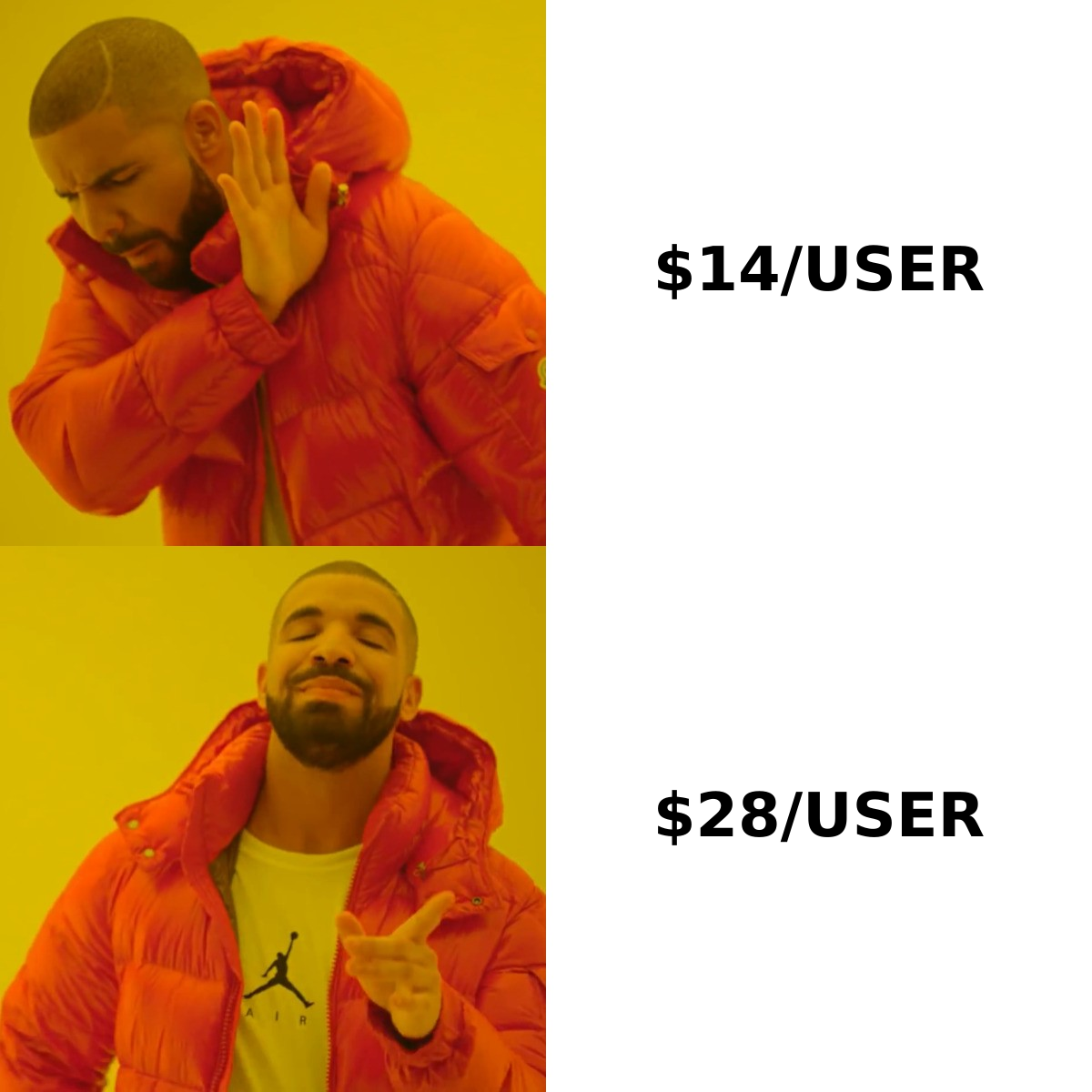
- Pricing diverges sharply: Grasshopper starts at $14/user/mo (Solo) up to ~$55 flat, while 8x8 starts around $28/user/mo (X2) and climbs into custom enterprise pricing.
- If you do >50 outbound dials a day per rep or need call recording, IVR analytics, and CRM dialing, 8x8 wins. If you need a second number on your iPhone for client calls, Grasshopper wins.
- Neither replaces your prospecting stack — you still need an email finder, a dialer, and a CRM to fill the funnel.
What is 8x8 and who is it for?#
8x8 is a Unified Communications as a Service (UCaaS) platform that bundles voice, video, team chat, SMS, and contact-center capabilities into a single cloud system. It is one of the longest-running cloud PBX vendors — public since 1997 — and competes directly with RingCentral, Zoom Phone, and Dialpad. Their official site at 8x8.com positions the product around the "XCaaS" (eXperience Communications) framing, which simply means CCaaS + UCaaS in one license.
The buyer profile is clear: 8x8 targets companies with 25 to 5,000 seats that need real PBX features — auto-attendants, hunt groups, call recording, supervisor barge-in, queue analytics, global DID coverage in 50+ countries, and integrations with Salesforce, HubSpot, and Microsoft Teams. Outbound sales teams pick it when they need a CRM-connected softphone that logs every call automatically and feeds the data into reporting.
You are not the 8x8 buyer if you are a single founder making 20 calls a week from your laptop.
What is Grasshopper and who is it for?#
Grasshopper is a virtual phone system, not a PBX. It gives you a business phone number (toll-free, vanity, or local) that rings through to your existing cell phones or desk phones. There is no softphone-first workflow, no contact-center module, no advanced analytics, and no native CRM logging beyond basic call history.
Their product page at grasshopper.com is upfront about the audience: solopreneurs, freelancers, real estate agents, contractors, and 2-to-10-person teams who want to keep work calls separate from personal ones without buying hardware. The whole system is configured in a few minutes through a web dashboard or mobile app.
Grasshopper is owned by GoTo (formerly LogMeIn), and the product hasn't materially evolved in years — that is a feature for the small-business audience that just wants reliability, not a bug.
How do 8x8 and Grasshopper compare on pricing?#
Pricing is the cleanest place to start because it tells you who each product is built for.
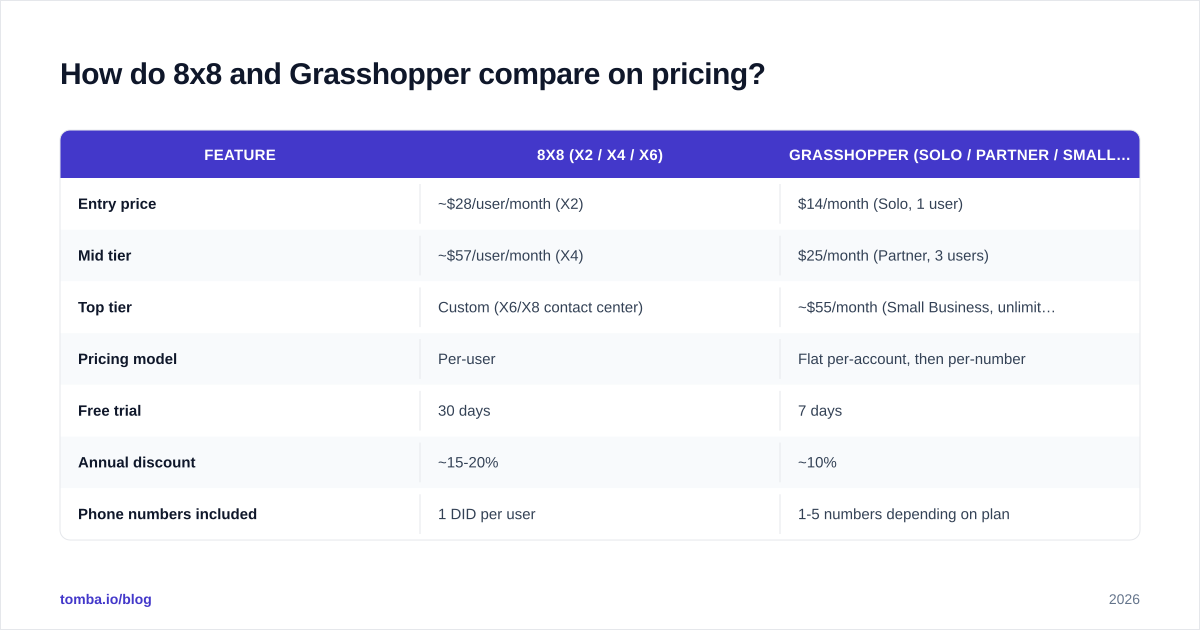
| Feature | 8x8 (X2 / X4 / X6) | Grasshopper (Solo / Partner / Small Business) |
|---|---|---|
| Entry price | ~$28/user/month (X2) | $14/month (Solo, 1 user) |
| Mid tier | ~$57/user/month (X4) | $25/month (Partner, 3 users) |
| Top tier | Custom (X6/X8 contact center) | ~$55/month (Small Business, unlimited users) |
| Pricing model | Per-user | Flat per-account, then per-number |
| Free trial | 30 days | 7 days |
| Annual discount | ~15-20% | ~10% |
| Phone numbers included | 1 DID per user | 1-5 numbers depending on plan |
| Minimum contract | 1 year typical | Month-to-month |
The structural difference: 8x8 scales with headcount, Grasshopper scales with phone numbers. A 20-person sales team on Grasshopper Small Business still pays one $55/mo bill. The same team on 8x8 X2 pays $560/mo — but gets 20 individual softphones with call recording, voicemail transcription, and SMS, plus a Salesforce integration.
Neither company publishes the very top of their pricing publicly. For 8x8's X6 and X8 (contact-center tiers), expect to talk to a rep. Industry reviews on G2 suggest X6 lands around $85-$115/user/month depending on volume.
Which one has better call features?#
This is where the gap is widest. Grasshopper is intentionally feature-light because its audience does not want a control panel with 200 toggles.
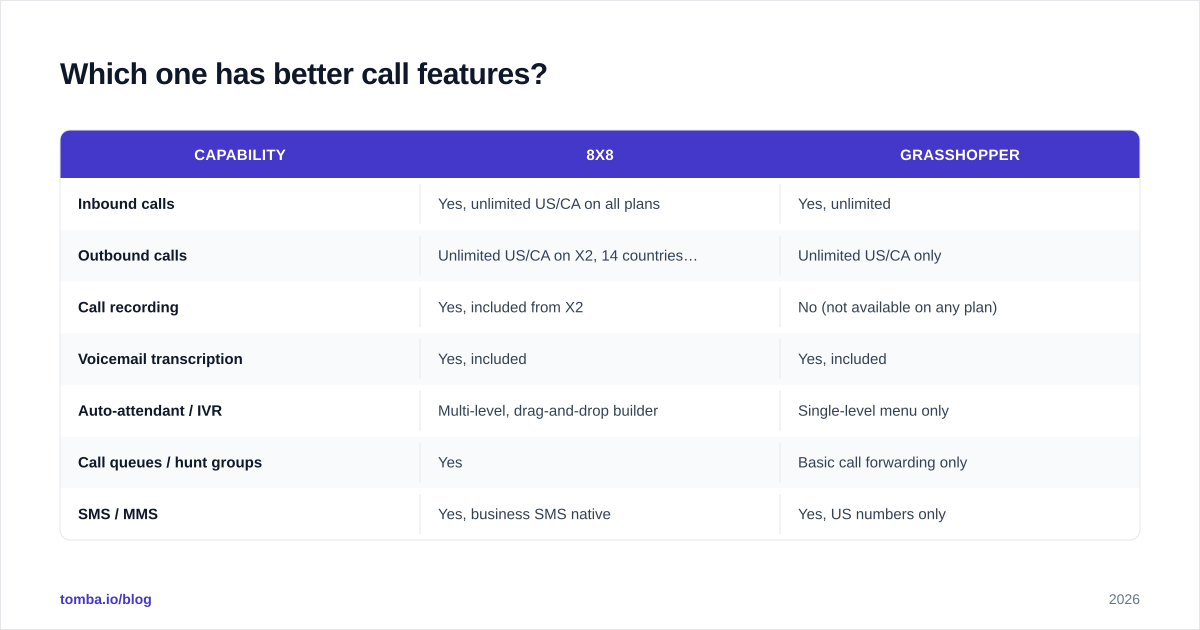
| Capability | 8x8 | Grasshopper |
|---|---|---|
| Inbound calls | Yes, unlimited US/CA on all plans | Yes, unlimited |
| Outbound calls | Unlimited US/CA on X2, 14 countries on X4, 47 on X6 | Unlimited US/CA only |
| Call recording | Yes, included from X2 | No (not available on any plan) |
| Voicemail transcription | Yes, included | Yes, included |
| Auto-attendant / IVR | Multi-level, drag-and-drop builder | Single-level menu only |
| Call queues / hunt groups | Yes | Basic call forwarding only |
| SMS / MMS | Yes, business SMS native | Yes, US numbers only |
| Video meetings | Yes, up to 500 participants | No |
| Team chat | Yes, native | No |
| Mobile + desktop softphone | Yes, full-featured | Mobile + desktop, but limited to dialing/messaging |
| Call analytics | Real-time dashboards + historical | Basic call history only |
| Supervisor tools | Whisper, barge, monitor | None |
| International DID coverage | 50+ countries | US, Canada, UK numbers only |
The honest summary: 8x8 is a phone system. Grasshopper is a phone number with extras.
If your team does outbound prospecting and you want to know which reps made how many calls, what their connect rate is, and where deals stall on the dial, Grasshopper cannot tell you. 8x8 can.
If you just need clients to call a business number that doesn't ring on your personal voicemail at 11pm, Grasshopper does that for $14/mo and you'll be set up by lunch.
Is 8x8 better than Grasshopper for sales teams?#
For an outbound sales team, yes — 8x8 wins almost every dimension that matters. The differences compound when you start looking at the daily workflow of a sales development rep:
- Click-to-dial from the CRM. 8x8's Salesforce and HubSpot integrations let reps dial from the contact record. Grasshopper has a HubSpot integration that logs calls, but does not turn HubSpot into a dialer.
- Call recording for coaching. 8x8 records every call by default (with compliance controls). Grasshopper offers zero recording — full stop.
- Power dialing. Neither platform is a true power dialer like Orum or Nooks, but 8x8's softphone gets close with Salesforce Lightning Dialer integration. Grasshopper has no equivalent.
- Analytics for managers. 8x8's reporting tells you talk time, abandoned calls, queue wait, and rep-by-rep volume. Grasshopper shows a call log.
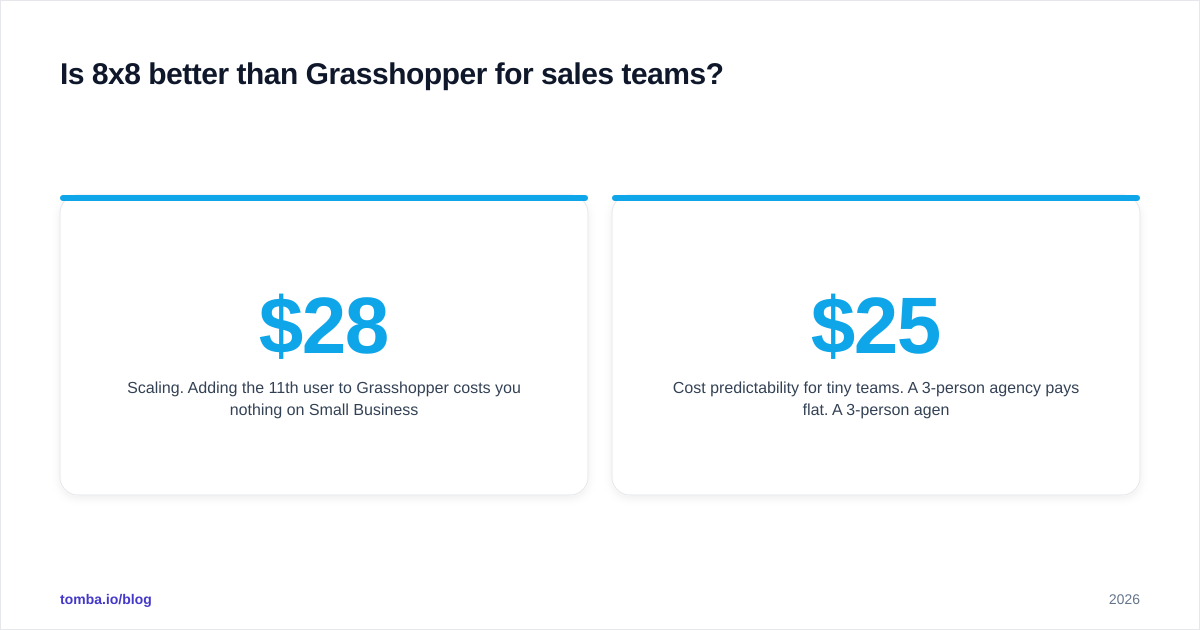
- Scaling. Adding the 11th user to Grasshopper costs you nothing on Small Business. Adding the 11th to 8x8 X2 is another $28/mo — but you also get another full PBX seat.
Where Grasshopper genuinely beats 8x8 for sales:
- Setup speed. A solo founder is selling on day one with Grasshopper. 8x8 onboarding for 20 seats typically takes 1-2 weeks with a configuration call.
- Personal-phone overlay. Grasshopper rings your existing iPhone. No new device, no new app required to receive calls.
- Cost predictability for tiny teams. A 3-person agency pays $25 flat. A 3-person agency on 8x8 X2 pays $84/mo and uses ~5% of what they're paying for.
Whichever platform you choose, the calls themselves are only useful if you're dialing the right numbers. Pair either system with a phone finder to pull verified mobile and direct-dial numbers, then use a phone validator to scrub the list before your reps burn time on disconnects.
What about call quality and reliability?#
Both vendors use VoIP, which means call quality depends on your internet, not their marketing copy. That said, the two platforms have different infrastructure profiles.
8x8 publishes a 99.999% uptime SLA on its enterprise plans, backed by a financially-guaranteed contract. Their voice traffic runs on a private global backbone with patented geo-routing. For international calls, this matters — a London-to-Singapore call on 8x8 typically routes through their own POPs rather than the public internet.
Grasshopper uses a more conventional VoIP setup and does not publish a public SLA. For US-only inbound calling, this is fine — connection quality is consistent in reviews on Capterra and G2. For international callers reaching a US Grasshopper number, mileage varies based on the caller's carrier.
The practical takeaway: if you are running a contact center where 30 reps are on the phone simultaneously, 8x8's infrastructure is purpose-built for that load. If you are a freelancer taking 5 calls a day, you will not notice a difference.
How do the integrations stack up?#
| Integration | 8x8 | Grasshopper |
|---|---|---|
| Salesforce | Native (CTI, click-to-dial, auto-log) | None |
| HubSpot | Native | Native, basic call logging |
| Microsoft Teams | Native (8x8 for Teams) | None |
| Zoho CRM | Native | None |
| Zapier | Yes | Yes |
| Pipedrive | Via Zapier | Via Zapier |
| Slack | Native | None |
| Google Workspace | Native | Native (Chrome extension) |
| API access | Full REST API | Limited |
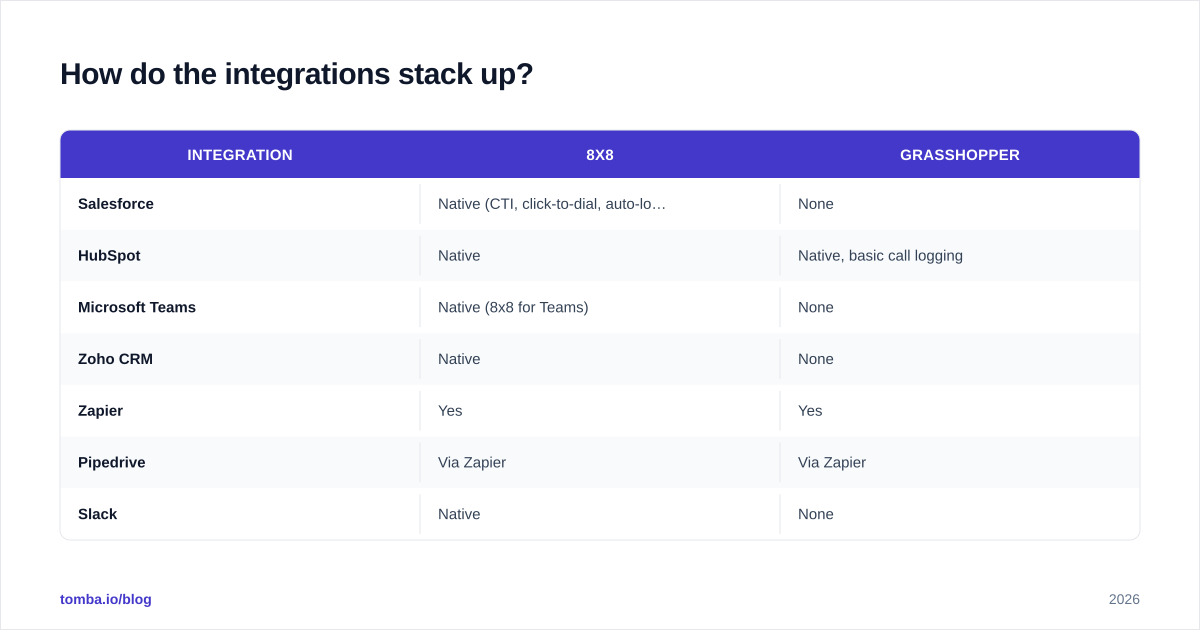
For revenue-ops teams, the Salesforce and HubSpot integrations alone justify 8x8 over Grasshopper. The auto-logged calls feed activity dashboards, sequencing tools, and forecasting. Grasshopper sales reps still copy-paste call notes into the CRM by hand.
If you're already routing your data through tools like HubSpot, Salesforce, or Pipedrive integrations, 8x8 fits the existing pipes. Grasshopper does not.
Which platform handles SMS better?#
Business SMS is the most-requested phone feature in B2B sales right now, and both platforms support it — with caveats.
8x8 includes SMS and MMS on every plan, with US, Canada, and UK numbers SMS-enabled by default. The platform also supports group MMS and SMS from the desktop softphone. For high-volume SMS (anything north of 1,000 messages a day), 8x8 requires 10DLC registration with The Campaign Registry, which is now a US carrier requirement across the industry — not an 8x8-specific hurdle.
Grasshopper supports SMS on US numbers only. It does not support MMS in any meaningful capacity, and the throughput limits are tight enough that bulk outreach campaigns will get flagged. Grasshopper is appropriate for 1:1 client texting; it is not appropriate for SMS prospecting at scale.
For either platform, remember that SMS volume restrictions are a regulatory issue, not a vendor one. The FCC's 10DLC registration framework applies regardless of which provider you choose.
What are the hidden costs of each platform?#
Neither vendor is dishonest about pricing, but both have line items that surprise buyers.
8x8 hidden costs:
- Activation fees on some channels ($25-$99/user one-time)
- Number porting fees (usually waived but check the contract)
- International calling beyond the included minutes (X4 includes 14 countries unlimited; X6 includes 47)
- Toll-free inbound minutes after the included bucket (~$0.02/min overage)
- Premium support tiers for sub-1-hour response
Grasshopper hidden costs:
- Extra phone numbers beyond what's included ($10-$15/number/mo)
- International calls outbound (per-minute rate, varies by country)
- Toll-free minutes after included bucket
- The "soft" cost: no recording means no coaching infrastructure, which costs hiring managers their best lever for SDR development
Total cost of ownership over a year for a 10-person sales team:
- 8x8 X2: ~$3,360/year base + activation + overages → ~$3,800-$4,200
- Grasshopper Small Business: ~$594/year base + extra numbers → ~$700-$900
8x8 is 4-5× more expensive at this team size. Whether that's a good trade is the actual decision.
Are there better alternatives to both?#
Depending on your team profile, yes:
- RingCentral MVP — closest direct competitor to 8x8; arguably more polished UI, similar pricing, deeper Microsoft 365 ties
- Dialpad Sell — AI-native, real-time call coaching, transcripts; mid-market sales focus
- Zoom Phone — if you already pay for Zoom, adding Phone is cheap ($10-$15/user/mo) and the integration is seamless
- OpenPhone — modern Grasshopper alternative, better UI, shared inboxes, $19/user/mo
- JustCall — Grasshopper-sized pricing with sales-team features (recording, SMS campaigns, CRM logging)
For a small team that has outgrown Grasshopper but doesn't need 8x8's full UCaaS stack, OpenPhone or JustCall is usually the right next stop.
How should you decide between 8x8 and Grasshopper?#
Use this decision shortcut:
| If your team... | Pick |
|---|---|
| Makes >30 outbound calls per rep per day | 8x8 |
| Needs call recording for compliance or coaching | 8x8 |
| Runs an inbound support queue with >3 agents | 8x8 |
| Operates internationally (multi-country DIDs) | 8x8 |
| Lives inside Salesforce/HubSpot/MS Teams | 8x8 |
| Has 1-5 users who just need a business number | Grasshopper |
| Wants to set up the phone system today, alone | Grasshopper |
| Cares about flat monthly pricing | Grasshopper |
| Is a side hustle, agency, or solo consultancy | Grasshopper |
| Will outgrow whatever they buy within 12 months | Skip both, look at OpenPhone or Dialpad |
The trap to avoid: buying 8x8 because it has every feature, then using 5% of them. The trap on the other side: buying Grasshopper because it's cheap, then watching reps copy-paste call notes for 2 hours a day because there's no CRM logging.
Where does prospecting data fit into the phone-system decision?#
A phone system is only as good as the numbers you dial. If your list is full of disconnects, wrong-numbers, or generic switchboards, neither 8x8 nor Grasshopper will save your connect rate.
Sales teams that win on the phone tend to:
- Build the target list in their CRM
- Enrich each contact with verified direct-dial mobile numbers using a B2B database or contact enrichment tool
- Validate the numbers before dialing
- Run the dial session through their phone system with CRM logging on
- Review recordings (8x8) or notes (Grasshopper) to coach the next session
Phone numbers decay fast — about 30-40% of B2B mobile numbers go stale in 18 months as people change jobs. Refreshing your list every quarter is more important than which dialer you bought.
Final verdict: 8x8 vs Grasshopper in 2026#
8x8 is the right choice if you are running a sales team of 10+ that lives on the phone, needs CRM integration, and wants recording and analytics to coach reps. The price premium over Grasshopper buys you a real PBX, not just a number forwarder.
Grasshopper is the right choice if you are a solo operator or a tiny team that wants a professional business number without a phone system. It's a sharp tool for a narrow job.
Neither product helps you find the right people to call. For that, you need a prospecting stack that pulls verified emails, direct dials, and LinkedIn profiles into your CRM before the dialer ever rings.
Ready to fill the top of your funnel? Use the Tomba Email Finder to pull verified business emails for your target accounts, then layer in our phone finder to get the direct dials your reps actually need. Start free with 25 searches a month, or move to Starter at $49/mo when you're ready to scale. The phone system is the megaphone — the data is the message.
Ready to find emails that actually work?
Join 150,000+ professionals who stopped guessing and started sending. Free credits on signup — no credit card required.
Get the Tomba newsletter
Practical outbound tactics and product updates — once every two weeks.
About the author