9 Steps to Build a Go-to-Market Strategy That Wins in 2026
A practical 9-step GTM playbook for 2026 — ICP, positioning, channels, pricing, and the metrics that actually move pipeline. No fluff, with templates and a comparison table.
9 Steps to Build a Go-to-Market Strategy That Wins in 2026
TL;DR
- A go-to-market (GTM) strategy is the plan that connects a product to a buyer — ICP, message, channels, pricing, motion, and metrics. Skip any layer and the rest collapses.
- The 2026 version of GTM is tighter: AI compresses research, intent data shrinks lists, and buyers tolerate fewer touches before they tune you out.
- The 9 steps below take you from "we have a product" to "we have a repeatable pipeline" without the 60-slide deck.
- Real GTM strategies fit on one page. Anything longer is a planning artifact, not an operating system.
- The biggest 2026 unlock isn't AI — it's the discipline to kill channels that don't pay back inside one sales cycle.
What is a go-to-market strategy?#
A go-to-market strategy is the operating plan a company uses to launch or relaunch a product into a specific market. It answers five questions in order: who are we selling to, why do they care, how will we reach them, what will they pay, and how do we measure if it's working.
It is not a marketing plan. Marketing plans live inside GTM. GTM also covers sales motion, pricing, packaging, customer success handoff, and the revenue operations layer that ties it all together.
The mistake most teams make is treating GTM as a launch event. A launch is a moment. GTM is the engine you keep tuning for the next four quarters.
Why does GTM matter more in 2026?#
Three shifts changed the math:
- Buyers are harder to reach. Average B2B inboxes now receive 40-60% more cold outreach than in 2022, and reply rates on generic sequences are in the low single digits. You don't get away with broad lists anymore.
- AI compressed prep time but not trust. A rep can research 200 accounts before lunch. The buyer still needs the same five proof points to take a meeting.
- CFO scrutiny tightened. "Growth at all costs" is dead. Every channel needs a payback period, and the channels that can't show one inside a sales cycle get cut.
A serious GTM strategy bakes those realities in. Skip them and you'll spend the year explaining why pipeline is light.
Step 1: Define a narrow ICP#
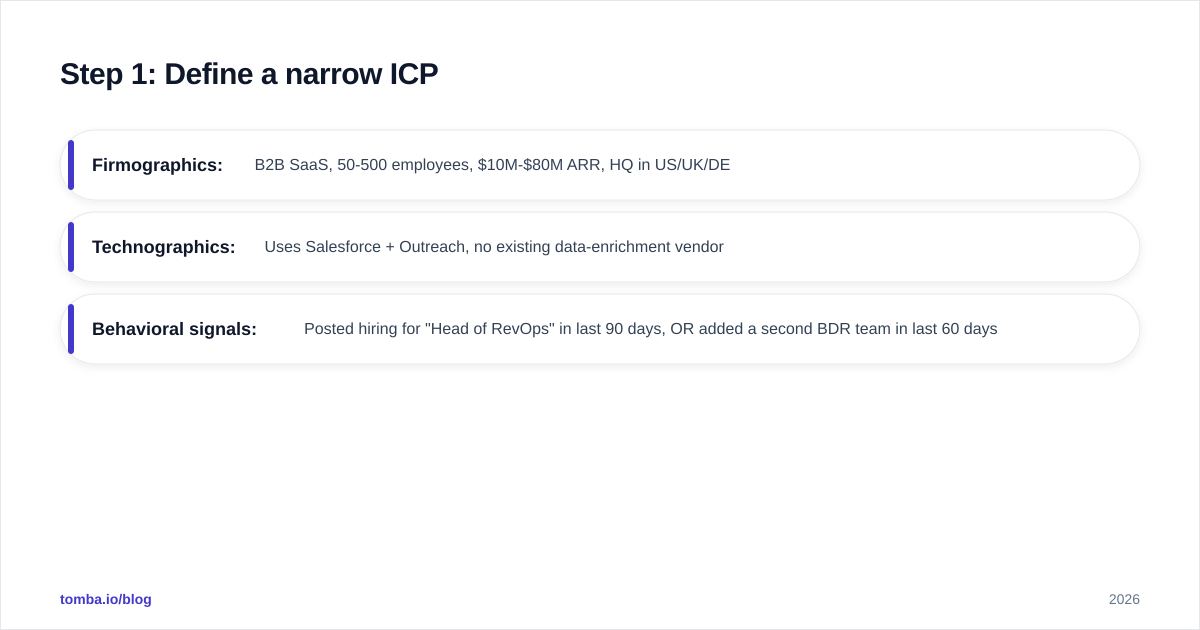
Your Ideal Customer Profile is not "mid-market SaaS companies." That's a market segment. An ICP is a specific firmographic + technographic + behavioral fingerprint of accounts that buy fast, expand, and stay.
A workable 2026 ICP looks like:
- Firmographics: B2B SaaS, 50-500 employees, $10M-$80M ARR, HQ in US/UK/DE
- Technographics: Uses Salesforce + Outreach, no existing data-enrichment vendor
- Behavioral signals: Posted hiring for "Head of RevOps" in last 90 days, OR added a second BDR team in last 60 days
Three to five attributes. No more. If your ICP fits on one line, your reps will actually use it. Validate it by checking your last 20 closed-won deals — do at least 14 match the profile? If not, you're guessing.
For tactical help building ICP lists from this fingerprint, the domain search and B2B database workflows are where most teams start.
Step 2: Nail positioning before you write a word of copy#
Positioning is the answer to "why us, why now, why not the alternative." If you can't say it in 30 seconds, your reps can't either.
Use the April Dunford frame: for [target customer], who has [problem], our product is a [category] that [unique benefit]. Unlike [competitor], we [key differentiator].
Bad positioning: "AI-powered sales platform that helps teams close more deals."
Good positioning: "For RevOps leaders at 50-500-person SaaS companies who waste 30% of seat spend on dead contacts, Tomba is an email finder and verification platform that ships 99% deliverable data at half the per-credit cost of Apollo or ZoomInfo."
Test positioning by reading it to five customers. If three nod and two ask a clarifying question, ship it. If all five ask what you mean, you have more work to do.
Step 3: Pick a primary sales motion#
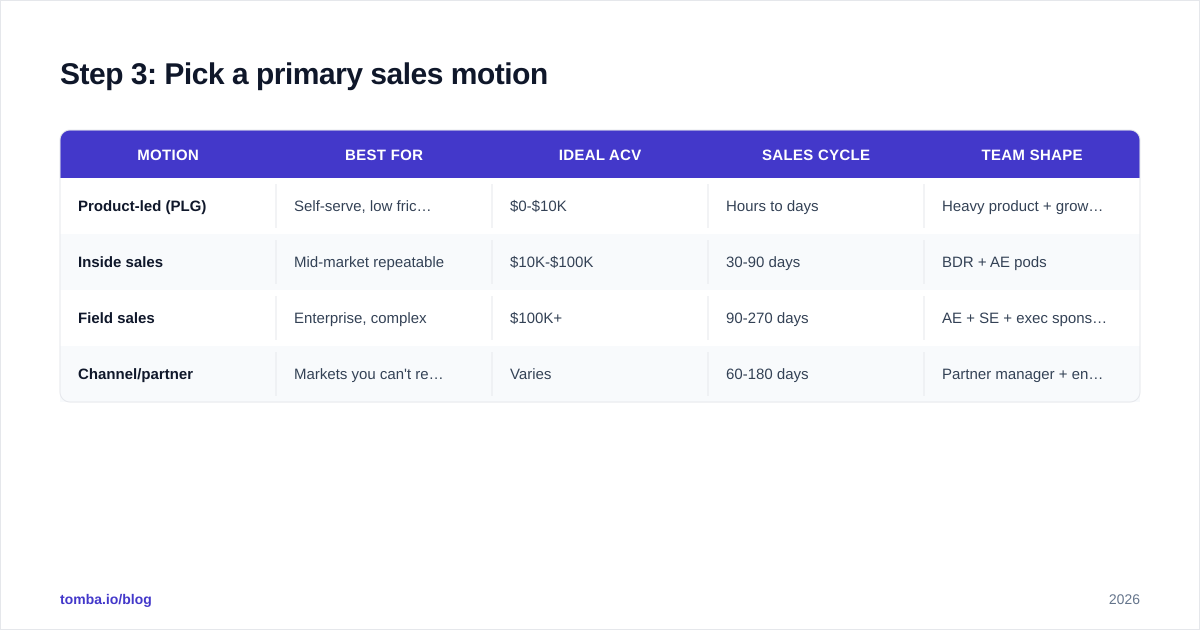
GTM strategy lives or dies on motion fit. The four motions:
| Motion | Best for | Ideal ACV | Sales cycle | Team shape |
|---|---|---|---|---|
| Product-led (PLG) | Self-serve, low friction | $0-$10K | Hours to days | Heavy product + growth eng |
| Inside sales | Mid-market repeatable | $10K-$100K | 30-90 days | BDR + AE pods |
| Field sales | Enterprise, complex | $100K+ | 90-270 days | AE + SE + exec sponsor |
| Channel/partner | Markets you can't reach direct | Varies | 60-180 days | Partner manager + enablement |
Pick one as primary. Layer a second only after the first hits $5M ARR. Teams that try to run PLG and enterprise simultaneously in year one almost always underfund both. Don't.
Step 4: Map the buyer journey honestly#
Plot every step from "doesn't know you exist" to "renews." For each stage, list the buyer's question and the asset that answers it.
A condensed map for a $25K ACV product:
- Unaware → content + thought leadership (LinkedIn, blog, podcast guesting)
- Aware → comparison pages, alternatives content, case studies
- Considering → product tour, free trial, ROI calculator
- Evaluating → security docs, customer reference call, pilot
- Decision → order form, procurement support, kickoff plan
- Adopted → onboarding scorecard, QBR cadence, expansion playbook
If a stage has no asset, the deal stalls there. That's where you build first.
Step 5: Pick channels with payback math, not vibes#
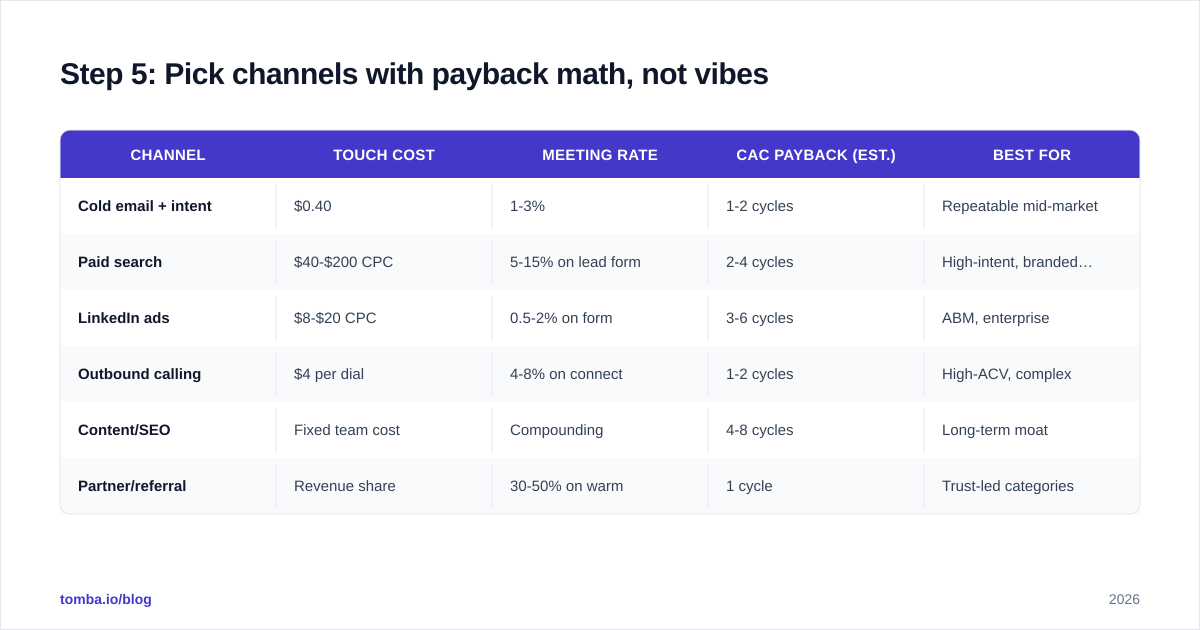
The 2026 mistake is spreading thin across eight channels because someone on LinkedIn said you should. Pick two or three with a defensible payback path.
For each candidate channel, write down:
- Cost per touch
- Realistic reply or click rate (use industry benchmarks, not vendor pitches)
- Conversion to qualified meeting
- Conversion to closed-won
- Implied CAC and payback in sales cycles
| Channel | Touch cost | Meeting rate | CAC payback (est.) | Best for |
|---|---|---|---|---|
| Cold email + intent | $0.40 | 1-3% | 1-2 cycles | Repeatable mid-market |
| Paid search | $40-$200 CPC | 5-15% on lead form | 2-4 cycles | High-intent, branded queries |
| LinkedIn ads | $8-$20 CPC | 0.5-2% on form | 3-6 cycles | ABM, enterprise |
| Outbound calling | $4 per dial | 4-8% on connect | 1-2 cycles | High-ACV, complex |
| Content/SEO | Fixed team cost | Compounding | 4-8 cycles | Long-term moat |
| Partner/referral | Revenue share | 30-50% on warm | 1 cycle | Trust-led categories |
Kill any channel that can't show payback inside two sales cycles after the ramp period. Brutal but necessary.
Step 6: Set pricing and packaging like a product decision#
Pricing is not a footnote. It's the second-strongest growth lever after positioning, and it's the one most teams undercook.
Three rules that hold in 2026:
- Anchor against value, not cost. "Per seat per month" only works if seat = clear unit of value. Otherwise switch to usage, outcomes, or hybrid.
- Three tiers, not five. Starter, growth, enterprise. Five tiers create choice paralysis and make procurement conversations longer.
- Publish prices. Hidden pricing is a tax on velocity. Buyers who can't see your price assume worst-case and disqualify you. Only hide enterprise tiers when the answer truly is "it depends."
Run a pricing test every six months. Sample 20 closed-lost deals and ask the buyer where you fell on cost vs. perceived value. The data beats the spreadsheet.
Step 7: Build a stack that compounds#
Your GTM tech stack should do four things: identify the right accounts, get accurate contact data, run plays against them, and report on what worked. Anything else is a distraction.
A minimum viable 2026 stack:
- CRM: Salesforce or HubSpot — pick one and commit
- Data + email: an email finder and email verifier layer to keep deliverability above 95%
- Sequencer: Outreach, Salesloft, or a leaner alternative
- Intent/signal: one provider — not three
- Enrichment: data enrichment on every inbound lead
- Reporting: native CRM dashboards first; only buy a BI tool when you've outgrown them
The trap is buying a category leader for every box. Most teams need three to five tools, not twelve. Audit anything with under 60% seat utilization after 90 days.
Step 8: Define metrics that map to revenue, not activity#
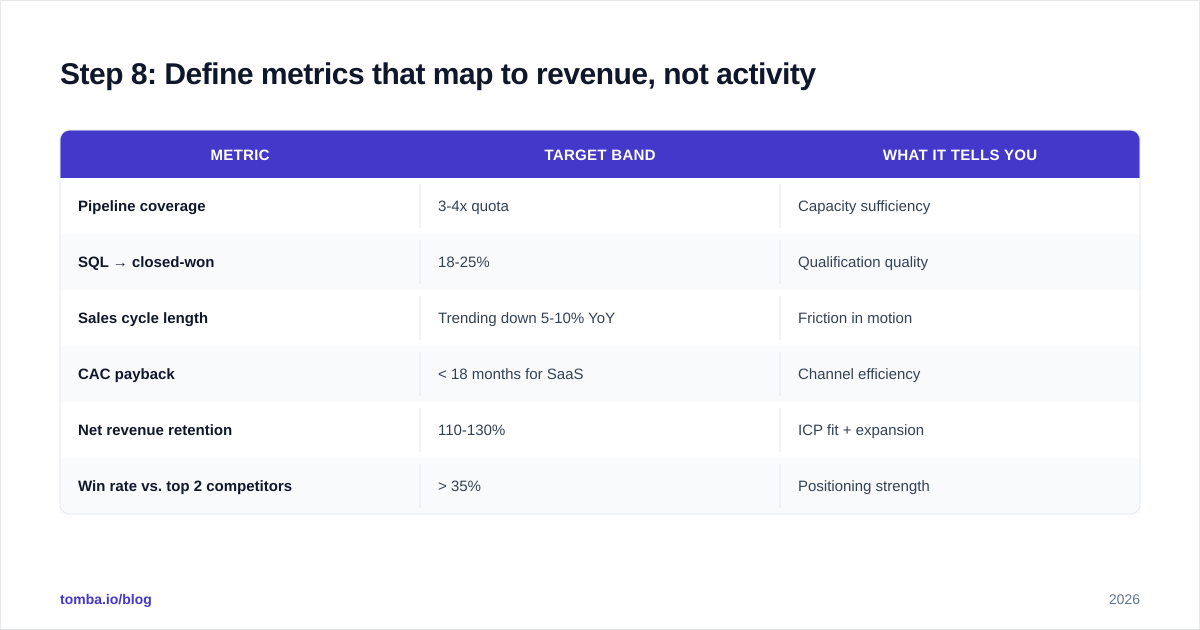
Activity metrics (calls dialed, emails sent) tell you if reps are working. Revenue metrics tell you if the strategy is working. You need both, but the second set drives decisions.
The 2026 GTM scorecard:
| Metric | Target band | What it tells you |
|---|---|---|
| Pipeline coverage | 3-4x quota | Capacity sufficiency |
| SQL → closed-won | 18-25% | Qualification quality |
| Sales cycle length | Trending down 5-10% YoY | Friction in motion |
| CAC payback | < 18 months for SaaS | Channel efficiency |
| Net revenue retention | 110-130% | ICP fit + expansion |
| Win rate vs. top 2 competitors | > 35% | Positioning strength |
Review monthly. Cut one channel, one tool, or one motion every quarter if the data demands it. GTM is a portfolio — you prune.
For a deeper dive on retention math, the response rate and win rate entries in the Tomba glossary are good companions.
Step 9: Operationalize and review every 90 days#
A GTM strategy that lives in a Notion doc nobody opens is a GTM strategy that doesn't exist. Operationalize it.
The 90-day rhythm that works:
- Week 1 of quarter: Strategy review — score the previous quarter against the scorecard. Kill, double down, or hold each channel.
- Weeks 2-12: Execute. Reps see ICP, message, and playbook in the CRM, not a PDF.
- Monthly: Pipeline council — RevOps, sales, marketing, CS. One hour. One decision per channel.
- Quarterly: Customer panel — five customers on a call. What was confusing? What almost killed the deal?
The companies that scale this stuff don't have smarter strategies. They have shorter feedback loops.
How do you know your GTM is actually working?#
Three honest signals, no vanity metrics:
- A new rep ramps to quota in under two quarters. If onboarding takes longer, your playbook isn't actually a playbook.
- You can predict next quarter's pipeline within 15%. If forecasting is a coin flip, your stages or your scorecard are broken.
- At least 60% of closed-won deals match your stated ICP. Below that, your ICP is aspirational.
If two of the three are red, stop adding channels and fix the foundation.
What are the most common GTM mistakes in 2026?#
- Hiring before product-market fit. A bigger BDR team does not fix weak positioning. It just burns runway faster.
- Confusing brand for demand. Brand investments compound over years. They don't fill next month's pipeline.
- Treating AI as a strategy. AI is leverage on a strategy. If the strategy is wrong, AI just makes you wrong faster.
- Ignoring CS. Net revenue retention is half of your GTM. A leaky funnel below the sale ruins everything above it.
- Skipping the kill list. No quarterly channel cuts means budget creeps into channels that don't pay back.
Final word and where to start#
If you've read this far and don't know which step to tackle first, do this: write your ICP in one line, your positioning in three lines, and your top two channels with payback math on a single page. That's day one. Everything else is iteration.
Strong GTM in 2026 starts with the contact data underneath it. If your reps are working from a list with 30% dead emails, no strategy can survive the bounce rate. Try the Tomba Email Finder — the free tier (25 searches/month) is enough to validate your top 50 ICP accounts before you commit to a campaign, and the Starter plan at $49/month covers most early-stage GTM teams. See full Tomba pricing for growth and enterprise tiers.
// get started
Find, verify and enrich your first contacts today
Start on the free plan with 25 searches a month, then scale when your team is ready.
Free plan · No credit card required · GDPR & CCPA
// about the author