ABM Account Plan Template: The 2026 Framework That Wins Deals
A battle-tested ABM account plan template for 2026, with the exact sections, signals, and stakeholder maps that turn target accounts into closed revenue.
ABM Account Plan Template: The 2026 Framework That Wins Deals
TL;DR
- An ABM account plan template is a one-page (or one-doc) operating system for a single target account — covering org map, buying committee, pain hypotheses, signals, and the next three plays.
- The 2026 version is signal-driven: intent data, product usage, and hiring triggers feed the plan weekly, not quarterly.
- Sales and marketing share one plan per account. If marketing has a different document, you don't have ABM — you have parallel work.
- Plans live or die on contact data quality. Bad emails and stale titles kill even the best strategy, so enrichment is non-negotiable.
- Below: the full template, a comparison of frameworks (ITSMA vs. Demandbase vs. Lean ABM), and the failure modes that kill 70% of programs.
What is an ABM account plan template, and why does it matter in 2026?#
An ABM account plan template is a structured document you fill out per target account that captures who the buyers are, what they care about, what signals you're seeing, and what you'll do next. Think of it like a flight plan: pilots don't take off without one because the cost of improvising mid-flight is too high. The cost of improvising a $250K deal is the same.
In 2026, three things changed that make the template more important than it was five years ago:
- Buying committees grew. Gartner now puts the average B2B buying group at 6–10 people. You cannot keep that map in your head.
- Signals exploded. Between intent platforms, product analytics, hiring data, and LinkedIn activity, you get more inputs per week than most reps can process without a structure.
- AI compressed the busywork. Drafting outreach, summarizing 10-Ks, and enriching contacts now take minutes. The bottleneck moved upstream — to plan quality.
A good template forces you to answer the hard questions: Why this account? Why now? Who decides? What do we know that competitors don't? Skip those and you're running spray-and-pray with a fancier list.
What does a great ABM account plan template look like?#
Here's the 2026 structure. Keep it to one page — if it doesn't fit, you're hoarding, not planning.
1. Account snapshot
- Company, industry, HQ, employee count, revenue
- Tech stack (relevant integrations and competitors they use)
- Recent news (last 90 days): funding, exec hires, layoffs, M&A
- Strategic priorities (from 10-K, earnings call, or CEO posts)
2. Why this account, why now
- Fit score (ICP match)
- Intent signals (G2, Bombora, 6sense)
- Trigger event (the specific thing that opened the window)
- Hypothesis: the business problem we believe we can solve
3. Buying committee map
- Economic buyer
- Champion(s)
- Decision-influencers
- Blockers / detractors
- Power-base diagram (lines = relationships, thickness = influence)
4. Stakeholder profiles (one row each)
- Name, title, tenure, reporting line
- Verified email, LinkedIn, phone
- Personal priorities and KPIs
- Last touchpoint and channel
5. Value proposition (account-specific)
- Top 3 pains we'll address
- Quantified business case (range, not single number)
- Proof points (case studies from similar accounts)
6. Plays in flight
- Current play (e.g., exec gift + warm intro + breakup email)
- Next play (date, owner, channel, message)
- Marketing assist (custom landing page, paid retargeting list, podcast pitch)
7. Risk and competitor watch
- Known incumbent
- Renewal date if known
- Procurement quirks (vendor onboarding hell, security review pain)
8. Definition of done for this quarter
- Meeting booked? Multi-thread coverage? POC scoped? Contract redlines?
Which ABM framework should you base your template on?#
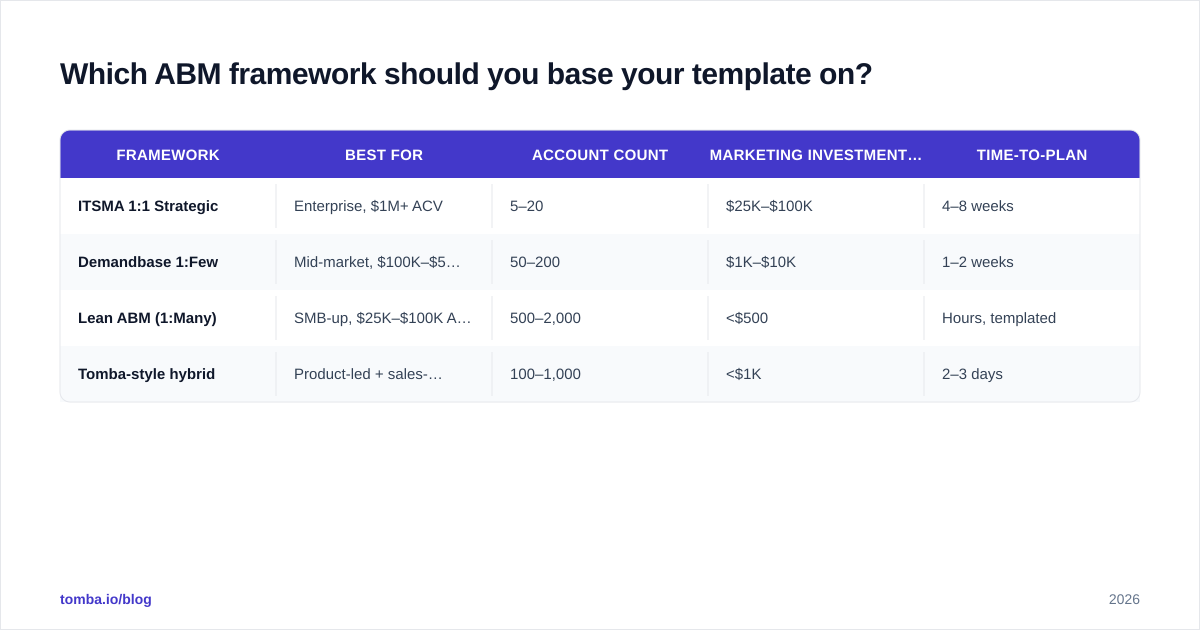
Three frameworks dominate, and most teams blend them. Pick based on tier size and team maturity.
| Framework | Best for | Account count | Marketing investment per account | Time-to-plan |
|---|---|---|---|---|
| ITSMA 1:1 Strategic | Enterprise, $1M+ ACV | 5–20 | $25K–$100K | 4–8 weeks |
| Demandbase 1:Few | Mid-market, $100K–$500K ACV | 50–200 | $1K–$10K | 1–2 weeks |
| Lean ABM (1:Many) | SMB-up, $25K–$100K ACV | 500–2,000 | <$500 | Hours, templated |
| Tomba-style hybrid | Product-led + sales-assist | 100–1,000 | <$1K | 2–3 days |
ITSMA — the original from the ITSMA research firm — is the gold standard for strategic accounts. It's heavy. Use it when one logo can fund a quarter.
Demandbase and 6sense pioneered the 1:few middle ground where you cluster 10–50 accounts with shared traits and run plays that are personalized at the cluster level, then customized lightly per account.
Lean ABM is what most product-led growth companies actually run: heavily templated plans, signal-triggered automation, and a rep who layers a 15-minute custom intro on top.
How do you fill in the buying committee section without guessing?#
This is where most plans collapse. The committee section is fiction unless you have verified contact data and a way to read the org.
Start with three sources:
- LinkedIn Sales Navigator for the org map and role changes
- A contact data provider for verified emails, phones, and reporting lines
- Product usage or CRM history for anyone who's already raised a hand
Then enrich each row with a verified work email. Bad email = bypassed buyer = dead plan. We've seen reps spend two weeks crafting a plan, send the opening volley, and get 30% hard bounces because they pulled emails from a 2024 scrape.
A few patterns that work in 2026:
- Use a bulk email finder to enrich the committee list in one pass, then verify before adding to sequencer. Don't ship 60% deliverability and call it ABM.
- Pair the LinkedIn finder workflow with title-based searches so you don't miss the lower-titled influencers the AE forgot about.
- For accounts where you only know the domain, run a domain search to pull the full team and pattern, then narrow by role.
If you have an internal data warehouse, plug into the Tomba API directly so the committee section auto-refreshes when someone changes jobs. Title and tenure drift are the silent killers of multi-quarter ABM motions.
What signals belong in the "why now" section?#
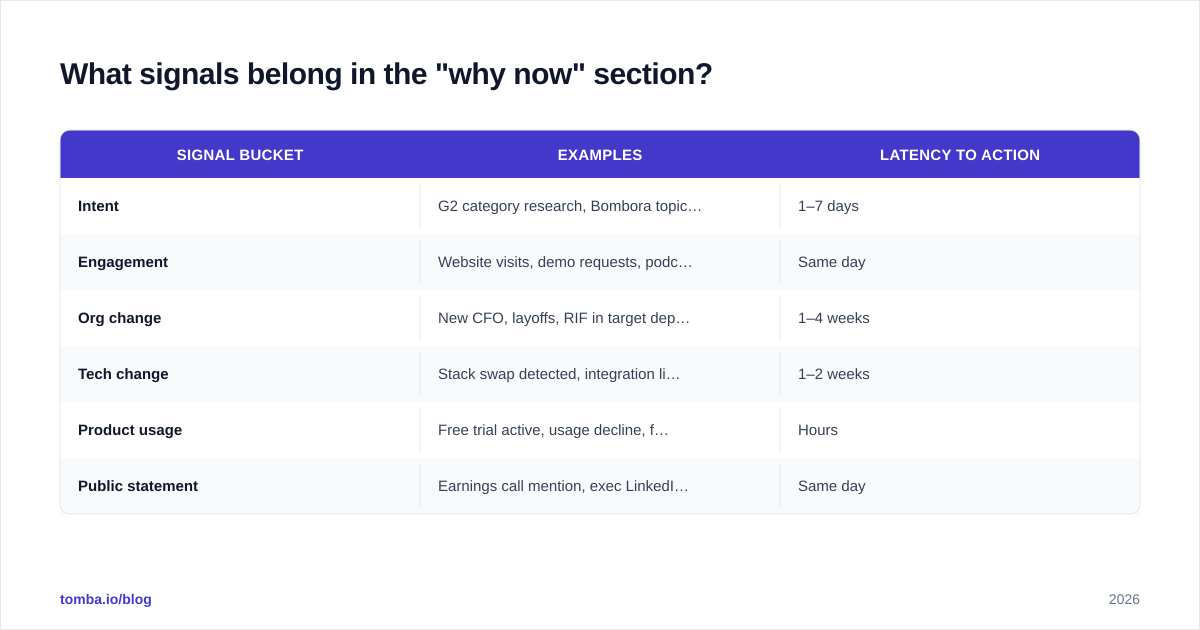
Signals are the difference between "we should call them" and "they're three weeks from buying." In the 2026 stack, you want at least one signal from each of these buckets:
| Signal bucket | Examples | Latency to action |
|---|---|---|
| Intent | G2 category research, Bombora topics, content syndication clicks | 1–7 days |
| Engagement | Website visits, demo requests, podcast listens, ebook downloads | Same day |
| Org change | New CFO, layoffs, RIF in target dept, expansion hire | 1–4 weeks |
| Tech change | Stack swap detected, integration listing, RFP posted publicly | 1–2 weeks |
| Product usage | Free trial active, usage decline, feature ceiling hit | Hours |
| Public statement | Earnings call mention, exec LinkedIn post, podcast appearance | Same day |
The mistake is treating signals as a list. They're a scoring model. A new CFO plus intent activity on "spend management" plus a security analyst hire is a five-alarm trigger. Each one alone is noise.
Most teams underweight org-change signals. A new VP gets a 90-day mandate to make their mark — that's a forced budget window you don't get with stable orgs.
How do you make sales and marketing share one plan?#
The single biggest reason ABM fails: marketing builds a "target account program," sales builds a "named account list," and the two documents never meet. Three rules:
- One artifact per account. Not a marketing brief plus an SFDC account plan. Same doc, same source of truth. Use a shared Notion page, an Airtable record, or your CRM's account object — but only one.
- Both sides write to it weekly. Marketing logs the air cover (ads, content, events). Sales logs the meetings and message variants. The plan becomes the activity log.
- One owner per account. Usually the AE. Marketing supports; ops audits. If the AE doesn't own it, the plan rots.
Your revenue operations team should audit a random sample of plans every two weeks. Look for: stale signals, missing committee members, last-touch older than 21 days, no defined next play.
What does the template look like for a real account?#
Here's a redacted example for a fictional account, "Northwind Logistics," a $400M revenue 3PL.
Account snapshot. 3PL, 2,100 employees, Atlanta HQ, $420M revenue. Tech: SAP TM, Manhattan WMS, Salesforce,
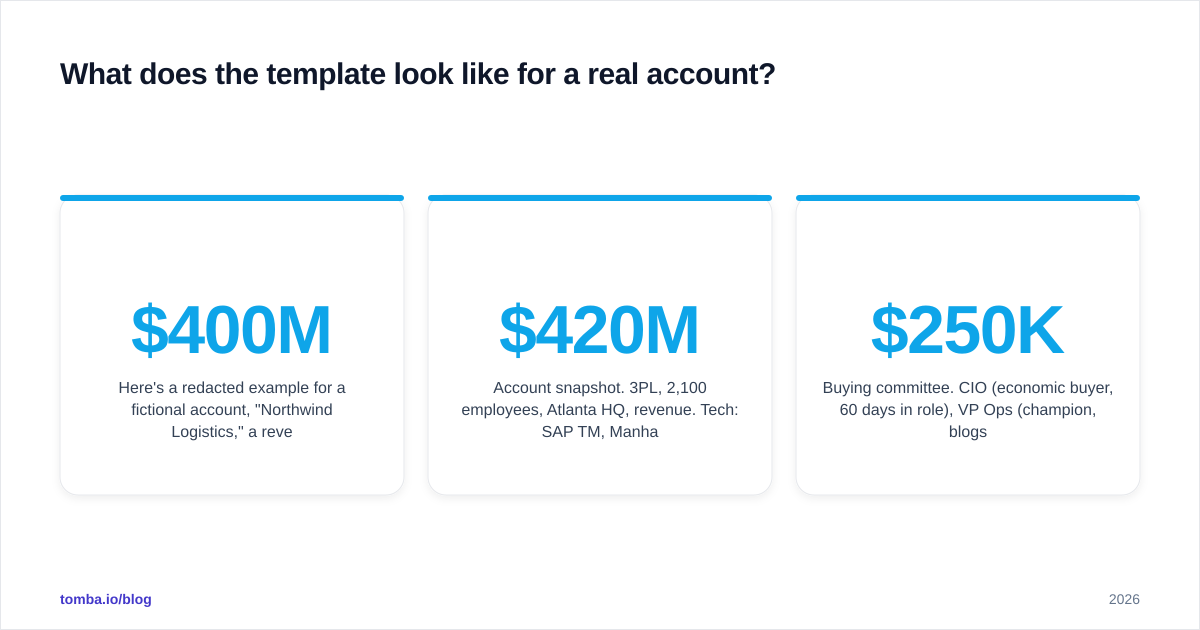
ZoomInfo. Recent: new CIO (March 2026), public RFP for warehouse-automation vendor, missed Q4 EBITDA target.
Why now. ICP fit 92/100. Intent score on "warehouse automation" rose 4x in 30 days. New CIO publicly posted about "fixing the data layer" on LinkedIn. Hypothesis: their warehouse data is fragmented across WMS and TMS, and the new CIO has a Q3 mandate to consolidate.
Buying committee. CIO (economic buyer, 60 days in role), VP Ops (champion, blogs about labor shortage), Director of IT (influencer, owns Salesforce), Procurement Lead (blocker, prefers incumbents), CFO (gatekeeper, signs above $250K).
Plays in flight. Current: ABM ad campaign to the 9-person buying committee + a custom landing page benchmarking Northwind's category against three peers. Next: AE sends a personalized Loom referencing the CIO's LinkedIn post (3-day window). Marketing assist: pitch the CIO for the company podcast.
Risk. Manhattan Associates is incumbent for the WMS layer; they will defend hard. Procurement requires 90-day SOC 2 review.
Definition of done for Q2. Discovery call with VP Ops booked. CIO replied to one email or LinkedIn DM. POC scope drafted with IT Director.
That's a plan you can run. Not "engage Northwind in Q2."
How do you scale this without burning your team out?#
You don't fill in 200 plans by hand. The 2026 stack does the busywork:
- Automate the snapshot. Pipe firmographics, news, and 10-K bullets from your data provider into the doc on creation. A rep should never copy-paste from Crunchbase.
- Automate the committee enrichment. Trigger contact discovery from CRM the moment an account moves to "Tier 1." Use a tool like bulk email finder plus a verifier to keep the data clean.
- Automate the signal layer. Intent and engagement signals should write directly to the plan. Reps read; they don't gather.
- Reserve human time for the hypothesis. That's the section no model can write for you. Why does this account need us specifically? What's the contrarian take?
If you're doing 1:few or 1:many tiers, build the template as a record in your CRM or a database row in Airtable, and let the AE override fields rather than write from scratch. The default values come from your data layer.
Compare your stack to alternatives — Apollo alternative, Clearbit alternative, and similar lists — based on data freshness and committee depth. A plan is only as good as the contact data feeding it.
What are the failure modes that kill 70% of ABM programs?#
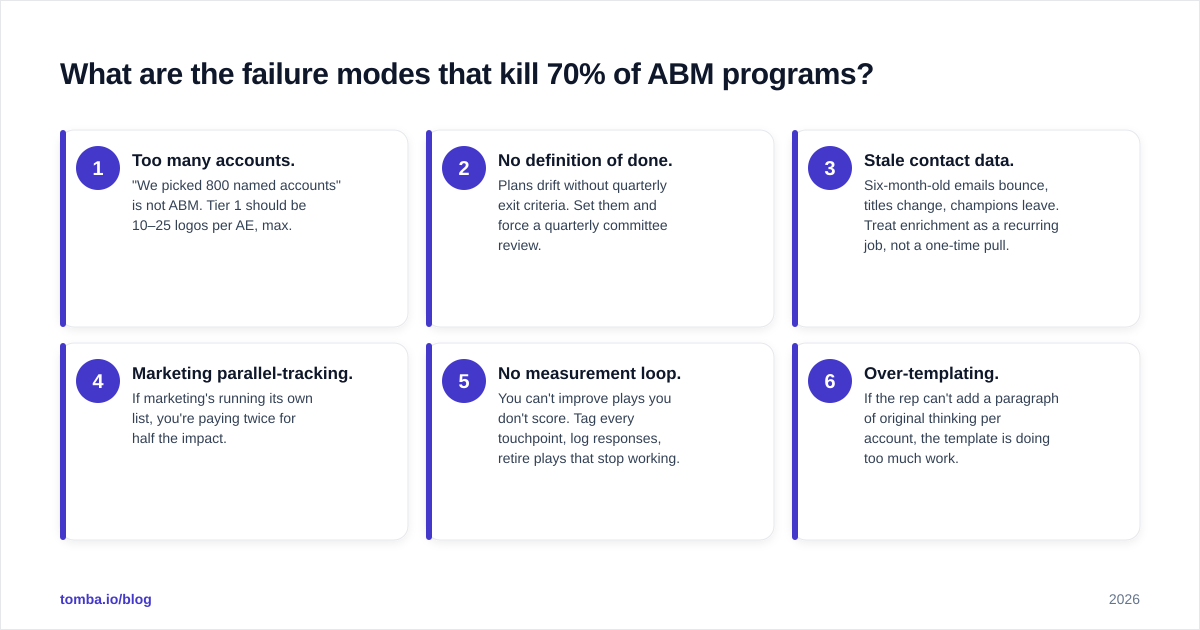
In the order they actually happen:
- Too many accounts. "We picked 800 named accounts" is not ABM. Tier 1 should be 10–25 logos per AE, max.
- No definition of done. Plans drift without quarterly exit criteria. Set them and force a quarterly committee review.
- Stale contact data. Six-month-old emails bounce, titles change, champions leave. Treat enrichment as a recurring job, not a one-time pull.
- Marketing parallel-tracking. If marketing's running its own list, you're paying twice for half the impact.
- No measurement loop. You can't improve plays you don't score. Tag every touchpoint, log responses, retire plays that stop working.
- Over-templating. If the rep can't add a paragraph of original thinking per account, the template is doing too much work.
For a cross-check on industry benchmarks, Forrester's ABM research and G2's category data are the most useful public sources right now.
How do you measure if your ABM account plan template is working?#
A plan that doesn't produce a measurable outcome is a journal entry. Track:
- Account coverage rate — % of buying committee with a verified contact and at least one touchpoint
- Multi-threaded meetings — % of opps with 3+ stakeholders on at least one call
- Cycle time — days from "plan created" to first stage progression
- Plan freshness — average days since last update (target: <14)
- Pipeline-per-plan — dollar pipeline created per account in plan
- Win rate uplift vs. non-ABM — the only metric your CFO cares about
Set baselines in the first quarter, then optimize. A team running plans correctly should see a 2–3x win-rate uplift on tier-1 accounts within two quarters. If you don't see it, the failure is almost always in execution discipline, not template design.
Ready to power your ABM plans with clean contact data?#
A plan is only as good as the buyers it targets. If your committee map has stale emails, missing phone numbers, or three people who left last year, even the best framework won't save the play.
The Tomba Email Finder gives your ABM team verified work emails for every stakeholder on the org map — at the API, in your CRM, or in bulk for the whole target list. Start free with 25 searches per month, then scale to the $49/mo Starter or $99/mo Growth plan when you're ready. See Tomba pricing for full plan details and run your next ABM plan with contact data that actually delivers.
Ready to find emails that actually work?
Join 150,000+ professionals who stopped guessing and started sending. Free credits on signup — no credit card required.
Get the Tomba newsletter
Practical outbound tactics and product updates — once every two weeks.
About the author