ABM Campaigns in 2026: The Complete Playbook for Revenue Teams
ABM campaigns concentrate budget on the accounts most likely to buy. Here's how modern revenue teams structure, target, and measure them in 2026.
TL;DR#
- ABM campaigns concentrate marketing and sales effort on a finite list of high-fit accounts instead of broad lead volume.
- The 2026 stack has three layers: a target account list, a signal layer (intent, web visits, hiring, funding), and an orchestration layer that coordinates ads, email, and SDR plays.
- Tiering still matters: 1:1 for strategic accounts, 1:few for clusters, 1:many for programmatic — each tier has a different budget per account and a different playbook.
- The hard part is the data. Bad firmographics and stale contacts will sink even a well-funded program. Enrichment and verified contact data are non-negotiable.
- Measure pipeline created, deal velocity, and account engagement scores — not MQLs. ABM and MQL dashboards usually contradict each other; pick one.
What are ABM campaigns?#
Account-based marketing campaigns flip the traditional B2B funnel. Instead of casting a wide net and qualifying leads at the bottom, you start with a defined list of companies — usually 50 to 2,000 accounts — and orchestrate marketing and sales touches against the buying committee inside each one.
A campaign is one coordinated push against that list with a defined window, message, and goal. It might be a six-week sequence aimed at heads of engineering at 120 mid-market SaaS companies, or a 1:1 microsite for a single strategic account worth $500K ARR.
The shift is structural. You stop measuring "how many leads did we generate this month" and start asking "how many of our target accounts moved from cold to engaged, engaged to opportunity, opportunity to won." If your CRM still ranks reps by MQL volume, ABM will feel like swimming upstream.
Why are ABM campaigns more relevant in 2026?#
Three forces pushed ABM from a fringe tactic to the default GTM motion for most B2B vendors above $5M ARR.
Buying committees got bigger. Gartner's data has consistently shown 6 to 10 people involved in any B2B purchase over $50K. Generating one lead means little when nine other people in that company will weigh in.
Outbound got harder. Open rates dropped, inbox providers tightened filters, and prospects ignore generic sequences. ABM works because the message can be specific to the account, not the persona.
The data layer matured. Intent providers, web visitor identification, hiring-signal feeds, and verified contact APIs now plug into a CRM in an afternoon. The infrastructure that used to require a six-figure ABM platform is now assembled from $99/mo tools.
What used to be an enterprise-only motion is now executable by a 10-person revenue team. The bar to entry is execution discipline, not budget.
What's the difference between ABM and demand generation?#
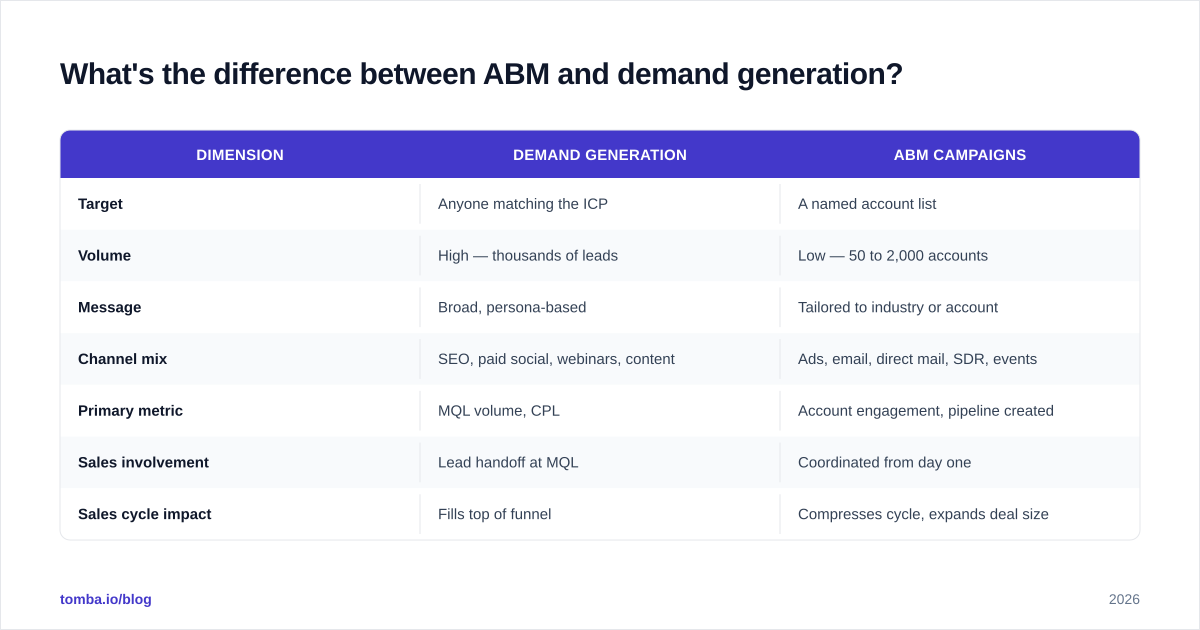
They're not opposites — most teams run both — but they optimize for different things.
| Dimension | Demand generation | ABM campaigns |
|---|---|---|
| Target | Anyone matching the ICP | A named account list |
| Volume | High — thousands of leads | Low — 50 to 2,000 accounts |
| Message | Broad, persona-based | Tailored to industry or account |
| Channel mix | SEO, paid social, webinars, content | Ads, email, direct mail, SDR, events |
| Primary metric | MQL volume, CPL | Account engagement, pipeline created |
| Sales involvement | Lead handoff at MQL | Coordinated from day one |
| Sales cycle impact | Fills top of funnel | Compresses cycle, expands deal size |
| Budget per account | $5–$50 | $200–$50,000 |
The mistake teams make is running ABM with demand-gen metrics. If your CMO asks "how many MQLs did the ABM program produce," the program will look like a failure even when it is creating $2M in pipeline.
How do you tier accounts for ABM campaigns?#
Tiering is the backbone of any ABM program. Without it, you either over-invest in low-fit accounts or under-invest in your best opportunities.
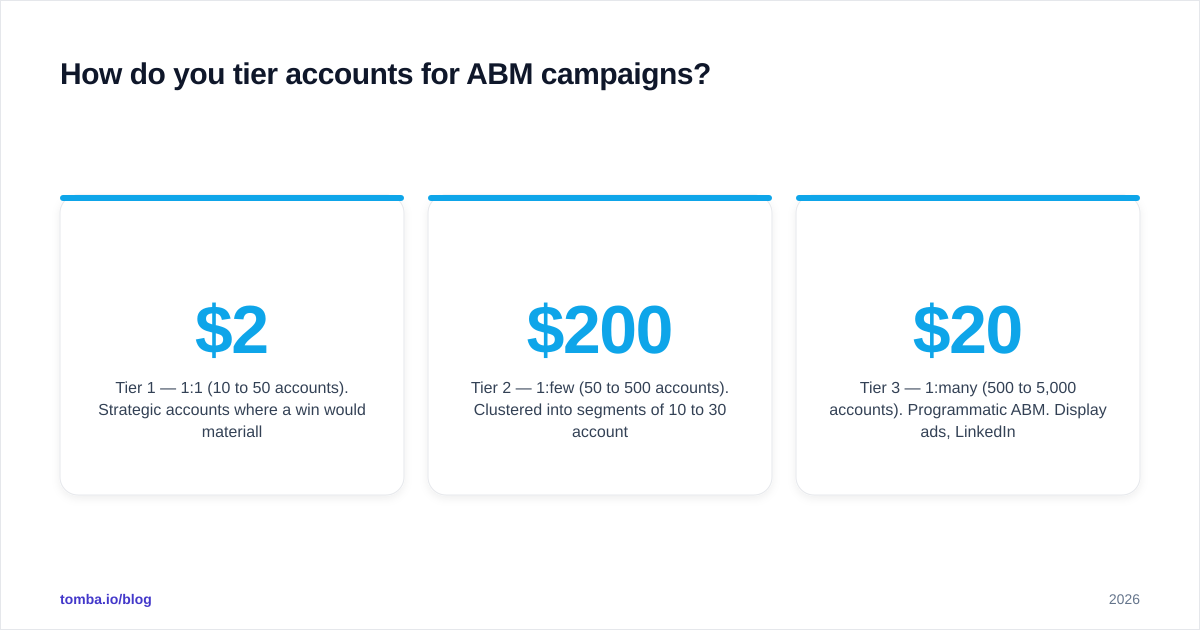
Tier 1 — 1:1 (10 to 50 accounts). Strategic accounts where a win would materially change the year. Each account gets a custom microsite, executive sponsorship, custom content, direct mail, and a dedicated SDR. Budget: $2,000 to $50,000 per account.
Tier 2 — 1:few (50 to 500 accounts). Clustered into segments of 10 to 30 accounts sharing an industry, tech stack, or trigger event. They get personalized but not custom touches — segment-level landing pages, industry-specific case studies. Budget: $200 to $2,000 per account.
Tier 3 — 1:many (500 to 5,000 accounts). Programmatic ABM. Display ads, LinkedIn sponsored content, and automated email targeting at the account level. Less personalized, but still account-scoped rather than persona-scoped. Budget: $20 to $200 per account.
A healthy program runs all three tiers in parallel. Tier 1 produces the headline wins. Tier 2 is the workhorse. Tier 3 maintains awareness across the broader market and feeds future Tier 1 and 2 lists.
What signals should trigger ABM campaigns?#
Signals are the difference between a calendar-driven campaign ("Q3 push to retailers") and a trigger-driven one ("they just hired a VP of Data"). Trigger-driven campaigns convert 3 to 5x better because timing is right.
The signal categories worth wiring into your stack:
- Intent data — surge in research topics relevant to your category (Bombora, G2, 6sense)
- Web visits — anonymous visitors from target accounts hitting pricing or product pages
- Hiring signals — new roles posted that imply the account is building the function you sell into
- Funding events — new rounds raised, often correlated with budget and hiring
- Tech stack changes — they just added or removed a competitor or complementary tool
- Leadership changes — new VP or C-level in your buyer persona
- Engagement spikes — multiple buyers from the same account engaging with your content
The orchestration question is: when a signal fires for an account, what happens? A well-designed program has a documented playbook per signal — not a Slack notification that gets ignored.
What does the ABM data stack look like in 2026?#
You don't need a single platform anymore. Most teams assemble four layers:
- Account list — Salesforce or HubSpot, with a custom field marking ABM tier
- Enrichment — fills firmographics, tech stack, employee count, funding
- Contact data — verified emails and phone numbers for the buying committee
- Signal feeds — intent, web visits, hiring, news, plugged in via API or Zapier
The contact-data layer is where most programs fail. You can have a beautiful target list and zero way to reach decision-makers if your contact data is stale. This is where an email finder and email verifier pair becomes infrastructure, not a nice-to-have. Bulk run your tier 1 and 2 lists through a domain search to map the buying committee, verify before any send, and feed the verified rows back into the CRM.
For larger lists, a B2B database or data enrichment workflow lets you backfill missing job titles, LinkedIn URLs, and direct dials in a single pass. The cost of bad data isn't just bounced emails — it's an SDR burning two days reaching the wrong person at the wrong account.
How do you orchestrate channels in an ABM campaign?#
A campaign isn't a single channel. The whole point is layered touches across channels so the account hears a coordinated message from every direction.
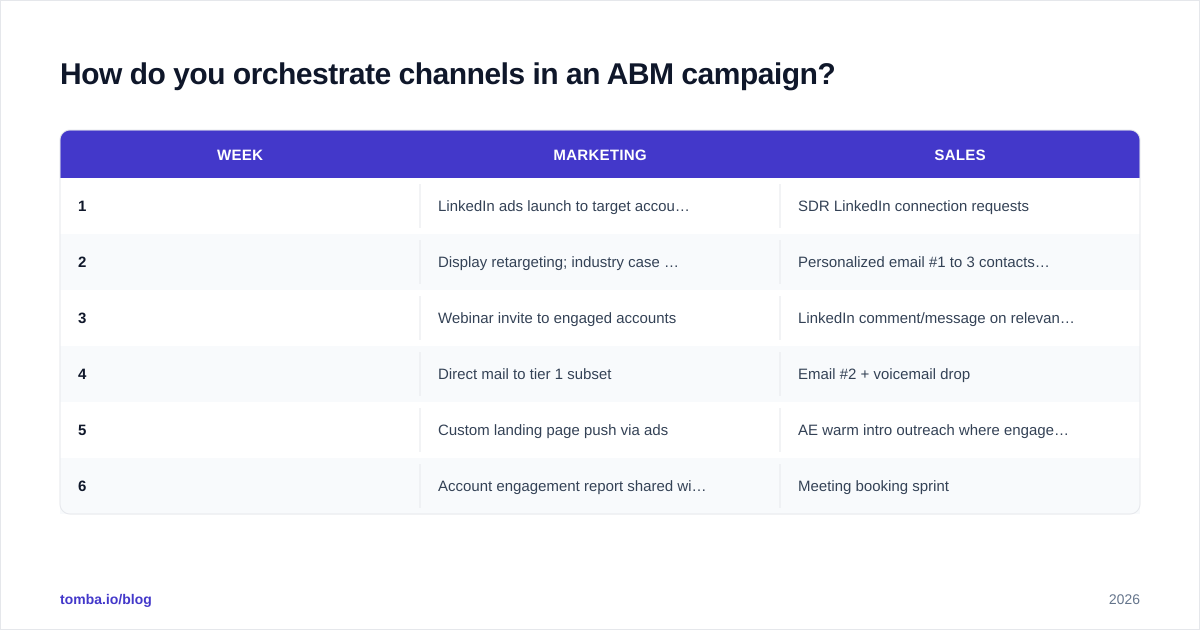
A typical six-week tier 2 sequence:
| Week | Marketing | Sales |
|---|---|---|
| 1 | LinkedIn ads launch to target accounts | SDR LinkedIn connection requests |
| 2 | Display retargeting; industry case study email | Personalized email #1 to 3 contacts/account |
| 3 | Webinar invite to engaged accounts | LinkedIn comment/message on relevant posts |
| 4 | Direct mail to tier 1 subset | Email #2 + voicemail drop |
| 5 | Custom landing page push via ads | AE warm intro outreach where engagement scored |
| 6 | Account engagement report shared with sales | Meeting booking sprint |
The orchestration only works if marketing and sales see the same account view. If the SDR doesn't know which accounts are getting ad impressions this week, the sequence collapses into two parallel monologues. A shared dashboard — even a simple Salesforce report with "ABM tier," "engagement score," and "last touch" — is enough to start.
For the SDR layer specifically, batch your tier 2 list through a bulk email finder, enrich titles and LinkedIn URLs, and load straight into your sequencer. Skipping verification at this step is where programs leak — bounce rates above 3% on a known target list look like spam to inbox providers and torch your sender reputation.
How do you measure ABM campaigns?#
The metrics that matter cluster into three buckets.
Account coverage. What percentage of your buying committee at each target account is in your database with verified contact data? If you can't reach four out of six buyers, the program is incomplete before it starts.
Account engagement. Did the account move from cold to engaged? Engagement is a composite: ad impressions, web visits, email opens and replies, content downloads, LinkedIn interactions. Most teams use a 0–100 score that compounds touches.
Pipeline and revenue. Pipeline created from target accounts, deal velocity (target vs non-target), average deal size, win rate, and total influenced revenue. The cleanest comparison is target-account pipeline vs non-target pipeline over the same window.
What you should not measure as a primary KPI: MQL volume from target accounts. You'll generate fewer MQLs from ABM than from demand gen — that's the point. If the CMO scoreboard counts MQLs, ABM will be politically dead within two quarters.
For deeper context on the underlying funnel mechanics, the revenue operations and marketing qualified lead glossary entries break down where ABM diverges from traditional funnel reporting.
What does an ABM campaign budget look like?#
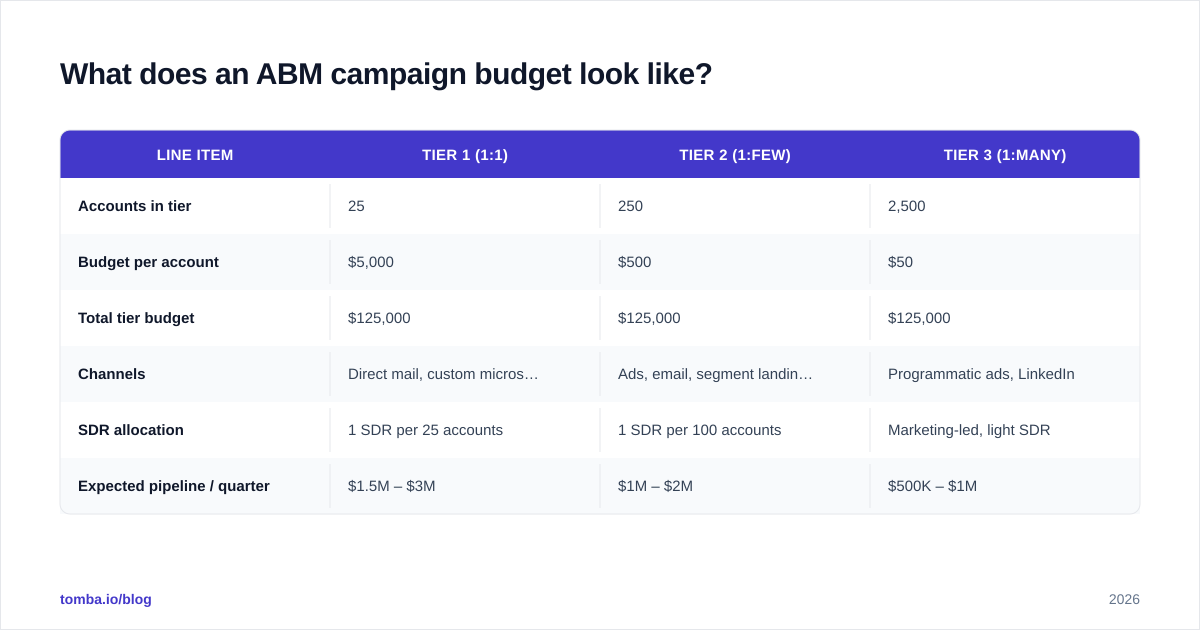
Rough benchmarks for a mid-market B2B vendor with $5–20M ARR running ABM across all three tiers:
| Line item | Tier 1 (1:1) | Tier 2 (1:few) | Tier 3 (1:many) |
|---|---|---|---|
| Accounts in tier | 25 | 250 | 2,500 |
| Budget per account | $5,000 | $500 | $50 |
| Total tier budget | $125,000 | $125,000 | $125,000 |
| Channels | Direct mail, custom microsite, exec gifting, events | Ads, email, segment landing pages | Programmatic ads, LinkedIn |
| SDR allocation | 1 SDR per 25 accounts | 1 SDR per 100 accounts | Marketing-led, light SDR |
| Expected pipeline / quarter | $1.5M – $3M | $1M – $2M | $500K – $1M |
These are starting points, not gospel. The split shifts based on average contract value: enterprise vendors over-invest in tier 1, SMB vendors over-invest in tier 3. Run a 90-day pilot in one tier, measure, then scale.
What are the most common ABM campaign mistakes?#
Treating it like a marketing project. ABM fails without sales co-ownership. If the AEs and SDRs aren't accountable for engagement on their named accounts, the program is just expensive ads.
Picking the wrong accounts. "Companies in our ICP" isn't a target list. The list needs to be filtered by fit, intent, and reach (can you actually get to the buying committee). A 500-account list of dream logos with no warm path is a wishlist, not a campaign.
Using stale contact data. Half your contacts churned out of those accounts in the last 18 months. Without ongoing enrichment and verification, you're sending email #3 of a sequence to people who left the company a year ago.
Measuring it like demand gen. Already covered above — if your scorecard rewards MQL volume, you'll quietly defund the ABM program.
Over-tooling. Three intent platforms, two ABM platforms, a separate orchestration tool, and a "next-gen" predictive layer. You don't need them. You need a clean list, verified contacts, signal feeds wired into Slack, and a campaign calendar everyone follows.
For more on the surrounding stack, see how teams pick between platforms in the Apollo alternative and Clearbit alternative breakdowns — both touch on the data-layer tradeoffs that decide whether an ABM motion holds together.
What tools should you actually use?#
You don't need a single all-in-one. The reference stack most $5–50M B2B vendors converge on:
- CRM — Salesforce or HubSpot. Tier and engagement score live here.
- Account data + intent — 6sense, Demandbase, or Clearbit + a focused intent provider like Bombora
- Contact data — Tomba (for accurate, verified email + phone), Apollo for broader contact coverage
- Ad orchestration — LinkedIn Campaign Manager + Google Ads with custom audiences synced from CRM
- Sales sequencer — Outreach, Salesloft, or Smartlead for tier 2 and 3
- Direct mail — Sendoso or Reachdesk for tier 1
- Analytics — Native CRM reports plus a BI layer (Looker, Mode) for the cross-channel view
Official docs for the major platforms — HubSpot's ABM hub and Salesforce's account-based playbook — are worth bookmarking. For independent reviews and head-to-head comparisons across the ABM platform tier, G2's ABM software category is the cleanest reference.
What's the right way to start an ABM campaign?#
Don't boil the ocean. The teams that succeed start with a 90-day pilot:
- Pick 50 to 100 accounts in one segment where you've already closed a few wins. Pattern-matching helps.
- Map the buying committee — 4 to 6 contacts per account, verified with a tool you trust. Use bulk verification to clean the list before the first send.
- Pick two channels you can execute well. Usually LinkedIn ads + SDR email.
- Run a six-week sequence with a shared marketing + sales playbook.
- Measure engagement, meetings booked, and pipeline created vs a matched control group of non-ABM accounts.
If the pilot shows lift, scale to a second segment and add a third channel. If it doesn't, the issue is almost always (a) wrong account selection, (b) bad contact data, or (c) marketing and sales not aligned. Fix the root cause, don't add tools.
Build the contact layer that makes your ABM campaigns work#
A target account list is only as good as your ability to reach the people inside it. If you're spending five figures a quarter on ads, signal feeds, and SDR time, the cheapest leverage point is the contact data those touches depend on.
Tomba's Email Finder gives you verified emails for buyers across your target account list, with bulk lookups, domain search for whole buying committees, and an API for syncing straight into your CRM or sequencer. Plans start at $49/month with a free tier for testing the workflow against your first 25 accounts. Check the full pricing details and run your tier 1 list through it before your next campaign launches — better data is always cheaper than another tool.
Ready to find emails that actually work?
Join 150,000+ professionals who stopped guessing and started sending. Free credits on signup — no credit card required.
Get the Tomba newsletter
Practical outbound tactics and product updates — once every two weeks.
About the author