7 ABM Challenges Killing Your Pipeline in 2026 (And Fixes)
Account-based marketing promises 3x pipeline lift, but most programs stall on the same seven ABM challenges. Here's how to diagnose and fix each one.
7 ABM Challenges Killing Your Pipeline in 2026 (And Fixes)
TL;DR
- 73% of B2B teams say their ABM program underperforms expectations — the same seven ABM challenges show up in nearly every post-mortem.
- The biggest blocker is not tooling. It's a fuzzy target account list paired with marketing-sourced metrics that ignore sales reality.
- Data decay kills personalization before it ships: 30% of B2B contacts go stale every 12 months, so enrichment must be continuous, not a one-time list buy.
- Sales–marketing alignment fails when ABM "tiers" exist only on a slide. You need shared definitions, shared dashboards, and shared comp.
- A tight stack — accurate contact data, an intent layer, and a CRM source of truth — beats a sprawling 14-tool ABM stack every time.
Account-based marketing is supposed to flip the funnel: pick the accounts you want, surround them with relevant content, hand sales a warm list. In practice, most programs stall. Forrester's 2025 ABM benchmark shows fewer than one in three teams hit their pipeline targets in year one.
This post walks through the seven ABM challenges that show up in nearly every stalled program, what causes them, and the specific fix that gets the program back on track. No platform pitches, no "alignment workshops" — just the moves that work.
What is account-based marketing, in one paragraph?#
Account-based marketing (ABM) is a revenue operations strategy where marketing and sales pick a finite list of target accounts and run coordinated campaigns at every buying-committee member inside those accounts, instead of casting a wide net for inbound leads. The promise: higher contract values, shorter sales cycles, better win rates. The reality: ABM is operationally heavier than demand gen, and it breaks in predictable ways.
Why do most ABM programs stall in year one?#
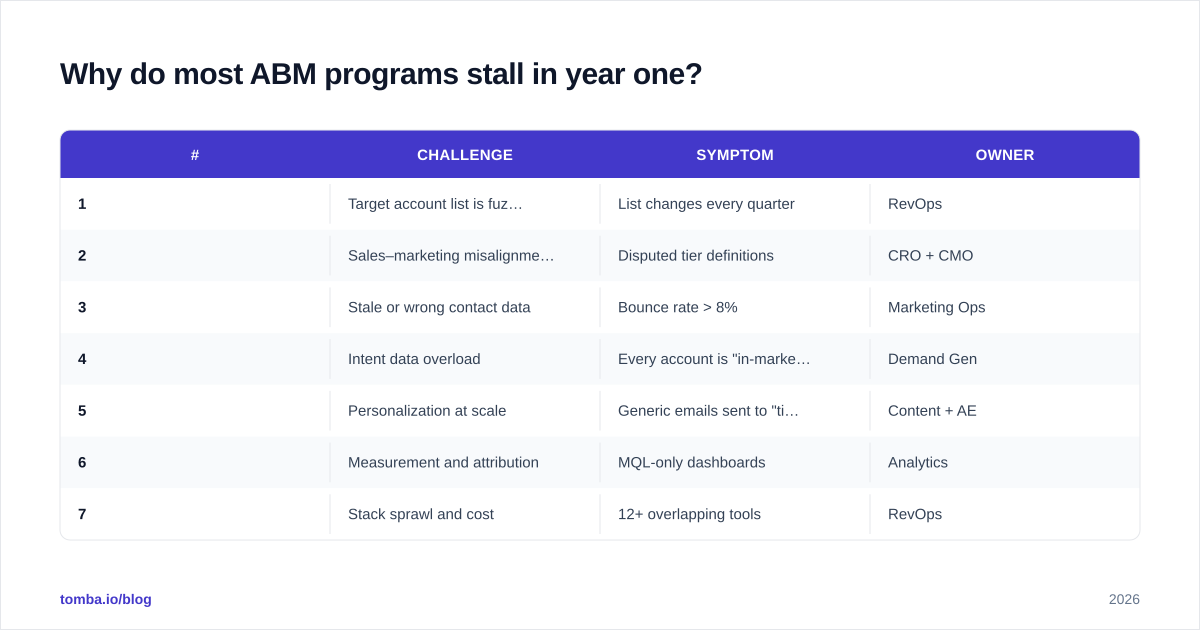
Across hundreds of programs analyzed by ITSMA, TOPO (now Gartner), and Forrester, the failure modes cluster into seven ABM challenges. Most teams hit three or four at once, which is why the fix feels overwhelming. Treat them one at a time, in this order:
| # | Challenge | Symptom | Owner |
|---|---|---|---|
| 1 | Target account list is fuzzy | List changes every quarter | RevOps |
| 2 | Sales–marketing misalignment | Disputed tier definitions | CRO + CMO |
| 3 | Stale or wrong contact data | Bounce rate > 8% | Marketing Ops |
| 4 | Intent data overload | Every account is "in-market" | Demand Gen |
| 5 | Personalization at scale | Generic emails sent to "tier 1" | Content + AE |
| 6 | Measurement and attribution | MQL-only dashboards | Analytics |
| 7 | Stack sprawl and cost | 12+ overlapping tools | RevOps |
The rest of this post unpacks each one. If you only have time for two fixes this quarter, focus on #1 and #6 — they unblock everything else.
Challenge 1: How do you build a target account list that survives the quarter?#
The most common ABM failure isn't execution — it's the input. Teams pick 200 accounts in January, lose 40 to "wrong fit" by March, swap in 60 new ones in April, and by Q3 nobody can tell you who's on the list anymore.
The fix: lock the list with three filters, in this order.
- Hard ICP filters (firmographic): industry, employee count, revenue band, geography. These should disqualify, not score. If a company fails a hard filter, it's off the list.
- Fit score (technographic + behavioral): tech stack, hiring signals, funding stage, recent leadership changes. This scores the survivors.
- Intent overlay: third-party intent data from G2, Bombora, or 6sense narrows the list to who is researching now.
Cap the list at a number sales can actually work — typically 50 accounts per AE for 1:1 ABM, 200–500 for 1:few, 1,000+ for 1:many. Forrester's data shows programs that change more than 15% of the list per quarter underperform programs that lock it for two quarters at a time.
Challenge 2: How do you fix sales–marketing misalignment without another offsite?#
Misalignment is the second-most-cited ABM challenge in every benchmark, and the workshops never fix it. The root cause is structural: marketing is comped on MQLs, sales is comped on closed-won, and the two metrics push the team in opposite directions.
The fix: three shared artifacts, signed off in writing.
- A tier definition document. What makes a tier-1 account vs tier-2? In writing, with examples. No "we know it when we see it."
- A shared dashboard. Pipeline created in target accounts, by tier, by source. Both teams open the same Looker or Tableau view in the Monday standup.
- A shared comp lever. Even a small spiff on closed-won in tier-1 accounts changes marketing's behavior more than any alignment meeting.
If your CMO and CRO can't show the same dashboard from memory, you don't have alignment — you have politeness.
Challenge 3: How bad is your contact data, really?#
B2B contact data decays at roughly 2.5% per month — about 30% per year — driven by job changes, layoffs, and email-system migrations. If you bought your list 18 months ago, half of it is wrong. Bounce rates above 8% will tank your sender reputation and put your domain in spam folders, which kills the entire ABM motion before the campaign starts.
The fix: treat contact data as a continuous process, not a one-time buy.
- Re-verify any contact older than 90 days before sending.
- Use a bulk email finder to refresh decision-maker contacts inside target accounts every quarter.
- Run a catch-all verifier on corporate domains — Microsoft 365 catch-alls are now common at mid-market companies and they will quietly destroy your bounce metrics.
- Enrich job-title changes monthly; a VP who became a CMO is a different buyer with different priorities.
For programs running cold outbound as part of ABM, pair the finder with a real email verifier before each send. Two-step verification (SMTP + catch-all check) drops bounce rates below 3% on most lists.
Challenge 4: Is intent data signal or noise?#
Intent data has become table stakes — and a trap. The first time you turn on Bombora or 6sense, every account you care about shows "high intent" on something. That's not signal; it's the baseline noise floor of the internet.
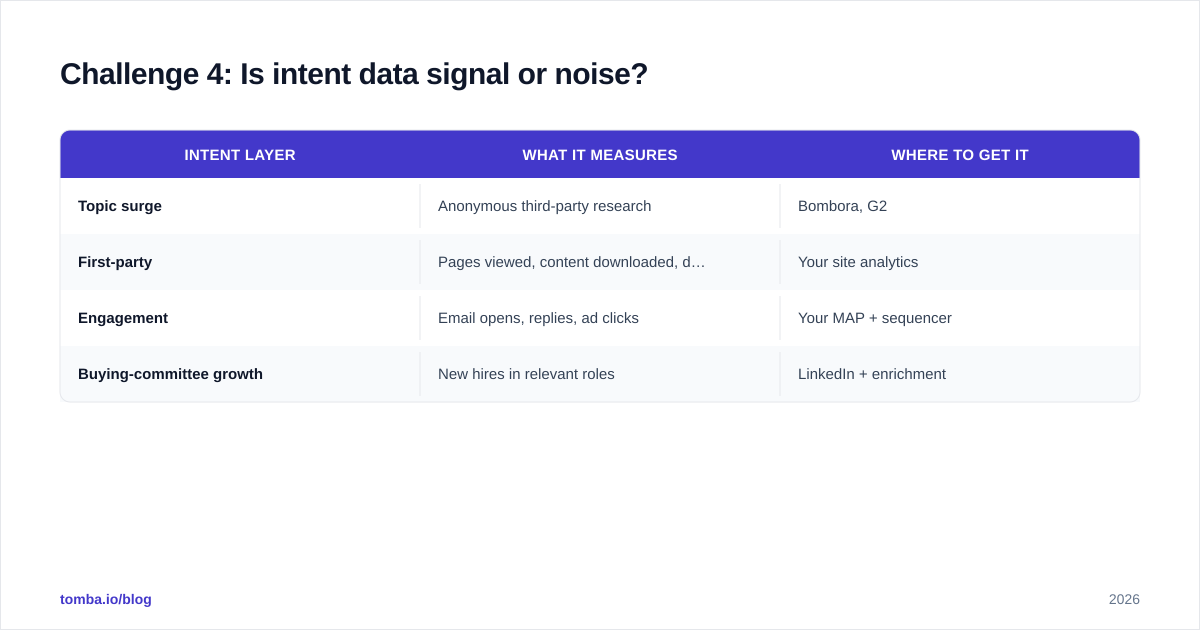
The fix: combine three intent layers and only act when at least two fire.
| Intent layer | What it measures | Where to get it |
|---|---|---|
| Topic surge | Anonymous third-party research | Bombora, G2 |
| First-party | Pages viewed, content downloaded, demo requests | Your site analytics |
| Engagement | Email opens, replies, ad clicks | Your MAP + sequencer |
| Buying-committee growth | New hires in relevant roles | LinkedIn + enrichment |
A target account that just hired a Director of Demand Gen, downloaded your pricing page, and shows topic surge on "marketing automation" is a buying signal. An account showing topic surge alone is a maybe.
Challenge 5: Can you actually personalize at scale?#
"Personalization at scale" is the most-promised, least-delivered ABM capability. Most "personalized" outbound is mail-merged with a first name and a vague company reference. Buyers see through it instantly, and reply rates drop below 1%.

The fix: tier your personalization the same way you tier your accounts.
- Tier 1 (1:1): AE writes the email. Marketing provides a research brief — recent news, exec quotes, tech stack, hiring signals. Goal: 30+ minutes of research per account.
- Tier 2 (1:few): segment by industry and persona. Five to ten template variants per quarter, manually edited per segment.
- Tier 3 (1:many): dynamic content blocks based on firmographic data. Use AI to generate opening lines from public signals, but keep humans in the QA loop.
Stack-wise, this means you need a clean enrichment layer feeding the templates. A data enrichment flow that pulls company size, tech stack, and recent funding into your sequencer is worth more than a fancier AI writer.
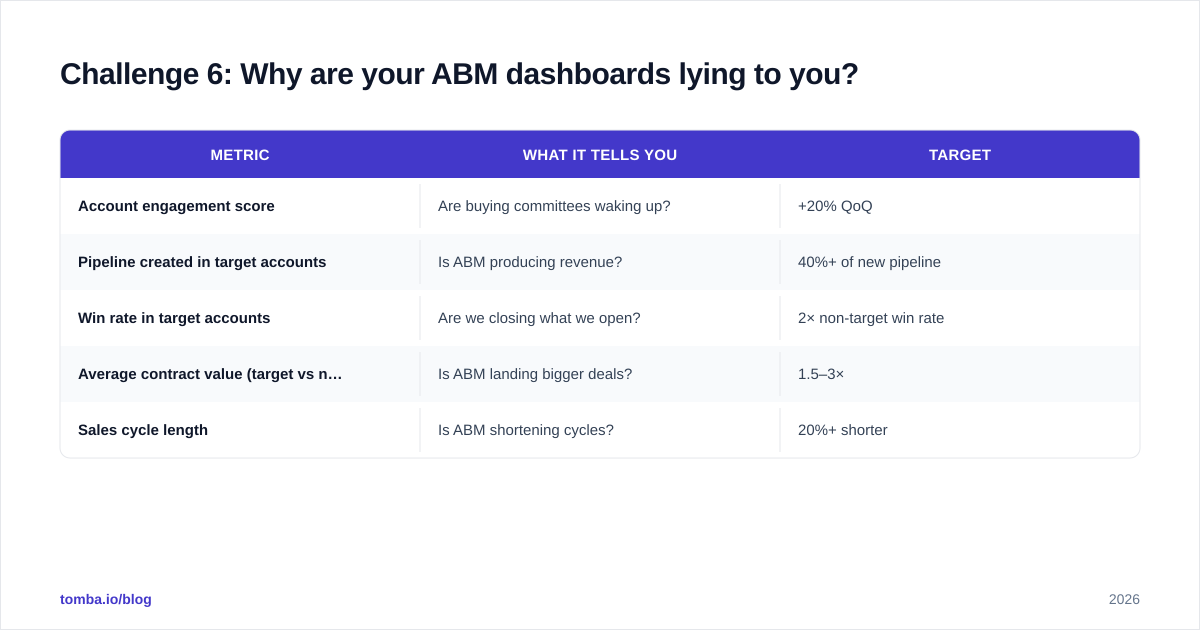
Challenge 6: Why are your ABM dashboards lying to you?#
MQL volume goes up and to the right. Pipeline doesn't move. This is the single most demoralizing ABM challenge, and it's almost always a measurement problem, not an execution problem. MQL is a leading indicator for demand gen, not ABM.
The fix: rebuild the dashboard around five ABM-native metrics.
| Metric | What it tells you | Target |
|---|---|---|
| Account engagement score | Are buying committees waking up? | +20% QoQ |
| Pipeline created in target accounts | Is ABM producing revenue? | 40%+ of new pipeline |
| Win rate in target accounts | Are we closing what we open? | 2× non-target win rate |
| Average contract value (target vs non) | Is ABM landing bigger deals? | 1.5–3× |
| Sales cycle length | Is ABM shortening cycles? | 20%+ shorter |
Kill the MQL column on your ABM dashboard. Marketing leaders hate this, but tracking MQLs alongside ABM metrics is exactly how teams end up over-investing in form-fills and under-investing in account engagement.
Challenge 7: How do you stop the ABM stack from eating your budget?#
The average enterprise ABM stack now spans 12–14 tools: an ABM platform, an intent vendor, a chat tool, two enrichment vendors, a sequencer, a CRM, a CDP, a personalization layer, a reverse-IP tool, an attribution tool, two analytics tools, and somehow still a separate email-finder license. Half of them overlap.
The fix: consolidate to a five-layer stack.
- CRM — single source of truth. Salesforce, HubSpot, or Pipedrive.
- Contact data + enrichment — accurate emails, phones, and firmographics. Tomba's domain search and enrichment APIs cover this for most mid-market teams.
- Intent layer — one vendor, not three. Bombora, 6sense, or G2.
- Engagement — outbound sequencer plus a chat tool. Don't run two sequencers.
- Analytics — dashboard layer (Looker, Tableau, or built-in CRM dashboards). Resist buying a separate "ABM attribution" tool until you've maxed out the CRM reports.
Anything outside those five layers needs a written justification and a quarterly review. Most ABM platforms (reviewed here on G2) can be replaced by a CRM + intent + enrichment combo at half the cost.
What does an ABM stack actually look like at $5M ARR vs $50M ARR?#
| Layer | $5M ARR team | $50M ARR team |
|---|---|---|
| CRM | HubSpot Sales Hub | Salesforce Sales Cloud |
| Contact data | Tomba | Tomba +ZoomInfo |
| Intent | G2 Buyer Intent | 6sense + Bombora |
| Sequencer | Smartlead or Instantly | Salesloft or Outreach |
| Chat | None or Crisp | Drift or Qualified |
| Analytics | HubSpot reports | Looker + Salesforce |
| Headcount on ABM | 1 marketer, 2 AEs | 4 marketers, 8 AEs |
| Monthly tooling | ~$2,000 | ~$25,000 |
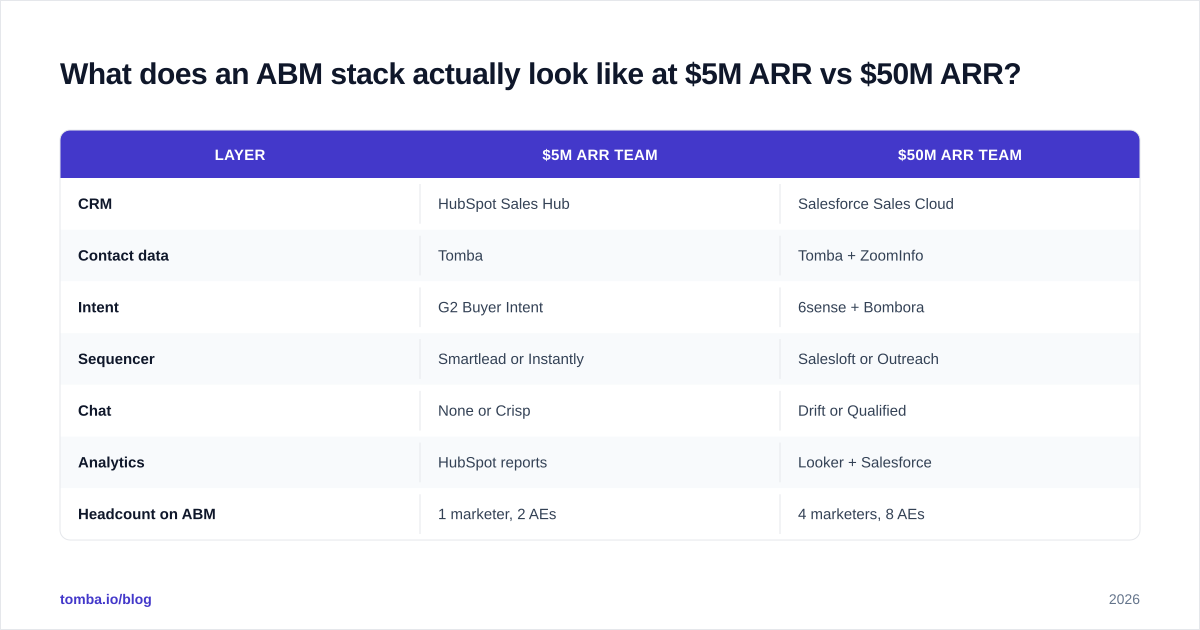
The smaller team wins more often than you'd think — fewer tools means less integration drift and more time spent actually talking to buyers.
What should you do in the next 30 days?#
If you're staring at a slipping ABM program, run this 30-day sequence. It's deliberately boring because the wins are operational, not creative.
- Week 1 — audit the list. Re-score every target account against your hard ICP filters. Cut the bottom 25%. Don't replace them yet.
- Week 2 — clean the data. Re-verify every decision-maker contact on the surviving accounts. Expect to lose 15–25% to job changes or wrong emails.
- Week 3 — rebuild the dashboard. Five ABM-native metrics, one view, both CMO and CRO have it bookmarked.
- Week 4 — kill two tools. Pick the two most-overlapping tools in your stack and cancel one. Use the savings to fund tier-1 personalization research.
After 30 days, you'll know whether the program needs more execution help or a strategy reset. Most teams discover their "ABM problem" was actually a data problem with an attribution problem stapled on top.
Try Tomba for the data layer#
The data layer is the cheapest fix on this list and the one with the biggest ROI. If your bounce rate is above 5% or your sales team complains about "wrong contacts," start there.
Tomba's email finder pulls verified work emails for target accounts by domain, name, or company, with sub-3% bounce on most lists. The free tier covers 25 searches a month, and paid plans start at $49/mo — small enough to slot into an existing ABM budget without a procurement cycle. Pair it with the API to enrich target accounts continuously inside your CRM, and you've solved Challenge 3 before the end of the week.
Pick one ABM challenge from the list above. Fix it this month. Measure the lift. Then pick the next one.
Ready to find emails that actually work?
Join 150,000+ professionals who stopped guessing and started sending. Free credits on signup — no credit card required.
Get the Tomba newsletter
Practical outbound tactics and product updates — once every two weeks.
About the author