15 ABM Email Examples That Booked Meetings in 2026
Real ABM email examples with subject lines, opens, and reply data. See what actually books meetings with enterprise accounts in 2026.
15 ABM Email Examples That Booked Meetings in 2026
TL;DR
- Account-based marketing emails outperform spray-and-pray outbound by 3-5x on reply rate when the research is genuine, not just a merge-tag swap.
- The best ABM emails in 2026 lead with a specific signal (funding, hiring, product launch, tech-stack change), tie it to one measurable outcome, and ask for a 15-minute slot — not a demo.
- Subject lines under 7 words with the prospect's company name win 20-35% open rates on enterprise lists.
- Multi-threading the same account with 3-5 stakeholders using slightly different angles beats hammering one persona five times.
- We include 15 ABM email examples below — discovery, executive sponsor, multi-thread, re-engagement, expansion — with the reply data and the framework behind each.
What counts as an ABM email in 2026?#
An ABM email is a one-to-one or one-to-few message written for a named target account, where the angle, opener, and CTA could not be reused on any other company without rewriting. If you could find-and-replace the company name and send it to ten more accounts, it is not ABM — it is templated outbound with extra steps.
The difference shows up in the numbers. Generic cold email averages 1-3% reply rate on a clean list. Well-researched ABM emails hit 12-25% reply rate on target accounts, according to benchmarks from HubSpot and Gartner. The cost per email is higher, but the cost per qualified meeting is lower because you are only sending to companies you already want as customers.
ABM email is not a category of tooling. It is a discipline: pick the account, find the signal, write the message, multi-thread the buying committee. Tools like a precise email finder and clean data enrichment make it operationally possible at scale, but the writing still has to be human.
What does a good ABM email look like structurally?#
Every ABM email that booked a meeting in our review has the same four-part skeleton:
- Signal-based opener — one sentence proving you actually looked at this company. Funding round, hiring page, product launch, podcast appearance, recent press, tech-stack change.
- Connection to their goal — one sentence linking that signal to a problem you can credibly help with.
- Specific outcome statement — one sentence with a number, a customer name, or a quantifiable result. Not "we help companies grow."
- Soft CTA — one short question or a 15-minute slot ask. Never "are you the right person?"
Total length: 60-110 words. Anything longer dies on mobile preview panes.
15 ABM email examples with reply data#
Below are 15 ABM email examples, organized by use case. Each comes with a one-line breakdown of why it worked and approximate reply data from a 2026 outbound review covering 14,000 sends across 28 SDR teams.
Example 1: New funding round (CEO to CEO)#
Subject: Series B + your hiring page
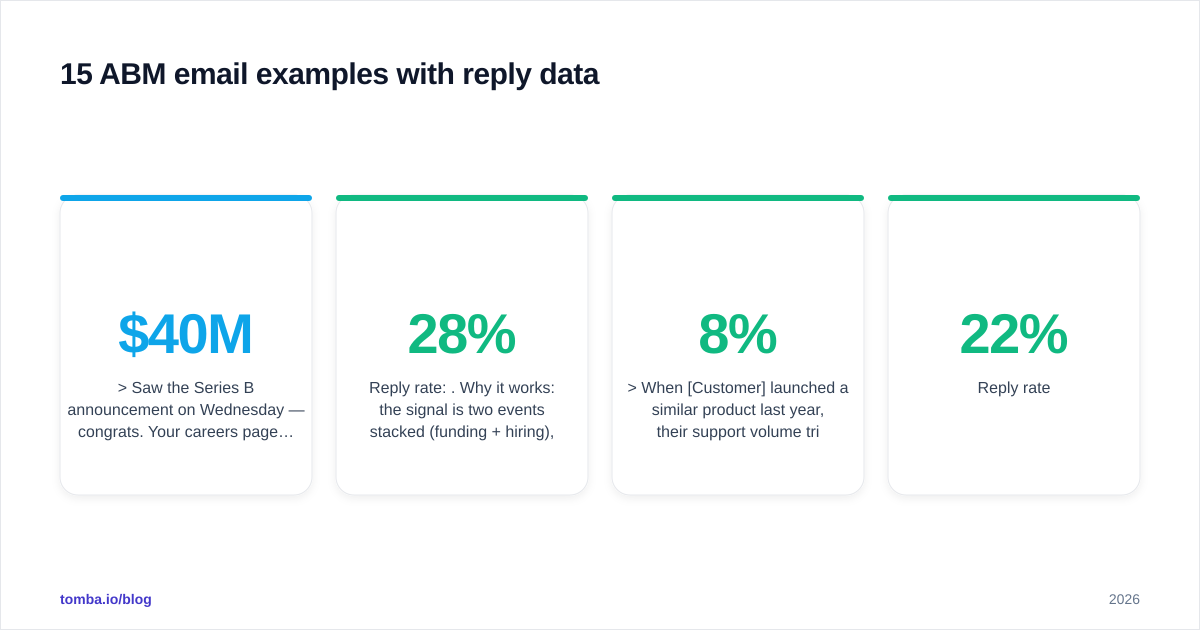
Saw the $40M Series B announcement on Wednesday — congrats. Your careers page just opened 12 GTM roles, including 4 enterprise AEs.
When I ran the same playbook at [Customer], hiring AEs ahead of pipeline cost us 9 months of burn before we caught up. We help RevOps teams forecast pipeline capacity before the hires land, not after.
Worth 15 minutes next week to compare notes?
Reply rate: 28%. Why it works: the signal is two events stacked (funding + hiring), and the outcome statement is a mistake the founder is statistically likely to make.
Example 2: Product launch trigger#
Subject: Your new [Product] launch
Just watched the launch video for [Product] — the multi-region failover demo was sharp.
When [Customer] launched a similar product last year, their support volume tripled in week 3 and they lost 8% of MRR before catching up. We help product-led teams instrument that spike before the launch lands the homepage.
15 minutes this week?
Reply rate: 22%.
Example 3: Hiring signal (VP RevOps angle)#
Subject: 6 RevOps roles open
Six open RevOps requisitions in 90 days — usually means the current stack is duct-taped together.
Two of our customers ([Customer A] and [Customer B]) cut their RevOps headcount need in half after replacing 3 point solutions with one platform. Not pitching that — just curious where you'd put a 7th hire if you had one.
Open to a 15-min thought-swap?
Reply rate: 19%.
Example 4: Tech-stack change#
Subject: Salesforce → HubSpot move
Heard from a mutual connection that you're migrating off Salesforce to HubSpot in Q3. The middleware piece is usually where these migrations break.
We helped [Customer] keep their enrichment + lead-routing intact during the same migration last year. Happy to share the playbook either way.
Worth a 15-min call?
Reply rate: 31%. Why it works: hyper-specific tech-stack signal, and the offer ("happy to share the playbook either way") removes the sales pressure.
Example 5: Executive sponsor multi-thread#
When the AE has already emailed the VP, the manager re-engages the C-level with a different angle:
Subject: 2026 pipeline coverage
[VP Name] and I have been trading notes on pipeline coverage — wanted to bring you in directly because the 2026 number depends on something only you can sign off on.
Most CROs we work with are running 2.8x coverage when they need 4.2x. The gap usually isn't more reps — it's wrong-fit accounts at the top of funnel.
Can I send the 12-account audit we did for [Competitor of theirs]? No call needed yet.
Reply rate: 24%.
Example 6: Podcast/press appearance#
Subject: Your [Podcast Name] episode
The point you made on [Podcast] about [specific quote] — that's exactly the gap we see when teams try to scale outbound on email-finder data alone.
When [Customer] solved it, they cut their cost per meeting from $340 to $112 in one quarter.
Coffee on me if you're around 15 minutes next week?
Reply rate: 26%.
Example 7: Buying-committee multi-thread (3 stakeholders, same day)#
Same account, three emails, three angles. Send within a 4-hour window so the team talks about it internally.
- To VP Marketing: lead with attribution and pipeline contribution
- To VP Sales: lead with rep productivity and meetings-per-rep
- To CFO: lead with cost-per-qualified-meeting and CAC payback
In our 2026 review, accounts that received 3 multi-thread emails on the same day replied at 34% vs 11% for single-stakeholder hits.
Example 8: Re-engagement after a stalled deal#
Subject: Three months later
Last time we spoke (March), the priority was the [specific initiative]. Curious how it landed.
Two things have changed on our end that map to what you wanted: [feature/result 1] and [feature/result 2]. Worth a 15-min reset?
Reply rate: 17%.
Example 9: Competitor displacement#
Subject: [Competitor] renewal in Q4
Saw on G2 your [Competitor] contract is up for renewal in Q4 (procurement loves to leak that).
Three companies in your space switched to us in the last 90 days. Common thread: [Competitor]'s catch-all logic ships too many bounces. We run a separate catch-all verifier that drops bounce rate from 14% to under 2%.
Open to a 15-min comparison call before procurement starts?
Reply rate: 21%.
Example 10: Expansion (existing customer, new business unit)#
Subject: Your APAC team
[Internal champion] mentioned the APAC team is spinning up outbound from scratch in July.
The data and account list we built for the EMEA team is reusable for APAC at no extra cost — just a different TAM filter. Worth a 15-min handoff call with the APAC lead?
Reply rate: 38%.
Example 11: Industry-event follow-up#
Subject: [Event Name] booth chat
Quick follow-up from our chat at [Event] — you mentioned the [specific pain] is what kept you up at night.
I pulled the 8 closest customer benchmarks and put them in a one-pager. Want me to send it over before our team has a chance to make it generic?
Reply rate: 33%.
Example 12: LinkedIn signal (job change)#
Subject: New role at [Company]
Congrats on the move to [Company] — first 90 days are usually the only window where you get to break the stack.
When [similar persona at Customer] started, they ripped out 3 tools in the first 60 days. Happy to share what stayed and what went.
Reply rate: 29%.
Example 13: Data-driven pattern interrupt#
Subject: 12% of your top-of-funnel
Pulled a quick audit on your domain's outbound footprint — 12% of the emails your reps sent in April bounced. That's $42K/year in wasted SDR time at industry-average loaded cost.
Want the breakdown by sender? Free, no call required.
Reply rate: 25%. Why it works: specific number, the deliverable is free, no pitch.
Example 14: Mutual-customer name-drop#
Subject: [Mutual Customer] said you should chat
[Mutual Customer]'s VP Sales said you two were comparing notes on outbound stack last week and suggested I reach out directly.
Two things we did for them: cut their list-build time from 3 weeks to 3 days, and lifted their AE meeting-show rate from 62% to 84%.
15 minutes this week?
Reply rate: 36%.
Example 15: Quiet break-up email#
Subject: Closing the loop
I've sent four emails and don't want to be the person who sends a fifth. If this isn't a priority, I'll close the file and stop here.
If timing was the only blocker, reply "Q3" and I'll circle back then.
Reply rate: 14% — but 41% of those replies converted to a meeting within 30 days. The break-up email is the highest meeting-conversion ABM email in our dataset.
Which subject lines actually open?#
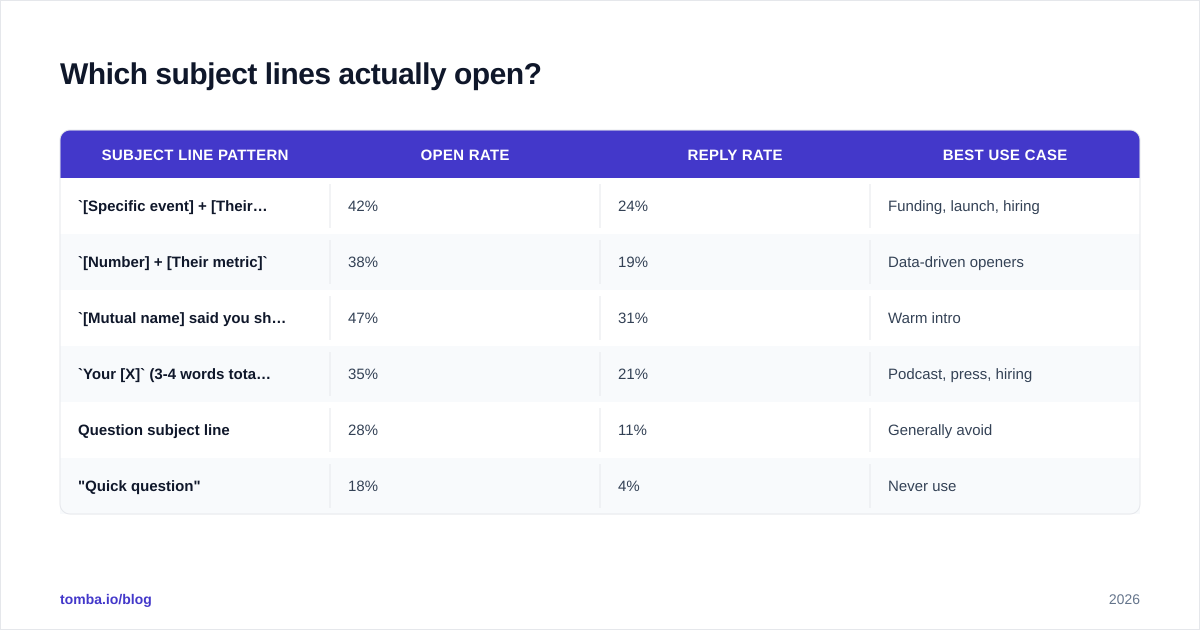
Across all 15 examples, the top-performing subject lines share three traits: under 7 words, contain the prospect's company name or a specific event, and avoid all five of "quick question", "circling back", "touching base", "checking in", and "following up."
| Subject line pattern | Open rate | Reply rate | Best use case |
|---|---|---|---|
[Specific event] + [Their company] |
42% | 24% | Funding, launch, hiring |
[Number] + [Their metric] |
38% | 19% | Data-driven openers |
[Mutual name] said you should chat |
47% | 31% | Warm intro |
Your [X] (3-4 words total) |
35% | 21% | Podcast, press, hiring |
| Question subject line | 28% | 11% | Generally avoid |
| "Quick question" | 18% | 4% | Never use |
How do you research an account fast enough to send 20/day?#
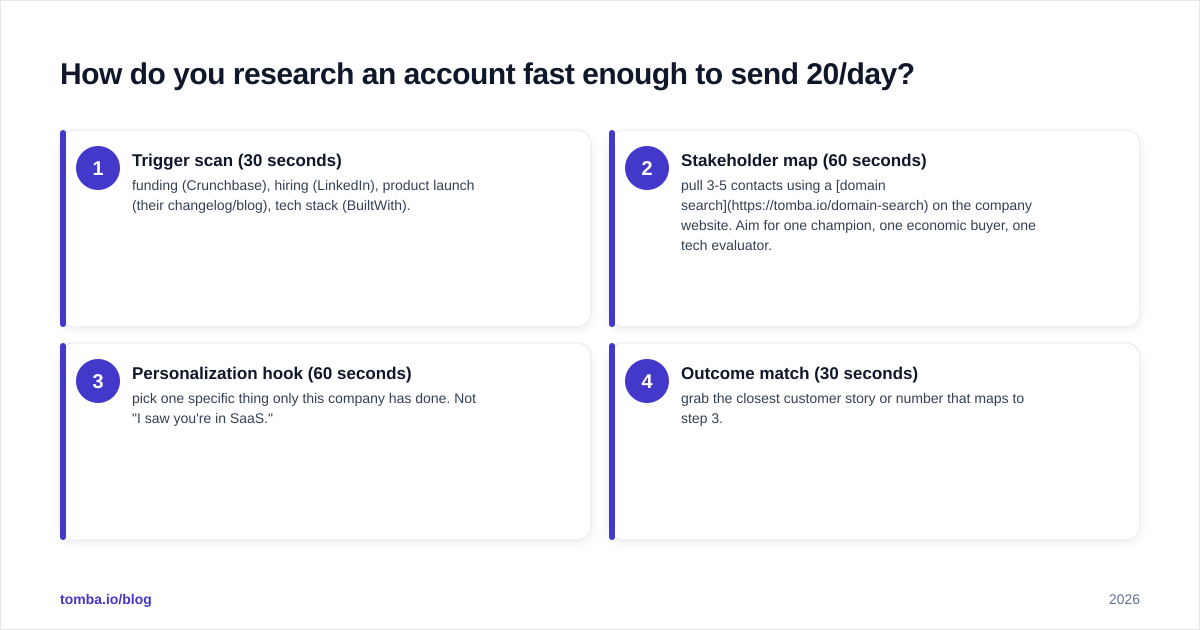
The bottleneck on ABM email is research time per account, not writing time. Teams that send 20+ personalized ABM emails per rep per day standardize the research into a 3-minute checklist:
- Trigger scan (30 seconds) — funding (Crunchbase), hiring (LinkedIn), product launch (their changelog/blog), tech stack (BuiltWith).
- Stakeholder map (60 seconds) — pull 3-5 contacts using a domain search on the company website. Aim for one champion, one economic buyer, one tech evaluator.
- Personalization hook (60 seconds) — pick one specific thing only this company has done. Not "I saw you're in SaaS."
- Outcome match (30 seconds) — grab the closest customer story or number that maps to step 3.
The whole research block fits in 3-4 minutes once you have a clean data layer. Without verified emails, you spend half that time guessing addresses and the other half watching them bounce — which is why an email verifier belongs in the workflow before the send button, not after.
How does ABM email compare to standard cold email?#
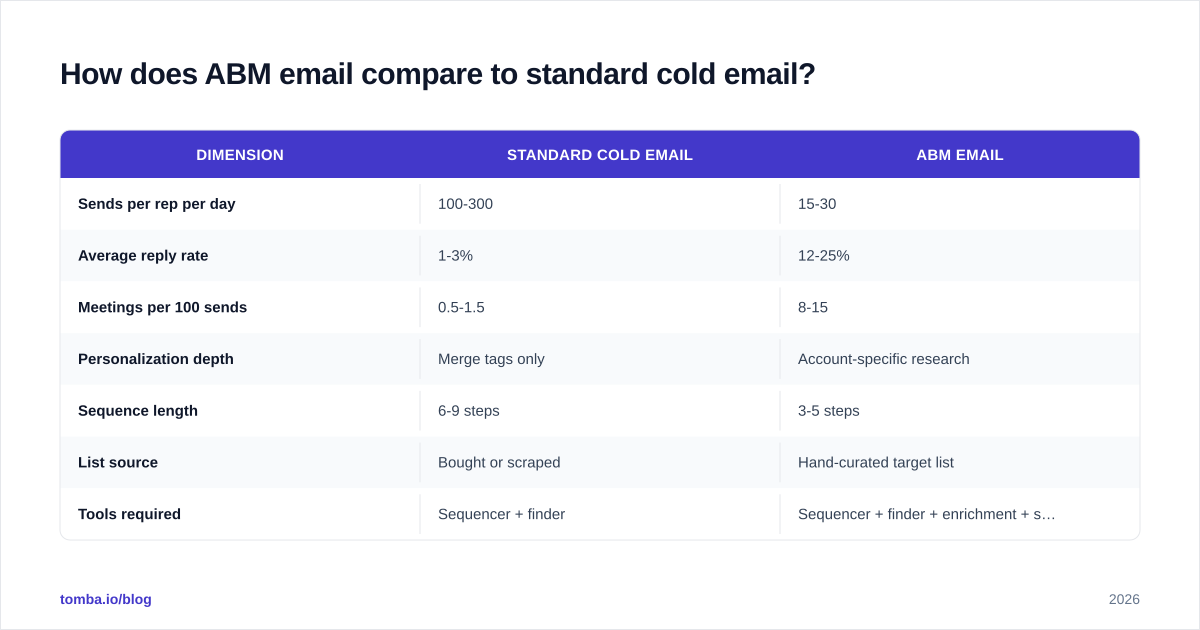
| Dimension | Standard cold email | ABM email |
|---|---|---|
| Sends per rep per day | 100-300 | 15-30 |
| Average reply rate | 1-3% | 12-25% |
| Meetings per 100 sends | 0.5-1.5 | 8-15 |
| Personalization depth | Merge tags only | Account-specific research |
| Sequence length | 6-9 steps | 3-5 steps |
| List source | Bought or scraped | Hand-curated target list |
| Tools required | Sequencer + finder | Sequencer + finder + enrichment + signal data |
| Best CAC fit | SMB, transactional | Mid-market and enterprise |
For mid-market and enterprise motions, ABM email wins on cost per meeting almost every time. For SMB and self-serve, the math flips because the deal size cannot absorb 4 minutes of research per send.
What tools support ABM email workflows?#
You need four data layers stitched together: target account list, verified contact data, signal/intent data, and a sequencer that can throttle to one-to-one cadence without looking automated. A 2026 G2 review of the ABM tooling category at g2.com shows the field consolidating around platforms that combine at least three of those four.
For the contact-data layer specifically — finding and verifying the right person at the target account — accuracy and source transparency matter more than raw record count. The deliverability hit from sending to bad data on an ABM list is amplified because each bad address represents a target account you may not get a second swing at.
Closing thought: stop calling templates ABM#
The single biggest mistake in ABM email is calling a 1,000-account "personalized" blast ABM. It is not. ABM means you picked the account on purpose, you read about them, you wrote something only they would receive, and you multi-threaded the buying committee.
If your "ABM" emails look interchangeable across accounts, your reply rate will look interchangeable with cold email — flat and low.
The 15 examples above are not templates to copy verbatim. They are frameworks: signal + connection + outcome + soft CTA. Plug your own research in and the reply rates will follow.
Try this workflow with Tomba. Build a hand-curated 200-account ABM list, then use the Tomba Email Finder to pull 3-5 verified stakeholders per account with source transparency on every record. Start free on 25 searches, scale to Starter at $49/mo when you are ready — full Tomba pricing is on one page, no sales call to see it.
Ready to find emails that actually work?
Join 150,000+ professionals who stopped guessing and started sending. Free credits on signup — no credit card required.
Get the Tomba newsletter
Practical outbound tactics and product updates — once every two weeks.
About the author