ABM Funnel Stages: The Complete 2026 Framework Guide
The traditional lead funnel breaks down when you're selling to accounts, not contacts. Here's how the ABM funnel actually works in 2026 — and the metrics that matter at each stage.
ABM Funnel Stages: The Complete 2026 Framework Guide
TL;DR
- The ABM funnel inverts the traditional lead funnel — you start with a finite target account list, not infinite top-of-funnel volume.
- There are six core stages: identify, expand, engage, convert, close, and expand-again. Each has distinct metrics and ownership.
- Stage transitions in ABM are account-level, not lead-level. A single MQL means nothing if the buying committee is silent.
- Intent data, engagement scoring, and multi-threading are the three levers that move accounts through the funnel.
- Most teams get stuck at "engage" — they generate awareness but cannot convert it to opportunity. The fix is multi-channel orchestration, not more ads.
If you're still reporting on MQLs in 2026, you're measuring the wrong thing. Account-based marketing rewrote the funnel the moment buying committees grew to seven-plus stakeholders and self-directed buyers started consuming 70% of the sales cycle before talking to a rep. This guide breaks down every stage of the ABM funnel, the metrics that matter at each step, and the operational moves that actually push accounts forward.
What is the ABM funnel and how is it different?#
The ABM funnel flips the traditional demand funnel on its head. Instead of casting a wide net at the top and watching most leads fall away, you start with a tight, finite list of target accounts and work to engage more stakeholders inside each one over time.
Traditional funnels measure volume — leads in, opportunities out. The ABM funnel measures depth and breadth: how many people inside a target account are engaged, how warm those signals are, and whether the buying committee is moving as a unit.
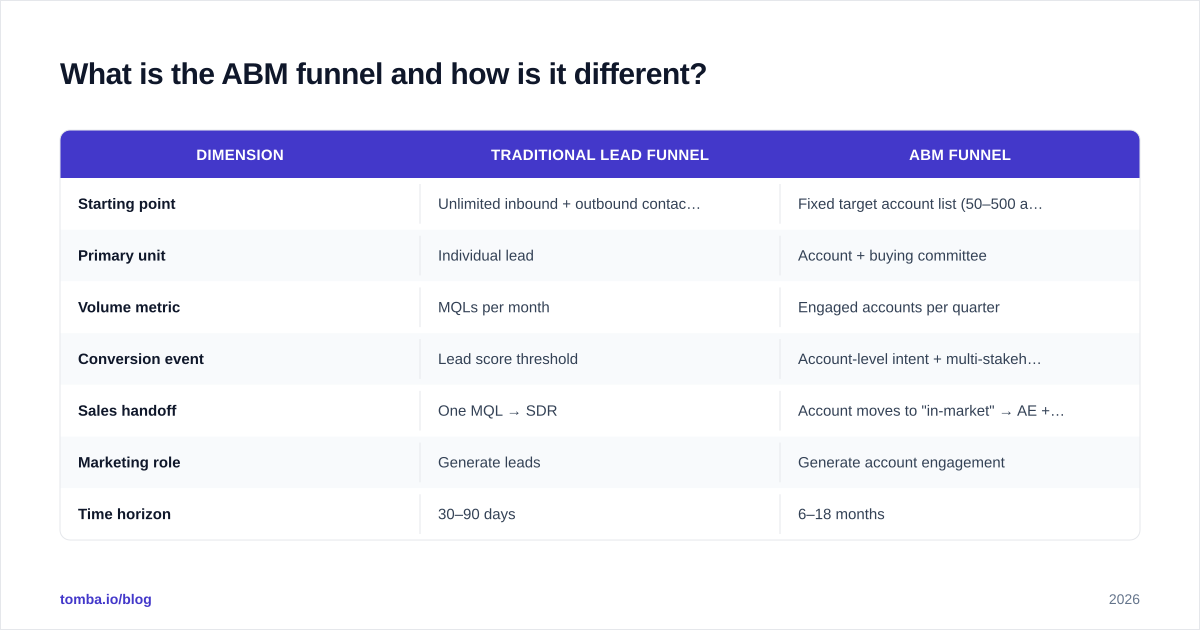
Here's the structural comparison:
| Dimension | Traditional Lead Funnel | ABM Funnel |
|---|---|---|
| Starting point | Unlimited inbound + outbound contacts | Fixed target account list (50–500 accounts) |
| Primary unit | Individual lead | Account + buying committee |
| Volume metric | MQLs per month | Engaged accounts per quarter |
| Conversion event | Lead score threshold | Account-level intent + multi-stakeholder engagement |
| Sales handoff | One MQL → SDR | Account moves to "in-market" → AE + SDR co-own |
| Marketing role | Generate leads | Generate account engagement |
| Time horizon | 30–90 days | 6–18 months |
The mental shift is the hard part. If your CRM is still set up so a single form fill creates an "MQL" that gets sales-routed in isolation, you're not running ABM — you're running lead-gen with an account list pasted on top.
For a deeper background on the underlying revenue model, see our breakdown of revenue operations and how it ties marketing, sales, and customer success to one number.
What are the six ABM funnel stages?#
Different vendors slice the funnel differently. ITSMA's classic model uses three phases. Forrester's revenue waterfall uses six. Demandbase pushes for seven. After comparing what teams actually report on, six stages is the sweet spot — granular enough to drive different plays, simple enough to align ops, marketing, and sales on.
Stage 1: Identify#
You define the universe. This is the target account list (TAL) — the finite set of companies you'll invest against. Most B2B teams land between 100 and 500 accounts for one-to-many ABM, 25–75 for one-to-few, and a handful for one-to-one strategic accounts.
Key activities:
- Build an ICP using firmographics (industry, revenue, headcount), technographics (current stack), and behavioral signals (recent funding, hiring patterns, leadership changes).
- Score accounts using fit + intent + relationship history.
- Tier the list: Tier 1 gets full multi-channel orchestration, Tier 2 gets programmatic plays, Tier 3 gets nurture only.
Stage metric: Number of accounts that meet ICP and have at least one named contact enriched.
Tools: Intent data platforms (6sense, Demandbase), enrichment tools, your CRM. For email and contact data, our B2B database gives you direct access to verified decision-maker contacts at your TAL accounts.
Stage 2: Expand (account contact discovery)#
You've named the accounts. Now you find the people. A modern B2B deal averages 7–10 stakeholders. If you only have one contact at an account, you don't have an account — you have a coin flip.
Key activities:
- Map the buying committee: economic buyer, champion, technical evaluator, end users, procurement, security/IT.
- Enrich each persona with verified email, mobile, LinkedIn, and reporting structure.
- Identify the gaps — which roles are unfilled in your contact data?
Stage metric: Average number of mapped, verified contacts per Tier 1 account (target: 6–10).
The breakdown happens here for most teams. They run intent plays against accounts where they have a single Marketing Coordinator's email and wonder why nothing converts. Use a domain search to pull every public email at a target company, then layer in a LinkedIn finder to enrich based on role and seniority.
Stage 3: Engage#
The account knows you exist, and people inside it are interacting with you — clicking ads, reading content, attending webinars, replying to outbound. Engagement is plural and multi-channel: a single click doesn't count, but a sequence of touches across two or three contacts does.
Key activities:
- Coordinated air cover (display + LinkedIn + retargeting) against the named buying committee.
- Personalized outbound from SDR or AE to 2–3 prioritized personas.
- Direct mail or executive gifting on Tier 1 accounts with high intent scores.
- Field events, dinners, or 1:1 briefings for strategic accounts.
Stage metric: Engaged accounts — accounts with ≥3 engagement events from ≥2 distinct contacts in a 30-day window.
The leak point: Most teams generate engagement but never convert it. Either the signals aren't surfaced to sales fast enough, or sales doesn't have a clear play for an "engaged but not in-market" account. Build a documented motion for this stage or your engagement is just expensive brand advertising.
Stage 4: Convert (opportunity creation)#
Engagement turns into a real conversation. Someone on the buying committee agrees to a meeting, demo, or scoping call. The account is now an opportunity in CRM.
Key activities:
- Discovery meetings with multiple stakeholders, not just the champion.
- Tailored content drops (custom decks, ROI models, mutual action plans).
- Threaded outreach to economic buyer if not already engaged.
Stage metric: Opportunity conversion rate (engaged accounts → opportunity), and average number of stakeholders per opportunity at creation.
Benchmark: A healthy ABM program converts 8–15% of engaged accounts to opportunity within a quarter. Below 5% means your engagement is shallow or your sales handoff is broken.
Stage 5: Close#
The opportunity progresses through your sales stages — discovery, evaluation, proposal, procurement, signature. ABM doesn't change the mechanics here, but it does change the win rate because you entered the cycle with more committee coverage and warmer signals.
Key activities:
- Multi-threaded selling: every active opportunity should have champion + economic buyer + technical evaluator in motion.
- Mutual action plan shared with the buying committee.
- Sales and marketing co-own deal acceleration content (case studies, security docs, reference calls).
Stage metric: ABM-influenced win rate vs. baseline win rate. Top-quartile ABM teams see a 1.5–2x win rate lift on target accounts vs. non-TAL deals (per ITSMA and Forrester benchmarks).
Track velocity here too — improvement in sales win rate only matters if you're not trading it for a longer cycle.
Stage 6: Expand#
The contract is signed. In most companies, this is where marketing's involvement dies and customer success takes over alone. That's a mistake — 70%+ of B2B revenue growth comes from existing accounts.
Key activities:
- Stakeholder mapping refresh post-close (new sponsors, new use cases).
- Cross-sell and upsell campaigns gated by health scores and product usage.
- Account-based advocacy: turn champions into references, speakers, case studies.
- Renewal motion starts 6–9 months before contract end, not 30 days.
Stage metric: Net revenue retention (NRR) on ABM accounts vs. non-ABM accounts. Top quartile NRR is 120%+; below 100% means churn and contraction are outpacing expansion.
How do you measure progress through ABM funnel stages?#
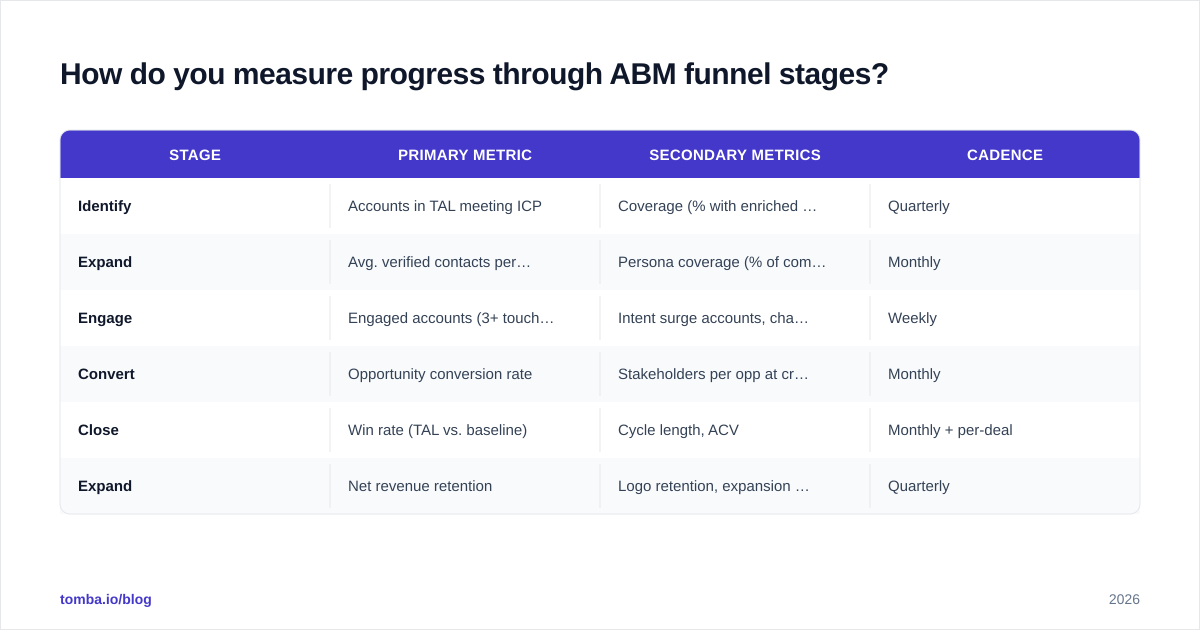
The metrics shift as accounts move down. Optimizing the wrong metric at the wrong stage is the single most common ABM reporting mistake.
| Stage | Primary Metric | Secondary Metrics | Cadence |
|---|---|---|---|
| Identify | Accounts in TAL meeting ICP | Coverage (% with enriched contacts) | Quarterly |
| Expand | Avg. verified contacts per account | Persona coverage (% of committee roles filled) | Monthly |
| Engage | Engaged accounts (3+ touches, 2+ contacts) | Intent surge accounts, channel mix | Weekly |
| Convert | Opportunity conversion rate | Stakeholders per opp at creation | Monthly |
| Close | Win rate (TAL vs. baseline) | Cycle length, ACV | Monthly + per-deal |
| Expand | Net revenue retention | Logo retention, expansion ARR, NPS | Quarterly |
A few rules of thumb:
- Never report on a single stage in isolation. If your engaged-account count is up 40% but conversion to opportunity didn't move, you're generating noise.
- Use cohorts, not totals. "We have 200 engaged accounts" tells you nothing. "Of accounts that became engaged in Q1, 12% converted to opportunity by end of Q2" tells you everything.
- Account-level intent is the leading indicator. A surge in account-level intent on your category typically precedes a meeting request by 30–60 days. If you're not tracking it, you're flying blind on pipeline forecasts.
What tactics move accounts through each ABM funnel stage?#
Stage-specific plays beat generic ABM "campaigns" every time. Here's what works at each transition point:
Identify → Expand: Run a bulk contact enrichment sprint against your TAL once a quarter. Aim for 80%+ committee coverage on Tier 1, 50%+ on Tier 2. Use a bulk email finder to process the full account list in one pass instead of one-off lookups.
Expand → Engage: Layer LinkedIn ads + display + outbound + direct mail against the same committee in a coordinated 6-week burst. Single-channel ABM is dead — buying committees ignore it.
Engage → Convert: Run an "engaged accounts" report every Monday. Any account with 3+ touches across 2+ contacts in the last 30 days gets a manual review from the AE. The fastest-converting ABM teams treat this list as their primary outbound queue.
Convert → Close: Multi-thread aggressively. Every opportunity over $50K ACV needs at least three engaged stakeholders by the demo stage. AEs who multi-thread close at 2x the rate of single-threaded reps (per Gong and Salesloft benchmark data).
Close → Expand: Hand off with a stakeholder map, not a "congrats" Slack message. Customer success should know who the champion is, who the economic buyer is, and what the next expansion conversation looks like before the kickoff call.
What tools do you need to run the ABM funnel in 2026?#
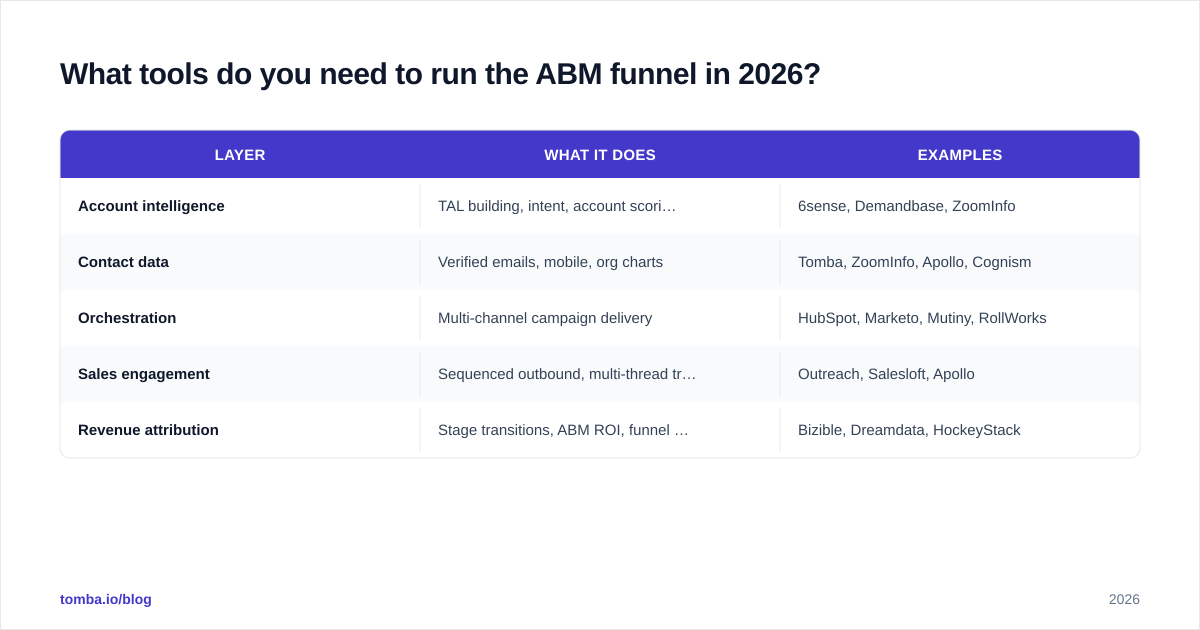
You need five categories. Don't buy them all from one vendor — best-of-breed beats suite for ABM because the data layer is the foundation, and most "ABM platforms" have weak contact data.
| Layer | What it does | Examples |
|---|---|---|
| Account intelligence | TAL building, intent, account scoring | 6sense, Demandbase,ZoomInfo |
| Contact data | Verified emails, mobile, org charts | Tomba, ZoomInfo, Apollo, Cognism |
| Orchestration | Multi-channel campaign delivery | HubSpot, Marketo, Mutiny, RollWorks |
| Sales engagement | Sequenced outbound, multi-thread tracking | Outreach, Salesloft, Apollo |
| Revenue attribution | Stage transitions, ABM ROI, funnel reporting | Bizible, Dreamdata, HockeyStack |
For a tight stack, anchor on a strong contact data layer plus one orchestration tool plus one sales engagement tool. Tomba sits in the contact data layer and integrates with HubSpot, Salesforce, and Pipedrive so enriched contacts flow into whichever orchestration system you're running. See the full integrations list for the complete set.
If you're evaluating ABM platforms specifically, Gartner's annual ABM Magic Quadrant and G2's ABM category are the two least-biased external references.
What are the most common ABM funnel mistakes?#
Five mistakes show up over and over in teams that fail to scale their ABM program:
- Too many accounts in the TAL. If you have 2,000 "target" accounts, you don't have an ABM program — you have demand gen with a list. Cut to the top 200–300.
- No buying committee coverage. Working a single contact at an account is the original sin of ABM. Map the committee before you run any play.
- Marketing reports on its own metrics. MQLs, MQAs, engagement scores — none of these matter if sales doesn't act on them or doesn't believe them. Co-own the funnel definitions with sales ops.
- Treating ABM as a campaign, not an operating model. A six-week campaign generates a six-week bump. Pipeline gravity comes from running the motion every week for a year.
- Ignoring expansion. The stage 6 expansion play is where most of the revenue lives. If your ABM program ends at "closed-won," you're leaving 60–70% of lifetime value on the table.
How does ABM funnel work for different deal sizes?#
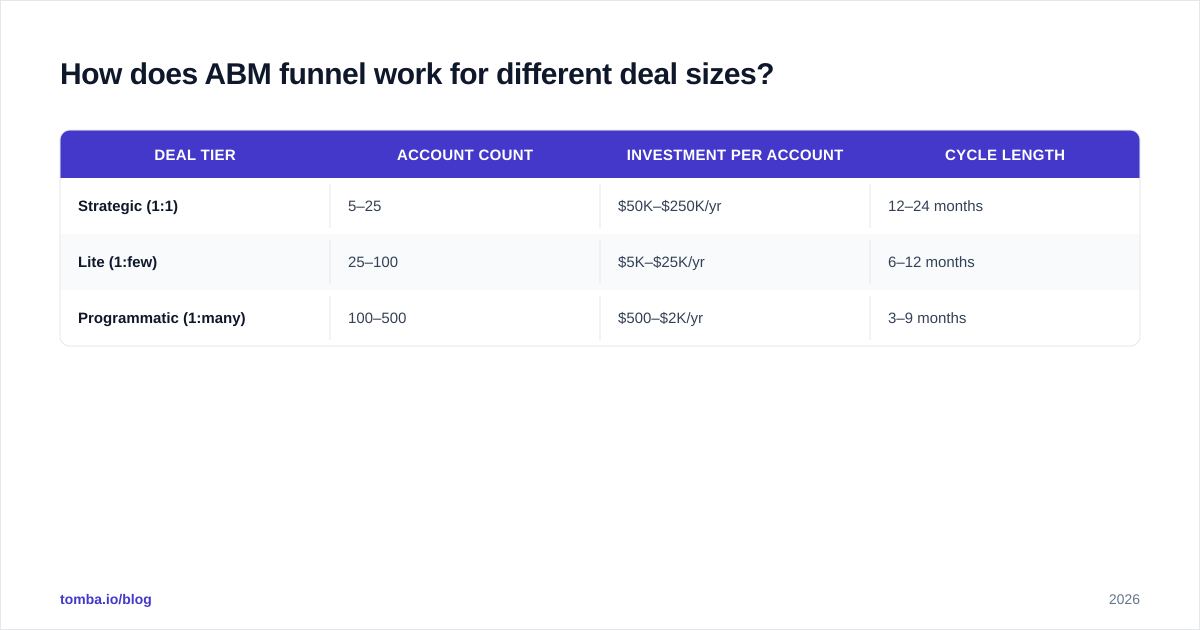
The funnel structure stays the same. The intensity per account changes.
| Deal tier | Account count | Investment per account | Cycle length |
|---|---|---|---|
| Strategic (1:1) | 5–25 | $50K–$250K/yr | 12–24 months |
| Lite (1:few) | 25–100 | $5K–$25K/yr | 6–12 months |
| Programmatic (1:many) | 100–500 | $500–$2K/yr | 3–9 months |
A 1:1 account gets custom landing pages, executive gifting, named SDR + AE, quarterly business reviews before they're even a customer. A 1:many account gets coordinated digital + outbound + nurture. Same six stages, vastly different per-account economics.
Final word: which Tomba tool should you start with?#
The ABM funnel falls apart at stage 2 — contact expansion — for nearly every team I've worked with. You can have the best intent platform on earth, but if you only have one verified contact at each target account, you're going to convert 1% of your engaged accounts into opportunities, not 12%.
Start there. Pull your top 100 target accounts into a spreadsheet, run them through the Tomba Email Finder and domain search, and aim for 6–10 verified, role-mapped contacts per account before you spend another dollar on ads or intent data. Once your committee coverage is real, every other stage of the ABM funnel starts working the way the frameworks promised.
The funnel was always the easy part. The execution is the contact data and the multi-threading. Get those right and the rest follows.
Ready to find emails that actually work?
Join 150,000+ professionals who stopped guessing and started sending. Free credits on signup — no credit card required.
Get the Tomba newsletter
Practical outbound tactics and product updates — once every two weeks.
About the author