ABM for High-Value Accounts: The 2026 Playbook That Closes Six-Figure Deals
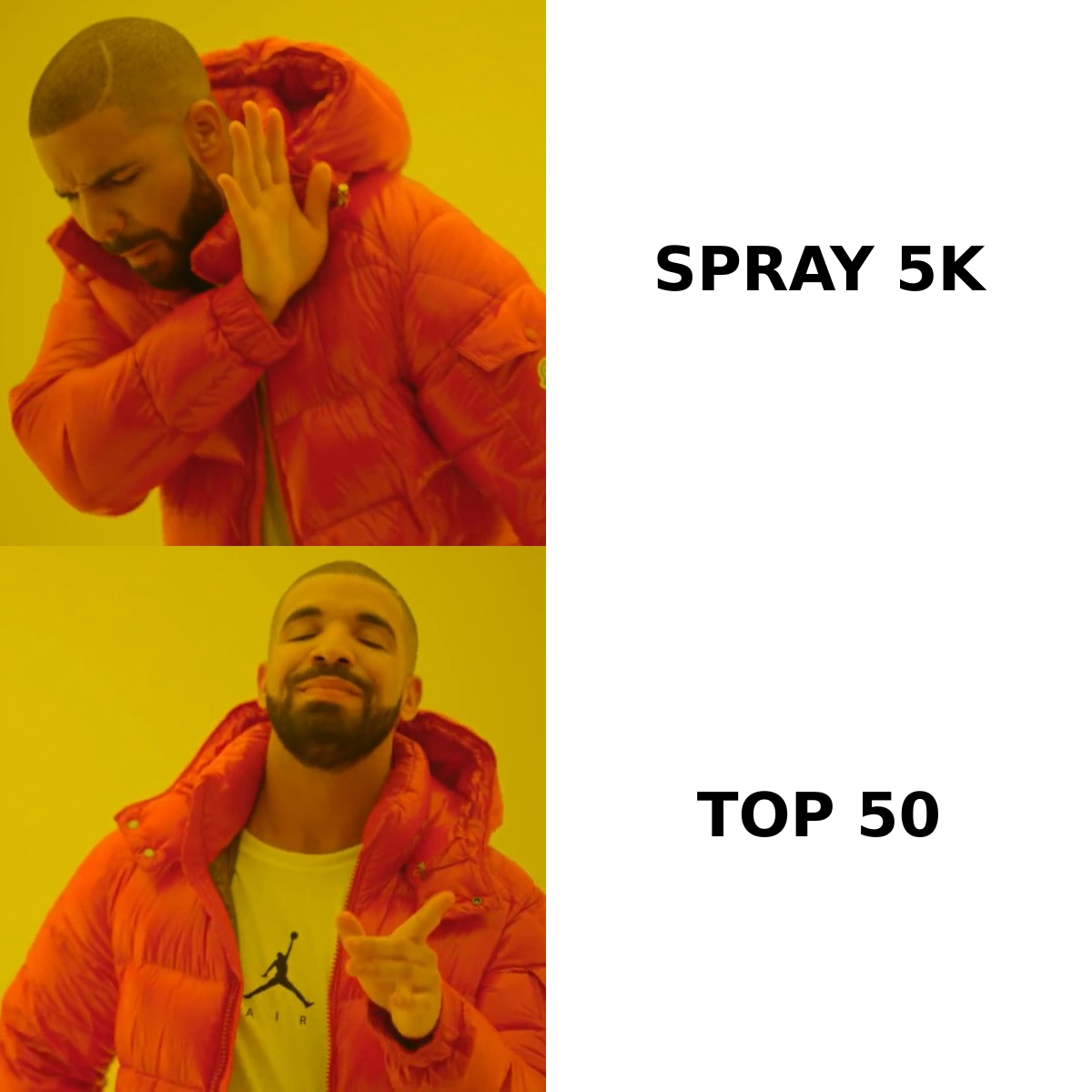
Targeting the top 50 accounts that drive 80% of pipeline requires a different playbook than spray-and-pray outbound. Here's the 2026 ABM framework for high-value accounts.
ABM for High-Value Accounts: The 2026 Playbook That Closes Six-Figure Deals
TL;DR
- ABM for high-value accounts is the discipline of treating 30–200 named companies as a market of one — not a list to blast.
- The 2026 winners pair tight account selection (ICP fit + intent + propensity) with multi-threaded plays across sales, marketing, and exec sponsors.
- Tier accounts into 1:1 (white-glove), 1:few (clustered plays), and 1:many (programmatic) — and resource each tier honestly.
- Pipeline quality beats volume: a 14-person buying committee at a $2B target is worth 500 SMB MQLs.
- Your data layer — firmographics, contact accuracy, signal capture — is the single biggest predictor of ABM ROI.
What is ABM for high-value accounts, really?#
Account-based marketing for high-value accounts is what happens when you stop chasing leads and start hunting companies. Instead of optimizing for MQL volume, you pick a defined list of target accounts, build a buying committee map for each one, and orchestrate sales, marketing, RevOps, and execs against that single list.
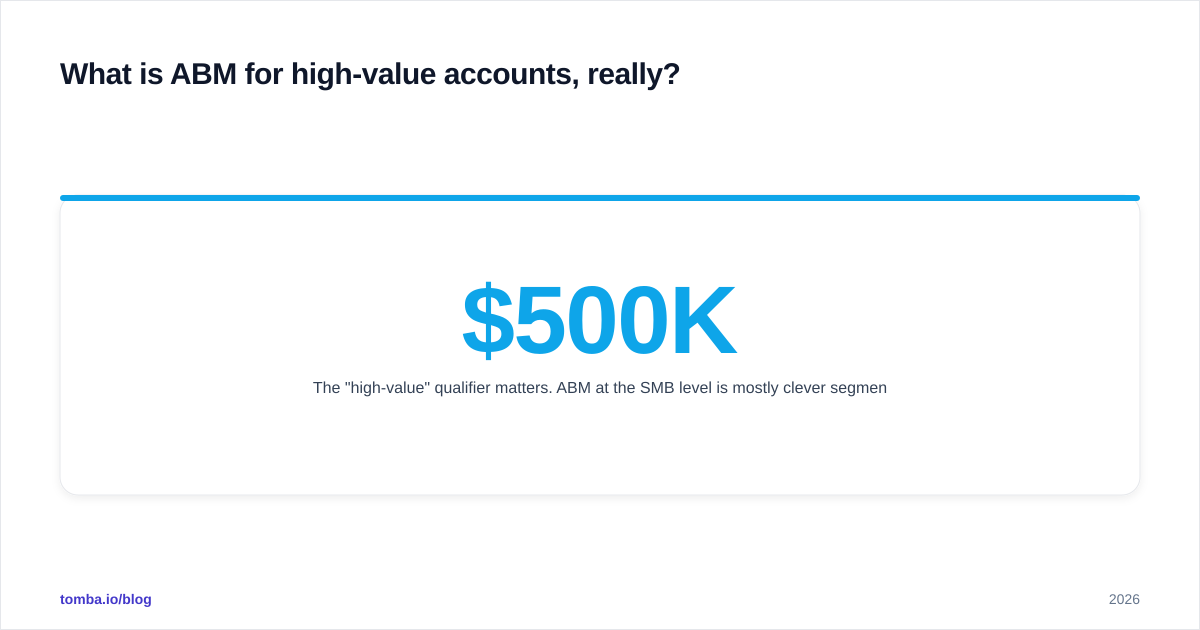
The "high-value" qualifier matters. ABM at the SMB level is mostly clever segmentation. ABM at the enterprise level — where one logo is worth $500K to $5M in ARR — demands real account research, custom content, and a level of multi-threading that conventional outbound does not support.
According to Forrester, companies running mature ABM programs report 1.7x higher average contract value and significantly shorter enterprise sales cycles. That spread doesn't come from better email subject lines. It comes from operating differently.
Why does ABM beat traditional demand gen for enterprise targets?#
Traditional demand gen is a funnel: pour in leads, qualify, hand off, close. It works at scale and fails at the top of the market. Three reasons:
- Enterprise buyers don't fill out forms. Your champion is a VP who delegates research. By the time someone raises their hand, 6–10 people on their side have already formed an opinion.
- Buying committees average 11–14 people in deals above $100K (Gartner). Spraying one persona never penetrates the committee.
- Custom relevance compounds. A generic case study has 2% engagement. A piece of content that names the prospect's CFO and their Q3 priorities has 40%+.
How do you pick the right high-value accounts?#
The single biggest failure mode in ABM is bad account selection. If your list is wrong, no amount of personalization saves the program. Use a three-layer model.
Layer 1: ICP fit (the floor)#
Hard firmographic filters: revenue band, employee count, industry, tech stack, geography. If a company fails these, they're out — regardless of how much they engage. Most teams use HubSpot, Clearbit, or a B2B intent platform to apply these filters at scale. Use Tomba's data enrichment and company email pattern tools when you need to validate firmographics and routing logic before importing into your CRM.
Layer 2: Propensity to buy (the ranker)#
Once you've filtered to ~2,000 ICP-fit accounts, rank them by predicted likelihood to convert. Inputs:
- Hiring signals (roles that imply your category)
- Tech stack changes (a competitor churn signal)
- Funding events (Series B+ unlocks budget)
- Executive moves (new CRO often = new tooling)
- First-party intent (multiple visits to pricing, demo, comparison pages)
Layer 3: Strategic value (the multiplier)#
Some accounts matter beyond their immediate deal size. A logo win in a new vertical, a flagship customer that opens a region, a strategic partner — these justify investment that pure propensity scoring would not.
How should you tier high-value accounts?#
Not every account in your ABM list gets the same treatment. Tiering forces honest resource allocation.
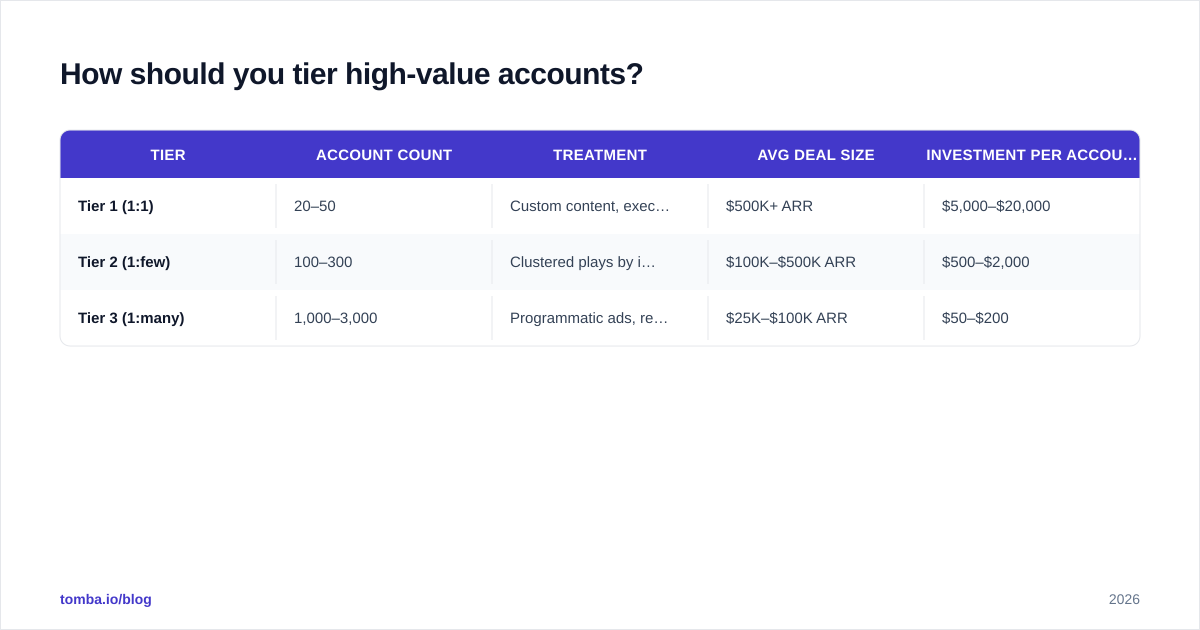
| Tier | Account count | Treatment | Avg deal size | Investment per account |
|---|---|---|---|---|
| Tier 1 (1:1) | 20–50 | Custom content, exec sponsor, named SDR + AE, field events | $500K+ ARR | $5,000–$20,000 |
| Tier 2 (1:few) | 100–300 | Clustered plays by industry/use-case, shared content kits | $100K–$500K ARR | $500–$2,000 |
| Tier 3 (1:many) | 1,000–3,000 | Programmatic ads, retargeting, automated email tracks | $25K–$100K ARR | $50–$200 |
The mistake teams make: putting everything in Tier 1 and then under-resourcing each one. If you can't credibly invest $10K per account, those accounts belong in Tier 2.
What signals should trigger an ABM play?#
Signals turn a static target list into a dynamic engagement model. The accounts at the top of your queue today should not be the same accounts as last week.
Buying signals worth chasing in 2026:
- Hiring intent — a posting for "Director of Revenue Operations" on a target account is a buying signal for any RevOps tool
- Job changes — when your champion moves to a new company, that company instantly becomes a Tier 1 target
- Tech stack movement — competitor uninstalls, contract renewal windows
- Engagement spikes — three different people from the same domain hitting your pricing page in 48 hours
- Earnings/M&A events — public companies signaling investment in your category on earnings calls
- Funding rounds — fresh capital + new exec hires = a 90-day buying window
Capture signals with a reverse email lookup when an anonymous visitor leaves a partial trail, and use website visitor reveal to de-anonymize traffic from your target accounts before they ever fill a form.
How do you build the buying committee map?#
For every Tier 1 account, you need a named map of the buying committee — not just "the CMO." Mature ABM teams build a 10–15 person account map covering:
- Economic buyer — usually one level above the user
- Champion — typically your main contact, often a Director or VP
- End users — the team that will actually use the product
- Influencers — adjacent teams (Security, Legal, IT) that can block deals
- Detractor — there's always one; identify them early
Use LinkedIn Sales Navigator for the org map and a precise email finder to get verified contact info for every name. A 14-person map with 14 valid emails beats a 50-person list with 30% bounce rate every single time. The Tomba LinkedIn finder bridges the Sales Nav profile to a deliverable work email so your SDRs aren't guessing at name@company.com permutations.
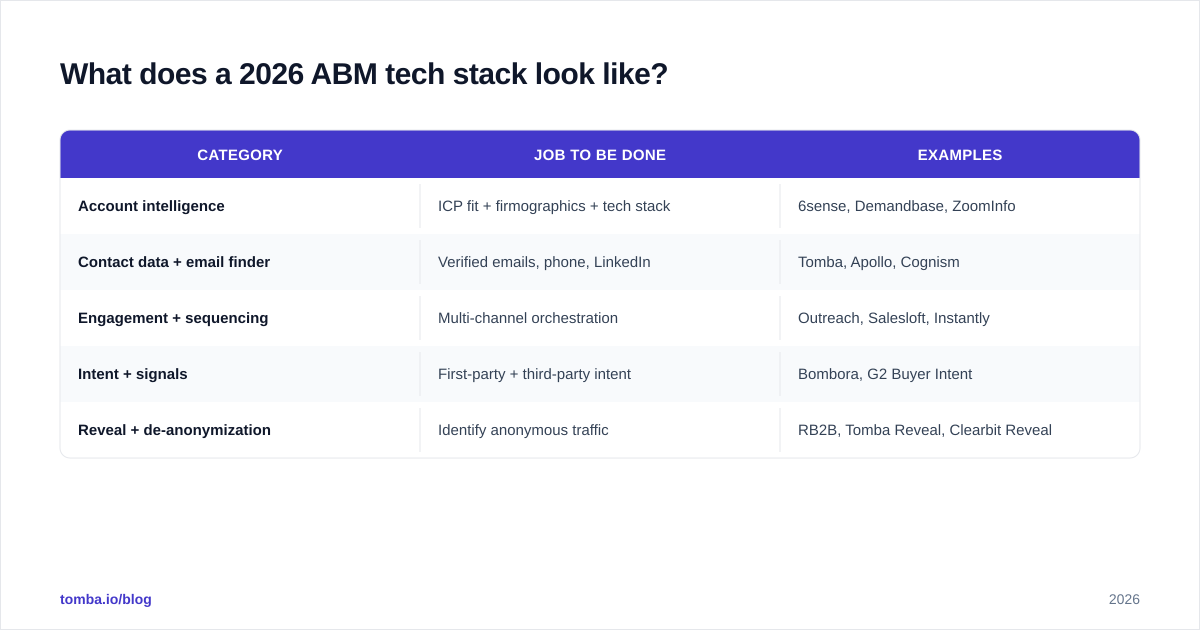
What does a 2026 ABM tech stack look like?#
The ABM tech stack has consolidated. You no longer need 12 tools — you need 5 categories working tightly together.
| Category | Job to be done | Examples |
|---|---|---|
| Account intelligence | ICP fit + firmographics + tech stack | 6sense, Demandbase,ZoomInfo |
| Contact data + email finder | Verified emails, phone, LinkedIn | Tomba, Apollo, Cognism |
| Engagement + sequencing | Multi-channel orchestration | Outreach, Salesloft, Instantly |
| Intent + signals | First-party + third-party intent | Bombora, G2 Buyer Intent |
| Reveal + de-anonymization | Identify anonymous traffic | RB2B, Tomba Reveal, Clearbit Reveal |
The connective tissue is your CRM (Salesforce or HubSpot) plus a workflow layer (the Tomba HubSpot integration and Salesforce integration push enriched contacts directly into account records so SDRs work from a single pane).
How do you actually run a 1:1 play?#
The Tier 1 play is the most expensive and the most misunderstood. Here's the pattern that works:
Week 1 — Account dossier
- Recent earnings calls, 10-K filings, press
- Org chart with 12+ named contacts and verified contact info
- A pain hypothesis grounded in a public signal (new CFO, new region, recent breach, etc.)
Week 2 — Custom content asset
- Industry teardown, ROI model, or peer benchmark naming the account's competitors
- Approved by the exec sponsor before sending
Week 3 — Coordinated entry
- AE sends a personal note to the economic buyer
- SDR works the champion and end users in parallel
- Marketing runs LinkedIn + display retargeting against the named accounts only
- Optional: a direct mail piece (still works in 2026, especially with execs)
Week 4 — Exec-to-exec
- Your CRO/CEO sends a 4-line note to their counterpart, referencing the asset
- This is the single highest-converting touch in the entire play
Weeks 5–8 — Multi-thread
- Aim for 4+ replies across the committee
- Book a discovery call only when 2+ stakeholders are engaged
A well-run 1:1 play converts 25–40% of targeted accounts into pipeline within 90 days. Spray outbound to the same list converts 1–3%.
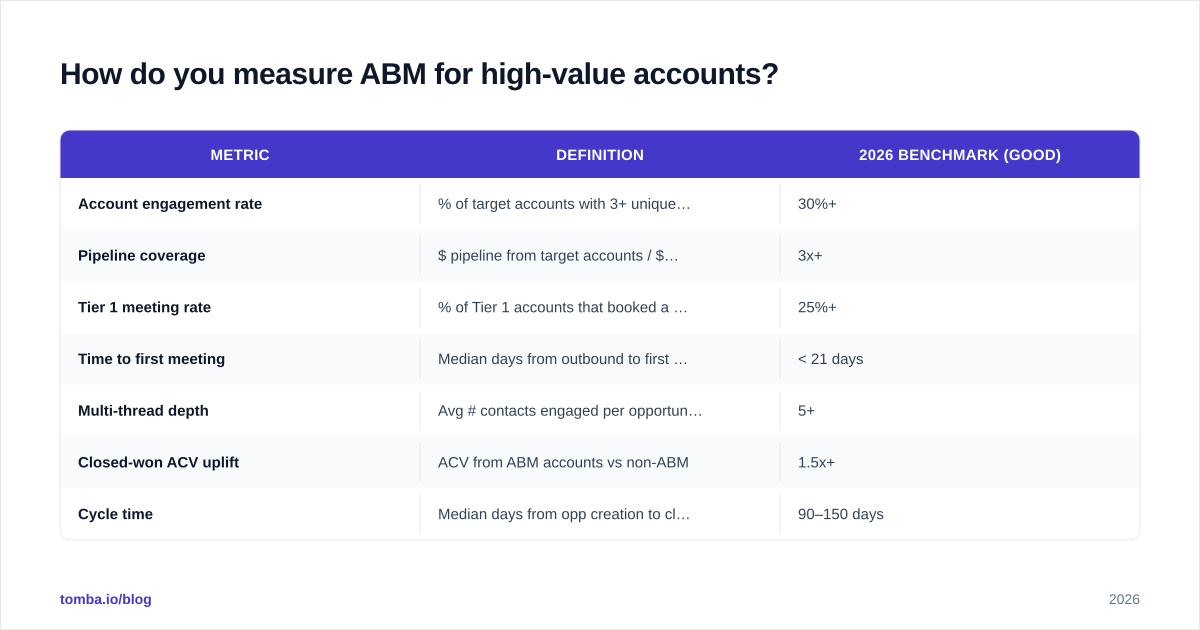
How do you measure ABM for high-value accounts?#
Stop measuring leads. Start measuring accounts.
| Metric | Definition | 2026 benchmark (good) |
|---|---|---|
| Account engagement rate | % of target accounts with 3+ unique people engaged in 30 days | 30%+ |
| Pipeline coverage | $ pipeline from target accounts / $ quota | 3x+ |
| Tier 1 meeting rate | % of Tier 1 accounts that booked a first meeting in 90 days | 25%+ |
| Time to first meeting | Median days from outbound to first call | < 21 days |
| Multi-thread depth | Avg # contacts engaged per opportunity | 5+ |
| Closed-won ACV uplift | ACV from ABM accounts vs non-ABM | 1.5x+ |
| Cycle time | Median days from opp creation to closed-won | 90–150 days |
Track these per-tier. A Tier 3 program with 30%+ engagement is healthy. A Tier 1 program at 10% engagement is broken.
What are the most common ABM mistakes in 2026?#
- Target list is too long. 500+ "Tier 1" accounts is not ABM, it's outbound with a fancy name. Cap Tier 1 at 50.
- Sales and marketing run separate lists. If marketing's ABM list isn't sales' top-50 prospect list, you don't have ABM.
- Personalization is cosmetic. Inserting
{{FirstName}}and a company name doesn't count. Real personalization references a recent business event. - No exec air cover. If your CRO won't send the four-line note, your AE's quota is on hard mode.
- Wrong contact data. A 30% bounce rate kills any sequence. Use an email verifier and a catch-all verifier before any Tier 1 outreach.
- Measuring MQLs. ABM does not generate MQLs. It generates engaged accounts. Change the dashboard.
How does ABM change the role of SDRs and AEs?#
ABM compresses the org. The handoff between SDR and AE blurs, because both work the same named accounts for months. The SDR isn't booking meetings off a leaderboard — they're building relationships across a committee, week after week.
Compensation has to follow. SDR comp tied to "meetings booked" creates the wrong behavior on Tier 1 accounts (rush a junior champion into a demo instead of nurturing the EB). Move to a hybrid model: meetings + account engagement score + pipeline sourced.
For G2-validated ABM patterns and customer evidence, look at how the leaders in your category structure their plays — most publish a version of their internal playbook in their analyst briefings.
Where does Tomba fit in an ABM stack?#
Tomba is the data layer for high-value account work. Account intelligence tools tell you which company to chase. CRMs hold the record. But between those two sits the hardest part of ABM: finding the right humans on the buying committee and reaching them with verified contact info.
That's the wedge where the Tomba Email Finder lives. Drop in a target domain and get the verified emails of the 14 stakeholders your ABM play depends on, complete with role, source, and confidence score. Pair it with the domain search for full company maps, the bulk email finder when you're enriching a fresh Tier 2 cluster, and the Tomba API when you want signals and contact data flowing directly into your orchestration layer.
The teams that win ABM in 2026 won't be the ones with the fanciest intent score. They'll be the ones who consistently get the right message to the right human on the right buying committee — and Tomba is the cheapest, highest-accuracy way to make that happen at enterprise scale. Start free at tomba.io/email-finder.
// get started
Find, verify and enrich your first contacts today
Start on the free plan with 25 searches a month, then scale when your team is ready.
Free plan · No credit card required · GDPR & CCPA
// about the author