ABM Multi-Threading in Sales: The 2026 Playbook for Closing Enterprise Deals
Single-threaded enterprise deals die when your champion leaves. Here is the 2026 ABM multi-threading sales playbook — who to contact, when, and how to do it without spamming the buying committee.
TL;DR#
- ABM multi-threading sales is now table stakes. Single-threaded enterprise deals lose 60% more often when your one champion changes jobs, gets reorged, or goes quiet.
- The 2026 standard is 6-8 contacts engaged per account across economic buyer, champion, technical evaluator, end user, and at least one detractor or skeptic.
- Sequence matters more than volume: start lateral (peers of the champion), then go up and down the org chart on a 21-day cadence.
- Tooling stack: enrichment to map the committee, intent data to time the outreach, and a sequencer that personalizes by persona — not by name only.
- Track account penetration depth, not reply rate, as the leading indicator of win rate.
What is ABM multi-threading sales and why does it matter in 2026?#
ABM multi-threading sales is the practice of engaging multiple stakeholders inside a target account at the same time. The alternative is one champion selling your product internally for you. That single point is a single point of failure. In a 2026 enterprise deal, the average buying committee has 11 people per Gartner research. The deal lifecycle now spans 9 months for contracts above $100K.
If you are talking to one person in that account, you are betting your quota on a coin flip. Champions change jobs every 18 months on average. Procurement gets pulled in late. Security review surfaces a blocker no one warned you about. The detractor you never met kills the deal in the final approval meeting.
Multi-threading is not "spam every VP on LinkedIn." It is a deliberate, sequenced outreach plan. You build parallel relationships across the buying committee. The deal then survives turnover, internal politics, and the inevitable "we are pausing this initiative for Q3."
Who are the seven contacts every ABM rep should be working?#
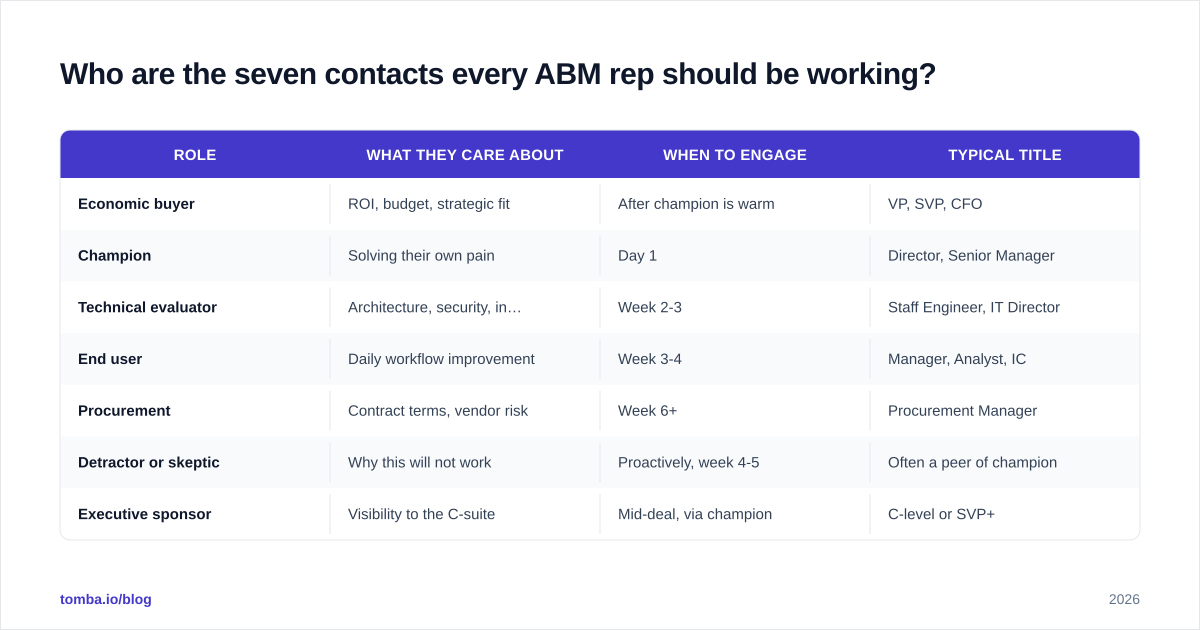
The contact map below is the minimum viable buying committee for any enterprise ABM deal. Skip a role and you are exposed.
| Role | What they care about | When to engage | Typical title |
|---|---|---|---|
| Economic buyer | ROI, budget, strategic fit | After champion is warm | VP, SVP, CFO |
| Champion | Solving their own pain | Day 1 | Director, Senior Manager |
| Technical evaluator | Architecture, security, integration | Week 2-3 | Staff Engineer, IT Director |
| End user | Daily workflow improvement | Week 3-4 | Manager, Analyst, IC |
| Procurement | Contract terms, vendor risk | Week 6+ | Procurement Manager |
| Detractor or skeptic | Why this will not work | Proactively, week 4-5 | Often a peer of champion |
| Executive sponsor | Visibility to the C-suite | Mid-deal, via champion | C-level or SVP+ |
Notice what is missing: there is no "the decision maker." In modern enterprise sales, there is no single decision maker. There is a consensus the committee either reaches or fails to reach. Your job is to make that consensus inevitable.
How is multi-threading different from old-school cold outreach?#
Cold outreach treats each person as a fresh prospect. Multi-threading treats the account as the unit of work. Each contact is a node in a graph. Messaging to the CFO references something the champion already told you. Outreach to the staff engineer mentions a technical concern raised in your discovery call with the VP.
This requires three things most teams underestimate:
- Account-level CRM hygiene. Notes, calls, and emails must be tagged to the account, not the contact. Otherwise no one knows what the other contacts said.
- Persona-specific messaging. A CFO does not want the same email as a Senior DevOps Engineer. Templates that change only the first name are not multi-threading. They are multi-spamming.
- A real account plan. One page per account, refreshed weekly, listing who you have talked to, what they said, what is blocking, and who you need to reach next.
What does the 21-day multi-threading cadence look like?#
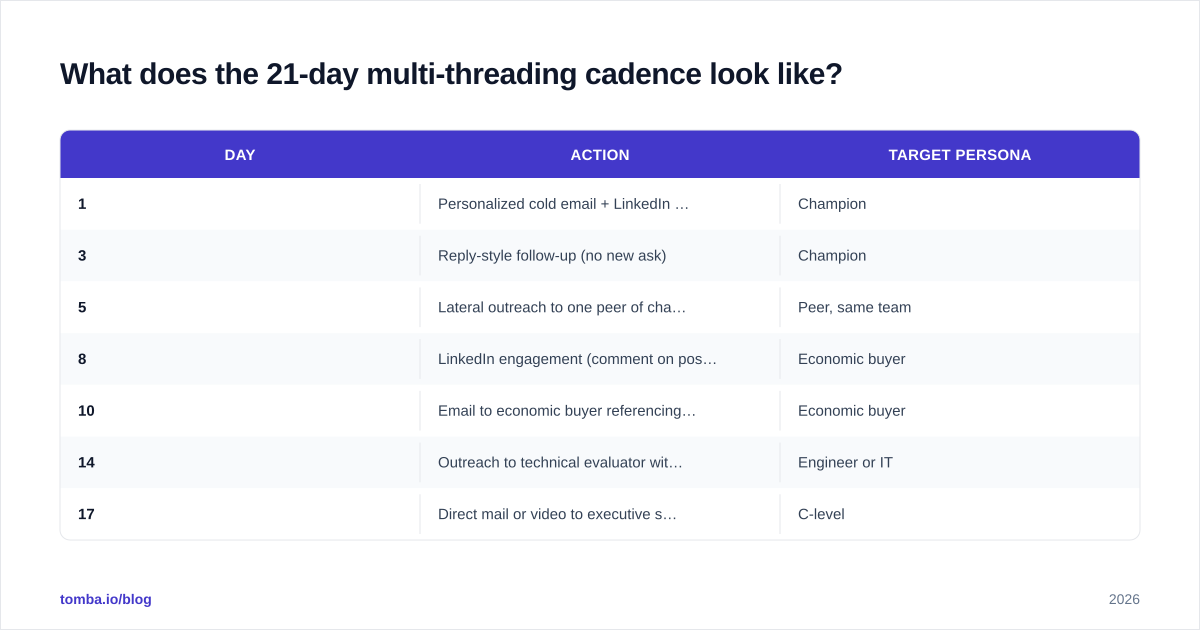
Here is the ABM multi-threading sales cadence I have seen work across roughly 200 enterprise deals reviewed in pipeline coaching sessions. Adjust the timing for your average sales cycle, but the sequencing principle holds.
| Day | Action | Target persona |
|---|---|---|
| 1 | Personalized cold email + LinkedIn connect | Champion |
| 3 | Reply-style follow-up (no new ask) | Champion |
| 5 | Lateral outreach to one peer of champion | Peer, same team |
| 8 | LinkedIn engagement (comment on post) | Economic buyer |
| 10 | Email to economic buyer referencing champion's pain | Economic buyer |
| 14 | Outreach to technical evaluator with a relevant doc | Engineer or IT |
| 17 | Direct mail or video to executive sponsor | C-level |
| 21 | Account review: who responded, who is dark, what next | Internal team |
The single biggest mistake reps make is collapsing this into week one. The buying committee should not feel like they are being carpet-bombed. Spacing the outreach is the difference between "this vendor is everywhere I look" (good) and "this vendor will not leave us alone" (bad).
What tools do you need to multi-thread effectively?#
You need three categories of tooling, and they have to share data cleanly.
Account intelligence and enrichment. You cannot multi-thread accounts you cannot map. This is where you need a strong B2B database and reliable data enrichment. The goal: identify every relevant contact at a target account, find their verified email and phone, and pull in firmographic context.
Intent and engagement signals. Tools like Bombora, 6sense, and G2 Buyer Intent show which accounts are researching your category right now. They also show which keywords are spiking. Use these to prioritize who gets the multi-threading treatment this week versus next quarter.
Sequencing and CRM. Salesloft, Outreach, Apollo, or HubSpot Sales Hub for the sequencing layer, anchored to Salesforce or HubSpot as the system of record. The non-negotiable: account-level reporting, not just contact-level.
The trap most teams fall into is buying too many overlapping tools. You do not need three enrichment vendors. You need one accurate source feeding a clean CRM. Start by auditing your current stack against the HubSpot sales hub overview to identify gaps versus duplicates.
| Tool category | Why you need it | Watch out for |
|---|---|---|
| Enrichment / email finder | Map the committee | Stale data, low accuracy on senior titles |
| Intent data | Time the outreach | Signal-to-noise ratio, attribution illusions |
| Sequencer | Run the cadence | Template-only "personalization" |
| CRM | Account-level truth | Contact-level fields drifting from account fields |
| Conversation intel | Capture committee mentions | Coverage gaps on non- |
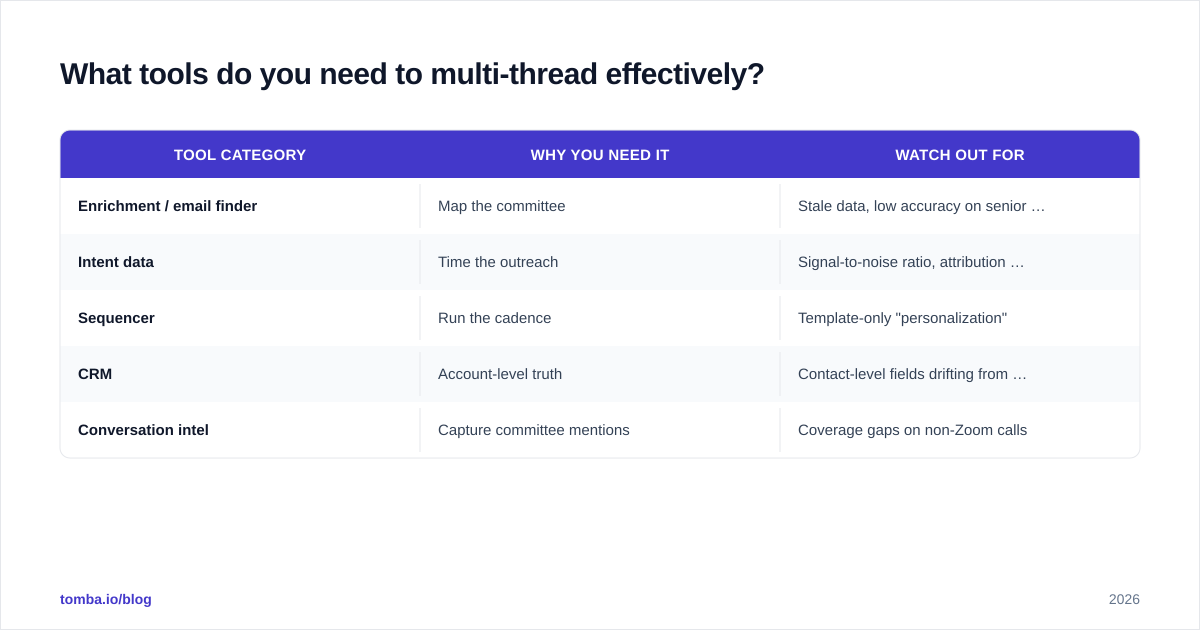
Zoom calls |
How do you find every member of the buying committee?#
This is where most multi-threading efforts stall. You know you need to reach the CFO and the VP of Engineering. But you do not have their direct contact info. InMail is a black hole.
The fastest path is to combine three lookup approaches:
- Domain search — pull every published email pattern at the account using a domain search tool, then filter by department and seniority.
- LinkedIn-to-email — for senior leaders you found on LinkedIn but cannot easily contact, use a LinkedIn finder to resolve verified business emails.
- Name + company lookup — for referrals from your champion ("you should talk to Sarah in finance"), an email finder gets you contact info in seconds.
Once you have the contacts, verify before you send. Sending to a bad address tanks your sender reputation. That kills the deliverability of every other thread you have running on that account. An email verifier pass before any cold outreach is mandatory in 2026. Gmail and Yahoo's 2024 sender requirements made it mandatory at the platform level.
What does great persona-specific messaging actually look like?#
Here is the practical difference between generic outreach and persona-specific multi-threading on the same account.
Generic version, sent to all five contacts:
Hi {firstName}, I noticed {company} is growing fast and wanted to see if a quick chat about our platform makes sense this week.
That is one message reused five times. It teaches the committee that you are not paying attention.
Persona-specific version, same account:
To the CFO: Reference the public earnings call where they mentioned operational efficiency targets. Tie your ROI to that number.
To the VP of Engineering: Reference the open Staff Engineer req on their careers page. Tie your product to the bottleneck implied by that hire.
To the end-user manager: Reference a specific workflow visible in their public job descriptions ("Salesforce admin, Outreach.io power user"). Tie your product to that workflow.
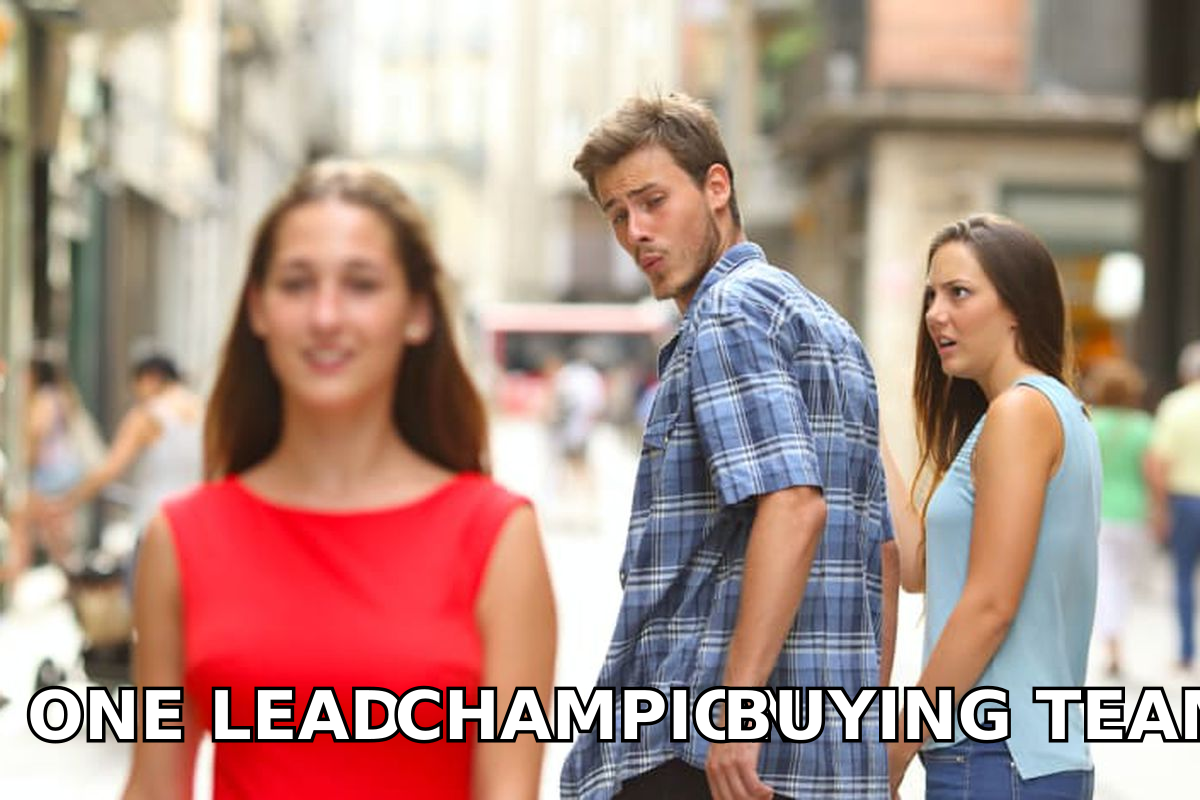
Same account, three distinct emails, each one reads like you only sent it to them. That is multi-threading. The first version is just volume.
How do you handle the detractor without making the deal worse?#
Every enterprise deal has a detractor. This is someone whose status, budget, or workflow is threatened by your product. New reps avoid them. Senior reps engage them early and openly.
The pattern that works:
- Identify them by week three. Ask your champion: "Who in this evaluation is most skeptical, and why?"
- Reach out directly. "I heard you have concerns about X. I would rather understand them now than discover them in the contract phase."
- Address the actual concern. Do not sell. Acknowledge the trade-off, share how other customers handled it, ask what would resolve it for them.
- Loop the champion in. "I had a good conversation with [detractor]. Here is what they need to see — can we work it into the next demo?"
A detractor who is heard becomes a neutral. A detractor who is ignored becomes a no.
What metrics actually predict multi-threaded ABM win rate?#
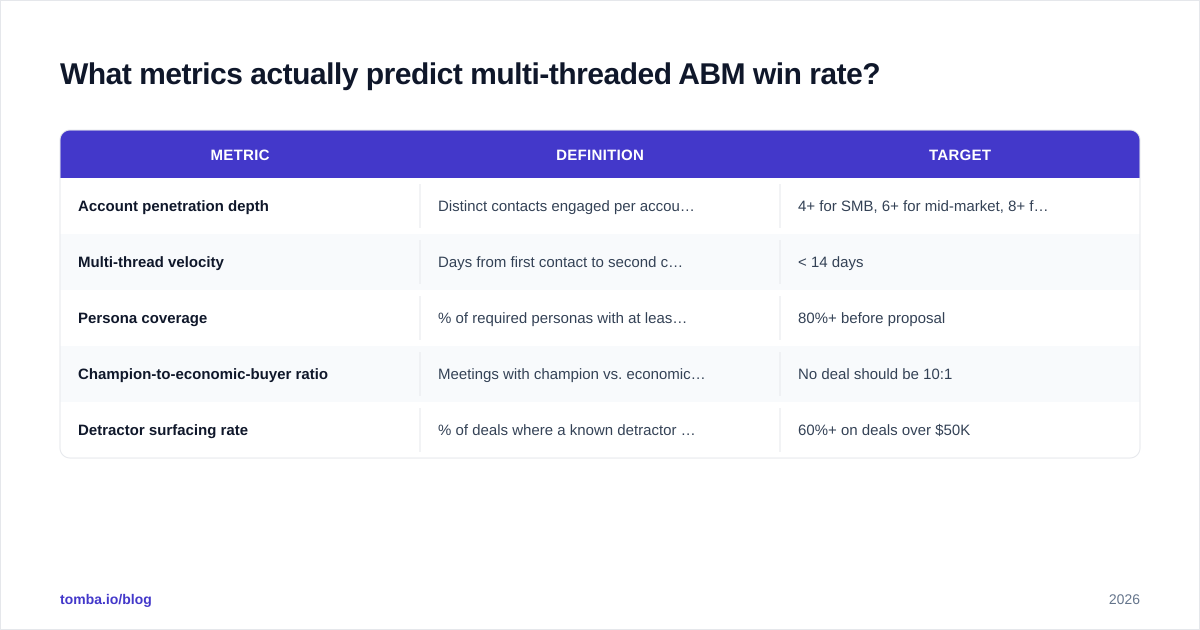
Stop tracking reply rate at the contact level. Start tracking these account-level metrics.
| Metric | Definition | Target |
|---|---|---|
| Account penetration depth | Distinct contacts engaged per account | 4+ for SMB, 6+ for mid-market, 8+ for enterprise |
| Multi-thread velocity | Days from first contact to second contact engaged | < 14 days |
| Persona coverage | % of required personas with at least one meaningful interaction | 80%+ before proposal |
| Champion-to-economic-buyer ratio | Meetings with champion vs. economic buyer | No deal should be 10:1 |
| Detractor surfacing rate | % of deals where a known detractor was identified | 60%+ on deals over $50K |
These leading indicators predict closed-won three to six months before the bookings number does. If your account penetration depth is stuck at 1.5 contacts per account, your forecast is fiction.
How does multi-threading differ across SMB, mid-market, and enterprise?#
The instinct to apply the same playbook everywhere is the fastest way to waste effort.
| Segment | Committee size | Threads needed | Cadence length |
|---|---|---|---|
| SMB (< 50 employees) | 1-2 | 2-3 contacts | 7-14 days |
| Mid-market (50-1000) | 3-5 | 4-6 contacts | 21-30 days |
| Enterprise (1000+) | 8-15 | 6-10 contacts | 45-90 days |
In SMB, the founder is often the champion, economic buyer, and end user combined. Over-threading creates noise without lifting win rate. In enterprise, under-threading is the single biggest cause of stalled deals. Tune accordingly.
What are the most common ABM multi-threading sales mistakes?#
The patterns I see most often in pipeline reviews:
- Copy-pasting the champion's name into five emails. The committee compares notes. They will notice.
- Going around the champion without permission. Always tell your champion you are reaching out to their boss. Surprise outreach burns trust permanently.
- Confusing thread count with thread quality. Six surface-level connections is not better than three deep ones. Engagement depth matters more than head count.
- Ignoring the org chart. Sending the same message to a VP and an IC is tone-deaf. Senior personas want strategic framing, ICs want workflow specifics.
- Treating multi-threading as a one-time activity. It is a continuous discipline. Accounts shift, people leave, new stakeholders join. Refresh your map every two weeks.
For broader prospecting frameworks that pair with multi-threading, the Apollo alternatives breakdown covers tool selection for teams scaling from single-threaded outbound to committee-level ABM.
How do you build a repeatable multi-threading motion across the team?#
Individual rep heroics do not scale. Three operational moves turn multi-threading from an art into a system.
Account plan templates. One page, mandatory, reviewed in weekly pipeline meetings. Sections: known contacts, role mapping, what each contact said, what is blocking, next action per contact.
Persona libraries. A shared doc per persona — CFO, VP Sales, IT Director, Procurement — with pain points, language patterns, sample outreach openers, and objection responses. New reps ramp in weeks instead of quarters.
Win-loss reviews focused on threading. Every loss interview asks: "How many people did we engage? Who did we miss? What did the detractor we never met say internally?" Pattern-match across losses, fix the gaps systematically.
This is what separates an ABM team that hits quota from one that misses by 30% and blames the market. The market is fine. The threading is not.
Where does Tomba fit in the ABM multi-threading stack?#
Mapping the buying committee is the bottleneck for most ABM teams. You cannot thread accounts you cannot reach.
The Tomba Email Finder is built for this exact problem. Feed it a target account. Get every verified contact across the buying committee, segmented by department and seniority. Pair it with the bulk email finder when you are loading a fresh tier-one account list. Use the HubSpot integration or Salesforce integration to push enriched contacts directly into your CRM at the account level.
Pricing starts free for 25 monthly searches, then $49/month on the Starter plan, $99 on Growth, and $249 on Pro. See the full Tomba pricing for usage tiers. If you are running ABM at scale, the Growth plan is the typical fit. Pro and Enterprise kick in once you cross 10K accounts in active rotation.
Multi-threading is a discipline, not a tool. But the discipline only works if you have clean, verified contact data for every member of the buying committee. That is what Tomba exists to deliver.
Ready to find emails that actually work?
Join 150,000+ professionals who stopped guessing and started sending. Free credits on signup — no credit card required.
Get the Tomba newsletter
Practical outbound tactics and product updates — once every two weeks.
About the author