ABM Orchestration in 2026: The Complete Playbook for RevOps
ABM orchestration is what separates account lists that sit in spreadsheets from accounts that actually convert. Here is the 2026 playbook RevOps teams are using.
ABM Orchestration in 2026: The Complete Playbook for RevOps
TL;DR
- ABM orchestration is the connective tissue between your data, channels, and teams — not a single tool, and not a campaign type.
- In 2026, the winning stack pairs an intent/signal layer (6sense, Demandbase) with an identity/enrichment layer (Tomba, Clearbit-class data) and a play execution layer (HubSpot, Salesforce, Outreach).
- Teams that orchestrate against account stages — not lead stages — see 2-3x higher win rates on target accounts versus generic outbound.
- The most common failure mode is "ABM theatre": custom landing pages and gifts with no synced sales motion behind them.
- Start with one tier-1 segment of 50 accounts, one trigger, one play, one owner. Then scale the pattern.
What is ABM orchestration, really?#
ABM orchestration is the coordinated execution of marketing, sales, and customer success motions against a defined list of accounts, triggered by signals, and measured at the account level.
Think of it like a film set. Account-based marketing is the script. The orchestration is the director, the gaffer, the boom op, and the assistant editor making sure that when the actor delivers the line, the lights are on, the mic is hot, and the camera is rolling. Without orchestration, ABM is just a list in a spreadsheet and a Slack thread that says "any updates on Acme?"
The technical definition, per Forrester, is the process of aligning data, channels, and plays around target accounts so that each touch is informed by the last. The practical definition is simpler: when a buying committee member at a target account does something, the right person inside your company knows about it and acts within 24 hours.
Why is ABM orchestration suddenly a 2026 priority?#
Three forces converged.
First, MQL volume crashed. Cookie deprecation, form fatigue, and AI-written outbound flooded inboxes — net new MQLs fell roughly 30-40% across most B2B benchmarks. RevOps leaders gave up trying to fix the lead funnel and shifted budget toward account-level pipeline generation.
Second, intent data finally got accurate enough to act on. 6sense, Bombora, and G2 now expose third-party signal at a quality where a meaningful percentage of "surging" accounts actually convert when worked correctly.
Third, AI made personalization cheap. The cost of writing 200 unique emails to 200 buying committee members dropped to near zero. The bottleneck moved from production to coordination — which is exactly what orchestration solves.
What does an ABM orchestration stack actually look like?#
There is no single product called "ABM orchestration." It is a layered system. Here is the shape most mature programs land on.
| Layer | Job | Common Tools |
|---|---|---|
| Identity & enrichment | Resolve accounts, fill in contact and firmographic gaps | Tomba, Clearbit,ZoomInfo |
| Intent & signals | Detect buying intent across third-party and first-party data | 6sense, Demandbase, Bombora, G2 |
| CRM & system of record | Hold account, contact, opportunity, stage | Salesforce, HubSpot |
| Engagement & sequencing | Execute multi-channel plays | Outreach, Salesloft, HubSpot Sequences |
| Advertising & display | Run account-targeted ads | LinkedIn Ads, Demandbase Ads, RollWorks |
| Analytics & attribution | Measure account-level progression | Native CRM reporting, Bizible, Dreamdata |
| Orchestration logic | Trigger plays from signals, route to owners | Tray.io, Workato, Zapier, native intent platforms |
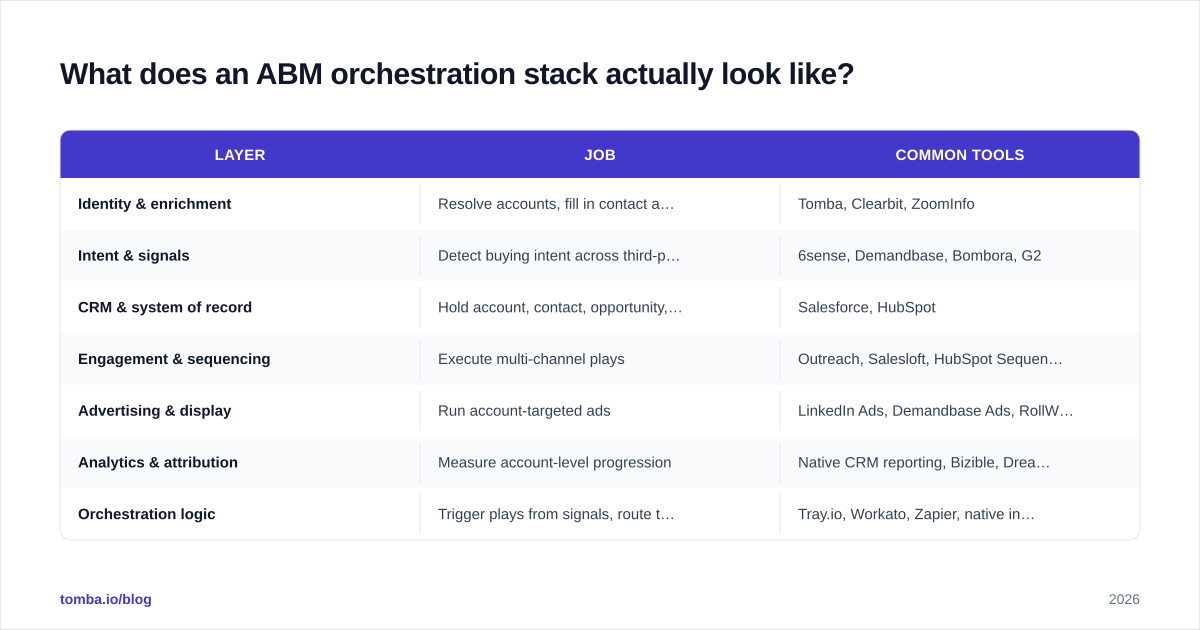
The mistake most teams make is buying the intent layer without solving the identity layer. Surging account names without verified buying-committee contacts is just a list of logos. You still need to find, enrich, and verify the humans you intend to reach — which is why a B2B database and a reliable email finder sit underneath every working ABM motion.
How does ABM orchestration differ from regular ABM?#
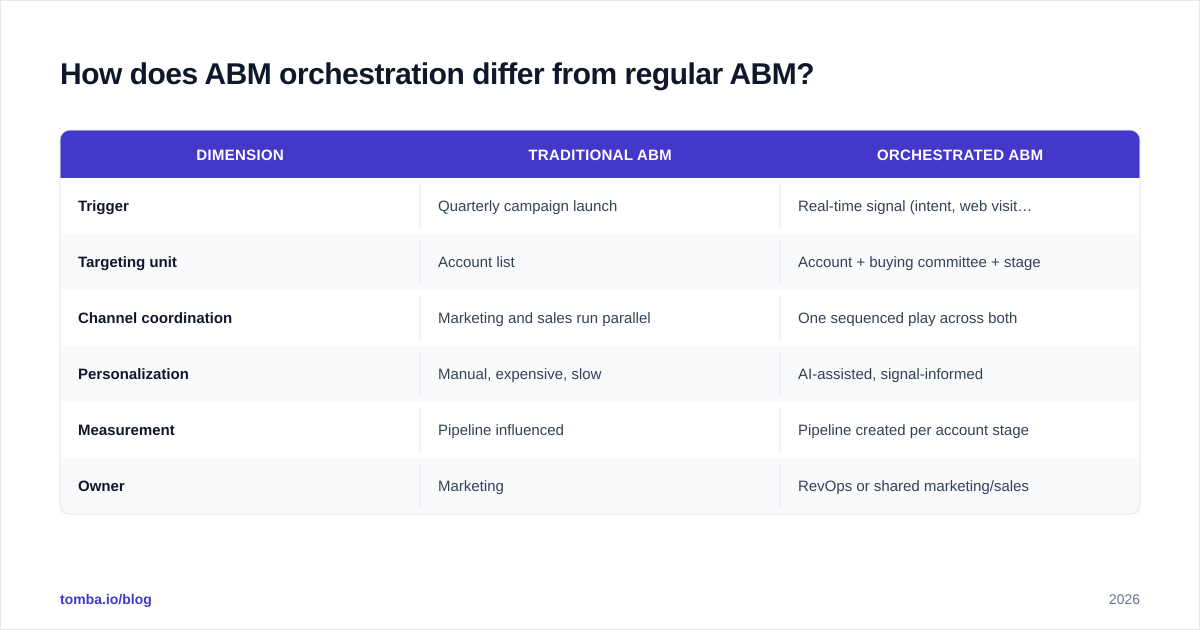
Most teams have been doing some form of ABM for years. The difference in 2026 is operational, not philosophical.
| Dimension | Traditional ABM | Orchestrated ABM |
|---|---|---|
| Trigger | Quarterly campaign launch | Real-time signal (intent, web visit, hire) |
| Targeting unit | Account list | Account + buying committee + stage |
| Channel coordination | Marketing and sales run parallel | One sequenced play across both |
| Personalization | Manual, expensive, slow | AI-assisted, signal-informed |
| Measurement | Pipeline influenced | Pipeline created per account stage |
| Owner | Marketing | RevOps or shared marketing/sales |
Traditional ABM looked like: marketing sends a quarterly direct mail piece to 500 accounts, then asks SDRs to follow up. Orchestrated ABM looks like: an account hits the "research" stage on Bombora, your platform pushes a Slack alert to the AE, the SDR sends a sequence informed by the keywords the account researched, LinkedIn ads spin up for the buying committee, and customer marketing pauses any "renewal" emails for accounts that are also customers.
Who owns ABM orchestration inside the company?#
In 2026 the honest answer is RevOps, even when the org chart says marketing.
The reason is structural. Orchestration touches data hygiene, lead routing, scoring, CRM workflows, and reporting — all of which live in revenue operations. Demand gen teams own the plays. SDR leaders own the human execution. But the connective tissue — the rules, the sync, the SLAs, the dashboards — has to sit with a function that has authority across both sides.
The pattern that works:
- RevOps owns the orchestration platform, the data model, the routing rules, and the reporting.
- Demand gen / ABM marketing owns the plays, the creative, the content offers, and the segment definitions.
- Sales (AE/SDR) owns the human follow-up and feedback loop on account fit.
- CS / Account management owns post-sale orchestration into expansion and advocacy.
A single person — usually titled "ABM Manager" or "Senior Demand Gen Manager" — sits in the middle and runs the weekly cross-functional sync.
What does an orchestration play look like in practice?#
Let's make this concrete. Here is one play, fully specified.
Play name: "Surging on competitor"
Trigger: Account is in target tier 1 list AND shows surging intent on a competitor's branded keywords for 3+ days.
Audience: Top 3 buying committee titles at the account (VP RevOps, Director Sales Ops, CRO).
Sequence:
- Day 0: Slack alert to assigned AE with intent context and named contacts.
- Day 0: LinkedIn ad campaign goes live to the buying committee with a "switch from [competitor]" message.
- Day 1: SDR sends personalized email referencing the specific keywords the account researched.
- Day 3: SDR follow-up with a comparison asset.
- Day 5: AE sends a LinkedIn voice note.
- Day 7: Direct mail trigger (Sendoso) if account opened any email.
- Day 14: Recycle to nurture if no engagement.
Success metrics: Meetings booked within 21 days, opportunities created within 60 days, pipeline value per account.
Owner: AE for the territory, with SDR execution, ABM manager monitoring.
The orchestration layer is what makes this run automatically when the trigger fires, instead of someone manually noticing the intent dashboard once a week.
How do you pick targets without drowning in noise?#
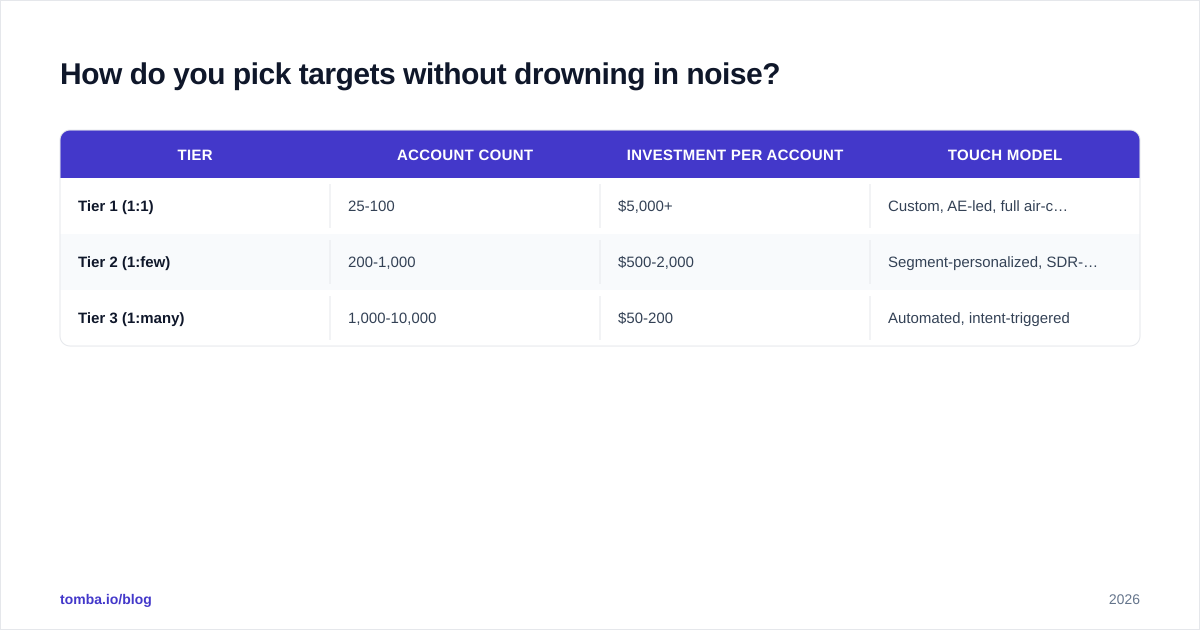
Tiering. Every working ABM program in 2026 uses some version of a 3-tier model.
| Tier | Account Count | Investment Per Account | Touch Model |
|---|---|---|---|
| Tier 1 (1:1) | 25-100 | $5,000+ | Custom, AE-led, full air-cover |
| Tier 2 (1:few) | 200-1,000 | $500-2,000 | Segment-personalized, SDR-led |
| Tier 3 (1:many) | 1,000-10,000 | $50-200 | Automated, intent-triggered |
The math that matters: a tier 1 account should justify the spend if you close 1 in 20. A tier 3 account should justify itself with much lower close rates because the cost per touch is two orders of magnitude lower.
To build the list, you need three inputs:
- ICP fit — firmographic and technographic match. Pulled from your B2B database or enrichment provider.
- Intent score — third-party signal showing in-market behavior.
- First-party engagement — your own product, web, and content signals.
Multiply the three. The accounts in the top decile across all three are tier 1. The top quartile across two of three are tier 2. Surging on one signal alone is tier 3.
How do you measure ABM orchestration?#
Pipeline-influenced is a vanity metric. The real KPIs sit at the account stage level.
| Metric | What It Tells You | Target |
|---|---|---|
| Target account penetration | % of tier 1 accounts with engaged buying committee contact | 80%+ |
| Time from signal to first touch | Median hours between trigger and first human action | < 24 hours |
| Account stage velocity | Days from "aware" to "evaluating" to "selected" | Trend down quarter over quarter |
| Tier 1 win rate | Closed-won / closed total on tier 1 | 2-3x non-target baseline |
| Cost per tier 1 opportunity | All-in spend / opps created from tier 1 list | Lower than blended outbound CAC |
| Multi-threading score | Avg contacts engaged per active account | 5+ |
A useful question to ask in every QBR: "On the accounts we lost, when was our first touch relative to the buying decision?" The answer is almost always "too late." Orchestration is the fix.
What are the biggest mistakes RevOps teams make?#
Mistake 1: Buying intent before fixing identity. You signed a 6sense contract but you can't actually find the VP of RevOps's email. The signal is wasted. Solve identity first — a working email finder and verified contact base — before you pay for surge data.
Mistake 2: One-channel "ABM." A LinkedIn ad campaign aimed at a list is not orchestration. If the SDR doesn't know the account is being advertised to, you have two unrelated motions.
Mistake 3: No clear owner. Marketing thinks sales owns follow-up. Sales thinks marketing owns the play. The play runs, no one acts, the signal dies.
Mistake 4: Measuring at the lead level. ABM is an account motion. If your dashboards still index on MQLs per rep, you have not actually moved to ABM. You have just bought new software.
Mistake 5: Skipping the dry run. New plays should run for two weeks as a manual pilot — a human follows the playbook by hand — before any of it gets automated. Automating broken plays just breaks them faster.
What does the orchestration process look like step by step?#
Here is the loop, once a quarter:
- Define segments. ICP + tier + named account list. Lock for the quarter.
- Map signals to plays. Each segment has 3-5 plays mapped to specific triggers.
- Build the data plumbing. Enrichment, deduplication, routing rules, Slack alerts.
- Equip the humans. Talk tracks, email templates, objection responses, signal context.
- Launch a single play. Don't launch eight at once.
- Measure for two weeks. Real-time dashboards visible to the whole pod.
- Iterate the play. Adjust trigger thresholds, copy, sequence length.
- Add the next play. Repeat.
The orgs that win do not try to orchestrate everything in week one. They orchestrate one play perfectly, then copy the pattern.
Which tools should you actually start with?#
If you have a small budget and a small team, here is the minimum viable stack:
| Need | Starter Pick | Why |
|---|---|---|
| Contact data | Tomba — Starter plan $49/mo | Verified emails for buying committee members at named accounts |
| Intent | G2 buyer intent or LinkedIn Sales Nav alerts | Cheapest entry into signal data |
| CRM | HubSpot or Salesforce | What you already have |
| Sequencing | Outreach, Salesloft, or HubSpot Sequences | What your AEs already use |
| Workflow automation | Native CRM workflows +Zapier | Skip the heavyweight middleware until you outgrow it |
| Account dashboard | Salesforce reports or HubSpot custom dashboard | One view of "what is happening on these 50 accounts" |
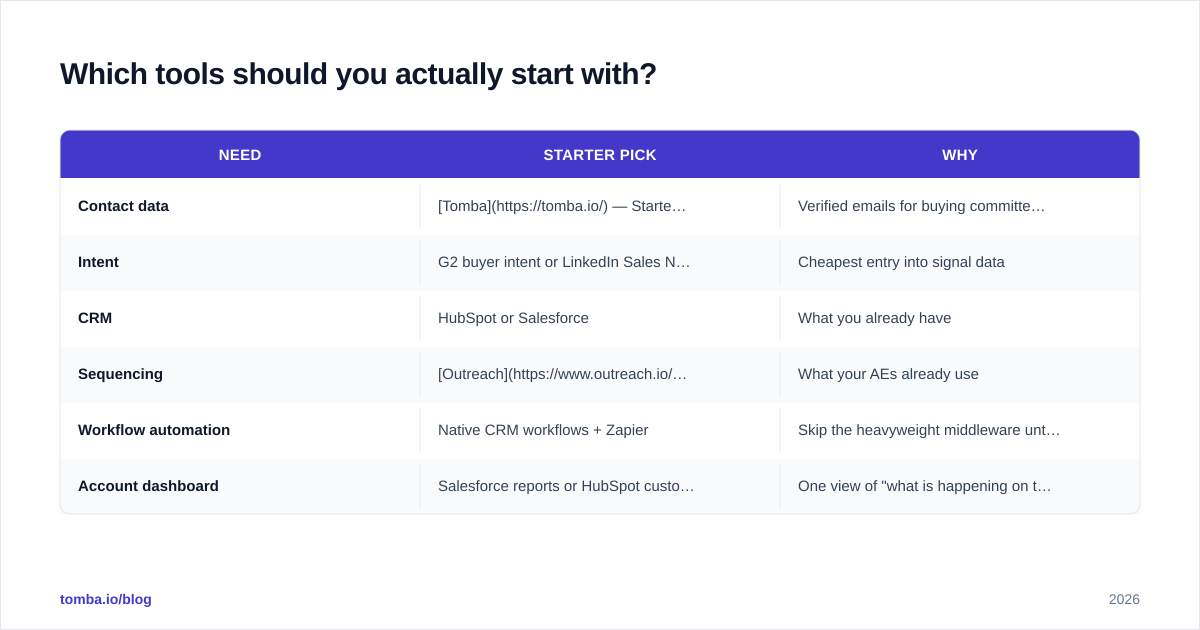
You do not need 6sense and Demandbase to run your first ABM play. You need a list, a signal, a sequence, and an owner. Once that loop is working on 50 accounts, you have earned the right to add platforms.
For the identity layer specifically, integrating contact discovery into the orchestration flow is what makes the signal actionable. Tools like the Tomba HubSpot integration and the Salesforce integration let intent triggers automatically pull verified contacts into the CRM as the account heats up, so the AE never has to ask "who do I email at this account?"
How does AI change ABM orchestration in 2026?#
AI doesn't replace orchestration — it makes the variable cost of execution near zero, which means orchestration logic becomes the entire game.
Three concrete shifts:
- Sequence personalization is no longer a bottleneck. Tools like Clay and the cold email AI generator can produce 500 unique emails informed by the prospect's recent activity in minutes. The constraint is now whether the underlying signal and trigger are good — garbage in, more garbage out.
- Signal synthesis got smarter. Instead of "this account is surging on keyword X," modern platforms summarize: "this account changed CFOs, opened a new HQ, and is researching billing software — likely re-evaluating their finance stack." The AE gets a thesis, not a data dump.
- Predictive scoring stopped being magic. It is now table stakes. Every CRM ships some form of account scoring. The question is whether your data is clean enough to make the score meaningful — which loops back to identity and enrichment.
The teams that lose with AI are the ones that automate broken plays. The teams that win use AI to scale plays that already worked in pilot.
What's the 90-day rollout plan?#
- Days 1-15: Pick one segment, build the tier 1 list (50 accounts), audit data hygiene, fill enrichment gaps with bulk email lookup. Define one play.
- Days 16-30: Build the routing and Slack alerts. Train AEs and SDRs on the play. Run it manually for two weeks.
- Days 31-60: Automate the trigger. Add a second play on the same segment. Set up the account-level dashboard.
- Days 61-90: Expand to a second segment. Add intent data if not already in stack. Run the first cross-functional retro.
Ship something visible in 90 days. The fastest way to lose budget for ABM is to spend six months building a perfect framework that produces no pipeline.
Conclusion: orchestration is the moat#
The ABM concept has been around for fifteen years. What's new in 2026 is that the gap between teams that orchestrate well and teams that don't has widened to the point of being structural. Orchestrated programs are producing 2-3x the pipeline efficiency of non-orchestrated peers on the same target lists.
The barrier to entry is not buying a $200K intent platform. It is doing the unglamorous work — clean data, mapped plays, named owners, weekly retros — that turns signals into meetings into revenue.
Start with identity. Without verified contacts on your tier 1 accounts, every other layer is theoretical. Tomba's Email Finder and bulk enrichment are how most teams seed the contact layer that the rest of the orchestration stack runs on top of. Plans start at $49/mo on Tomba pricing, with a free tier of 25 searches to test the workflow before committing.
Pick one segment. One signal. One play. One owner. Then orchestrate.
// get started
Find, verify and enrich your first contacts today
Start on the free plan with 25 searches a month, then scale when your team is ready.
Free plan · No credit card required · GDPR & CCPA
// about the author