ABM Outreach in 2026: The Complete Playbook for Account-Based GTM
ABM outreach is no longer batch-and-blast with a logo wall. Here's how modern revenue teams build target account lists, sequence multi-threaded plays, and measure pipeline impact in 2026.
TL;DR#
- ABM outreach in 2026 is multi-threaded, signal-triggered, and account-scoped — not lead-scoped.
- Tier your accounts (1:1, 1:few, 1:many) and assign different play patterns to each tier.
- Build a buying committee map of 4-7 stakeholders per account before you write a single email.
- Run plays across email, LinkedIn, phone, ads, and direct mail in coordinated bursts — not as isolated channels.
- Measure account engagement and pipeline coverage, not open rates. If you cannot tie a play to an account-level outcome, it does not belong in your motion.
What is ABM outreach in 2026?#
ABM outreach is the discipline of running coordinated, multi-channel plays against a defined set of target accounts, where every touch is mapped to a buying committee role and an account-level goal.
The phrase used to mean "send the same email to ten people at one company." That definition is dead. Modern account-based motions look more like a small heist crew than a mailshot: sales, marketing, SDR, and RevOps all hit the same account from different angles, in the same week, with messaging tied to a specific signal (job change, funding round, tech adoption, competitor churn).
The shift matters because B2B buying committees have grown. Gartner now puts the average enterprise buying group at 6-10 people, and 77% of buyers say their last purchase was complex or difficult. Single-threaded cold email cannot reach a 10-person committee. Account-based outreach can.
How is ABM outreach different from traditional outbound?#
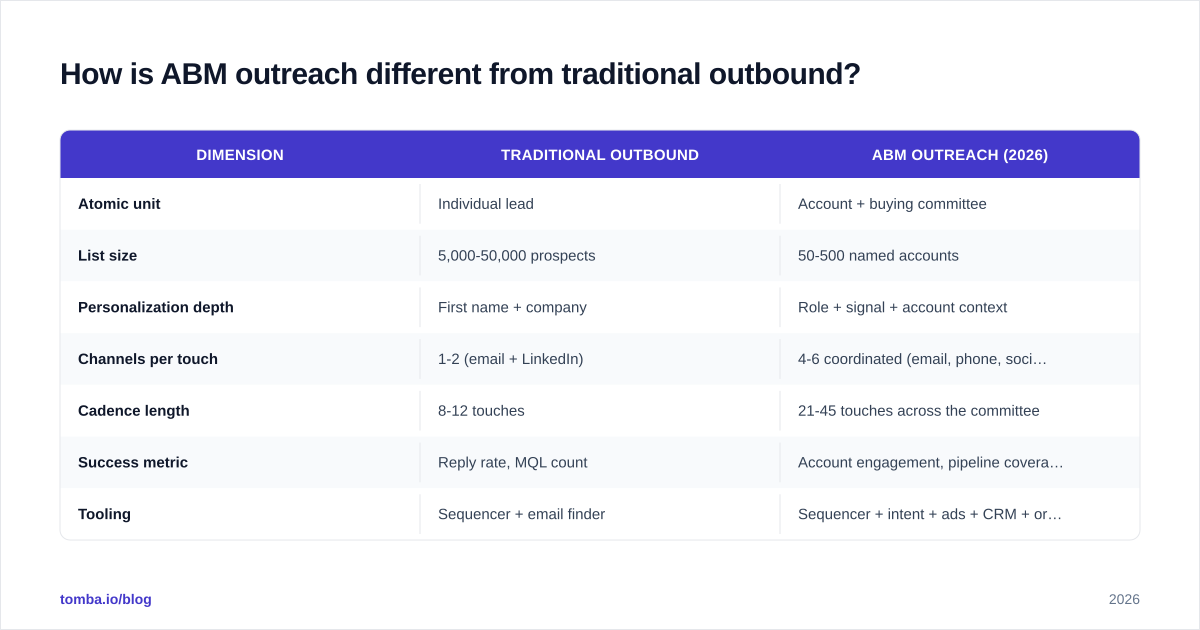
Traditional outbound treats every contact as an independent lead. ABM treats the account as the atomic unit and every contact as a node in a graph.
That single change cascades through your entire motion:
| Dimension | Traditional outbound | ABM outreach (2026) |
|---|---|---|
| Atomic unit | Individual lead | Account + buying committee |
| List size | 5,000-50,000 prospects | 50-500 named accounts |
| Personalization depth | First name + company | Role + signal + account context |
| Channels per touch | 1-2 (email + LinkedIn) | 4-6 coordinated (email, phone, social, ads, direct mail, events) |
| Cadence length | 8-12 touches | 21-45 touches across the committee |
| Success metric | Reply rate, MQL count | Account engagement, pipeline coverage, win rate |
| Tooling | Sequencer + email finder | Sequencer + intent + ads + CRM + orchestration layer |
The ABM motion is more expensive per account but produces much higher contract values. Forrester's research on account-based programs consistently shows higher win rates and deal sizes when ABM is run correctly — and lower returns when teams just rebrand cold email as "ABM."
Who should run ABM outreach?#
ABM outreach pays off when three conditions hold:
- Average contract value is high enough to justify the touch cost. Below roughly $15,000 ACV, the math gets hard. Above $50,000 ACV it almost always works.
- The buying committee is real. If a single VP can sign your contract alone, you are running solution selling, not ABM.
- Your TAM is narrow enough to name. If you can list every plausible buyer in a spreadsheet, you can run ABM. If your buyer is "any small business with email," run volume outbound instead.
Teams that try ABM without these conditions end up with an expensive, slow version of cold email that disappoints everyone. Be honest about whether you qualify before you reorg your SDR team.
How do you build a target account list?#
Start with three concentric tiers. The tier determines how much human effort an account gets — not whether you pursue it.
Tier 1 (1:1): 10-50 accounts. Hand-picked strategic accounts. Custom landing pages, custom email copy, executive sponsorship, direct mail, in-person ABM events. One SDR + one AE + marketing partner per cluster of 10-15 accounts.
Tier 2 (1:few): 100-500 accounts. Industry or use-case clusters. Templated-but-tailored sequences, segmented ads, role-based messaging. One SDR can manage 75-150 accounts in this tier.
Tier 3 (1:many): 1,000-5,000 accounts. Programmatic account-based plays. Intent-triggered sequences, retargeting, dynamic ad audiences. Mostly automated with light human review.
For each tier, codify your ICP with hard filters (industry, employee count, geo, tech stack) and soft signals (recent funding, job postings, leadership changes, intent surges). You can pull firmographic data from a B2B database and layer intent from Bombora, 6sense, or G2 buyer-intent feeds.
Once you have the list, you need the people. This is where most ABM programs leak. You cannot run a 6-person committee play if you only have 1 contact per account. Use a domain search to pull every published email at the company, then filter by title patterns (VP, Director, Head of, Manager) inside your relevant function. Aim for 4-7 verified contacts per account before you start any play.
What does a modern ABM play look like?#
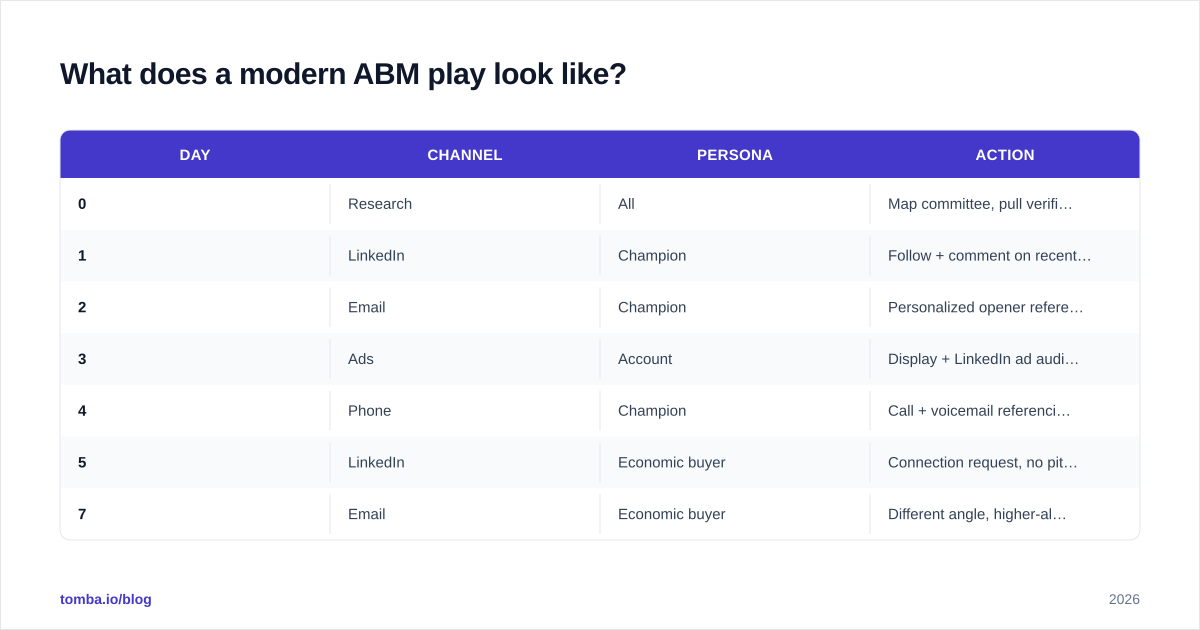
A play is a time-boxed sequence of touches against one account, triggered by a signal, coordinated across people and channels, and measured by an account-level outcome.
A canonical 21-day Tier 2 play might look like this:
| Day | Channel | Persona | Action |
|---|---|---|---|
| 0 | Research | All | Map committee, pull verified emails, note recent signals |
| 1 | Champion | Follow + comment on recent post | |
| 2 | Champion | Personalized opener referencing trigger signal | |
| 3 | Ads | Account | Display + LinkedIn ad audience activated |
| 4 | Phone | Champion | Call + voicemail referencing the email |
| 5 | Economic buyer | Connection request, no pitch | |
| 7 | Economic buyer | Different angle, higher-altitude problem | |
| 9 | Champion | Value-add asset (relevant case study) | |
| 11 | Phone | Economic buyer | Direct call to executive |
| 14 | LinkedIn voice note | Champion | 30-second personal message |
| 17 | User | Tactical, in-the-weeds pain point | |
| 19 | Direct mail | Economic buyer | Physical sendable, if Tier 1 |
| 21 | Multi-thread email | Champion + user + economic buyer | "I have reached out a few times…" wrap-up across committee |
The 21 days are not the point. The pattern is: every touch is justified by either a role or a signal, and the channels reinforce each other instead of operating in silos. When the economic buyer sees your ad on Monday, gets a LinkedIn ping on Tuesday, and a call on Wednesday, your brand starts looking like a category, not a vendor.
What signals should trigger ABM outreach?#
Signal-based plays beat calendar-based plays by 2-3x in reply rates. The trick is picking signals that actually correlate with buying intent.
Strong signals (run a play within 5 business days):
- New leadership hire in your buyer persona (CRO, VP Sales, VP Marketing, Head of RevOps)
- Funding round announced
- Tech stack change in your category (e.g. they just churned from a competitor)
- High-intent G2 / G-2 category page visit
- Job posting that mentions your category as a requirement
- M&A activity
- Earnings call mentions of priorities your product supports
Medium signals (queue for the next sprint):
- Content engagement (multiple pageviews on your site, podcast listens, webinar attendance)
- Champion job change to a new in-ICP company
- New office or geographic expansion
- Product launch in adjacent space
Weak signals (ignore unless stacked):
- Single page visit
- LinkedIn profile view
- Generic "open to opportunities" status
Buyer intent platforms (Bombora, G2, 6sense) sell the strong signals. You can layer free signals from LinkedIn Sales Navigator, Crunchbase, and job boards. The point is to act on signals within days, not weeks. A funding announcement is hot for 14 days, then it is just news.
How do you write ABM email copy that does not get ignored?#
The economic buyer reads two sentences before deciding whether to keep going. Write for those two sentences.
Three rules that move reply rates more than any other:
- Open with their world, not yours. Reference a signal, a quote from an interview, a recent hire, a job posting. Generic "I noticed your company is doing well" lines get archived in 0.4 seconds.
- One ask per email. "Worth a chat?" is fine. "Worth a chat, or would you prefer the deck, or should I loop in your team, or…" is not.
- Match altitude to seniority. The CRO reads about pipeline and retention. The Manager of Demand Gen reads about MQL quality and CPL. Same product, different pain.
For copy frameworks and pre-built starters, browse cold email templates and adapt them to your buyer's vocabulary instead of writing from scratch. Test subject lines against your domain reputation before you scale a sequence.
A simple Tier 2 opener that works:
Hi {first_name} — saw {company} posted a Director of {function} role last week. Usually when we see that hire in {industry}, the team is about to wrestle with {specific pain we solve}.
Mind if I send over how {peer company} cut {metric} by {%} after solving that?
It is six sentences, references a verifiable signal, names a peer, and asks for permission. That is the ABM opener template — fill in the variables.
What tech stack do you need to run ABM outreach?#
You can run a credible ABM program with five categories of tooling. Anything beyond that is usually duplicative.
| Category | Job to be done | Examples |
|---|---|---|
| Account & contact data | Find the committee, verify emails | Tomba,ZoomInfo, Apollo, Cognism |
| Intent & signals | Surface accounts in-market | Bombora, 6sense, G2, Demandbase |
| Sequencer / engagement | Run multi-channel cadences | Outreach, Salesloft, Instantly, Reply |
| Ads / orchestration | Coordinate display + social | LinkedIn Ads, Metadata, RollWorks |
| CRM + reporting | Pipeline of record, account engagement | Salesforce, HubSpot |
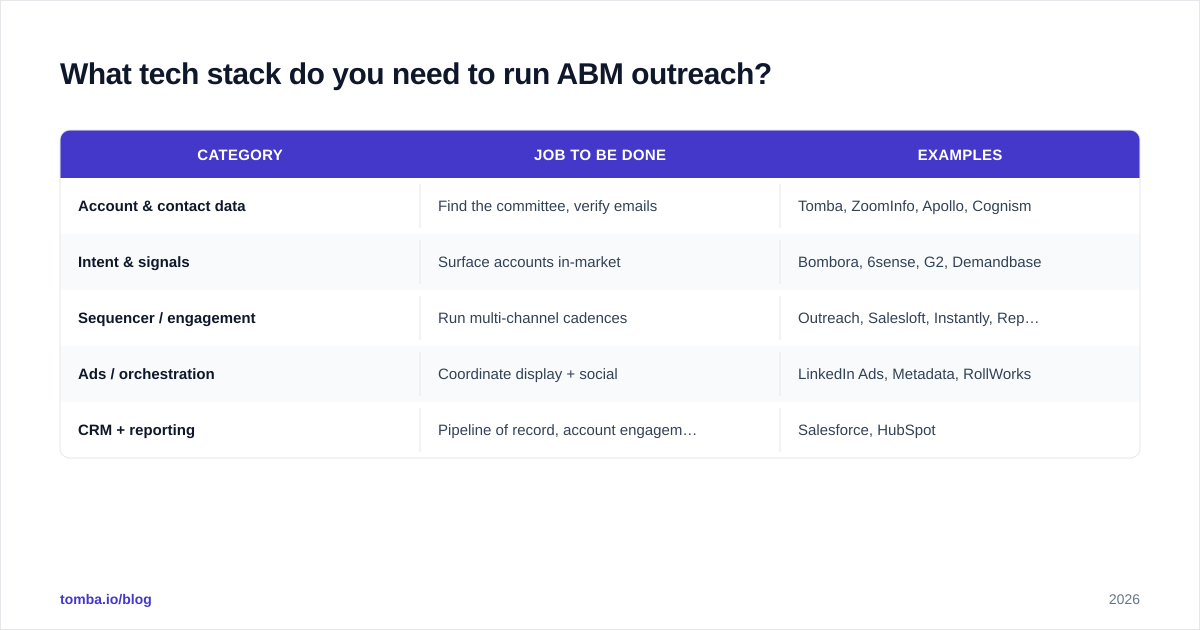
The orchestration layer is where most stacks break. If your SDR, AE, and marketer cannot see the same view of "what has happened to this account in the last 30 days," your plays will collide and your champions will get sequenced three times in a week. Either invest in a real ABM platform or build a Salesforce/HubSpot view that consolidates engagement across channels.
A pragmatic stack for a 5-person SDR team running 200 Tier 2 accounts: Tomba for find emails and committee discovery + an email verifier to keep bounce rates under 2% + a sequencer of choice + LinkedIn Ads + HubSpot. Total cost: roughly $2,500-4,000/month. That stack will outperform a $20,000/month "ABM suite" run badly.
How do you measure ABM outreach?#
Open rates and MQL counts are the wrong primary metrics. They reward volume and punish concentration — the opposite of what ABM is.
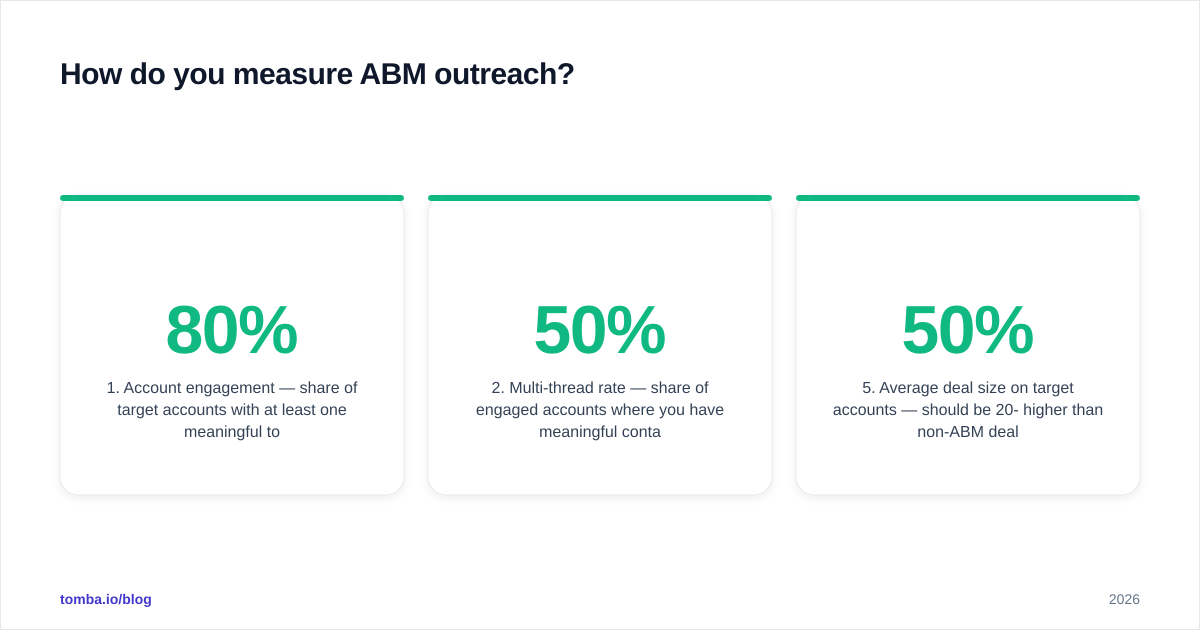
The metrics that matter, in order:
- Account engagement — share of target accounts with at least one meaningful touch in the last 30 days. Target: 80%+ for Tier 1, 60%+ for Tier 2.
- Multi-thread rate — share of engaged accounts where you have meaningful contact with 3+ committee members. Target: 50% of Tier 1, 25% of Tier 2.
- Pipeline coverage — pipeline created from target accounts as a multiple of quota. Target: 3-4x.
- Win rate on target accounts vs non-target — should be 1.5-2x higher within 6-9 months. If it is not, your ICP is wrong or your plays are weak.
- Average deal size on target accounts — should be 20-50% higher than non-ABM deals.
Vanity metrics to deprioritize: reply rate (a Tier 1 account that takes 14 touches to convert is more valuable than 20 cold replies), open rate (Apple Mail Privacy Protection broke this number anyway), and meeting count without a quality filter.
Reporting cadence: weekly account engagement review by tier, monthly pipeline coverage by segment, quarterly win-rate cohort analysis.
What are the most common ABM outreach mistakes?#
After watching dozens of programs, the failure patterns repeat:
- Rebranded cold email. Same blast, new name. No tiering, no committee, no orchestration. Stops working in week 4.
- No marketing partner. SDRs running solo without ad coverage and content support get 1/3 the meeting rate of coordinated plays.
- List bloat. "We have 2,000 Tier 1 accounts." No, you have a list you cannot serve. Cut it.
- Single-threading. Only emailing the champion. When the champion leaves, your deal dies.
- No signal layer. Cold-blasting your account list every Tuesday is not ABM, it is a sequence with a smaller TAM.
- Measuring like outbound. Reporting opens and replies to leadership, then wondering why ABM "is not working" when leadership cuts the budget.
- Skipping verification. Bouncing on your CFO's inbox kills domain reputation and burns the account. Run a catch-all verifier before sending into any Tier 1 account.
The diagnostic question is simple: if you removed the word "ABM" from your motion, would anything actually change? If not, you are running outbound with extra steps.
How long until ABM outreach produces pipeline?#
Be honest with leadership about the timeline. ABM is a 6-9 month investment, not a 30-day campaign.
- Months 1-2: stack setup, list build, signal feeds, baseline reporting. Expect minimal pipeline. Anyone selling "instant ABM results" is selling cold email.
- Months 3-4: first plays land. Account engagement metrics start moving. Pipeline begins.
- Months 5-6: multi-thread rate climbs, first ABM-sourced closed-won deals.
- Months 7-9: win-rate and deal-size lift becomes statistically meaningful. Program defends its budget.
- Months 10-12: optimization phase — kill weak plays, double down on strong signals, expand committee depth.
If quarterly reporting forces you into shorter cycles, run a small ABM pilot (25-50 accounts) inside an outbound team rather than reorging the whole motion. That way, you can demonstrate lift without putting the entire pipeline at risk.
Ready to run ABM outreach properly?#
You cannot run ABM without knowing who is on the committee. That starts with finding every verified email at your target accounts — not guessing patterns or scraping LinkedIn.
Tomba Email Finder pulls verified, deliverable emails for any company domain in seconds, so you can map a 5-7 person buying committee per account in a single afternoon. Free tier covers 25 searches per month, paid plans start at $49/mo on the Starter plan. Layer it with data enrichment to pull titles, LinkedIn URLs, and phone numbers for the same committee, and you are ready to run the plays in this post against your real account list — not a wishlist.
Start with 10 Tier 1 accounts this week. Map the committee. Pull the emails. Trigger the first play. The metrics will tell you within 60 days whether your motion is real ABM or rebranded outbound — and that is the only honest test.
// get started
Find, verify and enrich your first contacts today
Start on the free plan with 25 searches a month, then scale when your team is ready.
Free plan · No credit card required · GDPR & CCPA
// about the author