ABM Plays That Actually Close Revenue in 2026
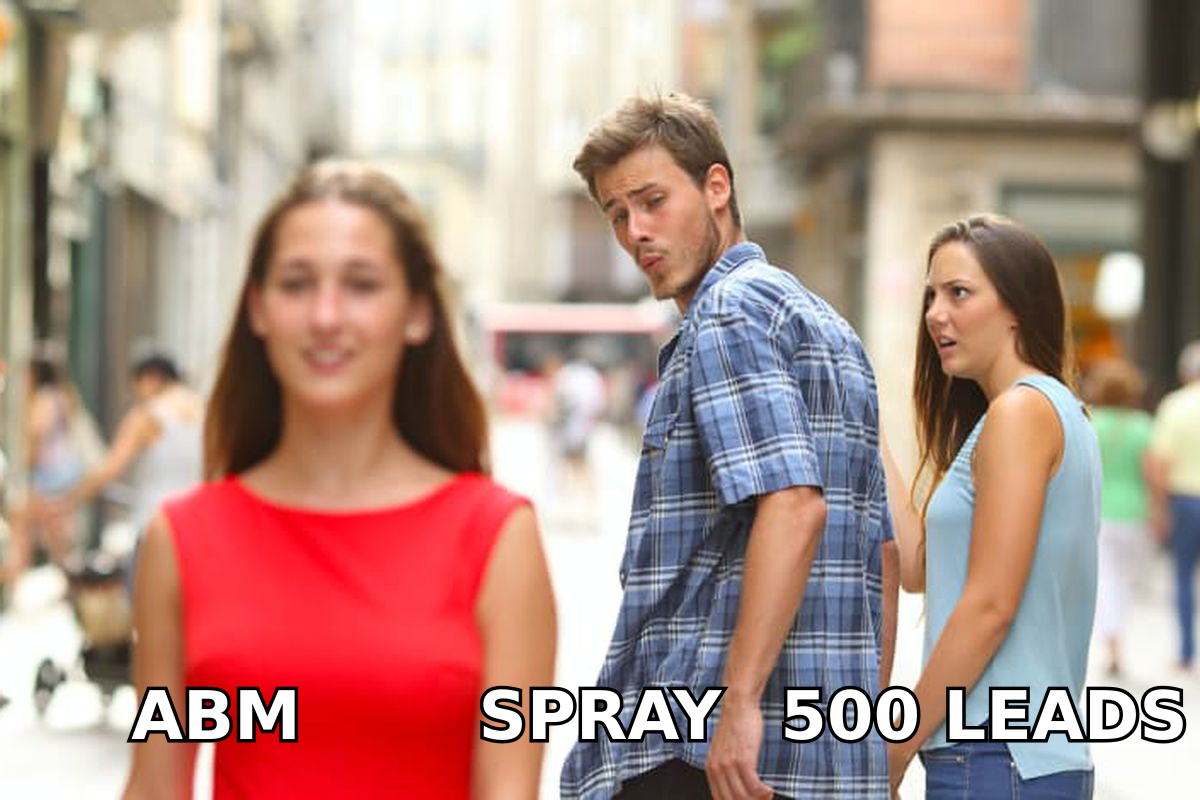
The ABM plays that move pipeline in 2026 are smaller, sharper, and built around intent signals — not 500-account lists. Here's the playbook.
TL;DR#
- ABM plays in 2026 are narrower than ever — the winning teams run 20-50 named accounts per rep, not 500.
- Intent signals (job changes, funding, hiring, tech installs) are the trigger, not the account list itself.
- Multi-threading 5-7 buyers per account beats a single executive sponsor every time.
- The best plays combine email, LinkedIn, ads, and direct mail in a 14-day choreographed sequence.
- Tooling matters less than discipline — clean data, tight ICP, and a shared scoreboard between sales and marketing.
Account-based marketing got a bad reputation between 2022 and 2024 because most teams ran it like volume outbound with extra steps. They bought a 5,000-account database, sprayed ads at the lot of them, and called it ABM. Reply rates fell. CAC climbed. Boards started asking hard questions.
The teams that survived rebuilt the motion from scratch. They cut their account lists by 80%, layered intent data on top, and started running discrete abm plays — repeatable sequences with clear triggers, clear plays, and clear exit criteria. This guide is the field manual for what works now.
What are ABM plays?#
An ABM play is a pre-built, multi-channel sequence triggered by a specific signal at a specific account, executed jointly by sales and marketing against a named set of buyers. Three things separate a play from generic outbound:
- The trigger is observable. A new CFO joins. A target hits 65% of their hiring cap on engineering. Your competitor's contract is up for renewal. The play fires because of the signal, not on a calendar cadence.
- The play is account-shaped, not contact-shaped. You're working 5-9 buyers inside one company in parallel. Messaging references the account's situation, not the contact's job title.
- It has a defined exit. After 14 or 21 days, the play either converts to opportunity, recycles to nurture, or kills the account. No infinite drip.
Compare that to traditional outbound, which is one-to-one, calendar-paced, and treats every prospect as an isolated unit. ABM treats the account as the unit of work.
Why do most ABM programs underperform?#
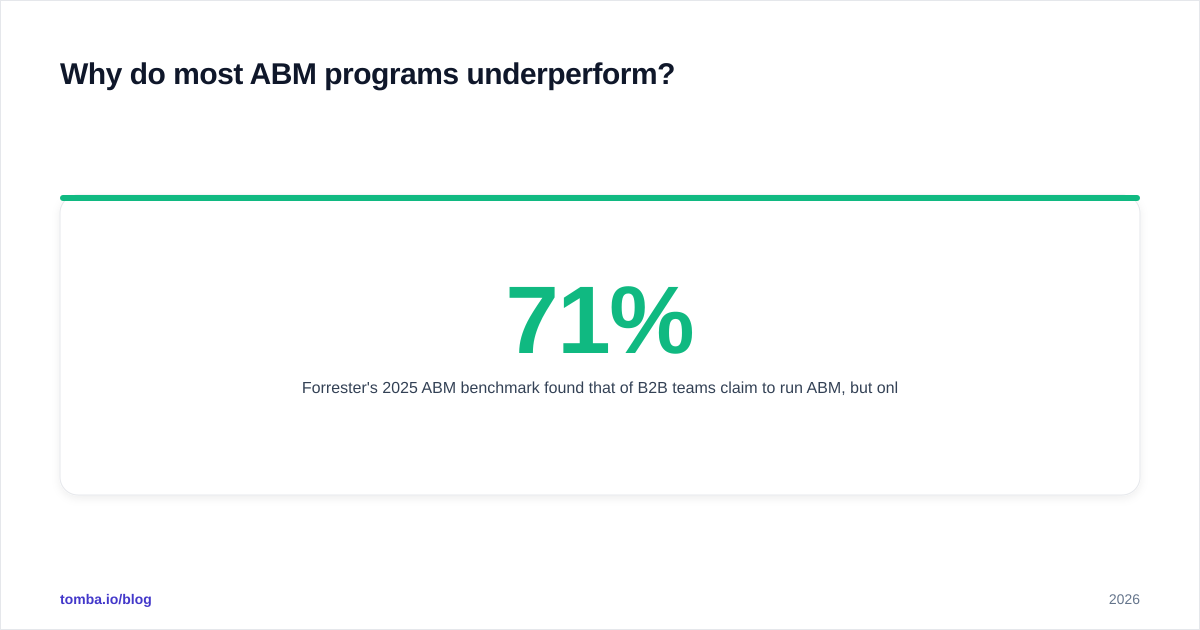
Forrester's 2025 ABM benchmark found that 71% of B2B teams claim to run ABM, but only 18% can point to closed revenue tied to specific plays. The other 53% are running rebranded outbound. The common failure modes:
- Account list bloat. A 1,200-account "tier 1" list is not ABM. That's a marketing database. Real tier-1 lists sit between 20 and 60 accounts per rep.
- No buyer mapping. Reps email a single VP and call the account "touched." A real ABM play touches 5-9 named people across champion, decision-maker, blocker, and end-user roles.
- Marketing and sales running parallel timelines. Marketing launches a display campaign in January, sales starts calling in April. By then the campaign has cooled.
- Generic content. A whitepaper about "digital transformation" is not an ABM asset. A one-pager referencing the target's specific tech stack, recent earnings call, or competitor switch is.
- No exit criteria. Plays run forever. Nobody kills bad accounts.
The fix is structural, not tactical. You need fewer accounts, more buyer coverage per account, and a calendar where marketing and sales fire in lockstep.
Which ABM plays actually work in 2026?#
Here are the seven plays that consistently produce pipeline for B2B teams running ABM correctly. Mix and match — most teams run 3-4 in rotation depending on which triggers fire.
Play 1: The new executive welcome#
Trigger: A target persona joins or gets promoted at a tier-1 account (VP+ in the buying committee). Window: First 60 days in role. Why it works: New executives have a 90-day mandate to make changes. Their tolerance for taking meetings is roughly 3x higher than tenured execs. The play:
- Day 1: Personalized congratulations email referencing their prior employer and a specific challenge they likely inherited.
- Day 3: LinkedIn connection request from your CEO or VP Sales.
- Day 5: Send a curated 5-page brief on their new industry to their office.
- Day 10: Marketing serves them and 4 peers display ads featuring a peer customer.
- Day 14: AE sends a meeting request with two specific time slots.
Play 2: The intent surge#
Trigger: An account spikes on intent topics (Bombora, G2, 6sense, or your own first-party data shows 3+ buyers researching your category in a 14-day window). Window: 21 days from signal detection. The play: Coordinated outreach to 5-7 buyers within the surging department, plus retargeting ads with a category-defining piece of content. The email opens with the specific topics they researched — not "I noticed you're interested in our space."
Play 3: Competitor displacement#
Trigger: Public signal that the account is unhappy with an incumbent — contract end-of-life, public Twitter complaint, a job posting that asks for your competitor's tool replacement skills. The play: A teardown of the incumbent's known weaknesses (with sources), a customer case study of someone who switched from the same incumbent, and a no-strings migration consult offer. Run this play with a SDR + AE pair, not a single rep.
Play 4: The funding follow-up#
Trigger: Series B or later funding round closes. Why it works: Newly funded companies hire fast and consolidate tooling within 90 days of close. The play: Hit the new CFO, new VP of operations, and any new VP of revenue with a play that maps the typical Series B operational rebuild — and where you fit in it.
Play 5: The technographic switch#
Trigger: The account installs or removes a complementary technology (BuiltWith, Wappalyzer, or HG Insights catches the change). The play: Reach out within 7 days referencing the install. Salespeople hate this play because it feels intrusive — but reply rates run 3-4x normal cold outbound when the signal is fresh.
Play 6: The dormant champion#
Trigger: A former buyer of yours changes jobs to a target account. The play: Welcome message + a tailored business case for bringing your product into their new company. This is the single highest-conversion play in most B2B portfolios. Track it religiously.
Play 7: The event surround#
Trigger: Your target account registers for a tier-1 industry event you're also attending. The play: Pre-event outreach with a curated session list, on-site meeting invite with calendar link, post-event recap with insights from sessions they attended. Skip the booth pitch.
How do these ABM plays compare on cost and lift?#
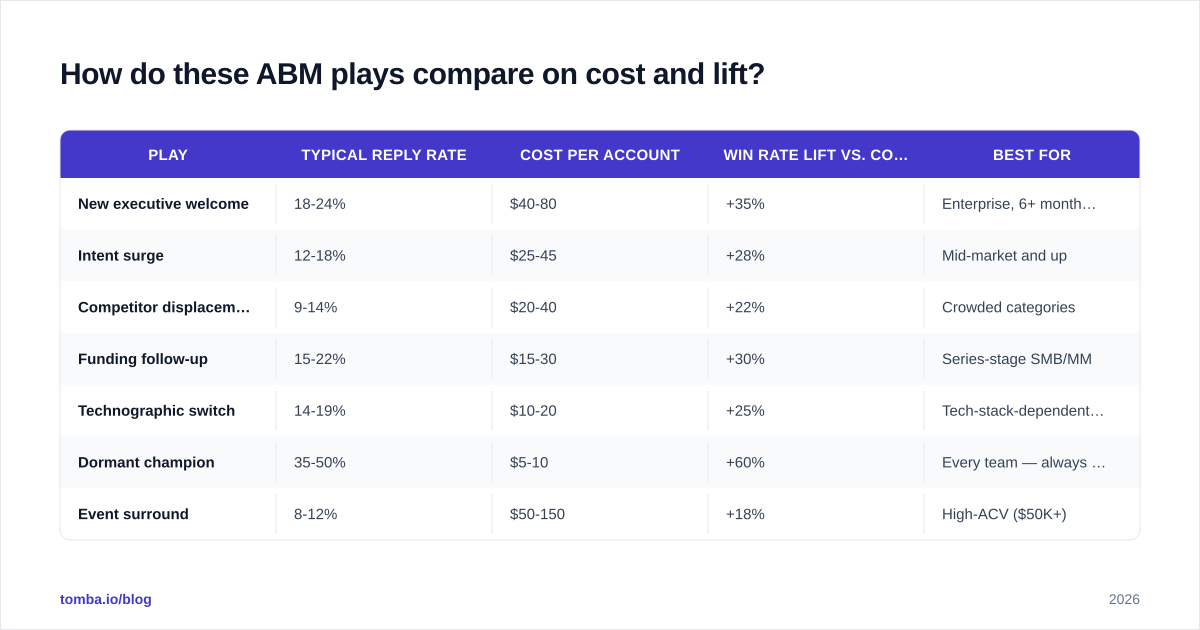
Each play has a different cost-to-revenue profile. Pick the ones that match your stage and budget.
| Play | Typical reply rate | Cost per account | Win rate lift vs. cold | Best for |
|---|---|---|---|---|
| New executive welcome | 18-24% | $40-80 | +35% | Enterprise, 6+ month cycles |
| Intent surge | 12-18% | $25-45 | +28% | Mid-market and up |
| Competitor displacement | 9-14% | $20-40 | +22% | Crowded categories |
| Funding follow-up | 15-22% | $15-30 | +30% | Series-stage SMB/MM |
| Technographic switch | 14-19% | $10-20 | +25% | Tech-stack-dependent products |
| Dormant champion | 35-50% | $5-10 | +60% | Every team — always run this |
| Event surround | 8-12% | $50-150 | +18% | High-ACV ($50K+) |
The cost numbers exclude tooling subscriptions and rep time — they reflect direct campaign costs (gifts, ads, mail). Win-rate lift is measured against the same accounts approached via standard cold outreach in your CRM.
What's the right ABM tech stack in 2026?#
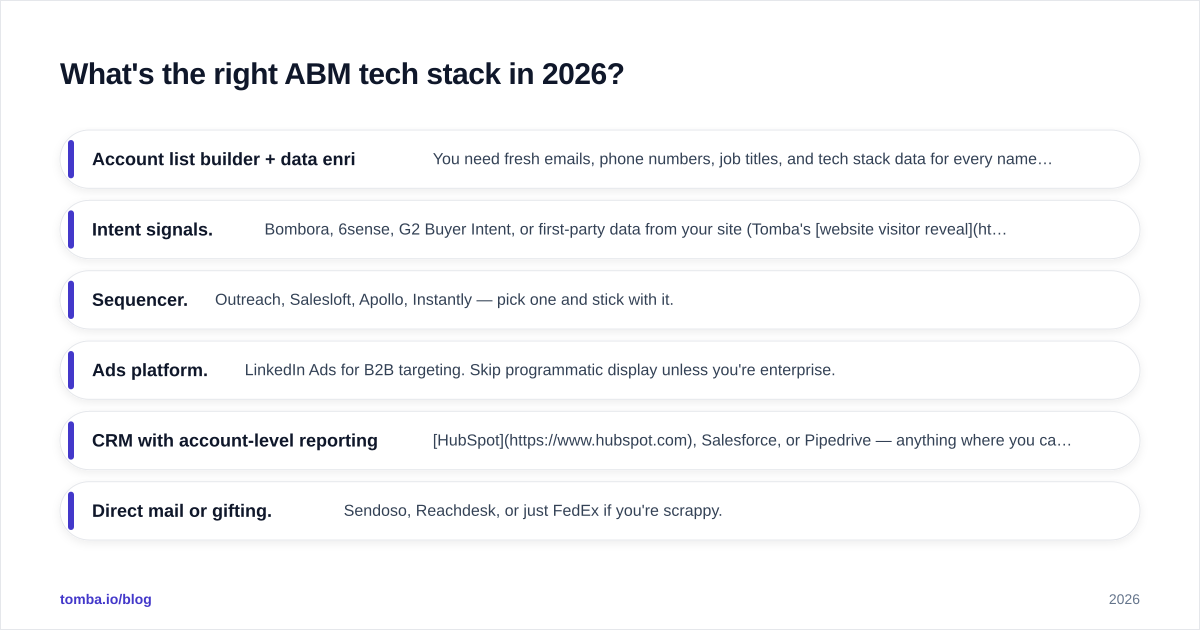
The stack matters less than people pretend. You can run great ABM with a CRM, an email tool, an intent provider, and a spreadsheet. The categories you actually need:
- Account list builder + data enrichment. You need fresh emails, phone numbers, job titles, and tech stack data for every named buyer at every account. This is where most plays die — bad data means bad sequences. A purpose-built email finder plus contact enrichment covers this for most teams without paying for a heavyweight platform.
- Intent signals. Bombora, 6sense, G2 Buyer Intent, or first-party data from your site (Tomba's website visitor reveal catches anonymous companies on your pricing page).
- Sequencer. Outreach, Salesloft, Apollo, Instantly — pick one and stick with it.
- Ads platform. LinkedIn Ads for B2B targeting. Skip programmatic display unless you're enterprise.
- CRM with account-level reporting. HubSpot, Salesforce, or Pipedrive — anything where you can roll up activity by account, not just contact.
- Direct mail or gifting. Sendoso, Reachdesk, or just FedEx if you're scrappy.
What you don't need: a dedicated "ABM platform" charging $80K/year. Those products bundle the above into one UI, but most teams get 80% of the value by stitching together best-of-breed tools and a clean B2B database.
How do you build the account list?#
Three concentric rings:
- Tier 1 (20-50 accounts per rep). These get every play, every quarter. Picked by hand by the AE and approved by sales leadership. Must match strict ICP fit and show buying readiness.
- Tier 2 (100-200 accounts per rep). Get one or two plays per quarter, mostly marketing-led with light sales touch.
- Tier 3 (the rest of ICP). Get scaled outbound, not ABM. Don't confuse the two.
For tier 1, the qualification framework most teams use is some variant of: Fit + Intent + Reachability.
- Fit: matches your ICP firmographics (employee count, industry, geo, tech stack).
- Intent: shows current buying signals (job posts, intent data, leadership change, funding event).
- Reachability: you can map 5+ named buyers with verified contact info.
If you can't tick all three, the account doesn't deserve a play.
How do marketing and sales coordinate the plays?#
This is where 90% of ABM programs break. The fix is a weekly account review with three artifacts:
- A shared account dashboard. Activity per account, by channel, with engagement score. Both teams see the same data.
- A play calendar. Marketing campaigns and sales sequences plotted on the same timeline. Marketing fires ads 7-10 days before sales reaches out, not the same day.
- An account scoreboard. Each tier-1 account has a target outcome (meeting booked, opportunity created, deal closed) and a quarterly checkpoint.
The weekly meeting reviews accounts that engaged, accounts that didn't, and what changes for the next two weeks. Twenty minutes max. Anything longer becomes theater.
How do you measure ABM play performance?#
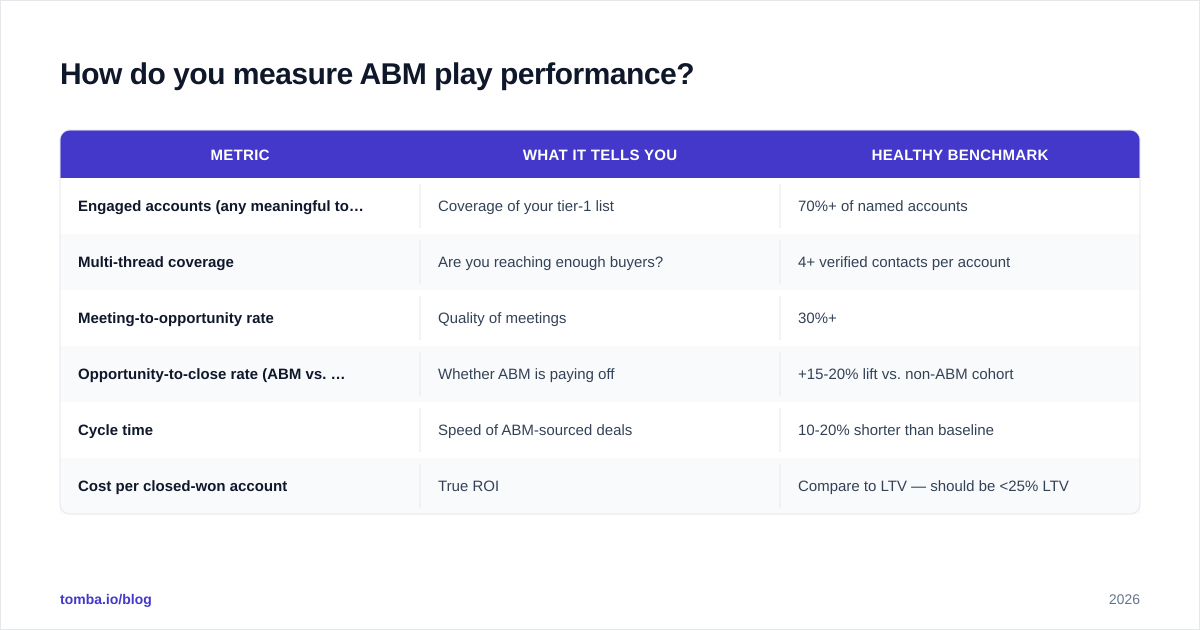
Vanity metrics will lie to you. Track these instead:
| Metric | What it tells you | Healthy benchmark |
|---|---|---|
| Engaged accounts (any meaningful touch in last 30 days) | Coverage of your tier-1 list | 70%+ of named accounts |
| Multi-thread coverage | Are you reaching enough buyers? | 4+ verified contacts per account |
| Meeting-to-opportunity rate | Quality of meetings | 30%+ |
| Opportunity-to-close rate (ABM vs. inbound) | Whether ABM is paying off | +15-20% lift vs. non-ABM cohort |
| Cycle time | Speed of ABM-sourced deals | 10-20% shorter than baseline |
| Cost per closed-won account | True ROI | Compare to LTV — should be <25% LTV |
Skip MQLs entirely. ABM doesn't run on lead counts. It runs on accounts moved from awareness to opportunity to closed-won. If your dashboard still leads with "leads generated," you're measuring the wrong motion. Read our revenue operations primer if your reporting still defaults to lead-level views.
What tools do you need to find the buyers?#
Once your account list is set, you need verified contacts for 5-9 buyers per account. This is the unsexy part that determines whether the play actually fires.
The minimum viable stack to build buyer lists:
- A domain search to pull every public email at a target company.
- An email verifier to scrub the list before you send (cold outreach with 3%+ bounce rate kills sender reputation).
- A LinkedIn finder to enrich job titles, seniority, and current role tenure.
- A phone finder for the multi-channel plays (executive welcome, competitor displacement).
You can string these together from individual tools or run them through a single API. Most teams running ABM at scale automate this with a CRM trigger: "when an account moves to tier 1, enrich the buying committee." If you'd rather skip the platform tax, see our breakdown of Apollo alternatives and LeadIQ alternatives for cheaper ways to source the same data.
Common ABM play mistakes to avoid#
- Over-personalizing. A 90-second voice note referencing the prospect's third-grade soccer team is creepy, not relevant. Reference business context — funding, hiring, public commentary — not personal data.
- Sending the same play to every account. Tier-1 accounts deserve custom adjustments. Copy-pasting the new-exec play to 50 accounts dilutes it.
- Forgetting to kill accounts. If a tier-1 account doesn't engage after 60 days of full-court press, demote it. Don't keep grinding.
- Confusing engagement with intent. Ad impressions and webinar attendance are weak signals. A reply from a VP saying "send me your pricing" is a strong one. Don't mistake the first for the second.
- No quarterback. Every account needs a single owner — usually the AE — who decides what fires next. Without an owner, plays stall.
How do you scale ABM plays without losing personalization?#
The trick is to standardize the play structure but customize the inputs. Build templates with five or six variable inserts — company name, recent trigger event, named competitor, specific peer customer, business pain — and pull those variables programmatically from your enriched account data. Tools like Clay and similar workflow builders are popular for this, but a simple bulk email finder wired into your sequencer covers 80% of the use case without the steep learning curve.
A two-person ABM team with clean data can run 200 well-personalized plays per quarter. A ten-person team with bad data runs 200 bad plays per quarter and burns its domain reputation. People often blame their tooling when the real bottleneck is data quality.
Final word — and where to start#
If you take one thing from this guide: the difference between great ABM and bad ABM is not budget, software, or headcount. It's the discipline to keep the account list small, the buyer coverage deep, and the trigger-to-touch window short.
Pick two plays from this list — start with the dormant champion play and the intent surge — and run them for one quarter against 25 named accounts. Measure ruthlessly. Most teams see a 2-3x lift on meeting rate within 90 days when they execute this narrowly instead of broadly.
To run any of these plays, you need verified, accurate contact data for 5-9 buyers at every named account. Tomba's Email Finder gives you verified business emails by domain, name, or company — with a free tier of 25 searches per month, and paid plans starting at $49/mo on the Starter tier. Pair it with domain search to map every buyer at a target account in seconds, and you have the data layer your ABM plays need to actually fire. Start with the free tier, build your tier-1 list, and run your first play this week.
// get started
Find, verify and enrich your first contacts today
Start on the free plan with 25 searches a month, then scale when your team is ready.
Free plan · No credit card required · GDPR & CCPA
// about the author