Abstract API vs BookYourData 2026: Which Wins for B2B Email Data?
Abstract API ships developer-first verification endpoints. BookYourData sells pay-as-you-go B2B lists. Here is which one fits your stack in 2026.
TL;DR#
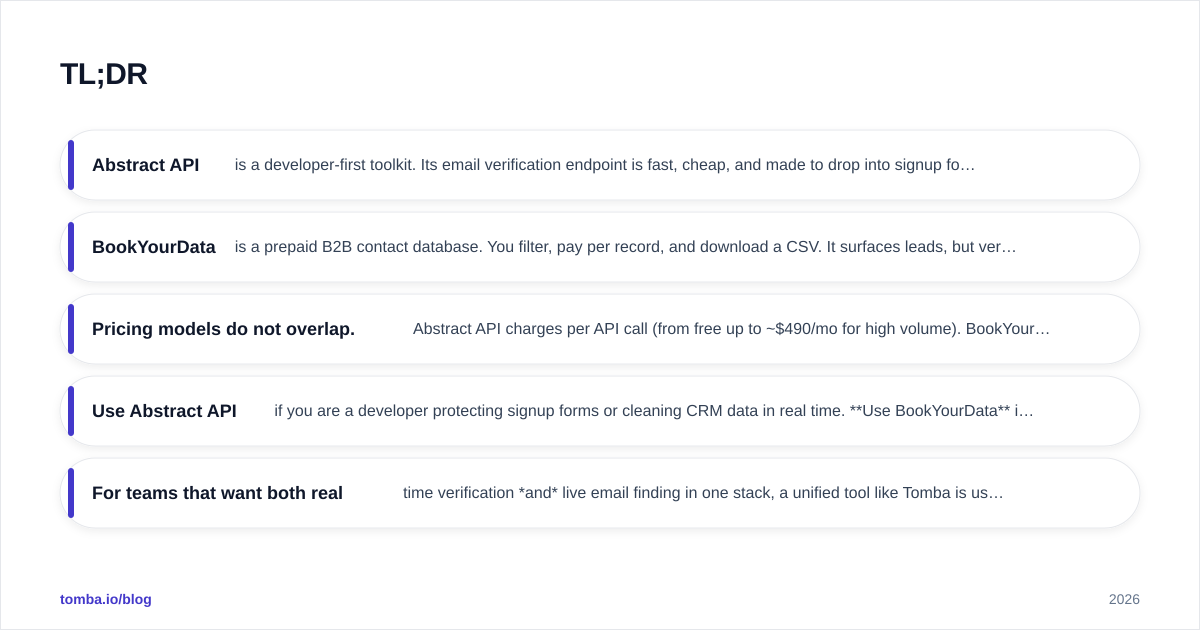
- Abstract API is a developer-first toolkit. Its email verification endpoint is fast, cheap, and made to drop into signup forms and CRMs, but it does not find new contacts for you.
- BookYourData is a prepaid B2B contact database. You filter, pay per record, and download a CSV. It surfaces leads, but verification is a one-time snapshot.
- Pricing models do not overlap. Abstract API charges per API call (from free up to ~$490/mo for high volume). BookYourData charges per downloaded contact (credits from roughly $99 for 1,000 leads).
- Use Abstract API if you are a developer protecting signup forms or cleaning CRM data in real time. Use BookYourData if you need a static, downloadable prospect list and do not want a subscription.
- For teams that want both real-time verification and live email finding in one stack, a unified tool like Tomba is usually the cleaner pick.
What is Abstract API?#
Abstract API is a collection of REST APIs for developers. It launched as a single email verification endpoint and now covers phone validation, IP geolocation, exchange rates, and a dozen other utility calls. Each product is a separate API key, separate pricing, and separate quota.
The email verification API is the one that competes with BookYourData. It checks syntax, MX records, SMTP responses, role addresses, and disposable domains, then returns a deliverability score in under a second. Documentation is on abstractapi.com and the pricing page lists six tiers from a free 100-request quota up to ~250,000 requests per month.
What Abstract API does not do: it does not give you a database of contacts. There is no "find me sales VPs at SaaS companies in Berlin" call. You bring the email, Abstract tells you if it is valid.
What is BookYourData?#
BookYourData is a B2B contact database that sells leads on a prepaid credit model. You log in, build a filter (industry, title, location, company size, tech stack), and the platform shows you a count of matching contacts. Buy credits, export the CSV, and the data is yours forever — no recurring subscription required.
Their claim is 100% email accuracy at the moment of download, backed by a refund policy on bounces above their threshold. The catalog covers about 250 million records globally, though the freshness varies sharply by region and seniority.
What BookYourData does not do: it is not an API. There is no real-time SMTP check you can call from your signup form. The verification happens before they sell you the record, not the instant your user types an email.
How do Abstract API and BookYourData compare on pricing?#
This is where the comparison gets awkward, because the two pricing models are built for different jobs.
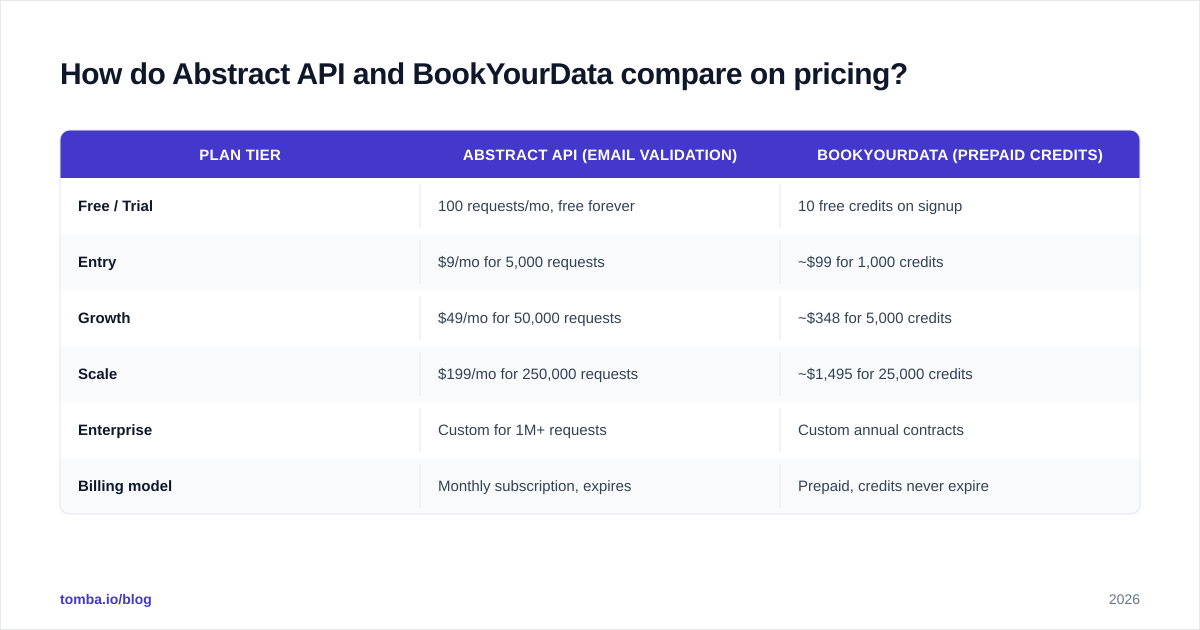
| Plan tier | Abstract API (Email Validation) | BookYourData (Prepaid Credits) |
|---|---|---|
| Free / Trial | 100 requests/mo, free forever | 10 free credits on signup |
| Entry | $9/mo for 5,000 requests | ~$99 for 1,000 credits |
| Growth | $49/mo for 50,000 requests | ~$348 for 5,000 credits |
| Scale | $199/mo for 250,000 requests | ~$1,495 for 25,000 credits |
| Enterprise | Custom for 1M+ requests | Custom annual contracts |
| Billing model | Monthly subscription, expires | Prepaid, credits never expire |
Abstract API is cheaper per call, but you are paying for a check — not a contact. BookYourData costs more per record because each record is a net-new lead with name, email, phone, title, and company firmographics attached.
If you only need verification, Abstract is the cost winner by an order of magnitude. If you need leads to verify in the first place, BookYourData is doing a different job entirely.
Is Abstract API more accurate than BookYourData?#
Accuracy questions hinge on what you are measuring.
For real-time verification accuracy — does this email bounce? — Abstract API performs in the 95-97% range on public benchmarks. It catches catch-all domains, role accounts, and disposables reliably. Its weakness is the same as every API verifier: providers like Microsoft 365 increasingly throttle or accept-all SMTP probes, so a "valid" response on a corporate tenant is sometimes a "we cannot tell."
For database accuracy — is the email in the record actually still in use? — BookYourData publishes a 95%+ deliverability guarantee with bounce refunds. In practice, that holds well for US tech and finance contacts but drops noticeably for EMEA, APAC, and operational roles with high turnover. Snapshot databases age fast: a record verified in January can churn by March.
A pragmatic rule: even if you buy a "verified" list from BookYourData, you should re-verify before any cold campaign. That re-verification is exactly what Abstract API (or a email verifier) does. The two tools are complementary, not interchangeable.

Which one fits a developer workflow?#
Abstract API was built for developers. The docs are clean, the SDK list covers Node, Python, PHP, Ruby, Java, .NET, and Go, and the response payload is a flat JSON object you can shove into any backend. Rate limits are generous on the higher plans, latency is sub-second, and the error model is standard HTTP. If your job is "stop fake signups," you can ship integration in an afternoon.
BookYourData has no public API in the same league. You filter in the web UI, download a CSV, and import it into your CRM, sequencer, or warehouse. That works fine for one-off list buys, but it is friction for any system that needs continuous data flow. If your roadmap includes anything like "enrich every new MQL automatically," BookYourData becomes a manual step.
What about coverage and data freshness?#
Coverage depends on whether you mean "how many contacts can I get" or "how many emails can I check."
For verification volume, Abstract API will validate anything you throw at it — there is no contact catalog limit, only a request quota. You could verify 100% of your CRM in a weekend at the Growth tier.
For contact volume, BookYourData lists roughly 250M records, weighted toward US-headquartered companies and traditional functional roles (sales, marketing, engineering, finance). Niche industries and recent job changes are weak spots. Compared to deeper databases like ZoomInfo or Apollo, the BookYourData catalog is mid-tier in size but cleaner per dollar because of the prepaid model.
Freshness is the bigger question. BookYourData refreshes data on a rolling cadence, but you are buying a snapshot. By contrast, a live email finder that hits SMTP and public sources at query time will reflect today's reality, not last month's.
Pros and cons at a glance#
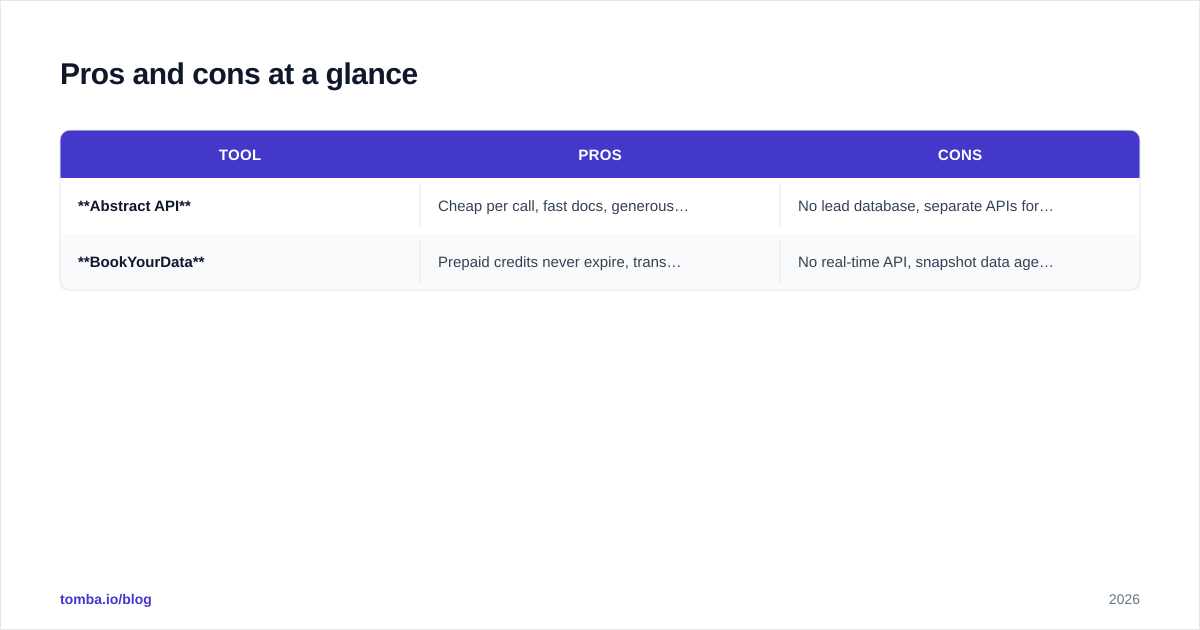
| Tool | Pros | Cons |
|---|---|---|
| Abstract API | Cheap per call, fast docs, generous free tier, multi-language SDKs, low-latency real-time checks | No lead database, separate APIs for separate jobs, subscription expires unused quota |
| BookYourData | Prepaid credits never expire, transparent per-record pricing, downloadable CSVs, decent US coverage, bounce refunds | No real-time API, snapshot data ages, weaker EMEA/APAC coverage, no enrichment workflows |
When should you pick Abstract API?#
Abstract API is the right call when:
- You are a developer or platform team trying to keep junk emails out of signup forms.
- You already have contacts (in your CRM, in a warehouse, from a form) and just need to know if they bounce.
- Your job is fraud reduction, signup quality, or list hygiene at scale.
- You need an API call that returns JSON in under a second from any backend.
Pair it with a real lead source. Abstract on its own will not generate pipeline.
When should you pick BookYourData?#
BookYourData fits if:
- You need a one-time prospect list and refuse to sign up for another monthly tool.
- Your ICP is US-heavy and lives in standard B2B functions (sales, marketing, ops, finance).
- You want to own the data outright with no recurring fee.
- Manual CSV-to-CRM imports are acceptable in your workflow.
It is a poor fit for continuous enrichment, real-time form validation, or any pipeline that runs unattended.
How does a unified tool change the math?#
The Abstract-vs-BookYourData framing assumes you have to pick one. Most modern GTM teams buy both shapes — a verifier and a finder — and end up juggling two contracts, two billing cycles, and two data conventions.
A unified B2B database with both real-time finding and verification collapses that stack. Tomba, for instance, exposes a finder, a verifier, a domain search, a bulk email finder, and enrichment under one API and one credit pool. You can verify a signup with one endpoint and discover the CEO's email at the same domain with the next.
That does not make Abstract or BookYourData wrong. Abstract still wins on per-call verification cost. BookYourData still wins if you genuinely want to pay once and never see another invoice. But for teams that need both jobs done — and want to avoid the integration tax — unified pricing usually beats split tooling.

How accurate is "100% verified" really?#
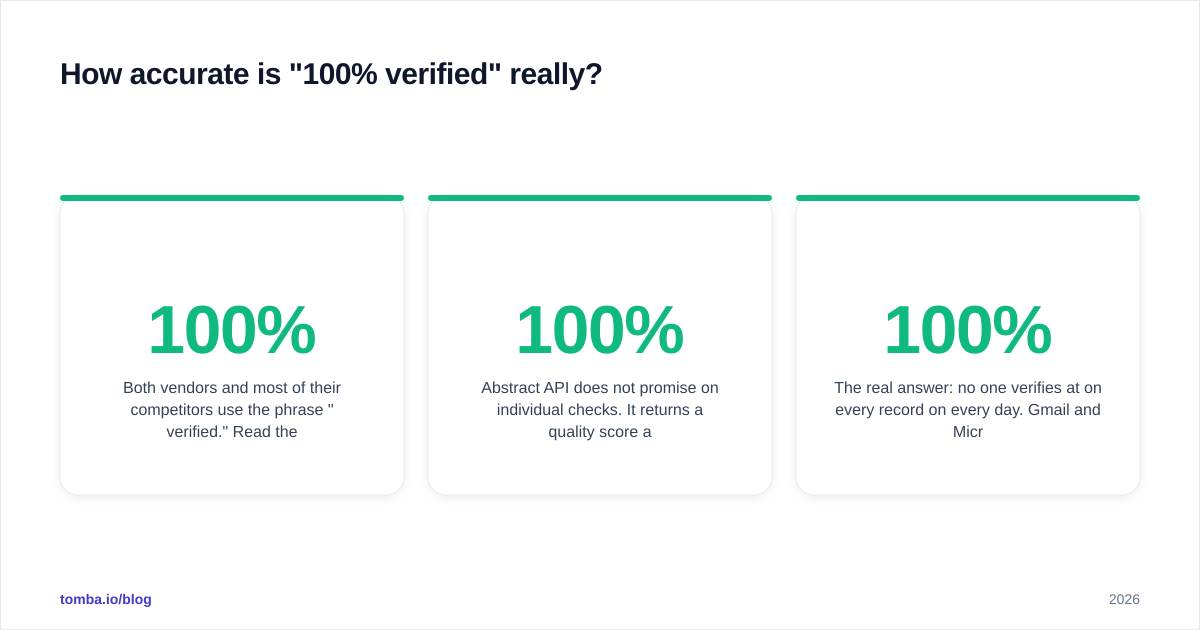
Both vendors and most of their competitors use the phrase "100% verified." Read the fine print.
BookYourData backs it with a bounce-rate refund — if a list bounces above a threshold, you get credits back. That is a meaningful guarantee, but it is reactive: you find out the data was stale after the campaign ran.
Abstract API does not promise 100% on individual checks. It returns a quality score and lets you set your own deliverability threshold. Honest, and arguably more useful in production code.
The real answer: no one verifies at 100% on every record on every day. Gmail and Microsoft 365 increasingly hide SMTP signal. The best you can do is verify close to send time (which is the API model) or re-verify a downloaded list immediately after purchase (which most BookYourData buyers do, often with a tool like Abstract).
For a deeper dive on the verification side of this question, the G2 verification category lists most of the credible vendors and their published accuracy claims.
What about alternatives to both?#
If neither one fits cleanly, the field has serious alternatives worth a look:
- For verification: ZeroBounce, NeverBounce, Tomba's verifier, and Bouncer all play in the same lane as Abstract API. Tomba's verifier and the free email checker are often cheaper at mid-volume.
- For prepaid lists: Apollo, Lusha, RocketReach, and Cognism cover similar ground to BookYourData, usually with subscription pricing instead of prepaid credits. See the Apollo alternatives breakdown for context.
- For unified finding + verification: Tomba and Hunter both bundle the two jobs into one credit pool and one API.
The right choice depends on whether your team wants a single tool that does both jobs at decent depth, or two specialists.
What is the bottom line on Abstract API vs BookYourData?#
They are not really competitors. Abstract API verifies emails you already have. BookYourData sells you emails you do not have yet. The question is not "which one is better," it is "which job am I trying to do today."
Pick Abstract API for real-time, code-driven verification at high volume. Pick BookYourData for one-off, prepaid prospect lists with no subscription. Pick a unified platform if you need both jobs done without managing two vendors.
Ready to consolidate your stack?#
If you have been running an Abstract-style verifier alongside a BookYourData-style list buy, you are paying twice for what should be one workflow. Tomba Email Finder unifies real-time email finding, verification, domain search, and enrichment under one API and one set of credits — no separate contracts, no CSV juggling, and live data instead of a snapshot. Start free with 25 searches per month, and see Tomba pricing if you want to scale beyond that.
Ready to find emails that actually work?
Join 150,000+ professionals who stopped guessing and started sending. Free credits on signup — no credit card required.
Get the Tomba newsletter
Practical outbound tactics and product updates — once every two weeks.
About the author