Abstract API vs Warpleads: Which Email Finder Wins in 2026?
Abstract API and Warpleads target different buyers. One is a developer-first validation API, the other is a bulk B2B lead exporter. Here's the honest 2026 breakdown.
Abstract API vs Warpleads: Which Email Finder Wins in 2026?
TL;DR
- Abstract API is a developer-first email validation API — strong at SMTP checks, syntax scoring, and disposable detection, weak at actually finding leads.
- Warpleads is a bulk B2B lead exporter — its strength is exporting CSVs of unlimited contacts on a flat fee, not surgical single-lookup accuracy.
- These tools solve different problems. Comparing them head-to-head only makes sense if you're trying to decide between "validate emails I already have" and "find new ones in bulk."
- On verified deliverability, Abstract API wins; on lead volume per dollar, Warpleads wins; on both at once, neither is class-leading.
- If you want a single platform that does find + verify + enrich without juggling two vendors, Tomba outperforms both at $49/mo starter pricing.
What does Abstract API actually do?#
Abstract API isn't one tool — it's a suite of REST APIs covering IP geolocation, currency conversion, VAT validation, and yes, email verification. The email validation API is the relevant SKU here. You POST an email address, and Abstract returns a JSON object with:
- Syntax validity
- Disposable domain flag (mailinator, guerrillamail, etc.)
- Free provider flag (gmail, yahoo)
- Role address flag (info@, support@)
- MX record presence
- SMTP ping result
- A quality score from 0.01 to 0.99
It's clean, fast, and the documentation is genuinely good. Developers like it because the response shape is predictable and the free tier (100 requests/month) makes it easy to prototype.
What Abstract API does not do: find emails. It does not take a name + domain and return an address. It does not crawl LinkedIn. It does not enrich a record with job title, company size, or phone number. If you arrive at Abstract with no email list, you leave with no email list.
What does Warpleads actually do?#
Warpleads sits at the opposite end of the funnel. It's a bulk lead database that markets itself on one promise: unlimited exports for a flat monthly fee. You filter by job title, industry, location, company size, and tech stack, then export the result as CSV. Pricing tiers gate how many filters and how often you can export, not how many contacts.
The database is sourced from a mix of scraped public profiles, partner data, and OSINT. Quality is uneven. Some segments (US-based SaaS sales leaders, for instance) are dense and reasonably current; others (European mid-market HR, Asian manufacturing) are thin or stale. Warpleads does not provide an SMTP verification step by default — verification happens on a separate credits pool or via integration with third-party verifiers.
Where Warpleads wins is cost per lead when your campaigns can absorb a 15-25% bounce rate or when you plan to re-verify the export externally before sending.
Abstract API vs Warpleads — side-by-side comparison#
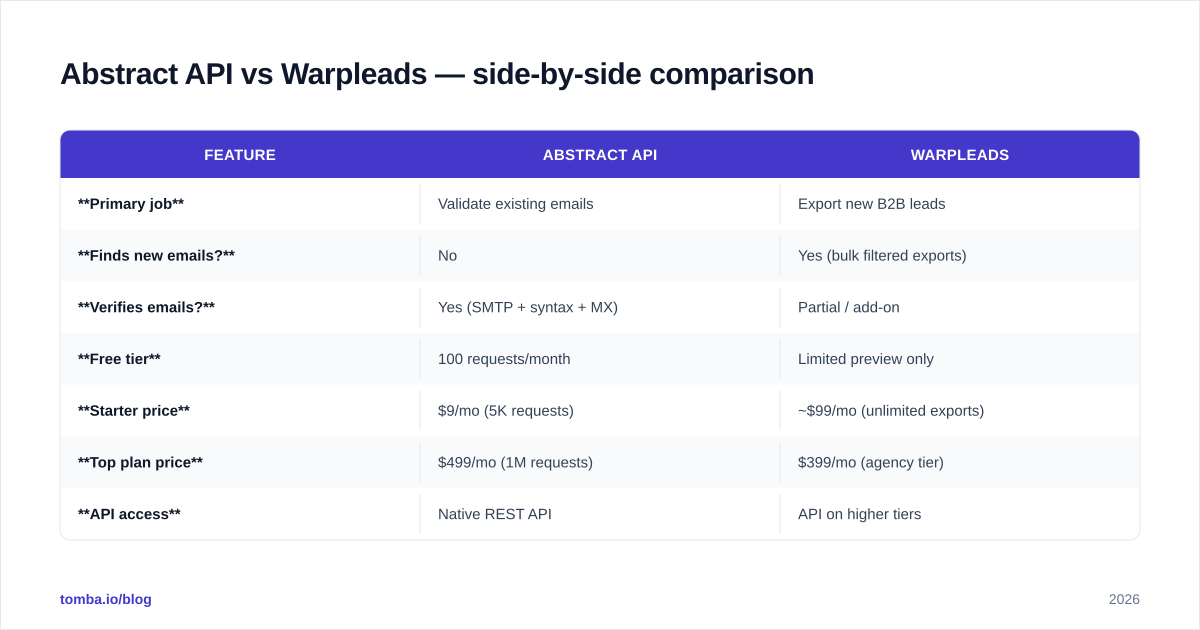
| Feature | Abstract API | Warpleads |
|---|---|---|
| Primary job | Validate existing emails | Export new B2B leads |
| Finds new emails? | No | Yes (bulk filtered exports) |
| Verifies emails? | Yes (SMTP + syntax + MX) | Partial / add-on |
| Free tier | 100 requests/month | Limited preview only |
| Starter price | $9/mo (5K requests) | ~$99/mo (unlimited exports) |
| Top plan price | $499/mo (1M requests) | $399/mo (agency tier) |
| API access | Native REST API | API on higher tiers |
| Enrichment data | None | Job title, industry, company size |
| Phone numbers | No | On some plans |
| CRM push | ViaZapier | Via CSV / Zapier |
| Best for | Form validation, signup hygiene | Cold email list-building |
| Worst for | Building new lists | Single-target precision |
How accurate is each one in 2026?#
Accuracy is a loaded word here because the two tools measure different things.
Abstract API's accuracy is measured on its validation verdict — when it says an address is deliverable, is it? Independent benchmarks have placed Abstract API in the 90-94% range for SMTP catch on non-catch-all domains. That's solid but a notch below specialists like
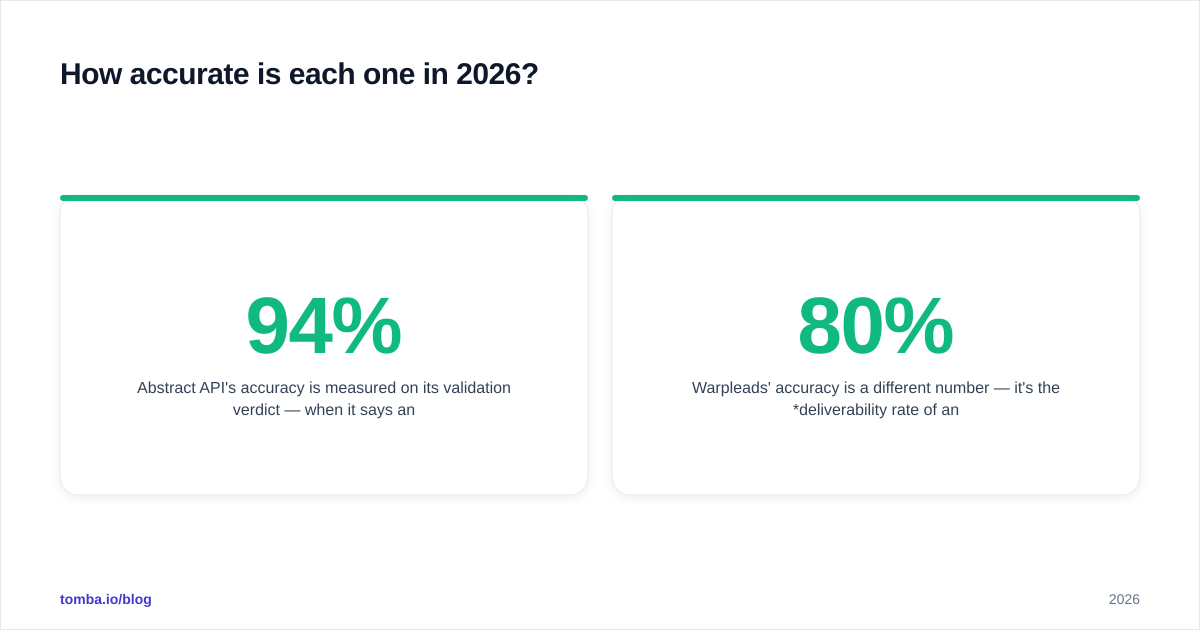
ZeroBounce or Tomba's email verifier, which sit around 97-99% on the same test sets. Where Abstract slips is on catch-all domains — its scoring is conservative and tends to mark too many catch-alls as "unknown," forcing you to either accept the risk or run them through a dedicated catch-all verifier.
Warpleads' accuracy is a different number — it's the deliverability rate of an exported list. Industry chatter in 2026 puts Warpleads exports at 70-80% deliverable on first send when used raw, and 88-92% after running them through a real verifier. That gap is the price of bulk-first sourcing. If you treat Warpleads as a sourcing layer and add a verification step (Abstract, Tomba, or otherwise), you get usable lists. If you blast straight from CSV, your sender reputation pays for it.

Which one is cheaper at scale?#
The pricing models don't overlap, so "cheaper" depends on the unit you care about.
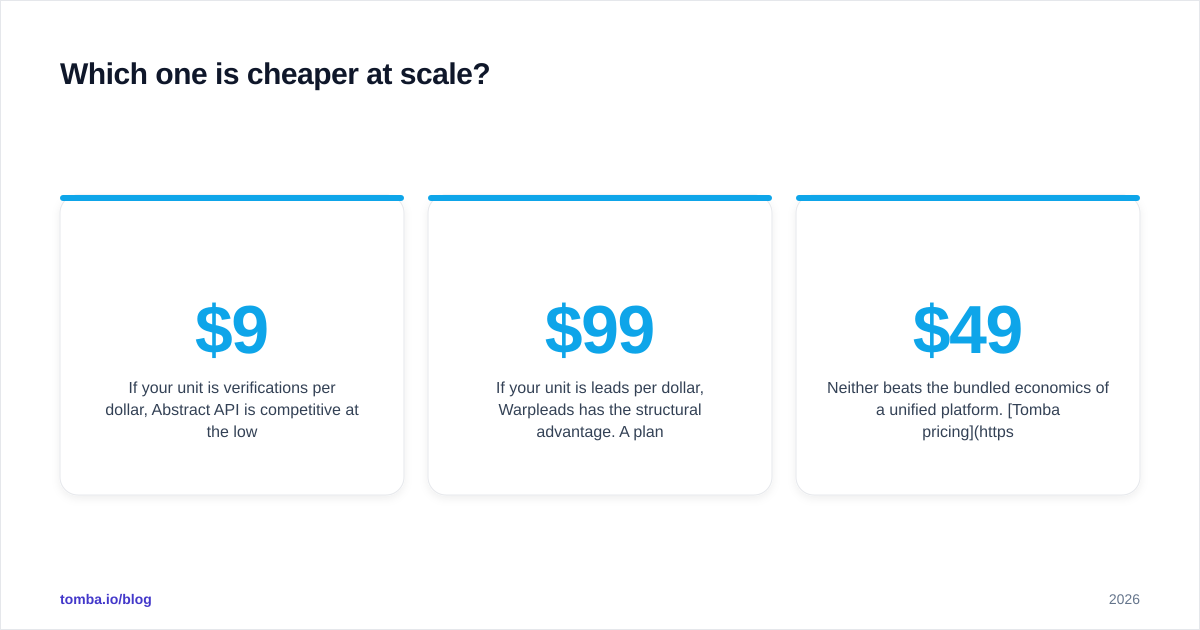
If your unit is verifications per dollar, Abstract API is competitive at the low end ($9/mo for 5K = $0.0018 per verification) and gets expensive at the top ($499/mo for 1M = $0.0005). It's a clean credit model.
If your unit is leads per dollar, Warpleads has the structural advantage. A $99/mo plan that genuinely lets you export 50K contacts in a month equates to fractions of a cent per lead — before you verify. After verification, your effective cost roughly doubles, but it's still aggressive.

Neither beats the bundled economics of a unified platform. Tomba pricing starts at $49/mo for the Starter plan, which includes finding and verifying credits in the same pool — you don't pay twice for the same workflow.
Is Abstract API better than Warpleads?#
The honest answer: they're not competitors.
Use Abstract API when:
- You have an existing list (signup form, CRM, scraped from an event roster) and need to clean it
- You're a developer adding email validation to a SaaS product's signup flow
- You want a no-frills REST API that returns JSON in under 500ms
- Your bounce-rate problem is inbound form spam, not outbound cold email
Use Warpleads when:
- You need fresh prospect lists for cold outbound
- Your filters are common (US tech companies, 50-500 employees, sales/marketing titles)
- You're willing to re-verify exports before sending
- You'd rather pay flat-rate than meter every credit
The mistake teams make is buying Warpleads expecting Abstract-level deliverability out of the box, or buying Abstract expecting it to find addresses. Both end in disappointment.
What do the alternatives look like?#
If you're shopping in this category, you're really comparing three flavors of tool:
- Validation APIs — Abstract API, ZeroBounce, NeverBounce, Kickbox, Bouncer
- Bulk lead databases — Warpleads, Apollo, Seamless.AI, Lusha, RocketReach
- Unified find-and-verify platforms — Tomba, Hunter, Snov.io
The third category is where most outbound teams end up after a year of stitching the first two together. The economics of two subscriptions plus the operational tax of moving CSVs between them adds up fast.
Tomba's pitch in this category is concrete: one API key, one credit pool, one dashboard. Email finder, email verifier, domain search, bulk operations, data enrichment, and phone finder all run on the same plan. You can read about where Tomba's data comes from if sourcing transparency matters to you.
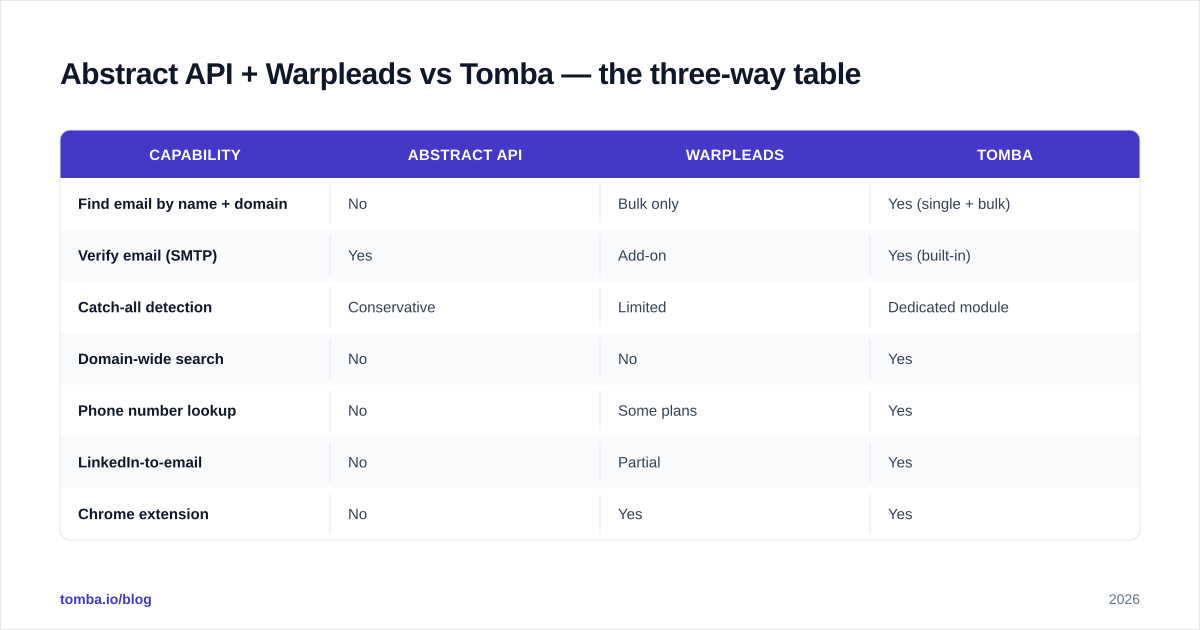
Abstract API + Warpleads vs Tomba — the three-way table#
| Capability | Abstract API | Warpleads | Tomba |
|---|---|---|---|
| Find email by name + domain | No | Bulk only | Yes (single + bulk) |
| Verify email (SMTP) | Yes | Add-on | Yes (built-in) |
| Catch-all detection | Conservative | Limited | Dedicated module |
| Domain-wide search | No | No | Yes |
| Phone number lookup | No | Some plans | Yes |
| LinkedIn-to-email | No | Partial | Yes |
| Chrome extension | No | Yes | Yes |
| Native CRM integrations | Zapier only | Zapier + few | HubSpot, Salesforce, Pipedrive, +30 |
| Free tier | 100/mo | Trial only | 25 searches/mo |
| Starter plan | $9/mo | ~$99/mo | $49/mo |
| GDPR / SOC 2 | Yes | Partial | Yes |
How do you actually choose?#
Walk through these three questions in order:
1. Do you already have a list, or do you need to build one?
- Already have one → you need a verifier. Abstract API or Tomba's verifier both fit. Tomba is more accurate; Abstract is cheaper at the entry tier.
- Need to build one → you need a finder. Warpleads or Tomba's email finder. Warpleads wins on raw volume per dollar; Tomba wins on per-lead accuracy and on having verification baked in.
2. Are you a developer or an operator?
- Developer wiring email checks into a product → Abstract's API ergonomics are excellent. Tomba's API is also strong and includes finding endpoints, so if your product needs to find and verify, default to Tomba.
- Operator running outbound campaigns → CSV/UI workflows matter more than SDK polish. Warpleads or Tomba via the Sheets add-on or Chrome extension.
3. Will you run two vendors or one?
- Two vendors → Warpleads (find) + Abstract API or a dedicated verifier (clean). Workable, but you're managing two contracts, two credit pools, and a CSV pipeline.
- One vendor → Tomba (or Hunter / Snov.io as alternatives). Cleaner ops, predictable cost.
What about deliverability after the verification step?#
Verification gets you past the technical filter — the mailbox exists, the SMTP server says "RCPT TO ok." It does not get you past spam filters. After you've cleaned a list (with Abstract, Tomba's verifier, or anything else), deliverability still depends on:
- Your sending domain's sender reputation
- Proper SPF, DKIM, and DMARC records
- Warmup history on the sending mailbox
- Content quality and personalization (real personalization, not first-name tokens)
- Volume ramp — going 0 to 500 sends/day on a cold domain is a guaranteed spam folder
Both Abstract API and Warpleads are silent on this side of the equation. A platform that bundles list building, verification, and connects cleanly to a sender like Instantly or Smartlead saves you a step.
When does Abstract API still win?#
For pure product-side validation — a signup form, a checkout flow, a free trial form — Abstract API is a sensible default. It's cheap, the API is predictable, and you don't need any of the lead-finding features you're paying for in a Tomba or Hunter plan. If validation is your only job and the volume is moderate, Abstract is hard to beat on developer experience alone.
It also wins when you need a non-email API in the same suite — IP geolocation, phone validation, currency. Buying one vendor for four validators is a reasonable consolidation play.
When does Warpleads still win?#
For agencies and SDR teams running high-volume cold outbound where the unit economics depend on cost per raw lead, Warpleads' flat-fee export model is genuinely useful. If you're sending 50,000+ cold emails a month, you're going to verify everything externally anyway, so paying for unmetered sourcing makes sense.
The catch: you need a serious deliverability stack on the other side. Warpleads will sell you the volume; it won't save you from your own SPF misconfiguration.
The verdict#
Abstract API and Warpleads aren't really competing. One verifies, one sources. Picking between them as if they're alternatives means you haven't clarified your own workflow yet.
If you've already got the list, Abstract API is a fine validation choice — though Tomba's verifier benchmarks higher on accuracy at a comparable price.
If you need leads, Warpleads is the cheapest bulk option — though the quality variance means you'll spend the savings on a verifier and a deliverability tool anyway.
If you want one tool that does both well, Tomba is the consolidation play. Check the G2 comparison of email tools in the category, or scan the Hunter alternatives and run a side-by-side trial.
Ready to skip the two-vendor juggle?#
Stop stitching Abstract API and Warpleads together. Tomba's email finder gives you find, verify, enrich, and bulk operations on one credit pool — starting at $49/mo with a free tier that includes 25 searches. Try it on your hardest 100 leads and compare the deliverability against your current stack.
Ready to find emails that actually work?
Join 150,000+ professionals who stopped guessing and started sending. Free credits on signup — no credit card required.
Get the Tomba newsletter
Practical outbound tactics and product updates — once every two weeks.
About the author