ABX Campaign Playbook 2026: How to Run Account-Based Experiences
ABX campaigns blend ABM precision with full-funnel experience design. Here's how to plan, execute, and measure an ABX campaign that actually books meetings in 2026.
ABX Campaign Playbook 2026: How to Run Account-Based Experiences
TL;DR
- An ABX campaign (Account-Based Experience) is a coordinated, multi-channel program aimed at a named list of accounts and tuned to the buying committee's stage, not the lead's stage.
- ABX is what ABM 1.0 wanted to be: orchestrated ads, outbound, content, and sales touches that feel like one continuous experience rather than five disconnected tools yelling at the same VP.
- The 2026 winning formula is tight: 50–300 target accounts, 6–9 personas per account, intent signals as the trigger, and a 90-day cadence with weekly reviews.
- Pipeline math beats vanity metrics. Track engaged accounts, meetings booked, opportunity creation rate, and influenced revenue — not impressions.
- Tooling matters less than data hygiene. Without accurate contact data, the most expensive 6sense or Demandbase deployment becomes an expensive Christmas card.
What is an ABX campaign?#
An ABX campaign is a structured, time-boxed program that delivers a coordinated experience to a defined set of target accounts across every channel they touch — ads, email, LinkedIn, sales calls, direct mail, events, and the website itself. The "experience" word is doing real work. Unlike classic ABM, which often collapses into "ads + outbound to a list," ABX treats every interaction as a beat in a single story arc designed around the buying committee.
The discipline grew out of dissatisfaction with two earlier acronyms. Demand gen produced too many junk MQLs. ABM 1.0 produced too many beautiful target lists that sales never worked. ABX, popularized by vendors like 6sense and Demandbase, tries to fix both by anchoring the program to buying-stage signals and orchestrating channels so the prospect sees a coherent story.
In practice, an ABX campaign has four moving parts: the account list, the buying committee map, the channel orchestration, and the measurement loop. Get those four right and the campaign works. Skip one and you're back to running expensive display ads against an outdated list.
How is ABX different from ABM?#
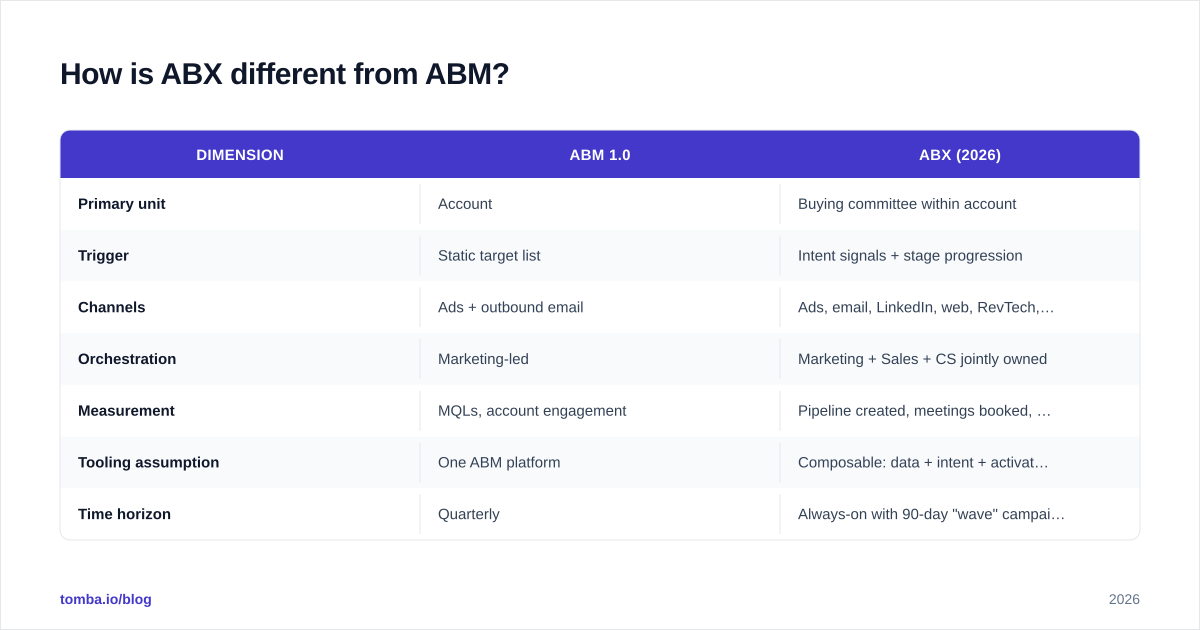
ABM (Account-Based Marketing) and ABX (Account-Based Experience) overlap, but they're not synonyms. ABM is the targeting strategy. ABX is the execution philosophy on top of it. Think of ABM as the guest list and ABX as the dinner party — same invitees, very different experience depending on whether the host actually plans the evening.
| Dimension | ABM 1.0 | ABX (2026) |
|---|---|---|
| Primary unit | Account | Buying committee within account |
| Trigger | Static target list | Intent signals + stage progression |
| Channels | Ads + outbound email | Ads, email, LinkedIn, web, RevTech, direct mail, events |
| Orchestration | Marketing-led | Marketing + Sales + CS jointly owned |
| Measurement | MQLs, account engagement | Pipeline created, meetings booked, deal velocity |
| Tooling assumption | One ABM platform | Composable: data + intent + activation + measurement |
| Time horizon | Quarterly | Always-on with 90-day "wave" campaigns |
The key practical shift: ABX assumes the buying committee is already partway through their journey before they ever talk to you. Gartner's research has held steady at roughly 17% of B2B buying time spent with sales reps. Everything else happens on the buyer's terms across web, peers, and third-party content. ABX accepts that reality and tries to be present in the right channels at the right stages, instead of pretending sales controls the timeline.
Who runs an ABX campaign?#
ABX is a team sport, and treating it as a marketing program is the single most common reason campaigns underperform. A real ABX campaign needs four roles in lockstep:
- Marketing: owns content, ads, automation, and brand consistency across touches.
- Sales (AEs and SDRs): owns outbound cadences, multi-threading, and the live conversations.
- RevOps: owns the data, scoring, attribution, and the dashboard everyone argues over.
- Customer Success or PMM: feeds product proof, case studies, and existing-customer ICP signals.
If you're running ABX out of a single team, you're running ABM 1.0 with a new name. The orchestration is what makes it ABX — and orchestration requires shared incentives. The cleanest setup we've seen has marketing measured on engaged accounts and SQOs created, AEs measured on pipeline from named accounts only, and a weekly 30-minute ABX standup where the list, signals, and next plays get reviewed.
This is also where revenue operations earns its budget. Without RevOps holding the system together, the program devolves into one team chasing intent data while another team runs its own list out of a spreadsheet.
How do you build the target account list?#
The target list is the single highest-leverage decision in any ABX campaign. Get it wrong and the rest is wasted spend. The list should be small enough that your team can actually run plays against each account, and tight enough that every account passes a clear ICP test.
A workable approach for most B2B teams:
- Define the ICP firmographically. Industry, employee range, revenue band, geography, tech stack. Use data enrichment to fill in gaps on accounts you already know.
- Layer behavioral and intent signals. Visits to your pricing page, third-party intent (Bombora, G2, 6sense), funded-round news, hiring signals on LinkedIn.
- Tier the list. Tier 1 = 1:1 (50 accounts, custom experience). Tier 2 = 1:few (150 accounts, segmented plays). Tier 3 = 1:many (1,000 accounts, programmatic only).
- Map the buying committee per account. For Tier 1 and 2, name 6–9 personas per account: economic buyer, champion, end users, blockers.
- Pull contact data. This is where most programs leak. Use an email finder and phone finder to pull verified contacts for every named persona, then verify against an email verifier before any send.
A pragmatic list size for most mid-market teams in 2026 is 200 accounts split 50/150 across Tier 1 and Tier 2. Bigger lists dilute the experience back into demand gen.
What channels should an ABX campaign use?#
Channel choice is where ABX either feels like an experience or feels like spam. The rule: every channel should reinforce the same message and stage, not introduce a new one. A prospect who downloaded a buyer's guide on Monday should not get a "we'd love to introduce ourselves" cold email on Tuesday.
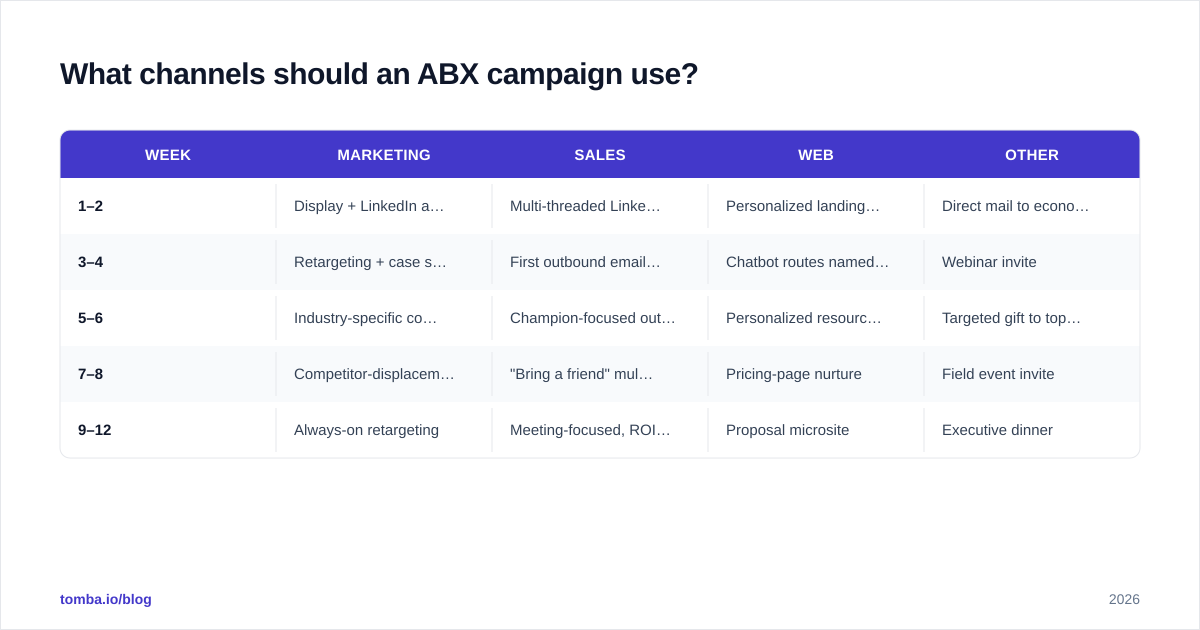
A baseline channel mix for a 90-day Tier 1 wave:
| Week | Marketing | Sales | Web | Other |
|---|---|---|---|---|
| 1–2 | Display + LinkedIn ads to all personas | Multi-threaded LinkedIn touches | Personalized landing page | Direct mail to economic buyer |
| 3–4 | Retargeting + case study ad | First outbound email + call sequence | Chatbot routes named accounts to AE | Webinar invite |
| 5–6 | Industry-specific content drop | Champion-focused outreach | Personalized resource center | Targeted gift to top-5 |
| 7–8 | Competitor-displacement ad | "Bring a friend" multi-thread email | Pricing-page nurture | Field event invite |
| 9–12 | Always-on retargeting | Meeting-focused, ROI-anchored emails | Proposal microsite | Executive dinner |
This is where tools like Apollo, Outreach, and Salesloft earn their seat, sequencing the sales side while a marketing automation platform handles the broadcast layer. The HubSpot ABM features hit the basics; for heavier intent + orchestration, G2 reviews of 6sense and Demandbase are worth reading before committing.
What does a 90-day ABX campaign timeline look like?#
Ninety days is the sweet spot. Shorter and you can't measure pipeline impact. Longer and the team loses focus and the list goes stale.
- Days 0–14 — Prep. Finalize list, enrich contacts, build creative variants, brief sales, set the dashboard. No external touches yet.
- Days 15–30 — Awareness wave. Ads live, first sales touches, personalized landing pages published. Goal: account engagement rate above 40%.
- Days 31–60 — Engagement wave. Layer in 1:few plays, webinar, direct mail to top tier. Goal: 25% of accounts in active conversation.
- Days 61–90 — Pipeline wave. Push hard for meetings, propose ROI conversations, invite top accounts to executive event. Goal: opportunities created from at least 15% of the list.
Run a retro on day 91. Promote what worked into the always-on layer; kill what didn't. Then start the next wave with a refreshed list informed by Q1 learnings.
How do you measure ABX campaign success?#
Vanity metrics are the kryptonite of ABX. Impressions don't book meetings. The metrics that matter, ordered from leading to lagging:
- Engaged accounts — accounts with at least 3 meaningful touches across channels in a 30-day window.
- Multi-threaded accounts — accounts where 3+ personas have been engaged. This is the single best predictor of deal closure in 2026 buying committees.
- Meetings booked — discovery calls with named contacts at target accounts. Sourced and influenced should be tracked separately.
- Pipeline created — dollar value of opportunities created from the list during the wave.
- Win rate of ABX-sourced opps vs. non-ABX — the honest answer to "is this worth it?"
- Deal velocity — time from first touch to closed-won. ABX should compress this; if it doesn't, something's off in the orchestration.
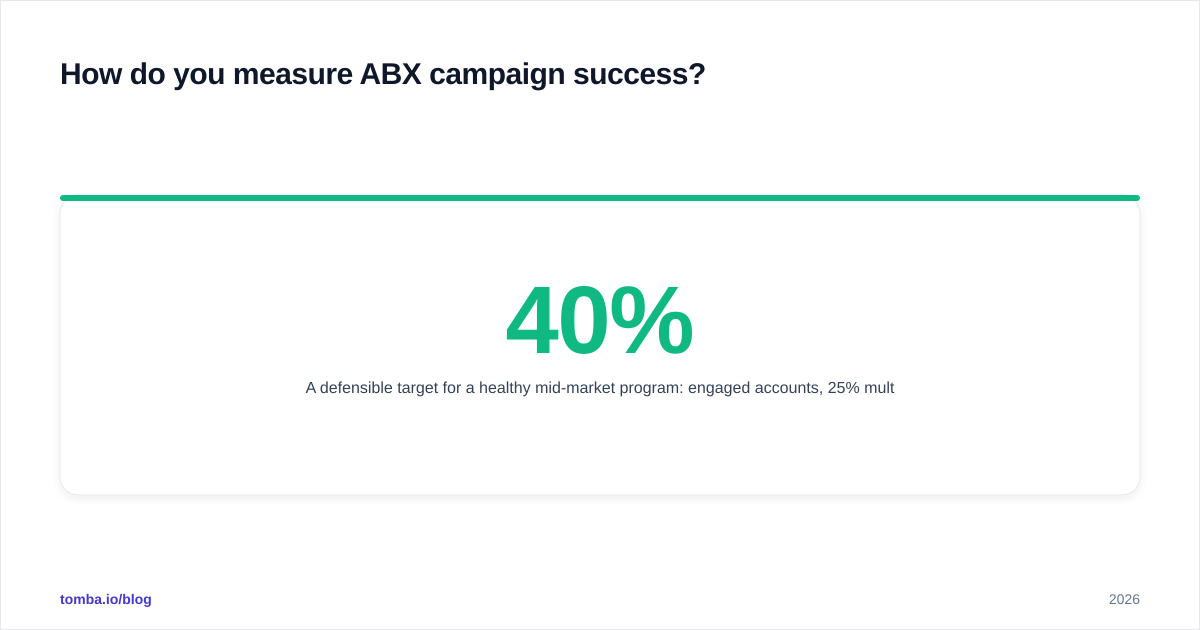
A defensible target for a healthy mid-market program: 40% engaged accounts, 25% multi-threaded, 15% with at least one meeting, 8% with a created opportunity, all measured at day 90. Influenced revenue at six months should be 3–5x program cost for the program to be worth scaling.
What tools do you actually need?#
The ABX tooling category is crowded and the marketing is loud. Strip it down to functions, not logos:
- Data and contact discovery: a verified B2B database with current emails, phones, and titles. Without this, intent data points at a contact who left in 2023.
- Intent and signals: 6sense, Demandbase, Bombora, G2 Buyer Intent — pick one as the primary, don't run three.
- Activation — marketing: HubSpot, Marketo, or Customer.io for orchestration; LinkedIn Campaign Manager + Google for ads.
- Activation — sales: Outreach, Salesloft, or Apollo alternatives for sequencing. Salesforce or HubSpot CRM for the system of record.
- Web personalization: Mutiny, RB2B, or native ABM features in your CMS.
- Measurement: dashboards in CRM, Looker, or a dedicated tool like Dreamdata. Account-level attribution, not lead-level.
The single most overlooked layer is contact data quality. Spending $80K on an intent platform and then mailing addresses that bounce 18% of the time is a self-inflicted wound. A bulk email finder plus verification step before every wave costs a fraction of the platform spend and protects your sender reputation.
What does an ABX campaign look like in practice?#
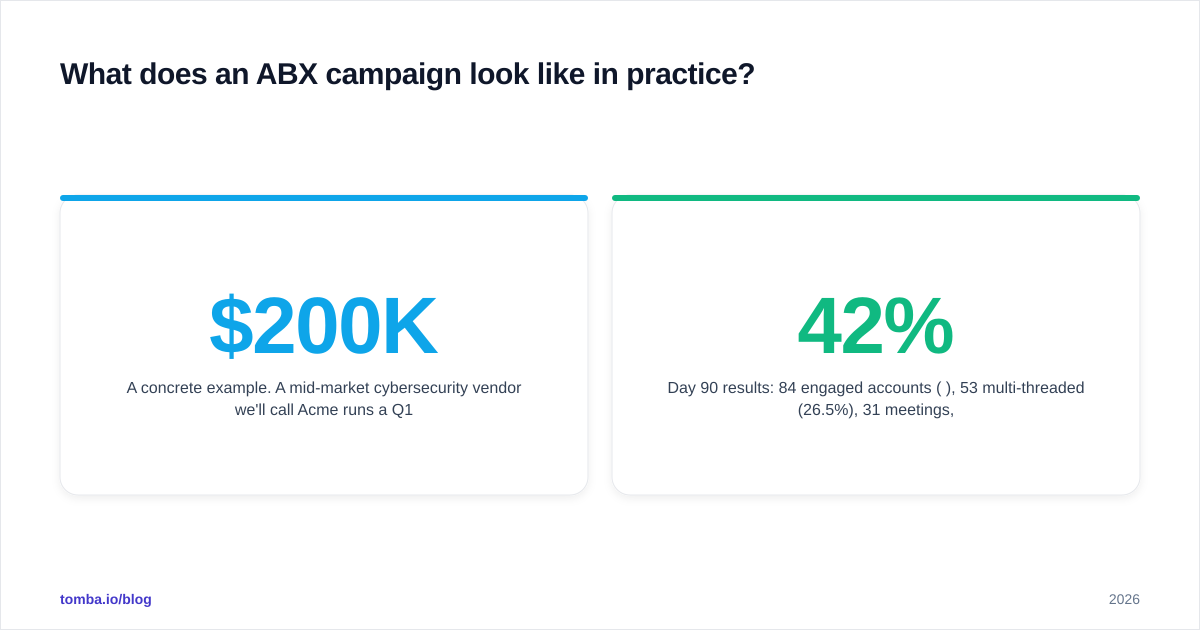
A concrete example. A mid-market cybersecurity vendor we'll call Acme runs a Q1 wave against 200 accounts. Industry: financial services, 500–5,000 employees, US/UK only. Intent triggers: G2 category visits + Bombora topic spikes on "zero trust." Buying committee map: CISO, VP Security, Director SecOps, IT Procurement, CFO (for deals above $200K).
Week 1, marketing turns on LinkedIn ads to all five personas with a "zero trust under 30 days" message. The website detects named-account traffic and swaps in a financial-services hero. SDRs send the first email sequence, anchored to the same hook. A printed copy of the buyer's guide goes to every CISO by FedEx.
Week 4, accounts that engaged twice or more get a personalized video from the AE. Accounts that didn't engage get a fresh creative angle and a different SDR persona (sometimes the AE outperforms the SDR; sometimes the reverse). Web visitors from named accounts get routed to a Calendly with the right AE pre-loaded.
Week 8, the campaign pivots to ROI proof. Case studies of three banks that deployed in 28 days drop into the ad rotation. SDRs reference specific intent signals in their emails ("noticed your team reviewed three zero-trust vendors on G2"). The top 25 accounts get an invite to a closed-door executive dinner.
Day 90 results: 84 engaged accounts (42%), 53 multi-threaded (26.5%), 31 meetings, 18 opportunities, 4 closed in the next quarter for $1.6M. Program cost: $310K all-in. Six-month ROI: 5.1x.
That's what a working ABX campaign looks like. The unsexy parts — clean data, consistent message across channels, AE/SDR/marketer alignment — are doing the heavy lifting.
What are the most common ABX campaign mistakes?#
- List too big. 2,000 accounts is not ABX. It's demand gen with extra steps.
- No multi-threading. Talking only to the champion is a single point of failure on every deal.
- Marketing and sales running parallel tracks. Same list, two messages, two cadences — disorienting for the prospect.
- Intent data without contact data. Knowing a company is in-market is useless if you can't reach the right human.
- Measurement that flatters. Reporting "engagement up 30%" without pipeline data is theater.
- No exit ramp for cold accounts. If an account hasn't engaged in 90 days, suppress and rotate. Don't keep paying to reach them.
Get the contact layer right before you spend on ABX tooling#
Every ABX dashboard you'll ever build assumes the contacts in your CRM are real, current, and reachable. They usually aren't. Before you sign a 6sense or Demandbase contract, run your target list through a verified data layer.
Tomba's email finder pulls verified work emails by domain or name, the phone finder backfills mobile numbers for multi-channel cadences, and the data enrichment endpoint completes the firmographic and persona data you need for tiering. Pricing starts at the free tier (25 searches/mo) and scales to $49/mo Starter, $99/mo Growth, $249/mo Pro — orders of magnitude cheaper than the platforms it makes work. See Tomba pricing for the full breakdown, or start finding accurate contacts for your next ABX wave today.
Ready to find emails that actually work?
Join 150,000+ professionals who stopped guessing and started sending. Free credits on signup — no credit card required.
Get the Tomba newsletter
Practical outbound tactics and product updates — once every two weeks.
About the author