How to Accelerate Pipeline Velocity in 2026: A Practical Guide
Pipeline stalls cost more than lost deals. Here is the operator playbook to accelerate pipeline velocity, compress sales cycles, and pull revenue forward without burning your team out.
How to Accelerate Pipeline Velocity in 2026: A Practical Guide
TL;DR
- Pipeline velocity is a single number:
(Qualified Opps × Win Rate × ACV) / Sales Cycle Days. Pull any lever and the equation moves. - Most teams try to accelerate pipeline by adding more leads. That makes the denominator worse, not better. Compress the cycle first.
- The four real accelerants in 2026: tighter qualification at the top, multi-threading by stage two, mutual action plans, and ruthless deal hygiene.
- Tooling matters less than process — but bad data (stale contacts, wrong titles, dead inboxes) silently doubles cycle time. Fix data first.
- Expect 20-35% cycle compression in 90 days if you implement all four. The teams that only buy more tools see no movement.
What does "accelerate pipeline" actually mean?#
When a CRO says "we need to accelerate pipeline," three different people in the room hear three different things. The AE hears "send more meetings." The SDR manager hears "book faster." The RevOps lead hears "fix the conversion math." All three are partly right, and that is the problem.
To accelerate pipeline is to increase pipeline velocity — the rate at which dollars move from first touch to closed-won. The canonical formula, originally popularised by Jason Lemkin and refined across the SaaStr community, is:
Pipeline Velocity = (# Qualified Opps × Win Rate × Average Deal Size) / Sales Cycle LengthThree of those four variables are numerator levers. Only one — cycle length — is a denominator. Most teams obsess over the numerator (more leads, bigger deals) and ignore the denominator. That is backwards. A 20% reduction in cycle length is mathematically identical to a 25% increase in win rate, and it is almost always cheaper to achieve.
This guide is about the denominator.
Why is your pipeline slow in the first place?#
Before you can accelerate pipeline, you need to know where it is decelerating. Pull your CRM data and chart the median days-in-stage for the last 90 days. You will almost always find one of these four patterns:
- The discovery swamp. Deals sit in "Discovery" for 21+ days because reps cannot get the second meeting booked. Usually a qualification problem disguised as a momentum problem.
- The single-thread cliff. Deals progress to "Demo" with one champion, then stall when that champion goes on PTO or gets reorganized. By Q3, 40% of the pipeline is single-threaded.
- The legal black hole. Deals reach "Verbal" and disappear into procurement / legal / security review for 45-90 days with zero touchpoints from sales.
- The CRM theater. Deals are reported as "Stage 4 — Negotiation" but the last meaningful activity was three weeks ago. The forecast is fiction.
Each pattern has a different fix. None of them is "send more cold emails."
How do you measure pipeline velocity correctly?#
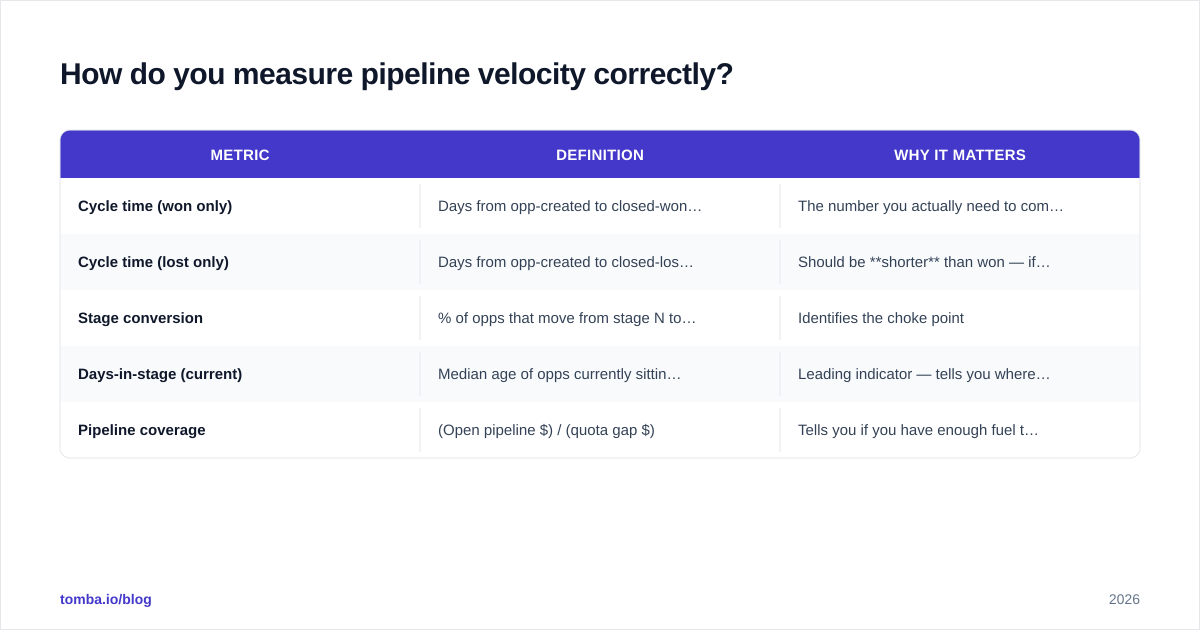
Most CRM dashboards measure velocity wrong. They report average cycle length across all closed deals, which conflates closed-won and closed-lost. A lost deal that died at stage 2 in 14 days will artificially compress your "average" cycle. You want two distinct numbers:
| Metric | Definition | Why it matters |
|---|---|---|
| Cycle time (won only) | Days from opp-created to closed-won, won deals only | The number you actually need to compress |
| Cycle time (lost only) | Days from opp-created to closed-lost, lost deals only | Should be shorter than won — if not, you are wasting reps' time on dead deals |
| Stage conversion | % of opps that move from stage N to N+1 | Identifies the choke point |
| Days-in-stage (current) | Median age of opps currently sitting in each stage | Leading indicator — tells you where things are stuck right now |
| Pipeline coverage | (Open pipeline $) / (quota gap $) | Tells you if you have enough fuel to hit the number |
Report these weekly. If you only have one number on the dashboard, make it days-in-stage for the current quarter's open opps. That is the closest thing to a live tachometer for your pipeline.
How do you accelerate pipeline at the top of the funnel?#
The fastest deals start with the right leads. The slowest deals start with leads who never should have been worked. This is where data quality matters more than any sequence template.
Three rules:
1. Tighten ICP before you tighten sequencing. A well-defined ICP — firmographic, technographic, and trigger-based — will outperform any prompt-engineered cold email by 2-3x in response rate. Use intent signals (Bombora, 6sense, G2) plus tech-stack data to score accounts before any rep touches them.
2. Verify every email before send. A 12% bounce rate doesn't just kill deliverability — it kills cycle time, because the AE who would have closed that deal never gets the meeting. Run every list through an email verifier before it hits a sequence. The catch-all problem is real; use a dedicated catch-all verifier for ambiguous domains.
3. Find direct contacts, not generic inboxes. info@, contact@, and sales@ addresses have a ~3% reply rate. A verified direct address to a named decision-maker converts 8-12x higher. Use an email finder keyed off LinkedIn URLs or company domain + name pairs.
The math is brutal: if you cut your bounce rate from 12% to 2%, and lift your reply rate from 3% to 8%, you have roughly tripled qualified meeting flow without adding a single SDR. That is pipeline acceleration before the deal even exists.
What is multi-threading and why does it cut cycle time in half?#
Multi-threading is the practice of building active relationships with three or more stakeholders inside an account before stage three. It is the single biggest cycle-time lever in B2B sales, and almost no one does it consistently.
Gong's 2024 analysis of 200K+ recorded deals found that deals with four or more contacts engaged closed 34% faster than single-threaded deals — and at a 28% higher win rate. The mechanism is intuitive: when your champion goes silent, you have three other people who can keep the deal moving.
How to operationalise it:
- Stage-gate it. Discovery cannot advance to Demo until at least two contacts from the account have been engaged. Make it a required field in the CRM.
- Map the buying committee explicitly. Champion, economic buyer, technical evaluator, end user, blocker. If any of these is blank, the deal is at risk.
- Use phone, not just email. A phone finder lets reps reach the CFO directly when the champion has gone dark. One phone call beats six emails.
- Send asynchronous video. A 90-second Loom to a new stakeholder you have never spoken to converts ~15% to a meeting. It scales multi-threading without scaling SDR headcount.
The teams that get this right compress their cycles by 30-50% with no other changes.
How do mutual action plans accelerate the late stage?#
Late-stage acceleration is a different problem. The deal is qualified, the demo went well, the champion wants to buy. Then it dies in legal review. Or procurement. Or "we need to re-evaluate budget."
The fix is a mutual action plan (MAP) — a shared document, agreed by both sides, that lists every step from verbal agreement to signed contract with owners and dates. Salesforce and HubSpot both publish MAP templates you can copy.
A well-run MAP does three things at once:
- Surfaces hidden blockers (security review, procurement quotas) early enough to parallelise them.
- Gives the champion ammunition to push internally — "we committed to a kick-off on the 15th."
- Makes ghosting socially expensive. If the buyer misses a date, they have to explain why.
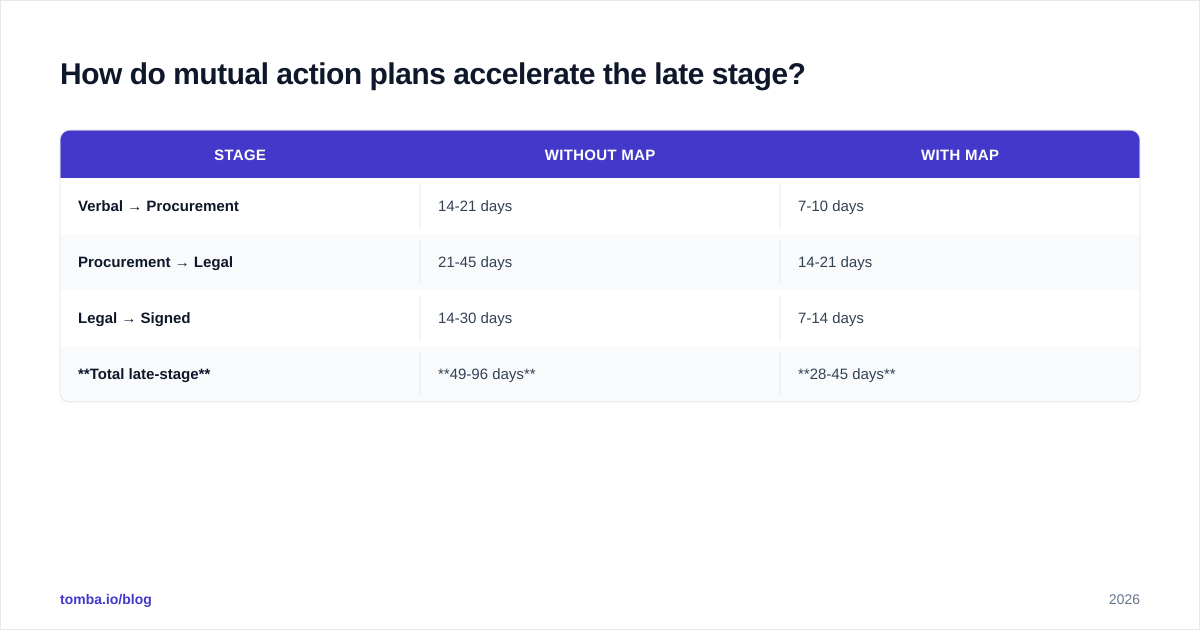
Teams that adopt MAPs on every deal over $25K typically see a 25-40% reduction in late-stage cycle time. The cost is one extra meeting in week one of the late stage. That is the highest-ROI meeting in your sales process.
| Stage | Without MAP | With MAP |
|---|---|---|
| Verbal → Procurement | 14-21 days | 7-10 days |
| Procurement → Legal | 21-45 days | 14-21 days |
| Legal → Signed | 14-30 days | 7-14 days |
| Total late-stage | 49-96 days | 28-45 days |
What about deal hygiene — does it really move the needle?#
Yes, and more than anything else on this list when you start from zero. Deal hygiene is the unglamorous work of keeping your CRM honest: closed-dating stale opps, pushing fields, validating next steps. Most teams treat it as a Friday afternoon chore. The best teams treat it as the forecast itself.
Three hygiene rules that compound:
- No "Next Step = TBD." Every open opp must have a concrete, scheduled next step with a date. If the rep cannot articulate it, the deal is not real.
- 30-day stale rule. Any opp with no activity in 30 days auto-flags for manager review. Either revive it with a documented plan, or close-lost it. Stale pipeline is worse than no pipeline because it pollutes the forecast.
- Activity ≠ progress. Logging a call is not progress. Booking the next meeting is. Coach reps to log outcomes, not actions.
The compounding effect: clean pipeline forecasts more accurately, which means leadership stops panicking and stops asking for "more activity," which means reps spend more time on real deals, which compresses cycle time.

Which tools actually help you accelerate pipeline?#
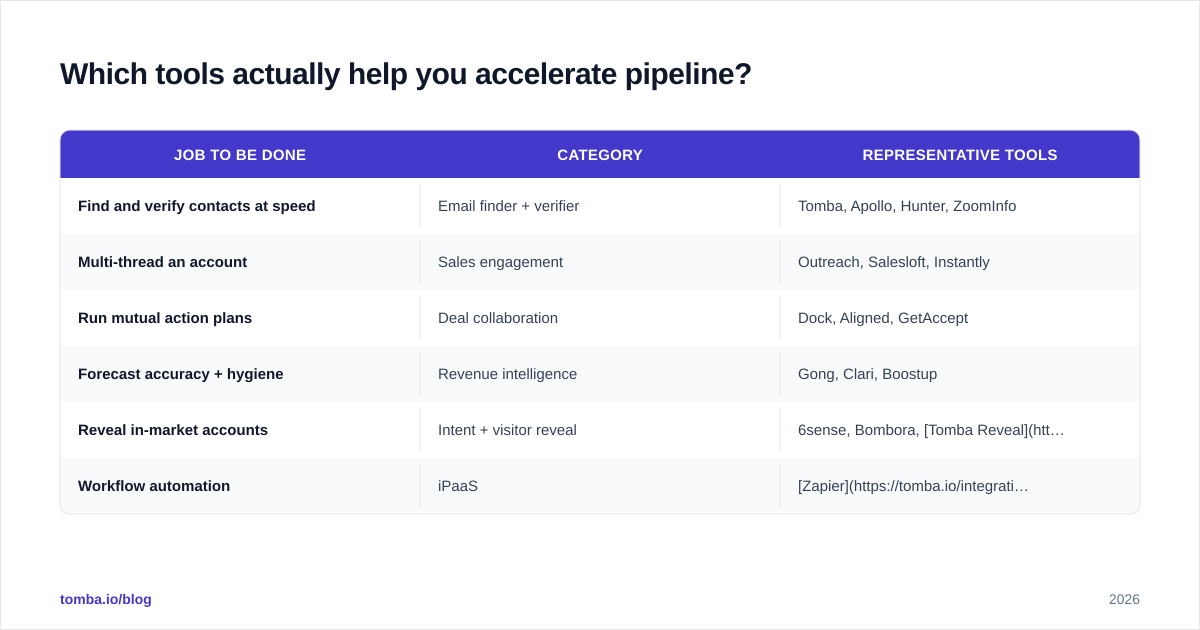
The market is saturated with "pipeline acceleration" software. Most of it is repackaged email sequencing. Here is the honest breakdown by job to be done:
| Job to be done | Category | Representative tools |
|---|---|---|
| Find and verify contacts at speed | Email finder + verifier | Tomba, Apollo, Hunter,ZoomInfo |
| Multi-thread an account | Sales engagement | Outreach, Salesloft, Instantly |
| Run mutual action plans | Deal collaboration | Dock, Aligned, GetAccept |
| Forecast accuracy + hygiene | Revenue intelligence | Gong, Clari, Boostup |
| Reveal in-market accounts | Intent + visitor reveal | 6sense, Bombora, Tomba Reveal |
| Workflow automation | iPaaS | Zapier, Make, n8n |
A few principles for buying:
- Buy data before you buy automation. Automating a sequence to bad contacts just sends garbage faster. Spend the first $1K/mo on contact data and verification, not on a $30K Outreach contract.
- Buy one tool per job. Two engagement platforms is one too many. Same for two enrichment tools.
- Integrations beat features. A 70%-good tool that writes cleanly to your CRM beats a 95%-good tool that needs a Zapier hack. Check G2's integration matrix before you sign anything.
If you are early-stage and pricing-sensitive, the most leverage per dollar in 2026 is still on the data layer. A combined email finder + verifier + enrichment stack on Tomba's Starter or Growth plan covers most teams under 10 reps. See current Tomba pricing for the breakdown — Starter is $49/mo for 500 finder credits, Growth is $99/mo for 2,500.
How long does it take to see results?#
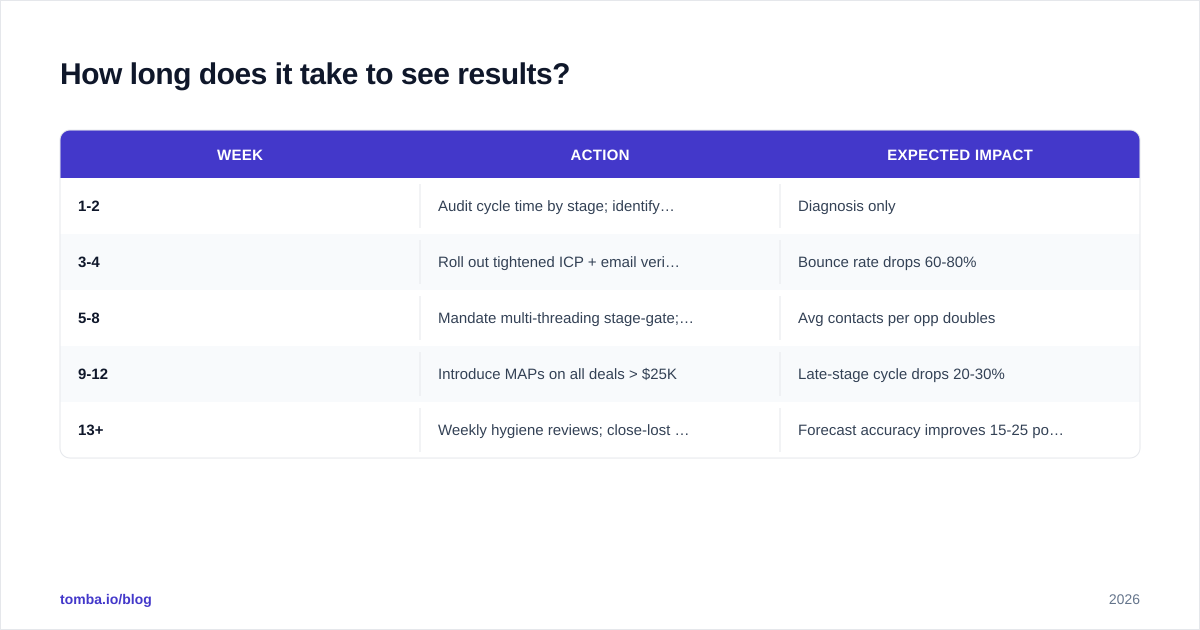
Realistic timeline for a 10-rep team starting from typical hygiene:
| Week | Action | Expected impact |
|---|---|---|
| 1-2 | Audit cycle time by stage; identify the choke point | Diagnosis only |
| 3-4 | Roll out tightened ICP + email verification on all outbound | Bounce rate drops 60-80% |
| 5-8 | Mandate multi-threading stage-gate; train reps on stakeholder mapping | Avg contacts per opp doubles |
| 9-12 | Introduce MAPs on all deals > $25K | Late-stage cycle drops 20-30% |
| 13+ | Weekly hygiene reviews; close-lost stale deals | Forecast accuracy improves 15-25 points |
Expect to see the first measurable cycle-time compression around week 6. The full effect — 20-35% reduction — lands at week 12-14. Anyone selling you a "30-day acceleration" is selling you a tool, not a result.
What are the most common mistakes when trying to accelerate pipeline?#
Five patterns that consistently fail:
- Adding SDRs without fixing data. More activity into a broken funnel = more noise, longer cycles, worse morale.
- Compressing cycles by skipping discovery. You will close faster — and churn faster. Net new ARR drops within two quarters.
- Buying revenue intelligence before you have process. Gong is excellent. Gong without a defined sales process is a $100K observability tool for chaos.
- Conflating pipeline acceleration with pipeline creation. Different problem, different fix. Acceleration is about what is already in the funnel.
- Forecasting on hope. "Commit" deals with no next step are not commit deals. Coach managers to challenge, not to cheerlead.
Frequently asked questions#
What is a healthy sales cycle length in B2B SaaS in 2026? Median is now ~84 days for SMB deals, ~120 days for mid-market, and 180+ for enterprise. These are up roughly 20% versus 2022 — the post-ZIRP buying environment is genuinely slower. The goal is not to beat the median; it is to beat your own baseline.
Does AI-generated outreach accelerate pipeline? Marginally, when used to personalise at scale. Significantly, when used to research accounts and prepare reps for calls. The biggest AI gains in 2026 are in call coaching and deal scoring, not in writing emails.
Should I cut my sales cycle by dropping qualification? No. Faster bad deals are still bad deals. Compress by removing friction (multi-threading, MAPs, hygiene), not by lowering the bar.
How does data quality affect pipeline velocity? Directly. Bad data — wrong titles, dead inboxes, missed decision-makers — inflates cycle time at every stage. A clean B2B contact stack typically compresses early-stage cycles by 30%+ on its own. Use a verified B2B database or enrich your CRM with a proper data enrichment layer.
Is "pipeline velocity" the same as "sales velocity"? Same formula, slightly different framing. "Pipeline velocity" emphasises the opportunity stage; "sales velocity" includes the full lead-to-cash motion. In practice the metrics overlap.
Ready to compress your cycle?#
The fastest pipelines start with the cleanest data. If your reps are burning days on bounces, wrong titles, and dead inboxes, no MAP template or velocity dashboard will save you. Fix the data layer first — then every other lever in this guide works harder.
Tomba's Email Finder gives you verified, direct contact data for the people who actually make the decision, scored on confidence and refreshed against live sources. Pair it with the email verifier and the Chrome extension and your reps stop wasting cycles on noise. Start free with 25 searches a month, or scale to the $49/mo Starter plan when the team is ready. Your forecast will thank you.
// get started
Find, verify and enrich your first contacts today
Start on the free plan with 25 searches a month, then scale when your team is ready.
Free plan · No credit card required · GDPR & CCPA
// about the author