Account Based Content Marketing: The 2026 Playbook for ABM Teams
Account based content marketing turns generic blog posts into named-account assets. Here is the 2026 playbook for building ABM content that books revenue, not just clicks.
TL;DR#
- Account based content marketing (ABCM) is the discipline of building content for a finite list of named accounts instead of an anonymous traffic audience.
- The 2026 model has three tiers — 1:1 (custom microsites), 1:few (industry cohorts), 1:many (programmatic personalization) — each with different cost, scale and intent signals.
- The bottleneck is rarely writing. It is account data: firmographics, intent, contact-level enrichment and a clean opt-in email layer.
- Measure ABCM on pipeline influence, account engagement score and meeting velocity — not sessions or MQLs.
- Your stack needs a CMS, an account graph (CRM + enrichment), a personalization layer and a contact-discovery tool. Tomba sits in the data layer feeding contacts into your sequences.
What is account based content marketing?#
Account based content marketing is the practice of producing, distributing and personalizing content for a pre-defined list of target accounts, rather than for an open audience funnel. Instead of writing "10 ways to reduce churn" and hoping the right buyer finds it on Google, you write "How Stripe's revenue team would reduce churn in a usage-based pricing model" and put it in front of seven people at Stripe.
It is the content arm of account based marketing (ABM) — the same shift from "audience" to "account" that Gartner and Forrester have been documenting since 2018, now mature enough that most B2B SaaS companies above $20M ARR run some version of it.
The mechanics differ from traditional content marketing in three ways:
- The unit of work is an account, not a keyword. You start from a target account list (TAL) and reverse-engineer what content each segment needs.
- Distribution is paid and direct, not organic-first. SEO is a bonus, not the channel. Most ABCM content never ranks because it is gated, ungated-but-unindexed, or shipped as a 1:1 microsite.
- Success is measured in pipeline, not pageviews. A 200-view asset that sourced $400K in pipeline beats a 200K-view asset that sourced zero.
Why does ABCM matter more in 2026?#
Three shifts forced the change.
Buyer committees got bigger. Gartner's latest B2B buying research puts the average enterprise software committee at 11 people. Generic top-of-funnel content cannot speak to all 11 at once — a CFO, a head of security and a developer have different objections to the same product. ABCM lets you ship 11 angles of the same story instead of one neutered version.
Organic CPC and SEO got harder. AI-generated answers in Google, Perplexity and ChatGPT are eating the middle of the funnel. The keyword "best CRM" no longer sends 10,000 monthly clicks to your blog — it sends a synthesized answer with three citations. The traffic that remains is high-intent and contested. Pure SEO content marketing now has to compete with synthesized AI summaries that scrape the same sources.
Sales cycles stretched. Average B2B SaaS sales cycles are up 18% since 2022 according to Forrester. Buyers ghost. They self-research for months. ABCM content — landing pages, executive briefs, ROI calculators built for one account — is how marketing stays present during the silent middle of the cycle.
The teams winning in 2026 stopped optimizing for "how do we publish more" and started asking "how do we publish less, for the right 500 companies."
What are the three tiers of ABCM?#
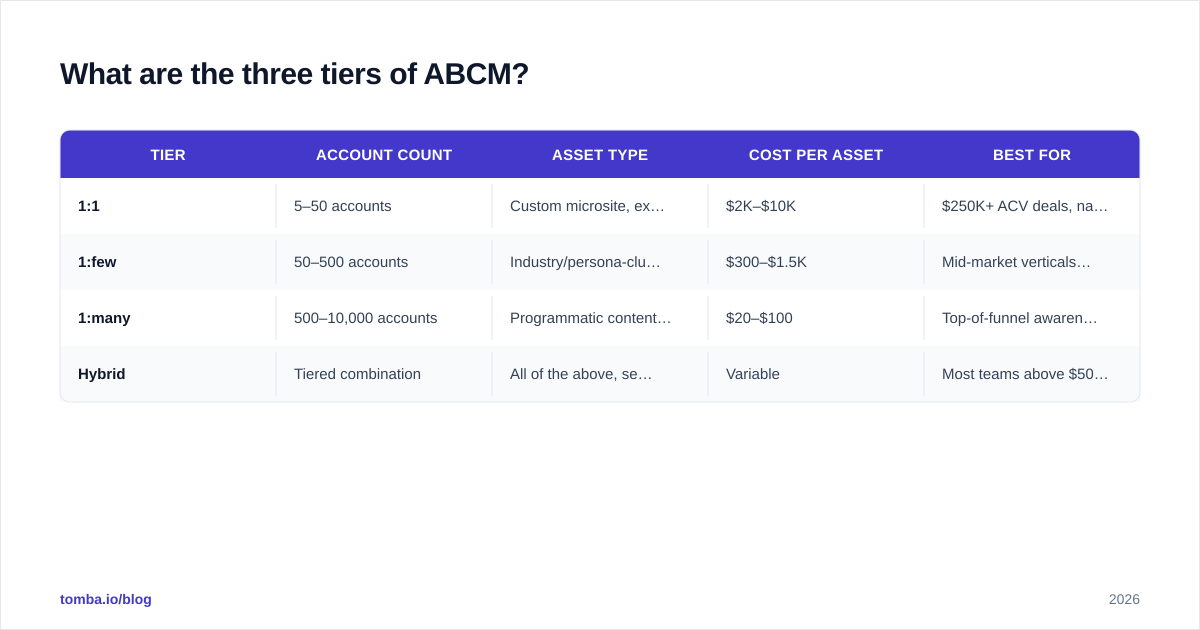
The Information Technology Services Marketing Association (ITSMA) framework, adapted for content, gives you three operating tiers. Pick one to start. Most teams sprint to 1:many because it feels scalable, then realize the conversion math only works at 1:1 or 1:few.
| Tier | Account count | Asset type | Cost per asset | Best for |
|---|---|---|---|---|
| 1:1 | 5–50 accounts | Custom microsite, executive brief, ROI model | $2K–$10K | $250K+ ACV deals, named strategic accounts |
| 1:few | 50–500 accounts | Industry/persona-clustered landing page, case study pack | $300–$1.5K | Mid-market verticals, segmented plays |
| 1:many | 500–10,000 accounts | Programmatic content with dynamic tokens (logo, industry, stat) | $20–$100 | Top-of-funnel awareness, retargeting |
| Hybrid | Tiered combination | All of the above, sequenced by stage | Variable | Most teams above $50M ARR |
A 1:1 microsite for Workday might include their logo, a custom ROI calculator pre-filled with their employee count from Crunchbase, and a quote from a peer company. A 1:many asset for the same industry might just dynamically swap the hero image and headline based on Clearbit's reveal data on the visitor's domain.
The trap: starting at 1:many. You will not learn what your accounts actually care about until you build one custom asset and put it in front of three buyers. Start narrow.
How do you build a target account list for content?#
Your TAL is the spine of ABCM. Without it, you are just doing content marketing with extra steps.
Build it in three passes:
Pass 1 — Firmographic fit. Pull every company in your CRM that matches your ICP filters (industry, employee count, revenue band, geography, tech stack). For most B2B SaaS this lands at 2,000–10,000 accounts.
Pass 2 — Intent overlay. Layer in intent data from Bombora, 6sense or G2. Filter the list down to accounts showing surge intent on your category, your competitors, or the problem you solve. This usually cuts the list to 200–1,500 accounts.
Pass 3 — Sales alignment. Hand the list to AEs. Let them strike accounts they can't sell to, and add named accounts they care about regardless of intent signal. The final TAL is usually 100–800 accounts for a mid-market team, 50–200 for an enterprise team.
Now you need contacts. A list of company names is not actionable until you have decision-maker emails, titles and LinkedIn profiles for each. This is where most ABCM programs stall — the marketing team has a beautiful TAL and no way to reach anyone on it. Use a B2B email finder or domain search to extract verified contact emails for every named account in a single pass, then push them into your CRM with the right account stamp.
Don't skip verification. A 30% bounce rate on a 1:1 ABCM sequence does not just waste sends — it torpedoes the sender reputation that lets the next 50 sequences land in the inbox. Run the full list through an email verifier before any outbound.
What does an ABCM content map look like?#
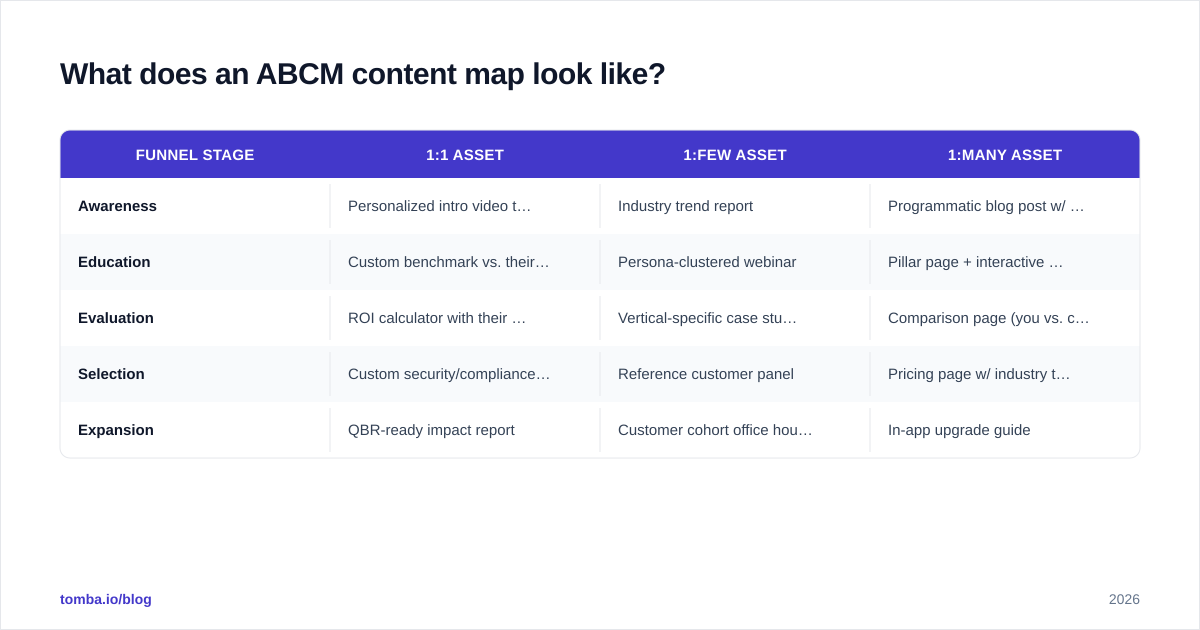
Once the TAL exists, map content to the buyer's journey for each tier. The same story gets retold in different formats and depths.
| Funnel stage | 1:1 asset | 1:few asset | 1:many asset |
|---|---|---|---|
| Awareness | Personalized intro video to CRO | Industry trend report | Programmatic blog post w/ logo |
| Education | Custom benchmark vs. their peers | Persona-clustered webinar | Pillar page + interactive quiz |
| Evaluation | ROI calculator with their data | Vertical-specific case study | Comparison page (you vs. competitor) |
| Selection | Custom security/compliance brief | Reference customer panel | Pricing page w/ industry tokens |
| Expansion | QBR-ready impact report | Customer cohort office hours | In-app upgrade guide |
Most teams have the 1:many column filled in (their existing blog and resource library). The competitive advantage in 2026 is the 1:1 and 1:few columns. Building one custom 1:1 microsite for a top-30 strategic account takes a strong copywriter 2–3 days. That same effort, repeated 30 times in a year, often outproduces an entire SDR team's outbound for those accounts.
How do you produce ABCM content without burning out the team?#
Three patterns separate teams that ship ABCM content from teams that talk about it.
Modular content blocks. Write once, reuse everywhere. A single product-led story can be sliced into a 1,200-word blog post, a 30-second video, an executive one-pager, a 12-slide deck and a LinkedIn carousel. Build the assets in atoms (claims, stats, quotes, screenshots) and assemble them per account.
Templated 1:1 microsites. Use a tool like Mutiny, RollWorks or PathFactory — or just a duplicable page template in your CMS — that swaps logo, industry stats, named contacts and a custom intro paragraph. The structural skeleton stays the same. Production drops from 3 days to 3 hours per account.
AI as the first draft, human as the last mile. GPT-class models will research the account, draft a custom intro and propose three angles in under 90 seconds. A human writer's job becomes editing for voice, adding the proprietary claim and shipping. This is also where your cold email AI can co-pilot the outbound sequence that promotes the asset.
What does not work: trying to handwrite every asset from scratch, or fully automating the writing and shipping unedited output. Both fail in opposite ways — the first never ships, the second ships garbage.
How do you distribute ABCM content?#
Distribution is where ABCM diverges hardest from regular content marketing. You are not waiting for Google. You are putting the asset directly in front of named humans.
The five distribution channels, in roughly the order they convert:
- 1:1 outbound email from the AE. A personalized "I built this for you" email with a custom link, sent from the rep's signature. Highest reply rate in the stack. Requires verified contact data — see the LinkedIn finder for sourcing from LinkedIn profiles.
- LinkedIn DM + connection request from the rep or exec. A custom microsite link sent in a connection note converts at 5–10x a cold email.
- Programmatic ABM ads (LinkedIn Matched Audiences, 6sense, Demandbase). Account-targeted display retargeting that drives traffic to the personalized page.
- Direct mail unlock. A physical mailer (book, gift, custom item) with a QR code to the microsite. Expensive, but pulls a 15–30% reply rate when targeted right.
- Sales-led webinars and roundtables for the cluster. A 1:few play — invite 30 buyers from 12 accounts in the same vertical to a closed-door discussion.
Notice what is missing: organic social, SEO, and broad newsletter blasts. These are not ABCM channels. They are content marketing channels that can support an ABCM program at the awareness layer, but they will never close the loop on a named account.
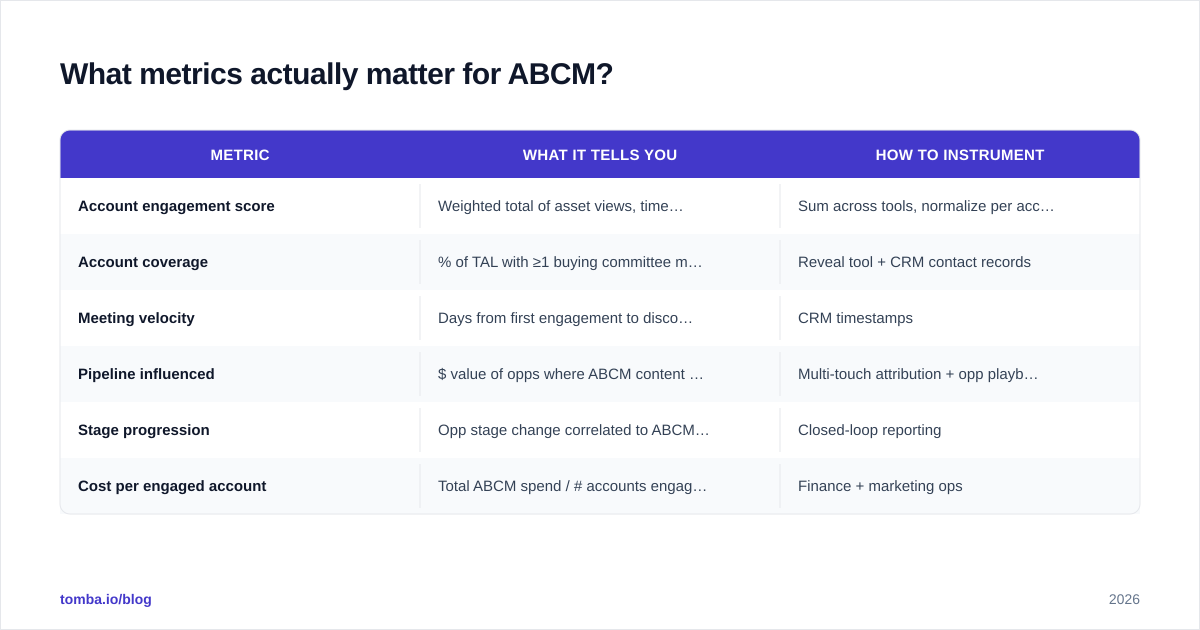
What metrics actually matter for ABCM?#
Throw out the traffic metrics. The dashboard for ABCM looks different.
| Metric | What it tells you | How to instrument |
|---|---|---|
| Account engagement score | Weighted total of asset views, time on page, video completion, repeat visits per account | Sum across tools, normalize per account |
| Account coverage | % of TAL with ≥1 buying committee member engaged in last 30 days | Reveal tool + CRM contact records |
| Meeting velocity | Days from first engagement to discovery call booked | CRM timestamps |
| Pipeline influenced | $ value of opps where ABCM content was touched in last 90 days | Multi-touch attribution + opp playbook |
| Stage progression | Opp stage change correlated to ABCM content consumption | Closed-loop reporting |
| Cost per engaged account | Total ABCM spend / # accounts engaged this quarter | Finance + marketing ops |
The headline number for your board deck should be pipeline influenced per ABCM dollar. Everything else is operational. If you cannot connect the asset to an opportunity in Salesforce or HubSpot, you cannot defend the budget when the CFO comes asking.
For the underlying definitions, revenue operations needs to own the attribution model — marketing alone cannot ship it.
What's the ABCM tech stack in 2026?#
Six layers, ordered by what you need first.
| Layer | Purpose | Example tools |
|---|---|---|
| Account graph | Single source of truth for TAL, firmographics, intent | Salesforce + Clearbit, HubSpot + 6sense |
| Contact data | Decision-maker emails, phones, LinkedIn URLs | Tomba, Apollo,ZoomInfo |
| Content authoring | CMS that supports dynamic tokens and templating | Webflow, Sanity, Contentful |
| Personalization | Swap content per visitor account in real time | Mutiny, RB2B, PathFactory |
| Distribution | Outbound sequencer, ABM ads, direct mail | Outreach, Instantly, Sendoso |
| Analytics | Account-level engagement scoring + attribution | Dreamdata, HockeyStack, native Salesforce |
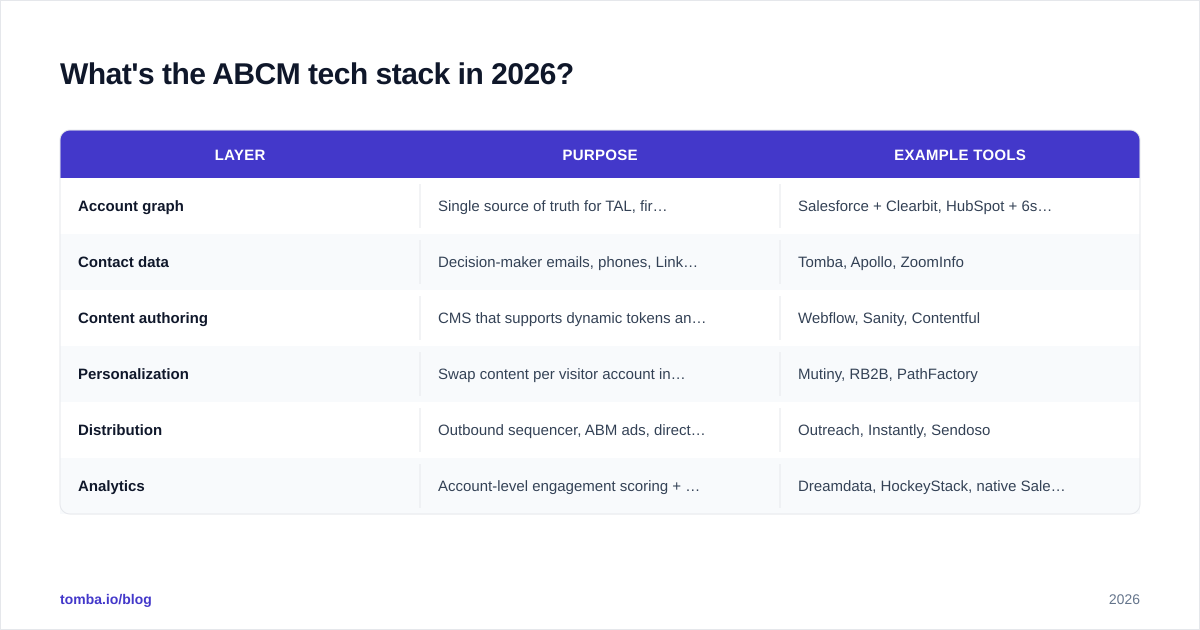
You do not need all six on day one. Most teams start with account graph + contact data + a templated landing page and add the rest over the first year. The trap is buying a $60K personalization platform before you have 100 accounts and verified contacts to point it at.
For comparison shopping the contact data layer, Apollo alternatives and ZoomInfo-class platforms are worth benchmarking on coverage, accuracy and price per credit before you commit.
How is ABCM different from demand generation and content marketing?#
This is the question every CMO asks in the quarterly planning meeting. Crisp answer:
| Dimension | Content marketing | Demand generation | Account based content marketing |
|---|---|---|---|
| Audience unit | Persona | Persona + lead score | Named account |
| Distribution | Organic search, social | Paid, gated, nurture | Direct, personalized, account-targeted |
| Asset shape | Evergreen, scalable | High-conversion, gated | Custom, often single-use |
| Primary metric | Traffic, rankings | MQLs, SQLs | Pipeline influenced per account |
| Sales involvement | Low | Medium | High — sales co-builds and distributes |
| Time to ROI | 6–12 months | 3–6 months | 1–3 months for top-tier accounts |
ABCM is not a replacement for the other two — it is the layer on top, focused on the accounts that move the revenue number. Most mature teams run all three in parallel, with content marketing feeding the funnel, demand gen converting it, and ABCM accelerating the strategic deals.
What does a 90-day ABCM rollout look like?#
If you are starting from zero, here is the minimum viable program.
Days 1–30 — Foundation.
- Pull TAL from CRM (firmographic + sales-vetted, 100–300 accounts).
- Enrich every account with decision-maker contacts via Tomba's bulk lookup and verify the list.
- Pick 10 lighthouse accounts for 1:1 plays.
- Audit existing content. What can be repackaged into industry/persona variants?
Days 31–60 — Build.
- Ship one templated 1:few landing page per top vertical (usually 3–5 pages).
- Build one custom 1:1 microsite for the top 3 lighthouse accounts.
- Launch a sales-led ABM ad campaign against the full TAL.
- Stand up account engagement reporting in your CRM.
Days 61–90 — Distribute and learn.
- AEs send 1:1 outbound to the 10 lighthouse accounts referencing the asset.
- Launch sequenced nurture for the 1:few cohorts.
- Review engagement weekly. Which accounts are reading? Which assets pull replies?
- Lock in the metrics you will report to leadership in Q+1.
You will not have closed revenue in 90 days. You will have signal: which accounts engaged, which sales conversations got warmer, which assets earned replies. That signal is what justifies scaling the program in quarter two.
What are the biggest ABCM mistakes to avoid?#
Five patterns burn ABCM programs every time.
- Building before you have contacts. The most beautiful 1:1 microsite is worthless if you cannot put it in front of a buying committee. Fix the contact data layer first — that means a verified, deduped, decision-maker-level list, sourced from reliable data and routed into your CRM.
- Optimizing 1:many before 1:1 works. Programmatic personalization at scale is hard. Get one 1:1 motion to convert before you industrialize it.
- Reporting on traffic. If your ABCM dashboard shows sessions and time on page, you are running content marketing with extra steps. Rebuild the dashboard around account engagement and pipeline.
- Sales not co-owning. ABCM dies in marketing-only orgs. The AEs must distribute the asset, follow up on engagement and report what landed.
- Tooling before strategy. Buying Mutiny, 6sense and Demandbase in the same quarter is how you spend $200K and learn nothing. Buy the platform after you have a working manual motion.
Ready to fuel your ABCM program with verified contacts?#
ABCM lives or dies on whether you can reach the named humans on your target account list. Beautiful microsites, custom ROI models and personalized executive briefs do nothing if your outbound emails bounce or your reps don't have the right inbox to send to.
Tomba Email Finder finds decision-maker emails by domain, name, or company, verifies them in the same call, and pushes the cleaned list into Salesforce, HubSpot or your sequencer of choice. Free tier gives you 25 searches a month to test it on your top-10 lighthouse accounts; paid plans start at $49/month for full ABCM-scale lookups. See full Tomba pricing when you are ready to scale the program.
Build the asset, find the buyer, ship the play. That is account based content marketing in 2026.
Ready to find emails that actually work?
Join 150,000+ professionals who stopped guessing and started sending. Free credits on signup — no credit card required.
Get the Tomba newsletter
Practical outbound tactics and product updates — once every two weeks.
About the author