Account Based Marketing Campaigns: 2026 Playbook & Examples
A field-tested playbook for account based marketing campaigns in 2026: how to pick target accounts, build the data spine, sequence plays across channels, and measure pipeline impact.
TL;DR#
- Account based marketing campaigns work when sales and marketing share one target list, one data spine, and one definition of "engaged."
- A 2026 ABM program is not a single channel — it's a coordinated sequence of ads, email, LinkedIn, direct mail, and SDR plays against a finite account list (typically 50–500).
- The cheapest mistake to avoid: launching ABM ads before your contact data is clean. Bad emails and missing buying-committee roles tank every downstream play.
- Use a 1:1 / 1:few / 1:many tier model. Spend disproportionately on the top tier; automate the long tail.
- Measure pipeline created, deal velocity, and account engagement score — not MQLs. MQLs are the wrong unit for ABM.
What are account based marketing campaigns?#
Account based marketing campaigns are coordinated outreach programs that treat a named list of companies — not individual leads — as the unit of revenue. Instead of generating 10,000 MQLs and hoping a few are from your ideal customer profile (ICP), you pick the 200 accounts you actually want to close, then orchestrate ads, email, social, events, and SDR outreach against the full buying committee inside each one.
Think of it like a film crew shooting a single big-budget scene versus a stock-photo factory cranking out a thousand images. ABM is the film crew: fewer subjects, far more attention per subject. Technically, it's the deliberate alignment of marketing spend with sales target accounts, where every touch is logged against the account record in your CRM and rolled up into an account engagement score.
The Information Technology Services Marketing Association (ITSMA) coined the term in 2004. Two decades later, Forrester reports that 70%+ of B2B marketers above $250M in revenue run some form of ABM program. What changed in 2026 is the tooling: signal-based intent, AI-personalized landing pages, and CRM-native orchestration mean a 4-person marketing team can now run plays that used to require a Demandbase deployment.
Why do ABM campaigns beat traditional demand gen for B2B?#
Traditional demand gen optimizes for volume: total leads, cost per MQL, form-fill rate. That works for self-serve SaaS at <$5K ACV. It falls apart the moment your average deal size crosses $30K and your buying committee crosses 4 people, because:
- One MQL from a 12-person buying committee is statistical noise. You need 6+ engaged contacts at the same account before sales has a real shot.
- The "lead" abstraction hides what matters: is this account in-market right now? Are the right titles engaging? Is the champion talking to procurement yet?
- Most MQLs at enterprise accounts are interns and analysts. Routing them to AEs wastes cycles.
ABM flips the unit of analysis from person to company. The same $50K marketing spend, redirected from broad LinkedIn ads to 100 named accounts with personalized landing pages and matched SDR outreach, typically produces 3–5x more qualified pipeline. Not because the channels are better — because the targeting is.
What are the three tiers of ABM campaigns?#
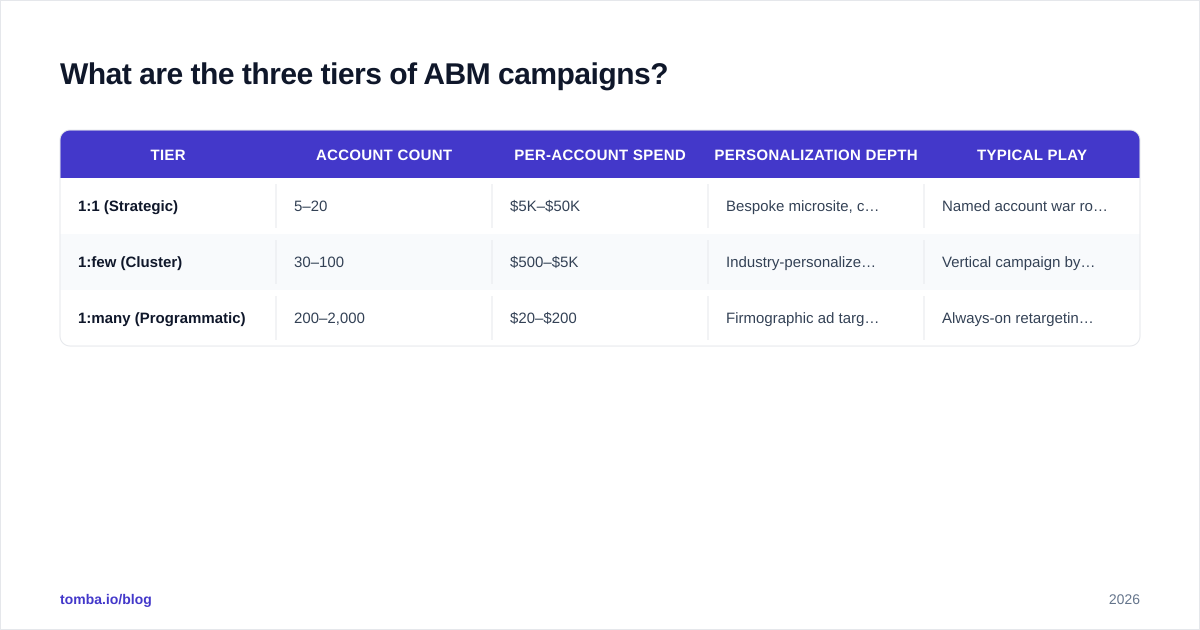
ITSMA's tiered model is still the cleanest way to think about how much you should spend per account. In 2026 the labels are unchanged but the tooling per tier has gotten cheaper, so even a 5-person team can run all three.
| Tier | Account count | Per-account spend | Personalization depth | Typical play |
|---|---|---|---|---|
| 1:1 (Strategic) | 5–20 | $5K–$50K | Bespoke microsite, custom research, executive briefings | Named account war room with sales |
| 1:few (Cluster) | 30–100 | $500–$5K | Industry-personalized landing pages, role-based ads | Vertical campaign by segment |
| 1:many (Programmatic) | 200–2,000 | $20–$200 | Firmographic ad targeting, dynamic content | Always-on retargeting + nurture |
The mistake most teams make is starting at 1:1 because it sounds impressive. Start at 1:few. You'll learn what messaging resonates across a cluster, then graduate your top 10 accounts to 1:1 treatment once you see engagement.
How do you pick the target account list?#
Your account list is the entire program. Get it wrong and no amount of clever creative saves you. The selection process has three layers stacked on top of each other:
1. ICP fit. Static firmographics: industry, employee count, revenue band, tech stack, geography. This filters your TAM down to "companies who could plausibly buy."
2. Intent signal. Dynamic behavior: surge in research topics relevant to your category, recent funding, leadership changes, hiring spikes for adjacent roles, job posts mentioning your competitors. This narrows further to "companies who are probably in-market this quarter."
3. Relationship strength. First-party signals: existing pipeline, past customers churned, warm intros available, opted-in newsletter subscribers, free tool users. This identifies "companies where you have an unfair advantage."
A defensible list usually has 60% ICP-only, 30% ICP + intent, 10% ICP + intent + relationship. Refresh the bottom 20% monthly — accounts that haven't shown a single signal in 90 days are dead weight.
To build the contact-level data underneath the account list, most teams stitch together a B2B database for firmographics, an intent provider (Bombora, G2 Buyer Intent, 6sense), and an email finder to fill in buying-committee gaps your CRM doesn't have.
What data infrastructure do ABM campaigns require?#
ABM dies on bad data. Specifically, on three problems:
- Account-to-contact mapping. You target Acme Corp, but your CRM has 8 contacts at "Acme Corporation," 3 at "Acme Corp.", and 4 at "acme.com" — none of them merged. Every ad impression and email send fragments across these records.
- Buying committee coverage. You have the VP of Marketing's email but not the CMO, CFO, or three directors who actually approve the deal.
- Email and phone freshness. 25–30% of B2B contact data decays each year (HubSpot's 2024 State of Marketing). An ABM list built 18 months ago is mostly noise today.
The fix is mechanical, not strategic. You run weekly:
- Account dedup against a canonical domain (preferred) or D-U-N-S number
- Buying-committee gap report: for every Tier 1/2 account, which of the 6–8 required titles are missing? Fill the gaps with a bulk email finder or LinkedIn-sourced enrichment.
- Email verification on every contact before any send. Bounces above 2% threaten sender reputation across your whole domain — see our email deliverability glossary entry for the deeper plumbing.
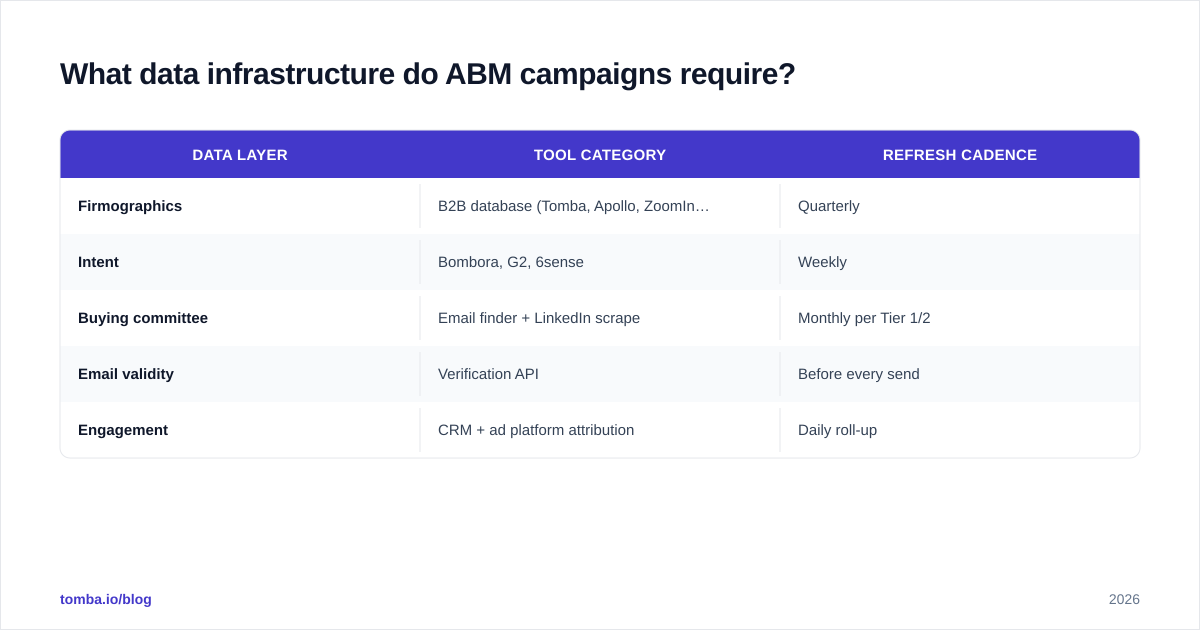
| Data layer | Tool category | Refresh cadence |
|---|---|---|
| Firmographics | B2B database (Tomba, Apollo,ZoomInfo) | Quarterly |
| Intent | Bombora, G2, 6sense | Weekly |
| Buying committee | Email finder + LinkedIn scrape | Monthly per Tier 1/2 |
| Email validity | Verification API | Before every send |
| Engagement | CRM + ad platform attribution | Daily roll-up |
What channels actually move ABM accounts?#
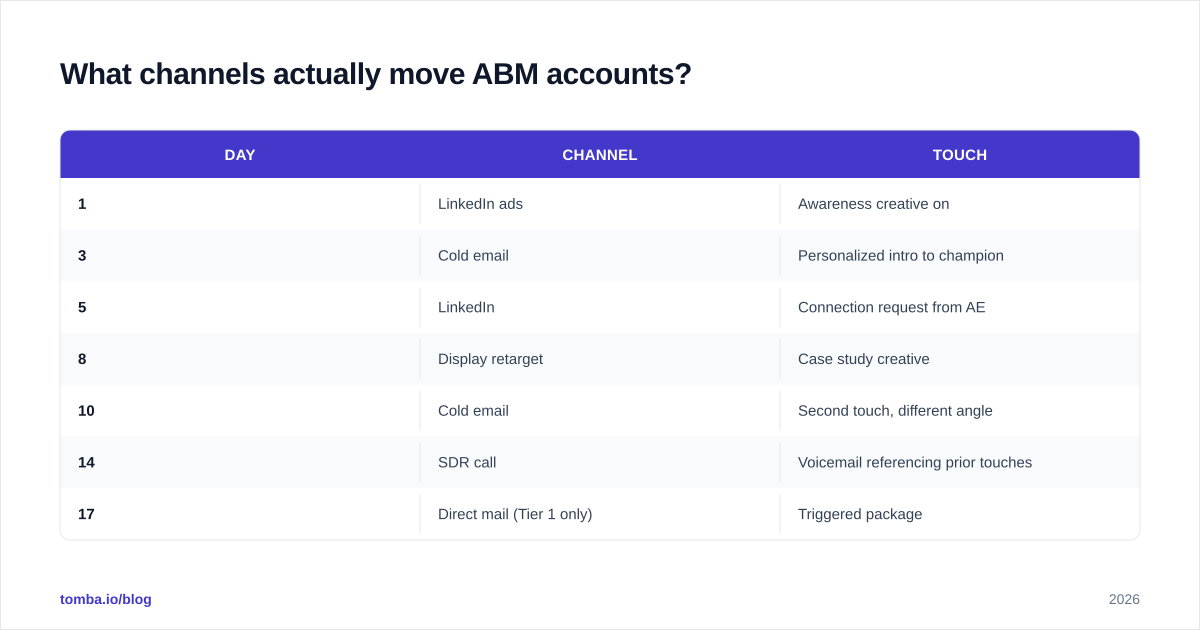
A 2026 ABM campaign typically runs 4–6 channels in coordinated sequence. The exact mix depends on tier, but the principle is consistent: one channel is a touch, three channels is a campaign.
- LinkedIn ads (matched audiences): upload your account list, target by title within those companies. Highest-fidelity B2B targeting available. Expect $80–$200 CPMs but 5–10x better click-to-meeting rates than broad targeting.
- Display retargeting: lower CPMs ($15–$30) for brand reinforcement against the same account list via 6sense, Demandbase, or RollWorks.
- Cold email to the buying committee: personalized, role-specific, sent from the right rep's mailbox. This is the highest-conversion channel and the easiest to break (deliverability).
- SDR phone/voicemail: still works at the top tier. A real voicemail from a real human is a 1:1 signal.
- Direct mail: for Tier 1 only. Triggered by intent signals — a custom box arrives the week after a champion downloads your pricing page.
- Executive social: your CEO/CRO commenting on the target buyer's LinkedIn post. Manual, expensive, disproportionately effective.
The sequencing matters more than the channel list. A common high-performing 21-day cadence for Tier 2 accounts:
| Day | Channel | Touch |
|---|---|---|
| 1 | LinkedIn ads | Awareness creative on |
| 3 | Cold email | Personalized intro to champion |
| 5 | Connection request from AE | |
| 8 | Display retarget | Case study creative |
| 10 | Cold email | Second touch, different angle |
| 14 | SDR call | Voicemail referencing prior touches |
| 17 | Direct mail (Tier 1 only) | Triggered package |
| 21 | Cold email | Breakup or meeting ask |
What does a great ABM campaign play look like?#
A "play" is a self-contained mini-campaign with a trigger, a target, a sequence, and a goal. Think of plays as the atomic unit of an ABM program — the program is just a portfolio of plays running concurrently.
Example: Competitor evaluation play
- Trigger: account researches your competitor on G2 (intent signal)
- Target: VP and director titles in product, engineering, ops
- Sequence: LinkedIn ad ("Switching from X to Y" case study) → cold email from AE with side-by-side comparison → SDR call referencing the research
- Goal: book a 30-min discovery call
- Success metric: meetings booked from triggered cohort vs. control
Example: New executive welcome play
- Trigger: target title hire announced at ICP-fit account (job change signal)
- Target: the newly hired exec + their direct reports
- Sequence: personalized congratulations email → relevant case study → invitation to a private 5-person roundtable
- Goal: warm intro before they finish their first-90-day tool audit
- Success metric: response rate from new hires within 30 days
Build a library of 8–12 plays mapped to your highest-value triggers. Most ABM programs that struggle aren't missing tooling — they're missing a documented play library.
How do you measure ABM campaign performance?#
The single biggest mistake in ABM measurement is reporting MQLs. MQLs reward the wrong behavior: routing analysts and interns to AEs because they filled a form. The right metrics:
- Account engagement score: weighted sum of touches (ad click, email reply, page visit, demo) across all known contacts at the account. The aggregation is what matters.
- Pipeline created from target accounts: dollar value of opportunities sourced from the named list, segmented by tier.
- Win rate, target vs. non-target: if ABM is working, target accounts should close at 1.5–3x the rate of inbound from non-list companies.
- Deal velocity: target accounts should move from stage 1 to closed-won faster, because the buying committee was already warm.
- Cost per opportunity (not per lead): what does it cost to generate one qualified opportunity from a Tier 2 account? This is the only spend efficiency metric worth optimizing.
Set up a target-account dashboard in Salesforce or HubSpot with these five metrics. Report weekly. Anything else is a vanity slide.
What ABM tools should you compare in 2026?#
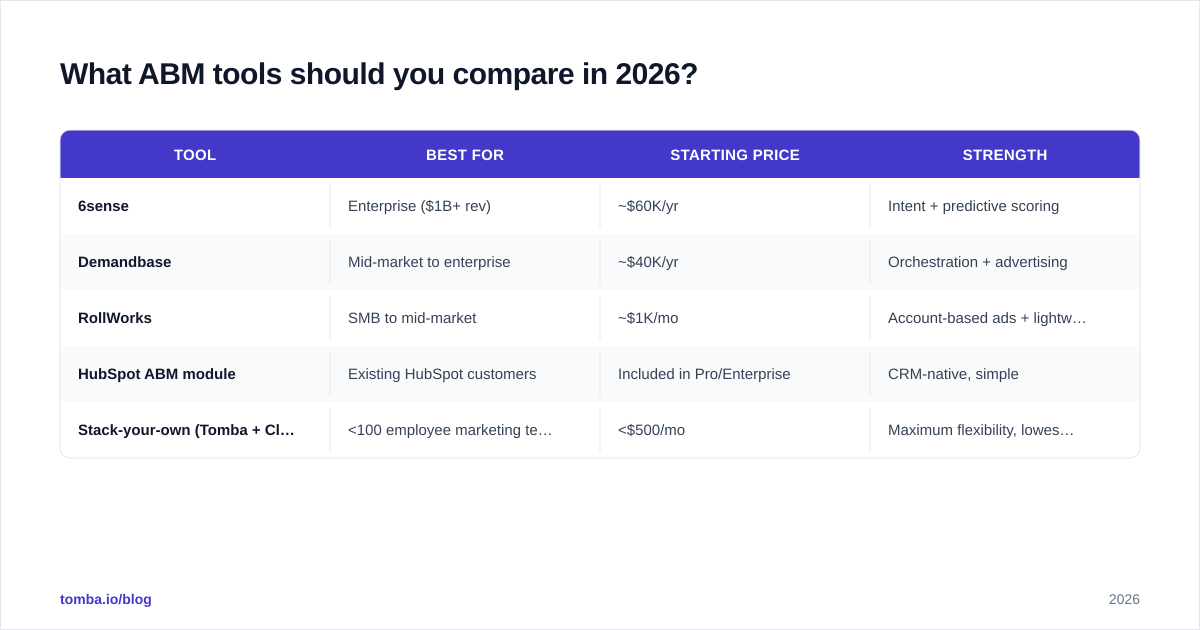
The platform market has consolidated. You'll evaluate one of three categories depending on company size:
| Tool | Best for | Starting price | Strength |
|---|---|---|---|
| 6sense | Enterprise ($1B+ rev) | ~$60K/yr | Intent + predictive scoring |
| Demandbase | Mid-market to enterprise | ~$40K/yr | Orchestration + advertising |
| RollWorks | SMB to mid-market | ~$1K/mo | Account-based ads + lightweight scoring |
| HubSpot ABM module | Existing HubSpot customers | Included in Pro/Enterprise | CRM-native, simple |
| Stack-your-own (Tomba + Clay + Apollo + LinkedIn) | <100 employee marketing teams | <$500/mo | Maximum flexibility, lowest cost |
For most teams under 200 employees, the right answer is "stack your own" — build the data spine with Tomba and a B2B database, orchestrate through your existing marketing automation, and skip the $60K platform fee until your program is mature enough to need it. Compare more options in our Apollo alternatives and Clearbit alternatives write-ups.
What are the most common ABM campaign mistakes?#
After watching dozens of programs launch, these are the failures that kill more ABM rollouts than any platform decision:
- Account list too big. "We're doing ABM on 5,000 accounts" means you're doing demand gen with a target list. Cut to 500.
- No sales alignment. Marketing picks the list, sales ignores it, the program dies in quarter two. Run a joint workshop; sales must commit to working the list.
- Vanity engagement metrics. "Ad impressions on target accounts up 300%" is not a result. Pipeline is the result.
- One-touch campaigns. A single LinkedIn ad campaign is not ABM. Without sequencing across channels you're just running display ads.
- Stale data. See the data infrastructure section. Refresh contacts before every campaign or burn deliverability.
- Ignoring the long tail. Tier 1 gets all the attention while 1,000 Tier 3 accounts sit idle. Programmatic always-on retargeting is cheap; run it.
- No play library. Reinventing the wheel every quarter. Document plays, measure them, retire the losers, scale the winners.
How do you launch your first ABM campaign in 30 days?#
A realistic first-program timeline if you're starting cold:
- Week 1: Joint sales+marketing workshop. Lock the ICP, agree on a 100-account starter list, define the buying committee titles (usually 6–8 per account).
- Week 2: Build the data spine. Enrich every account with current contact emails, phones, and roles. Verify, dedup, segment by tier. This is where most teams spend the most time — budget accordingly.
- Week 3: Build 3 plays. Pick one trigger-based (competitor research), one always-on (Tier 2 nurture), one Tier 1 (executive ABM). Write copy. Build creative. Set up tracking.
- Week 4: Launch. Run for two weeks before judging. Review engagement scores weekly, pipeline monthly.
Don't try to launch all 12 plays at once. Pick three, launch, measure, expand.
Final take#
Account based marketing campaigns aren't a tool you buy — they're an operating model your sales and marketing teams adopt together. The technology is now commoditized; the platforms are interchangeable past a certain size; the difference between a program that produces $5M in pipeline and one that produces $50K comes down to list discipline, data hygiene, and play execution.
If you're starting from scratch, the highest-leverage place to invest is the contact data layer — because nothing else works without it. Build a target list, find the buying committee, verify every address. Then launch your first three plays.
Tomba's Email Finder is built for exactly this: feed it your target-account domains, pull the full buying committee with verified emails, and hand the clean list to your campaign tool. Free tier starts at 25 searches per month — enough to test against your first 10 accounts before committing to a paid plan. Plug it into your existing stack via the Tomba API, HubSpot integration, or Salesforce integration and start running ABM plays this week.
// get started
Find, verify and enrich your first contacts today
Start on the free plan with 25 searches a month, then scale when your team is ready.
Free plan · No credit card required · GDPR & CCPA
// about the author