Account Based Marketing Checklist: The 2026 ABM Playbook
A practical, no-fluff account based marketing checklist for 2026. Build your ICP, pick target accounts, align sales and marketing, run plays, and measure pipeline impact.
TL;DR#
- Account based marketing (ABM) in 2026 is a tight loop: pick a small list of accounts, build a shared sales-marketing plan per tier, run plays against named buyers, and measure pipeline — not MQLs.
- Most ABM programs fail because of bad data and weak sales alignment, not bad creative. Fix the contact list and the joint scorecard first.
- This account based marketing checklist walks through 9 phases: strategy, ICP, account selection, tiering, data, plays, channels, measurement, and iteration.
- AI changes the budget math: personalization at scale is now cheap, but generic AI outreach is already trained out of the inbox. Specificity wins.
- Tooling matters less than discipline. Pair a clean data foundation (a verified B2B database and an email verifier) with a real account plan and you will outperform teams running a $200k stack on guesswork.
What is account based marketing in 2026?#
Account based marketing is a go-to-market strategy where marketing and sales jointly target a defined set of high-value accounts with coordinated, personalized plays, instead of generating leads from a wide funnel and hoping the right buyer slips through.
In 2026, the practical definition has shifted. The "ABM vs. inbound" debate is over — most mature B2B teams run a hybrid: inbound for the long tail, ABM for the named accounts they actually want to close. The center of gravity has moved from "send a direct mail box" to "orchestrate buying committees across email, LinkedIn, ads, and human follow-up, with shared data."
If you want the textbook definition, Gartner describes ABM as "an alternative B2B strategy that concentrates sales and marketing resources on a clearly defined set of target accounts within a market." That's still accurate. What's new is the speed at which you can execute it.
For more on the broader GTM motion this sits inside, see our note on revenue operations.
Why does ABM still work when buyers ignore everything else?#
Three reasons.
First, B2B buying committees are bigger. The average enterprise deal now touches 9-12 people. A lead-based funnel optimizes for one of them filling out a form. ABM optimizes for the account — the full committee, mapped, sequenced, and influenced together.
Second, inbound volume is flat or declining in most categories. Generic gated whitepapers stopped converting around 2023. Outbound volume is up, response rates are down. The teams winning today are running fewer, deeper plays on fewer accounts.
Third, CAC is up across the board. When every channel is more expensive, concentrating spend on accounts that match your ICP yields a better return than spraying it across a million impressions.
The account based marketing checklist (9 phases)#
This is the checklist we recommend running through, in order, before you spend a dollar on ABM tooling. Each phase has a clear deliverable.
Phase 1 — Strategy and scope#
- Pick the business outcome (new logo pipeline, expansion, win-back, geo entry)
- Define the program size: 1:1 (5-25 accounts), 1:few (25-200), 1:many (200-1000+)
- Set a 12-month revenue target tied to the account list, not impressions
- Get executive sponsorship from both VP Sales and VP Marketing in writing
- Agree on the "no" list — segments, regions, or company sizes you will NOT pursue
Phase 2 — ICP definition#
- Pull your last 24 months of closed-won and closed-lost deals
- Cluster closed-won by industry, size, tech stack, geography, and trigger event
- Identify the 3-5 firmographic attributes that predict close rate
- Identify the 2-3 technographic attributes (tools they already use) that correlate with fit
- Document buying committee roles: economic buyer, champion, technical evaluator, blocker, end user
- Write a one-page ICP doc that a new SDR could repeat back to you in 60 seconds
Phase 3 — Account selection#
- Source the candidate universe from a clean B2B database
- Score every account by ICP fit (firmographic + technographic + intent)
- Have AEs nominate 10-25 dream accounts each and score them on the same scale
- Merge, deduplicate, and rank — top of the list goes to tier 1
- Review the final list with sales leadership before publishing
Phase 4 — Tiering#
- Tier 1 (1:1) — top 5-25 accounts, custom plays, dedicated AE + marketer time
- Tier 2 (1:few) — 25-200 accounts grouped by industry or use case, light personalization
- Tier 3 (1:many) — programmatic plays, ICP-fit but not custom-served
- Document the cost-per-account budget for each tier
- Set the rule for promoting an account between tiers (and demoting one)
Phase 5 — Data and contact discovery#
- For each tier-1 account, map the full buying committee (5-12 named people)
- Verify every email with an email verifier before any campaign
- Enrich with role, seniority, tenure, and LinkedIn URL using data enrichment
- Capture phone numbers where outbound calling is in scope
- Log all contacts in the CRM under the account, not as orphan leads
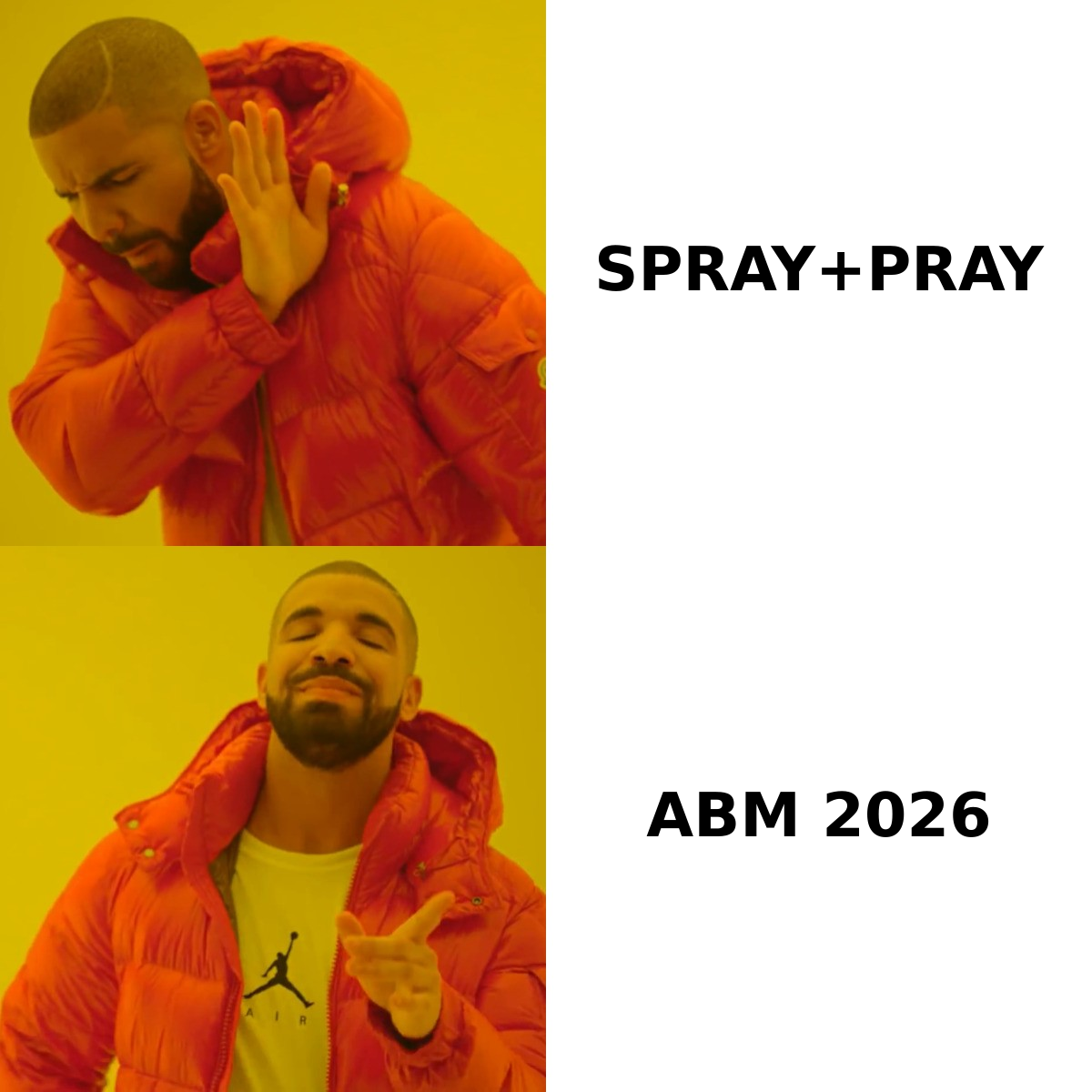
- Re-verify the list quarterly — B2B contact data decays at roughly 30% per year
Phase 6 — Plays and content#
- Build 3-5 named plays (e.g., "competitive displacement," "expansion to security team," "new-CMO welcome")
- Per play: trigger, target persona, channel mix, messaging angle, asset list, owner, SLA
- Create the assets you actually need — one-pagers, micro-sites, custom ROI calculators — not a generic library
- Build a cold email sequence per play, written for the buyer's role, not your product
- Define the human follow-up step for every digital play; ABM dies when no one calls
Phase 7 — Channel orchestration#
- Email: 1:1 from AE for tier 1, semi-templated from SDR for tier 2, marketing-sent for tier 3
- LinkedIn: AE personal outreach, marketing-sponsored InMails, retargeting ads
- Paid: account-based display, LinkedIn Sponsored Content limited to the target list
- Direct mail / gifting: budgeted for tier 1 only, tied to a meeting ask
- Events: pre-event invite plays + post-event follow-up plays, both account-scoped
- Website personalization: dynamic copy and CTAs for known tier-1 visitors
Phase 8 — Measurement#
- Build the joint scorecard: account engagement, meetings booked, pipeline created, pipeline progressed, closed-won
- Stop reporting on MQLs at the account level — they don't matter in ABM
- Track account-level "engagement score" weekly per tier
- Review pipeline coverage (pipeline ÷ quota) per segment, not just totals
- Set a quarterly business review cadence with sales
Phase 9 — Iterate#
- Kill plays with < 5% reply rate after two cycles
- Promote plays with > 15% reply rate into the standard library
- Refresh the account list every quarter; assume 10-20% churn
- Re-score ICP annually as your closed-won data evolves
- Audit data hygiene every quarter — bad data is the #1 silent killer
How do 1:1, 1:few, and 1:many ABM compare?#
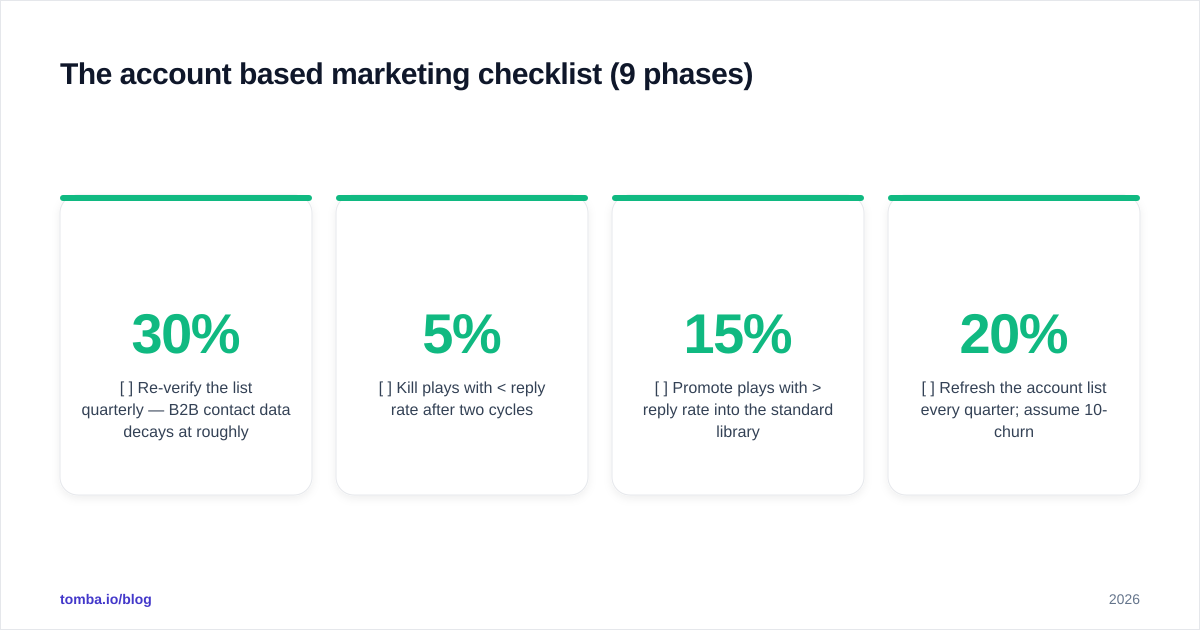
The tiers are not three flavors of the same program. They have different staffing, cost, and expected outcomes.
| Attribute | 1:1 ABM (tier 1) | 1:few ABM (tier 2) | 1:many ABM (tier 3) |
|---|---|---|---|
| Account count | 5-25 | 25-200 | 200-1000+ |
| Annual budget per account | $5,000-$50,000 | $500-$5,000 | $50-$500 |
| Personalization depth | Custom assets, named outreach | Vertical or use-case clusters | Programmatic, persona-level |
| Owner | AE + dedicated ABM marketer | SDR + marketing ops | Marketing ops + paid media |
| Channels | Email, LinkedIn, calls, gifting, events, custom site | Email, LinkedIn, ads, webinars | Ads, nurture email, retargeting |
| Expected pipeline rate | 30-60% of accounts in pipeline within 12 months | 10-20% | 3-8% |
| Best for | Enterprise net-new, named expansion | Mid-market named lists | Strategic awareness, ICP coverage |
A common mistake: running tier-3 economics with tier-1 expectations. If you're spending $200 per account, you will not get a $500k deal out of every 10 accounts. Tier the program honestly.

What data foundation do you need for ABM to work?#
Bad data is the silent killer of ABM. You can have the best play library in the industry, but if half your tier-1 contacts are wrong job titles or bounced emails, the program dies before it starts.
A defensible data foundation looks like this:
- Account-level firmographics: industry, employee count, revenue, HQ, growth signals — refreshed monthly.
- Technographics: what's in their stack today, sourced from a verified source rather than guessed.
- Contact-level enrichment: role, seniority, tenure, LinkedIn URL, validated work email, mobile where compliant.
- Intent signals: third-party intent from Bombora/6sense-equivalents, plus first-party intent from your own site, content, and product.
- CRM hygiene rules: every contact joined to an account, no orphan leads, owner assigned within 24 hours.
The cheapest place to start is fixing your contact discovery flow. Tools like Tomba's email finder, an email verifier, and domain search build a clean working list in a day. Compare to alternatives like Apollo, Clearbit, or RocketReach and weigh against your accuracy needs.

For a deeper look at where the data actually comes from, see our data sources.
What plays actually work in 2026?#
The plays that produced reply rates above 15% in the last 12 months share four traits: a clear external trigger, a specific buyer named, a value statement tied to that buyer's job, and a low-friction next step.
Here are five plays worth stealing into your library.
1. Competitive displacement#
Trigger: contract renewal window detected (G2 review activity, job postings, intent data). Target: VP-level economic buyer + technical champion. Sequence: 3 emails + 2 LinkedIn touches + 1 AE call over 14 days. Asset: 1-page comparison + ROI calculator pre-filled with their account data.
2. New-exec welcome#
Trigger: target persona starts a new role at a tier-1 account. Target: the new exec, in their first 60 days. Sequence: congratulatory note from the AE, value-add asset (industry benchmark), no ask in week one. Asset: a peer roundtable invite or a short benchmark report.
3. Product trigger#
Trigger: account shows in-product behavior matching an upsell pattern (works for expansion). Target: champion + buying authority + their boss. Sequence: usage screenshot + ROI from existing usage + meeting ask. Asset: a personalized usage report.
4. Webinar follow-up#
Trigger: tier-1 contact attended or registered for an event. Target: every attendee from the account, not just the one who registered. Sequence: same-day thank-you with the recording, 48h follow-up with a question, week-two meeting ask. Asset: event recording, related case study.
5. Cold list activation#
Trigger: account on the tier-1 list but no engagement in 90 days. Target: 3-5 buying committee members. Sequence: AE warm note + SDR follow-ups + paid retargeting + LinkedIn ad burst, all in the same 21-day window. Asset: an industry-specific point-of-view doc.
How do you measure ABM without lying to yourself?#
Most ABM dashboards lie. They report on "engaged accounts" — a metric that goes up whenever anyone opens an email — and call the program a success. Pipeline doesn't move, but the slide deck looks good.
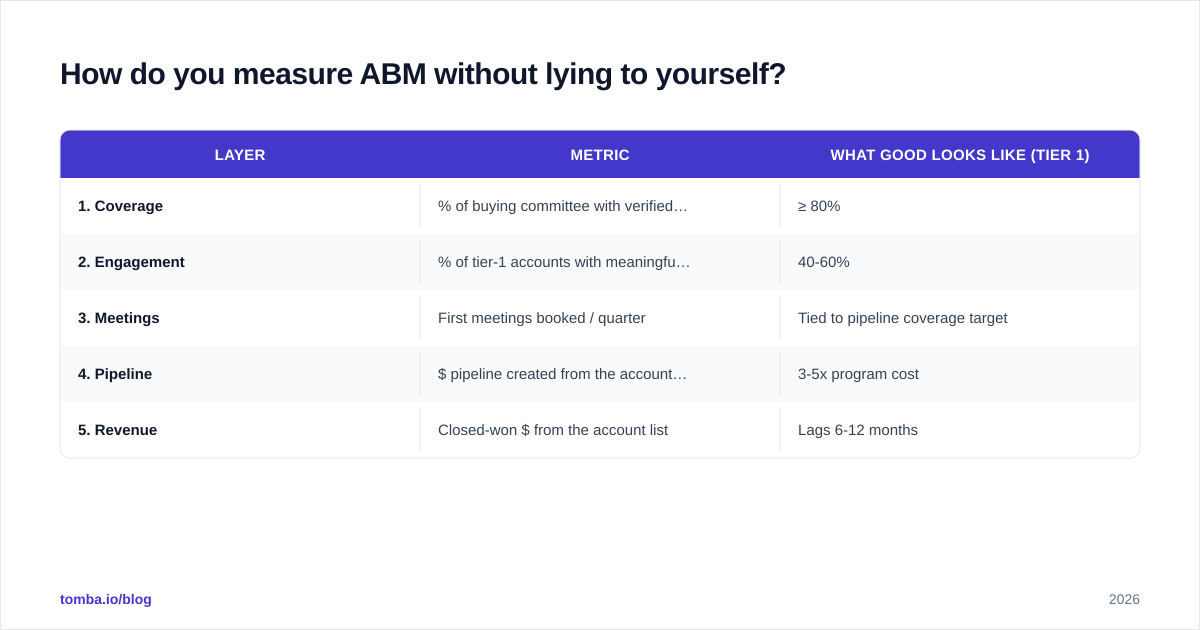
A real ABM scorecard has four layers. Use them in order. Don't skip to layer 4 to make the program look good.
| Layer | Metric | What good looks like (tier 1) |
|---|---|---|
| 1. Coverage | % of buying committee with verified contact data | ≥ 80% |
| 2. Engagement | % of tier-1 accounts with meaningful activity in 30 days | 40-60% |
| 3. Meetings | First meetings booked / quarter | Tied to pipeline coverage target |
| 4. Pipeline | $ pipeline created from the account list | 3-5x program cost |
| 5. Revenue | Closed-won $ from the account list | Lags 6-12 months |
If layer 1 is broken, every layer above it is noise. Start there.
For more on the underlying response-rate dynamics, see our note on email response rate.
How do you align sales and marketing on ABM?#
ABM that runs through marketing alone is just expensive demand gen. The only programs that hit pipeline are jointly owned. Three concrete moves get you there:
- One scorecard, one number. Marketing's bonus and sales' bonus both pay out on the same pipeline-from-target-accounts metric. If they don't, you have not aligned anything, you've just renamed your old metrics.
- One weekly stand-up. 30 minutes, Mondays, AEs + ABM marketers + RevOps. Review last week's activity, this week's plays, blockers. No status decks.
- One CRM source of truth. Every touch logged, every account owned, every play tagged. If your AE can't see the marketing touches in 3 clicks, they will assume marketing did nothing.
Cross-reference our note on sales automation for the workflow side.
What does an ABM stack actually look like?#
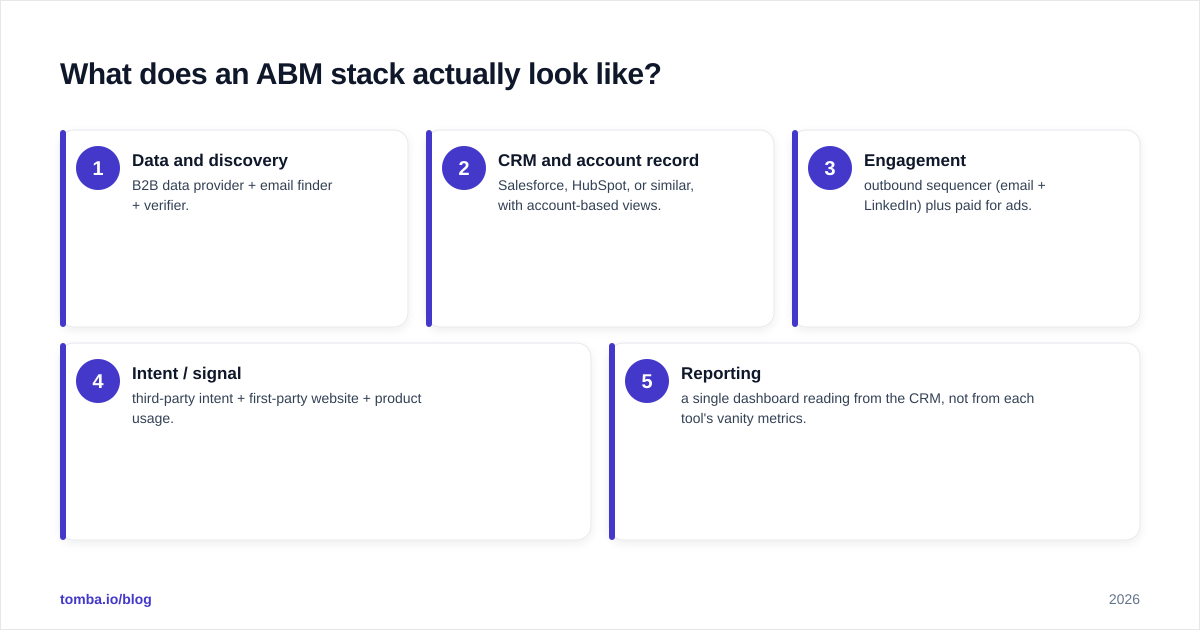
You don't need 14 tools. A working ABM stack in 2026 has five layers:
- Data and discovery — B2B data provider + email finder + verifier.
- CRM and account record — Salesforce, HubSpot, or similar, with account-based views.
- Engagement — outbound sequencer (email + LinkedIn) plus paid for ads.
- Intent / signal — third-party intent + first-party website + product usage.
- Reporting — a single dashboard reading from the CRM, not from each tool's vanity metrics.
Resist the "ABM platform" pitch that bundles all five into one $80k seat license until you have a working manual playbook. Most teams overspend on platform before they have a play library worth automating.
For a side-by-side of common starting points, see our breakdown of Apollo alternatives and the Salesforce integration.
Common ABM mistakes to avoid#
- Putting 200 accounts in tier 1 because everyone is "important." Pick 25.
- Treating ABM as a marketing campaign. It's a joint motion.
- Reporting on MQLs. They are irrelevant at the account level.
- Personalizing the wrong things. "Hi {{FirstName}}, I see you work at {{Company}}" is not personalization, it's automation. Speak to the buyer's actual problem.
- Skipping data verification. A campaign sent to bounced contacts hurts your domain reputation and your team's morale.
- Outsourcing the play. SDRs do not invent plays; they execute them. Plays belong to marketing + sales leadership.
- Quitting after one quarter. ABM pipeline lags 90-180 days. Judge it at six months minimum.
ABM checklist FAQs#
How many accounts should be in our ABM program? Tier 1: 5-25 per AE. Tier 2: 50-200 per AE. Tier 3: programmatic, no per-rep cap. Resist the urge to make tier 1 larger than your team can actually serve.
How long until ABM shows results? Engagement metrics move in 30-60 days, meetings in 60-90, pipeline in 90-180, closed-won in 6-18 months depending on your sales cycle. If your CFO won't fund the full lag, tier the program so tier-3 shows faster signal.
Can a 5-person sales team do ABM? Yes — and arguably better than enterprises. Small teams find it easier to maintain a real 1:1 account plan because there's no committee approving every play.
Is ABM dead because of AI outreach? No. AI made bad outreach worse, which makes well-executed ABM more valuable, not less. The signal-to-noise ratio in the inbox is at an all-time low. Specific, account-researched outreach stands out more in 2026 than it did in 2019.
Closing — your first 30-day ABM sprint#
If you've never run ABM before, don't try to build the whole program in a quarter. Run a 30-day sprint instead:
- Week 1: pick 20 tier-1 accounts, agree the list with sales, map buying committees.
- Week 2: verify and enrich every contact, build one play, write the sequence.
- Week 3: launch the play, log everything, hold the joint stand-up.
- Week 4: review what worked, kill what didn't, decide what to do next.
The bottleneck in week 2 is almost always data. Most teams discover their CRM contacts for tier-1 accounts are 30-50% wrong on title, seniority, or email — and that's before you've called a single one. Fix that and the rest of the program gets dramatically easier.
Tomba's Email Finder — paired with the email verifier and data enrichment — is built for this exact step: take a list of target accounts, return a verified buying committee with role, seniority, and validated work email, in minutes. Free tier covers 25 searches a month; paid plans start at $49/mo. See Tomba pricing for the full breakdown, or jump straight to the email finder and run your first tier-1 account through it before your next sales stand-up.
// get started
Find, verify and enrich your first contacts today
Start on the free plan with 25 searches a month, then scale when your team is ready.
Free plan · No credit card required · GDPR & CCPA
// about the author