Account Based Marketing CRM: The 2026 Buyer's Guide
A practical 2026 guide to choosing an account based marketing CRM — the data model, the integrations, the workflows, and the vendors actually worth shortlisting.
Account Based Marketing CRM: The 2026 Buyer's Guide
TL;DR
- An account based marketing CRM is not a separate product — it's your existing CRM (HubSpot, Salesforce, Pipedrive) re-modeled around accounts, buying groups, and intent signals instead of single leads.
- The two real choices are (1) extend a general CRM with an ABM layer like 6sense or Demandbase, or (2) buy a CRM that ships with ABM primitives out of the box.
- The biggest failure mode in 2026 is data, not software. Without verified contacts, firmographics, and intent, every ABM workflow degrades into spam to bad addresses.
- Budget plan: $99-$249/mo for contact data, $1.5K-$15K/mo for an ABM platform, $50-$150 per seat for the CRM, plus enrichment APIs on top.
- Build the buying-group view in the CRM first. Tooling comes after. If you can't list 6 stakeholders per target account from your own data, no platform will save you.
What is an account based marketing CRM?#
An account based marketing CRM is a CRM configured so the account is the unit of work, not the lead. In a lead-centric CRM, a rep sees a list of contacts and chases the ones with the highest score. In an ABM-aligned CRM, a rep sees a list of named target accounts, each with a buying group of 4-12 stakeholders, current intent signals, last touch, next play, and a single owner from both sales and marketing.
That sounds obvious. It is not how most CRMs are deployed.
To make a CRM ABM-ready, you typically need four things working together: an account list with tiering, a contact model that links every person to their employer account, intent and engagement data flowing in from outside the CRM, and orchestration that fires plays when a target account heats up. A vanilla CRM gives you the first two. The other two come from add-ons, enrichment, or a dedicated ABM platform.
Gartner's coverage of account-based marketing frames it the same way: ABM is a go-to-market strategy first, a software category second.
Why does the CRM matter more than the ABM platform?#
Because the CRM is where the work actually happens. ABM platforms are excellent at scoring, surfacing intent, and lighting up ads — but reps don't live in them. Reps live in HubSpot tabs, Salesforce list views, or Pipedrive pipelines. If the ABM signals don't land cleanly inside those tools as fields, tasks, and filters, the signals get ignored.
A useful test: ask any rep to show you the next 5 target accounts they will work this week. If they have to open a second tool to answer, your ABM stack is broken. The CRM is the truth layer. Everything else feeds it.
How does an ABM CRM differ from a regular CRM?#
The differences look small in a demo and feel huge in production.
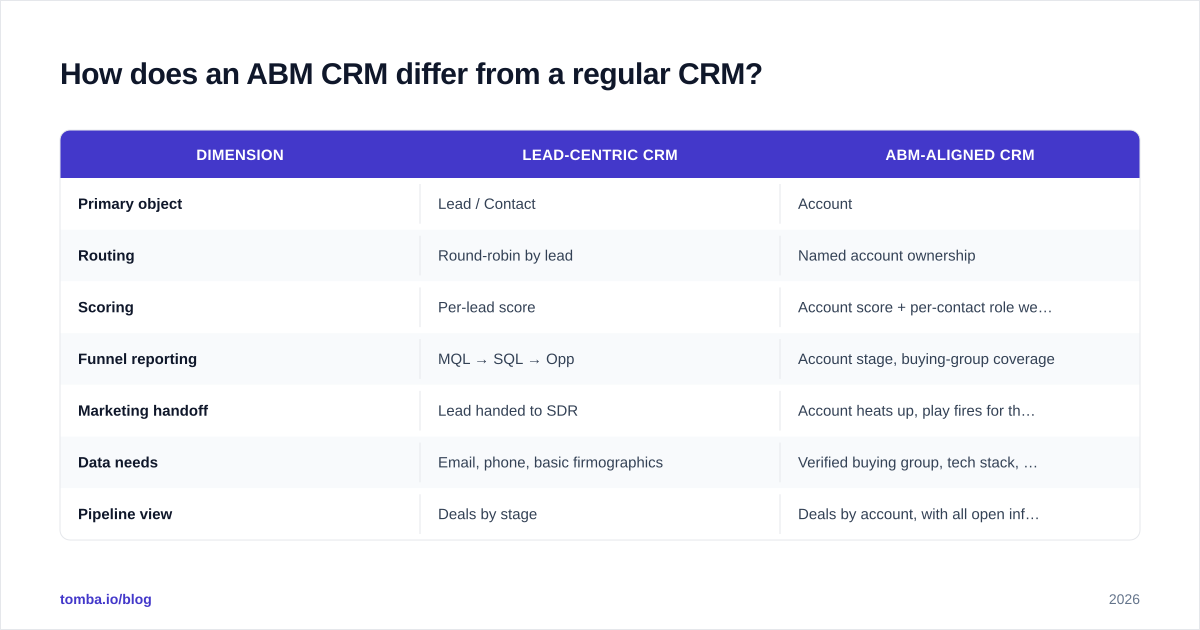
| Dimension | Lead-centric CRM | ABM-aligned CRM |
|---|---|---|
| Primary object | Lead / Contact | Account |
| Routing | Round-robin by lead | Named account ownership |
| Scoring | Per-lead score | Account score + per-contact role weighting |
| Funnel reporting | MQL → SQL → Opp | Account stage, buying-group coverage |
| Marketing handoff | Lead handed to SDR | Account heats up, play fires for the whole group |
| Data needs | Email, phone, basic firmographics | Verified buying group, tech stack, intent, hierarchy |
| Pipeline view | Deals by stage | Deals by account, with all open influence |
| KPI | MQL volume | Pipeline coverage on target list, win rate per tier |
Look at the Routing row first. That single decision rewrites everything below it. The moment marketing and sales agree the named account is the unit, MQL volume stops being the KPI and pipeline coverage on the target list takes over.
What features should an account based marketing CRM actually have?#
A short, opinionated list. Anything beyond these is nice-to-have.
- Account hierarchy — parent/child relationships so you can roll up engagement across subsidiaries.
- Buying group model — every contact tagged by role (champion, decision-maker, blocker, user, finance) and seniority. Not a custom field — a real schema.
- Account-level scoring — accepts inputs from intent vendors, web analytics, product usage, and ad engagement, not just form fills.
- Signal inbox — surfaces "this account just did X" in a place reps will see (not a separate dashboard).
- Play library — templated motions (e.g., "Tier 1, no opp, surge detected → send Loom + book exec touch") that any rep can fire.
- Bi-directional sync with the ad platform — LinkedIn audiences, Google Customer Match, Meta CAPI, fed from CRM segments.
- Reporting on coverage — % of target accounts with ≥3 known stakeholders, % with active engagement in last 30 days, pipeline coverage by tier.
- Verified contact data — clean firmographics and a working email for every named contact. This is where most stacks silently fail. A purpose-built email finder and email verifier are non-negotiable here.
Forrester's B2B Revenue Waterfall is a useful reference for the account + buying-group reporting shape.
Which CRM is the best account based marketing CRM in 2026?#
There is no single best CRM. There are good fits per company size and per ABM maturity. The honest comparison:
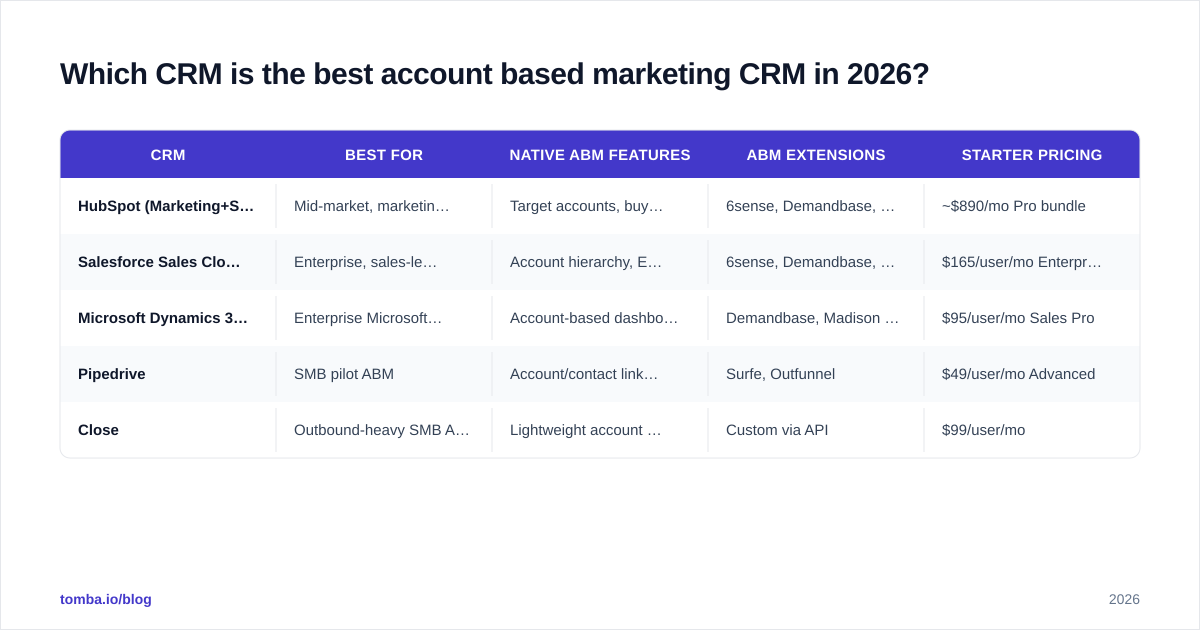
| CRM | Best for | Native ABM features | ABM extensions | Starter pricing |
|---|---|---|---|---|
| HubSpot (Marketing+Sales Hub Pro) | Mid-market, marketing-led ABM | Target accounts, buying roles, account scoring | 6sense, Demandbase, RollWorks | ~$890/mo Pro bundle |
| Salesforce Sales Cloud + Pardot | Enterprise, sales-led ABM | Account hierarchy, Einstein scoring, Pardot account view | 6sense, Demandbase, Terminus | $165/user/mo Enterprise |
| Microsoft Dynamics 365 | Enterprise Microsoft shops | Account-based dashboards, LinkedIn Sales Navigator deep link | Demandbase, Madison Logic | $95/user/mo Sales Pro |
| Pipedrive | SMB pilot ABM | Account/contact linking, custom fields | Surfe, Outfunnel | $49/user/mo Advanced |
| Close | Outbound-heavy SMB ABM | Lightweight account view | Custom via API | $99/user/mo |
If you are under 50 employees and running ABM as a pilot, HubSpot Pro plus a verified contact source gets you running fast. If you are enterprise with a real revenue team, Salesforce plus 6sense or Demandbase is still the default. Mid-market is the contested zone — HubSpot has closed most of the gap, and the integration ecosystem is now comparable.
Check independent reviews on G2's ABM platform grid before signing — feature sheets lie, peer ratings less so.
How do you set up an account based marketing CRM workflow?#
A working setup, in the order it should be built:
- Pick the target account list (TAL). Pull from your ICP. Tier them 1/2/3 by fit and revenue potential. Cap Tier 1 at 50 accounts per AE — beyond that, attention dilutes.
- Build the buying group per account. For each TAL account, identify 4-12 stakeholders by role. Use domain search and a LinkedIn finder to get verified contact info, then enrich with data enrichment for titles, seniority, tech stack.
- Wire intent and engagement. Connect Bombora/G2/6sense or your first-party tools (web visits, content downloads, demo abandons). Pipe scores into one account field.
- Define the plays. Pick 5-7 motions ("Tier 1 surge", "Tier 2 ICP opened pricing page", "Champion changed jobs", etc.) and document the play. Each play has a trigger, an owner, and a step list.
- Co-own dashboards. One dashboard, viewed weekly by marketing + sales together. Metrics: coverage, engagement, pipeline created, pipeline progressed, win rate by tier.
- Loop. Every 30 days, audit which accounts have zero engagement after three plays — demote or replace.
What's the data problem nobody talks about?#
You can buy the best ABM platform on earth and it will not help if the contact data underneath is dirty. The most common pattern I see: a $50K/year ABM platform firing perfectly-timed plays to a CRM where 30% of the email addresses bounce and 40% of the job titles are two years stale.
Fix the data layer first. Concretely:
- Re-verify every Tier 1 contact monthly. Use a bulk email finder workflow that re-checks status and routes invalids to a research queue.
- Catch the catch-all domains. Big-enterprise targets hide behind catch-all SMTPs — use a catch-all verifier to mark them and route via LinkedIn rather than direct email.
- Track sources. Know where each record came from, when it was last verified, and what the confidence score is. Without provenance, you can't unwind a bad import six months later.
HubSpot's own ABM strategy guide makes the same point: bad data is the silent killer of ABM ROI.
Is a dedicated ABM platform worth it on top of the CRM?#
Sometimes. Run this checklist before signing a $50K/year ABM contract:
- Do you have ≥150 target accounts you actively work? (Below that, native CRM features + spreadsheets are fine.)
- Do you spend ≥$10K/month on B2B ads? (ABM platforms shine at the ad-orchestration layer.)
- Do you have 3+ AEs and a marketer dedicated to ABM? (Below that, nobody will operate the platform.)
- Is intent data actually changing your decisions, or just decorating dashboards? (If your reps don't act on surge signals today, a platform won't fix the behaviour.)
- Are your CRM and contact data already clean? (If not, fix that first. Order of operations matters.)
Three or more yeses = look at 6sense, Demandbase, or RollWorks. Two or fewer = scale your CRM-native ABM motion for another two quarters before buying. If you do shop, also compare 6sense alternative and Demandbase alternative options to keep vendors honest.
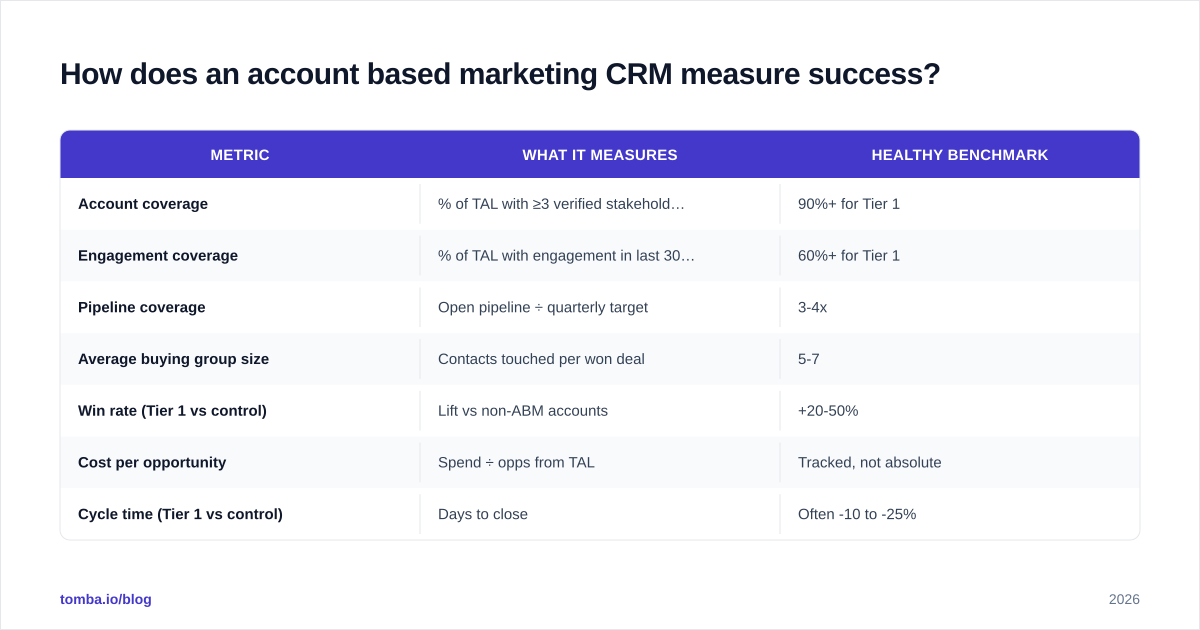
How does an account based marketing CRM measure success?#
Stop reporting MQLs. They mislead in ABM. Use this set instead:
| Metric | What it measures | Healthy benchmark |
|---|---|---|
| Account coverage | % of TAL with ≥3 verified stakeholders | 90%+ for Tier 1 |
| Engagement coverage | % of TAL with engagement in last 30 days | 60%+ for Tier 1 |
| Pipeline coverage | Open pipeline ÷ quarterly target | 3-4x |
| Average buying group size | Contacts touched per won deal | 5-7 |
| Win rate (Tier 1 vs control) | Lift vs non-ABM accounts | +20-50% |
| Cost per opportunity | Spend ÷ opps from TAL | Tracked, not absolute |
| Cycle time (Tier 1 vs control) | Days to close | Often -10 to -25% |
Coverage is the leading indicator. If coverage falls below 60% in any tier, no downstream metric will be healthy 90 days later.
What does the 2026 ABM CRM stack actually cost?#
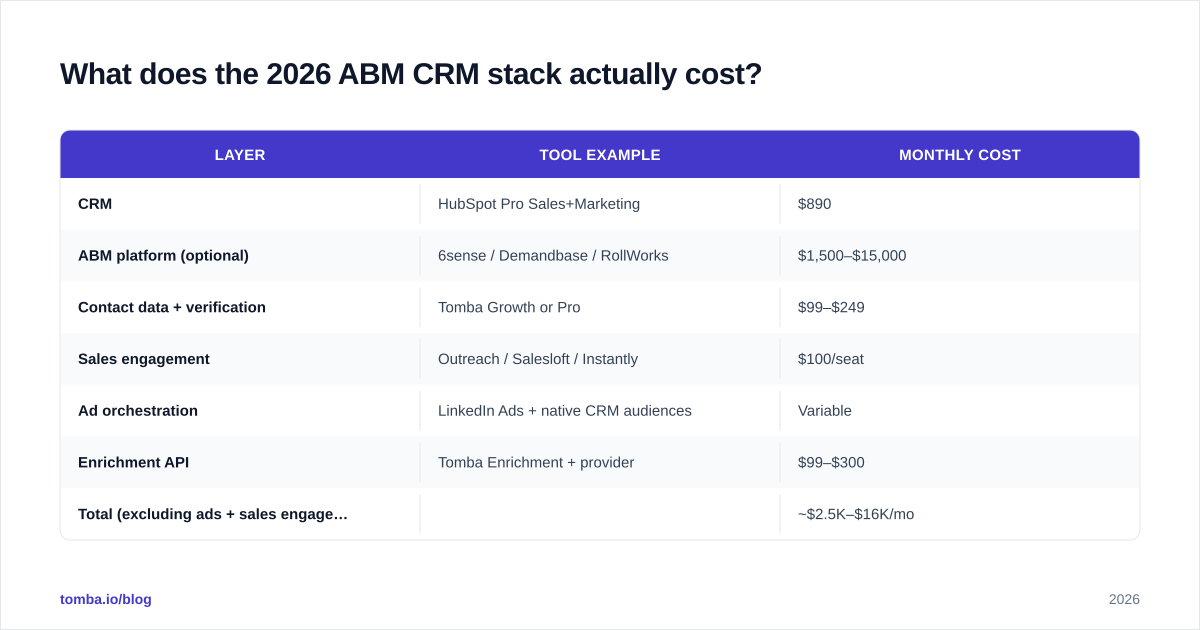
A realistic mid-market build, monthly:
| Layer | Tool example | Monthly cost |
|---|---|---|
| CRM | HubSpot Pro Sales+Marketing | $890 |
| ABM platform (optional) | 6sense / Demandbase / RollWorks | $1,500–$15,000 |
| Contact data + verification | Tomba Growth or Pro | $99–$249 |
| Sales engagement | Outreach / Salesloft / Instantly | $100/seat |
| Ad orchestration | LinkedIn Ads + native CRM audiences | Variable |
| Enrichment API | Tomba Enrichment + provider | $99–$300 |
| Total (excluding ads + sales engagement seats) | ~$2.5K–$16K/mo |
The variance comes almost entirely from whether you buy a dedicated ABM platform. The contact data line is non-negotiable and small — and it's the line that most determines whether the rest works.
Where does Tomba fit in an ABM CRM stack?#
Tomba sits in the data layer underneath the CRM and the ABM platform. It is not an ABM platform itself. The job it does is unglamorous and essential: keep the contact records inside your CRM clean, verified, and complete so the platforms above don't waste budget on dead emails and wrong titles. Specifically:
- Finding the buying group for each target account via domain search.
- Verifying email validity and detecting catch-all domains before outreach.
- Enriching contacts with titles, seniority, location, and LinkedIn.
- Running monthly re-verification on Tier 1 contacts in bulk.
- Powering CRM workflow steps via the Tomba API, HubSpot integration, and Salesforce integration.
Pricing sits at the predictable low end of the stack: Free tier (25 searches/mo), Starter $49/mo, Growth $99/mo, Pro $249/mo, Enterprise custom — see the full Tomba pricing page.
Frequently asked questions#
Do I need an ABM platform if I have HubSpot or Salesforce? Not at first. HubSpot Pro and Salesforce Enterprise both ship enough ABM features to run a 50-200 account program. Add a dedicated ABM platform when you outgrow native intent and ad orchestration.
Can SMBs run ABM with a $49 CRM? Yes, with a tight target list (≤50 accounts) and a strong contact-data layer. Pipedrive or HubSpot Starter + verified emails + LinkedIn + Slack alerts on signals will out-execute most enterprises sleeping inside expensive ABM platforms.
Where does email finding sit in this workflow? At the start and again every 30 days. You need verified contact info to build the buying group, then you need to re-verify because B2B job turnover runs 20-30% annually.
Is ABM dead in 2026? No, but "spray a 5,000-account TAL" ABM is dead. The motion that works now is tight lists, deep buying-group coverage, signal-driven plays, and ruthless measurement.
Ready to build the data layer right?#
The CRM is your truth, the ABM platform is your radar, but neither works without clean, verified contact data inside them. Start with the Tomba Email Finder to build verified buying groups for every account on your target list, then layer the rest of the stack on top. The Free tier covers your first 25 searches, and the Growth plan at $99/mo handles a typical mid-market TAL of 150-300 accounts. Build the foundation first — the dashboards come later.
Ready to find emails that actually work?
Join 150,000+ professionals who stopped guessing and started sending. Free credits on signup — no credit card required.
Get the Tomba newsletter
Practical outbound tactics and product updates — once every two weeks.
About the author