Account Based Marketing for Small Business: 2026 Playbook
Account based marketing isn't just for enterprise teams with seven-figure budgets. Here's how small businesses run ABM that actually closes deals in 2026 — without an SDR army or a six-month rollout.
TL;DR#
- Account based marketing for small business works when you pick fewer than 50 named accounts, not 5,000.
- You don't need 6sense or Demandbase to start. A spreadsheet, an email finder, LinkedIn, and a CRM cover 80% of the playbook.
- The lean ABM stack costs $200–$800/month — not the $60K/year enterprise teams pay.
- Three plays cover most small-business ABM: 1:1 for whales, 1:few clusters, and programmatic retargeting on a tight list.
- Measure pipeline created per account and meeting rate, not MQLs. ABM dies the moment you score it like inbound.
What is account based marketing for small business?#
Account based marketing (ABM) flips the funnel. Instead of running broad campaigns and filtering for fit, you start with a list of companies you've already decided you want — then you concentrate marketing and sales effort on those exact accounts.
The enterprise version of this involves intent data vendors, account orchestration platforms, and dedicated ABM teams. That's not what you have. The good news: account based marketing for small business is actually easier in some ways. You have fewer dollars, but you also have fewer accounts to track, faster decision cycles inside your own team, and more flexibility to run 1:1 plays a 200-person marketing org can't pull off.
Think of ABM like fishing with a spear instead of a net. The net (inbound, broad outbound) catches a lot of stuff you don't want and shreds easily. The spear takes more aim per fish, but you only stab the ones you'd actually keep.
Is ABM actually viable if you have fewer than 20 employees?#
Yes — and it's often the only sane go-to-market motion for small B2B teams selling deals over $10K ACV. Here's why:
- Your TAM is small anyway. If you sell to mid-market HR leaders in North America, there are maybe 8,000 buyers worth talking to. Spraying ads at all of them is wasteful.
- You can't outspend HubSpot on broad demand gen. You can absolutely out-personalize them on 30 accounts.
- Founder-led sales already looks like ABM. Most early-stage founders intuitively run 1:1 plays. ABM just gives that motion structure and lets it scale past the founder's calendar.
The trap small businesses fall into is copying enterprise ABM playbooks — orchestration tools, six-stage MQL/SQL handoffs, gifting platforms. Skip all of it. The minimum viable ABM motion is: a list, a research process, a multi-channel sequence, and a CRM to track it.
How is ABM different from regular outbound?#
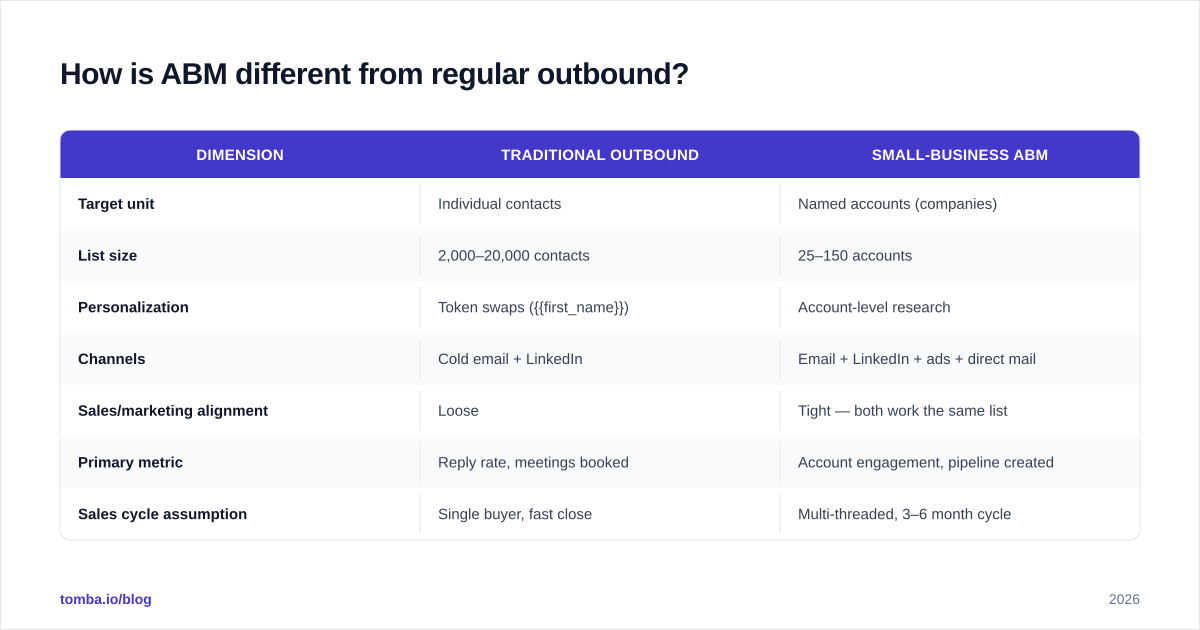
People conflate these all the time. The difference matters because the metrics, tools, and team coordination are not the same.
| Dimension | Traditional Outbound | Small-Business ABM |
|---|---|---|
| Target unit | Individual contacts | Named accounts (companies) |
| List size | 2,000–20,000 contacts | 25–150 accounts |
| Personalization | Token swaps ({{first_name}}) | Account-level research |
| Channels | Cold email + LinkedIn | Email + LinkedIn + ads + direct mail |
| Sales/marketing alignment | Loose | Tight — both work the same list |
| Primary metric | Reply rate, meetings booked | Account engagement, pipeline created |
| Sales cycle assumption | Single buyer, fast close | Multi-threaded, 3–6 month cycle |
| Cost per opportunity | Low per contact, high volume | High per account, lower volume |
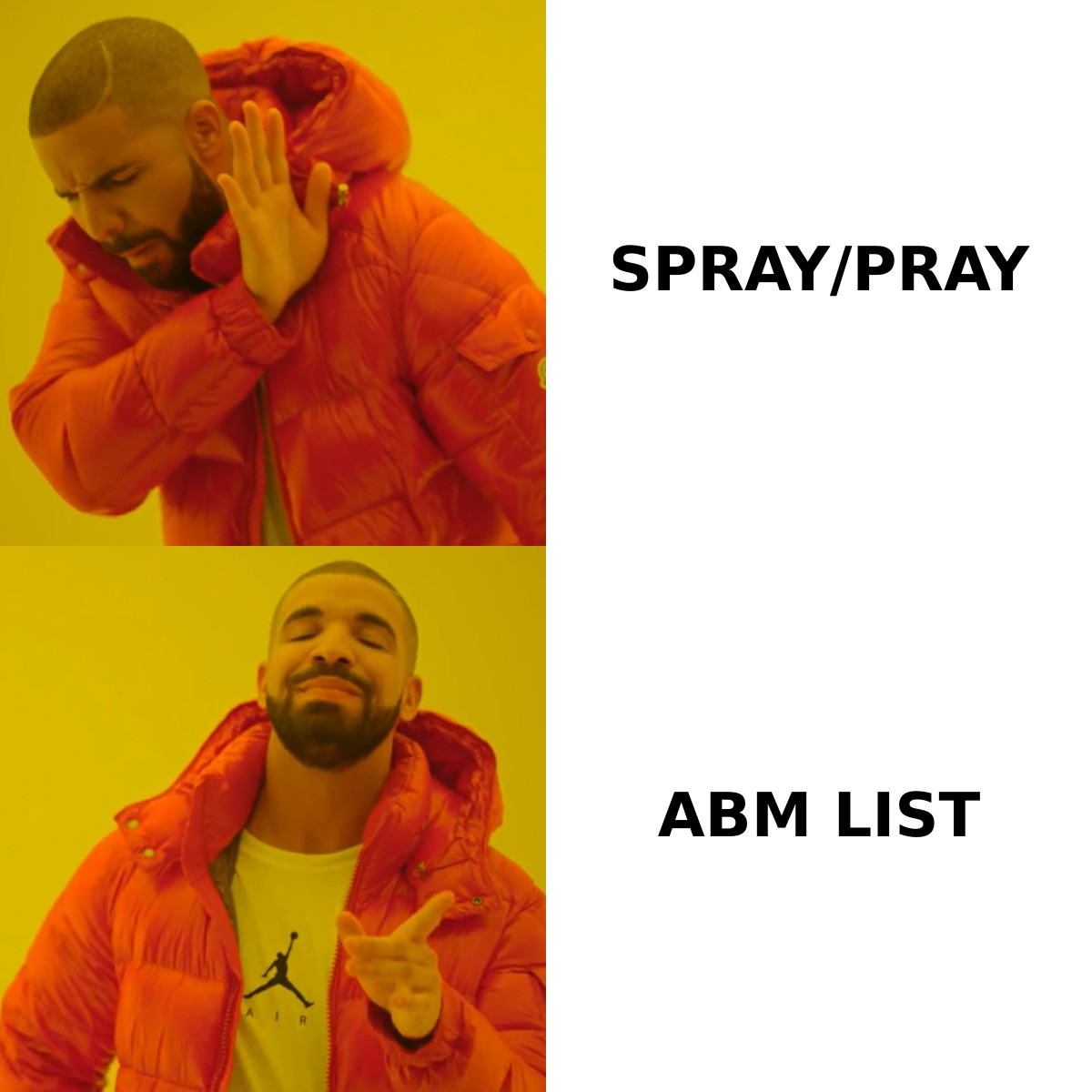
The mental shift: in outbound, you're trying to find anyone willing to talk. In ABM, you've already decided who you want to talk to — your job is to earn the meeting through relevance.
How do you build the account list?#
This is the single highest-leverage decision in the entire program. A bad list will burn six months and convince you ABM doesn't work. A good list makes mediocre execution look brilliant.
Step 1 — Define your ICP with brutal honesty#
Look at your last 20 closed-won deals. Find the pattern that's actually paying your bills, not the one you wish was. Common attributes:
- Industry / sub-vertical (be specific — "SaaS" is not specific, "vertical SaaS for legal" is)
- Headcount band
- Tech stack signals (using Salesforce? Built on Shopify?)
- Funding stage / revenue band
- Geography
- Trigger events (new VP of Sales hired, Series B announced, recent layoff, opened a new office)
Step 2 — Build the list#
You have three viable sources:
- Manual research — LinkedIn Sales Navigator + Crunchbase + Google. Slow but high signal. Best for the 1:1 tier.
- B2B data tools — pull a filtered list from a B2B database or similar. Faster, larger, slightly noisier.
- Intent + visitor data — companies already showing buying signals. Reveal anonymous site traffic with a visitor identification tool to surface accounts researching you right now.
Step 3 — Tier the list#
Not all 50 accounts deserve the same treatment. Tier them:
- Tier 1 (1:1) — 5–15 accounts. Custom landing pages, hand-written sequences, founder-to-founder outreach, possibly physical mail.
- Tier 2 (1:few) — 20–40 accounts grouped by shared trait. Templated-but-relevant plays, segmented ads.
- Tier 3 (1:many programmatic) — the rest. Retargeting + light automation. Closer to outbound, but still scoped to the list.
What does a working ABM tech stack cost?#
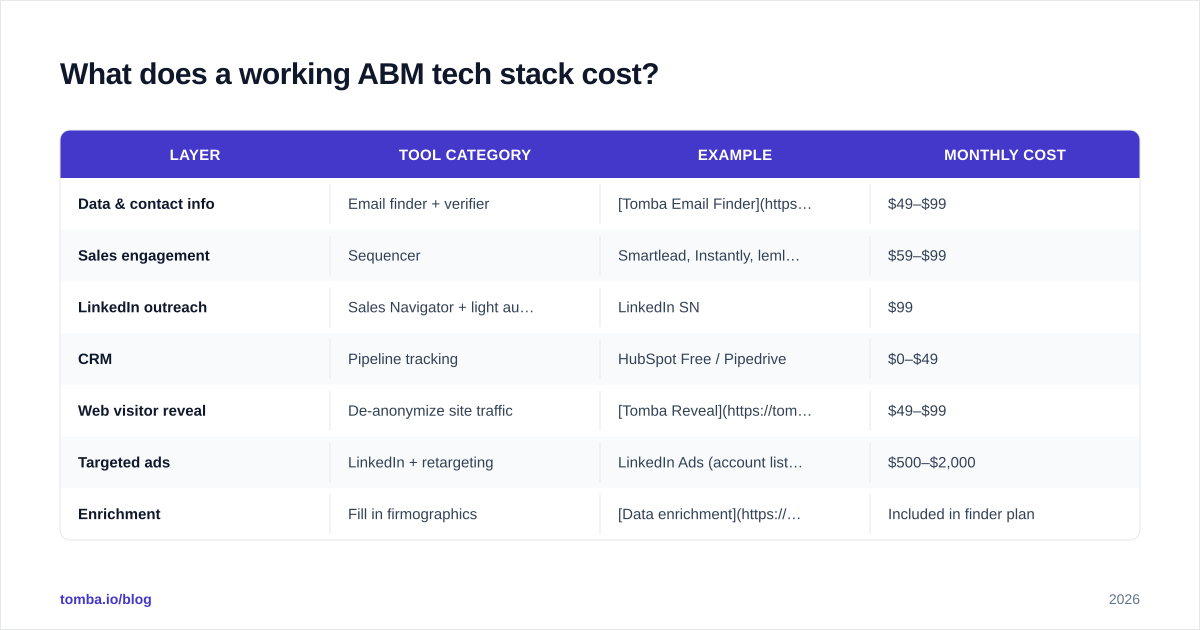
Here's a real lean stack — not the slideware version, the one teams actually run.
| Layer | Tool category | Example | Monthly cost |
|---|---|---|---|
| Data & contact info | Email finder + verifier | Tomba Email Finder | $49–$99 |
| Sales engagement | Sequencer | Smartlead, Instantly, lemlist | $59–$99 |
| LinkedIn outreach | Sales Navigator + light automation | LinkedIn SN | $99 |
| CRM | Pipeline tracking | HubSpot Free / Pipedrive | $0–$49 |
| Web visitor reveal | De-anonymize site traffic | Tomba Reveal | $49–$99 |
| Targeted ads | LinkedIn + retargeting | LinkedIn Ads (account list upload) | $500–$2,000 |
| Enrichment | Fill in firmographics | Data enrichment | Included in finder plan |
| Total | ~$800–$2,500/mo |
For comparison, an enterprise ABM stack (Demandbase or 6sense + Outreach +
ZoomInfo + Drift + a gifting platform) clocks in around $8,000–$15,000/month before ad spend. You're paying 10x less and giving up maybe 20% of the capability — most of which you wouldn't use anyway.
What plays actually work?#
Here's the playbook. Run two or three of these consistently, not all of them poorly.
Play 1 — The "personal landing page" 1:1 play#
Best for Tier 1. Cost: 30 minutes of work per account.
- Build one landing page per target account using a simple template. URL:
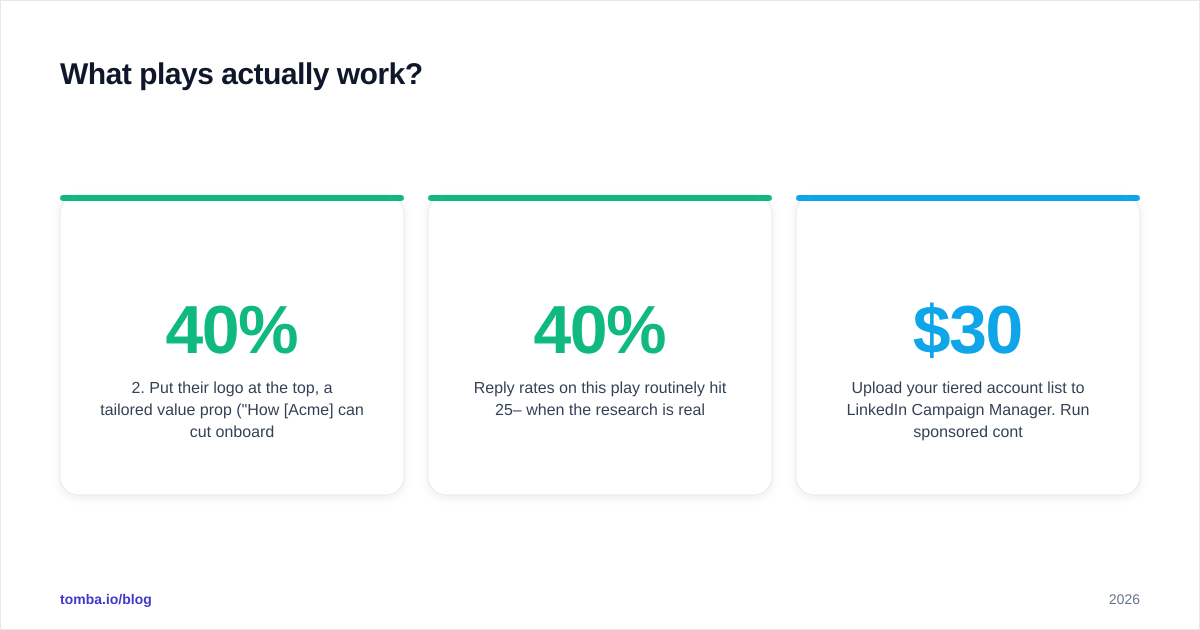
yourdomain.com/for/<companyname>. - Put their logo at the top, a tailored value prop ("How [Acme] can cut onboarding time by 40%"), and one case study from a similar company.
- Send a Loom video walking through it, embedded in a short email or LinkedIn DM.
Reply rates on this play routinely hit 25–40% when the research is real.
Play 2 — The "trigger event" 1:few play#
Watch for triggers — funding rounds, new exec hires, product launches, expansion announcements. When one fires on an account in your list, run a five-touch sequence inside 10 days referencing the trigger. Pair email with a LinkedIn comment on the executive's announcement post.
You'll need clean contact data to make this work. Pull verified emails for the buying committee with a domain search, then verify emails before you send anything — bouncing on the C-suite is the fastest way to torch deliverability.
Play 3 — Account-list LinkedIn ads#
Upload your tiered account list to LinkedIn Campaign Manager. Run sponsored content + thought-leader ads targeted at the right job titles inside only those companies. Budget $30–$50/day total. The goal isn't clicks — it's awareness so cold outreach lands warmer.
Play 4 — Reverse the funnel: "who's already looking?"#
Anonymous site traffic includes people from your target accounts. Reveal them, push the matching account into your priority queue, and have sales reach out within 24 hours. This single play has the highest meeting-conversion rate of anything on this list because the buyer is already mid-research.
How do you align sales and marketing on a 5-person team?#
The good news: you can fit everyone in one Slack channel. The bad news: small teams often skip the alignment ritual entirely because "we already talk all the time" — and then sales works one list while marketing runs ads against a different one.
A 30-minute weekly ABM standup is enough. Agenda:
- Account list changes (added, removed, tier moves)
- Engagement signals from the past 7 days (ads clicked, emails opened, site visits)
- Sales activity on Tier 1 accounts — who got a meeting, who went dark
- One account to focus the next 7 days on
Document this. A shared Notion or Airtable view beats Slack messages that scroll into oblivion. If you use HubSpot integration or Pipedrive, tag accounts with an abm_tier property so both teams filter the same view.
How do you measure ABM without lying to yourself?#
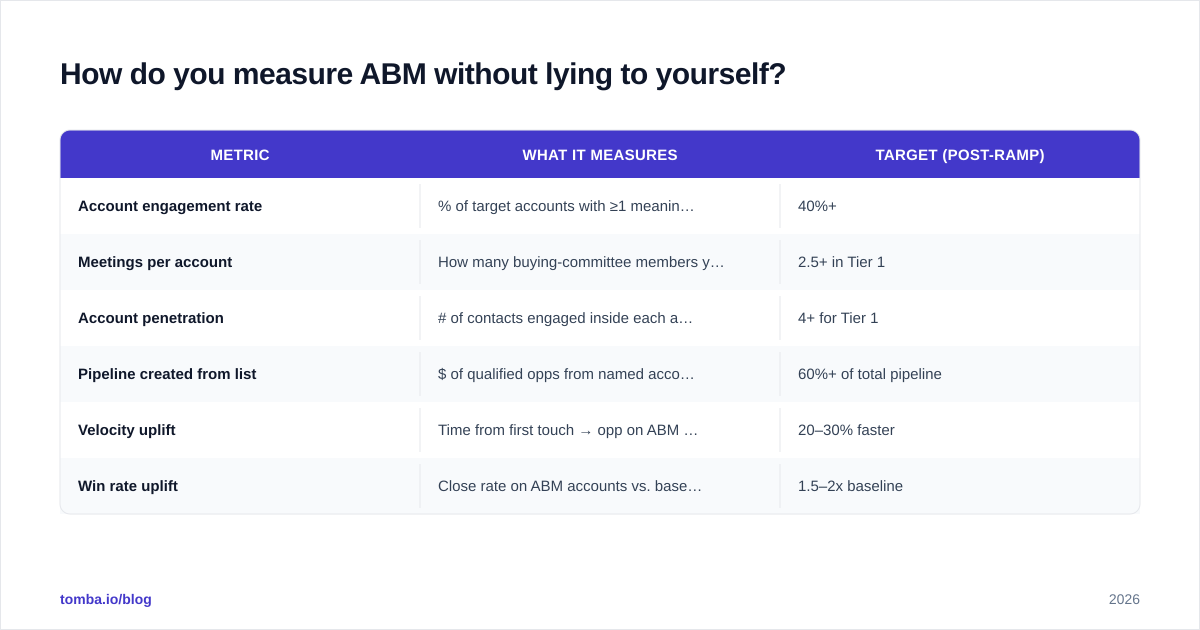
Stop using MQLs. They're noise on a list of 50 accounts. Real ABM metrics:
| Metric | What it measures | Target (post-ramp) |
|---|---|---|
| Account engagement rate | % of target accounts with ≥1 meaningful touch from their side in the last 30 days | 40%+ |
| Meetings per account | How many buying-committee members you've met | 2.5+ in Tier 1 |
| Account penetration | # of contacts engaged inside each account | 4+ for Tier 1 |
| Pipeline created from list | $ of qualified opps from named accounts | 60%+ of total pipeline |
| Velocity uplift | Time from first touch → opp on ABM accounts vs. inbound | 20–30% faster |
| Win rate uplift | Close rate on ABM accounts vs. baseline | 1.5–2x baseline |
Track these monthly, not weekly. ABM is a slow build. If you're checking pipeline impact after three weeks, you'll panic and bail. Give it a full sales cycle plus 30 days before deciding the program is working or broken.
Want a primer on the broader RevOps view of these numbers? Forrester's B2B Revenue Process Framework and the work coming out of Gartner's ABM research are both worth a read. For the metrics side specifically, see revenue operations and how the response rate on ABM cohorts compares to broad outbound.
What's the 90-day rollout for a small team?#
Don't try to do everything in week one. Here's a sane sequence:
Days 1–14 — Foundation
- Define ICP from closed-won analysis
- Build 50-account starter list with tiering
- Audit current contact data quality, fill gaps with an email finder
- Stand up account view in CRM with
abm_tier,engagement_score,last_touchfields
Days 15–45 — Pilot
- Launch Play 2 (trigger events) and Play 4 (visitor reveal) — these have the fastest payback
- Run LinkedIn ads to Tier 1 + Tier 2 (Play 3)
- Weekly ABM standup begins
- Start tracking engagement metrics — no pipeline judgment yet
Days 46–90 — Expand
- Add Play 1 (personal landing pages) for Tier 1
- Refresh the account list — drop dead weight, add new triggers
- First pipeline review against ABM accounts vs. non-ABM
- Decide what to double down on, what to kill
By day 90 you'll have enough data to know if ABM is your motion. Either you'll see pipeline concentration in named accounts (good — pour fuel on the plays that worked), or you'll see flat numbers everywhere (probably a list problem, not an execution problem — go back to the ICP).
What are the most common small-business ABM mistakes?#
- List too big. 500 accounts isn't ABM, it's outbound with a sticker on it. Cap at 100 for most small teams.
- No multi-threading. You sent one email to the VP. That's not ABM, that's a cold email. Aim for 4+ contacts per Tier 1 account.
- Treating marketing and sales like separate scoreboards. ABM needs one shared list and one shared definition of "engaged."
- Quitting at 60 days. B2B sales cycles are 3–9 months. You can't judge ABM after one cycle of follow-ups.
- Skipping data hygiene. Sending personalized outreach to bouncing email addresses kills your domain reputation and your credibility with the prospect's IT team. Verify before you send.
- Copying enterprise plays. You don't need a gifting platform until you've maxed out the free plays first.
Where does ABM fit alongside inbound and outbound?#
It doesn't replace either — it concentrates them. Run inbound to capture the buyers actively searching. Run outbound to start conversations at scale. Run ABM as the highest-conviction layer on top, pointed at the 50 accounts you most want as customers.
For most small B2B teams the ratio looks like: 50% inbound investment, 30% ABM, 20% broad outbound. Adjust based on average contract value — higher ACV pushes you toward more ABM, lower ACV toward more inbound and broad outbound.
Start with the list, not the tools#
The biggest mistake we see from small businesses trying ABM is buying tools before deciding which accounts they want. Don't. Spend a week on the list. Then spend a week on contact data quality — because the best play in the world fails when the email bounces and the LinkedIn profile is three jobs out of date.
If you're starting this week, the cheapest, highest-leverage move is to pull verified contact data for your top 50 accounts. The Tomba Email Finder finds and verifies professional emails for any company, with a free tier for 25 searches and paid plans starting at $49/month — enough to seed a real ABM list without a procurement conversation. Combine it with the Chrome extension and you'll be building your Tier 1 list straight from LinkedIn Sales Navigator inside an hour.
// get started
Find, verify and enrich your first contacts today
Start on the free plan with 25 searches a month, then scale when your team is ready.
Free plan · No credit card required · GDPR & CCPA
// about the author