Account Based Marketing Plan Template 2026: Full Build
A working account based marketing plan template for 2026 — tier model, target list build, plays, budget split, and metrics that actually tie to pipeline.
Account Based Marketing Plan Template 2026: Full Build
TL;DR
- An account based marketing plan template is not a slide deck. It is a tiered operating plan that maps named accounts to plays, owners, budget, and pipeline targets.
- Build it in five layers: ICP and tiering, account list, account intelligence, plays per tier, and a measurement model that ties spend to closed-won revenue.
- Tier 1 is 1:1 (custom plays, ~25-50 accounts). Tier 2 is 1:few (clusters of 5-15 accounts). Tier 3 is 1:many (programmatic against 500-2,000 accounts).
- Budget rule of thumb: 50% to Tier 1, 30% to Tier 2, 20% to Tier 3. Adjust based on ACV and sales capacity.
- The plan is wrong on day one. Re-baseline every quarter against pipeline coverage, not vanity engagement.
What is an account based marketing plan template?#
An account based marketing plan template is a structured document that defines which accounts you will pursue, what you will do for each tier, who owns it, what it costs, and how you will measure pipeline impact. It replaces lead-volume thinking with account-level revenue thinking.
A good template forces five decisions before any campaign launches:
- Who counts as a target account (ICP definition).
- How those accounts are ranked (tiering).
- What you will do for each tier (plays).
- Who runs each play (marketing, SDR, AE, CS).
- What "working" looks like in pipeline dollars, not opens.
If your current ABM doc skips any of those five, it is a wish list. The template below covers all of them and is the one I hand to RevOps teams when they ask for a starting point.
Why does ABM need a template instead of a campaign plan?#
Because the unit of work is the account, not the campaign. A campaign plan asks "what email goes out Tuesday?" An ABM plan asks "what is the next best action for Cisco, and who owns it?" Those are different jobs.
Demand-gen teams that try to do ABM with a campaign calendar end up running broadcast plays against narrow lists. That is just expensive email marketing. Real revenue operations requires the plan to live at the account row level, with a status, an owner, and a next step — closer to a CRM pipeline view than a marketing calendar.
According to Gartner's B2B buying research, the average enterprise buying committee now includes 11+ stakeholders. You cannot reach 11 humans inside one account with a single nurture track. You need a plan per account, or per tight cluster of look-alike accounts.
What are the five components of the template?#
1. ICP definition#
Before tiering, write the ICP in one paragraph that any new hire can use to disqualify a deal. Include:
- Industry / sub-industry (use NAICS or SIC for clarity)
- Employee count band
- Revenue band
- Tech stack signals (Salesforce, HubSpot, Snowflake, etc.)
- Trigger events that elevate fit (new exec, funding, M&A, layoffs in a specific function)
- Hard disqualifiers (region, regulated industry, prior churn)
A loose ICP produces a 5,000-account list that nobody can work. A tight ICP produces 300-1,500 named accounts and a sales team that says yes.
2. Tiering model#
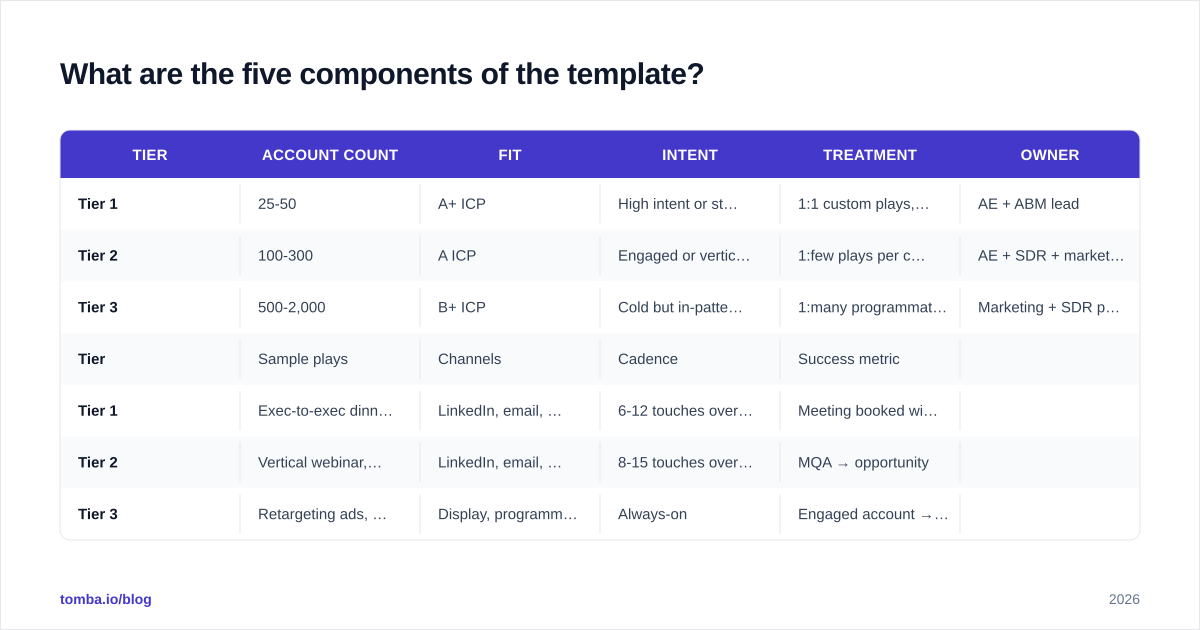
Tiering is how you decide what plays each account gets. Most teams over-engineer this. Three tiers is enough.
| Tier | Account count | Fit | Intent | Treatment | Owner |
|---|---|---|---|---|---|
| Tier 1 | 25-50 | A+ ICP | High intent or strategic logo | 1:1 custom plays, exec sponsor | AE + ABM lead |
| Tier 2 | 100-300 | A ICP | Engaged or vertical cluster | 1:few plays per cluster | AE + SDR + marketing |
| Tier 3 | 500-2,000 | B+ ICP | Cold but in-pattern | 1:many programmatic + retargeting | Marketing + SDR pool |
Tier 1 is where revenue lives. If you only have headcount to do one tier well, do Tier 1 well and skip the rest until you can staff it.
3. Account list build#
You cannot run ABM against a list you scraped from an event two years ago. The list build needs to be:
- Sourced from your CRM (existing accounts and open opportunities) plus a fresh top-of-funnel pull from a B2B database.
- De-duplicated against churned and bad-fit accounts.
- Enriched with firmographics, tech stack, and 1-3 verified contacts per buying-committee role.
This is the step where most plans collapse. Sales hands marketing a CSV with 200 company names and no emails. To make the plan executable, every account row needs at least the CEO/CRO/VP-of-target-function plus the practitioner contact. Tools like the Tomba Email Finder and domain search let you go from "200 logos" to "200 logos with 4 verified contacts each" in one afternoon. For enrichment beyond email — title, LinkedIn, phone — layer in data enrichment so the row is workable on day one.
For larger pulls, run the list through a bulk email finder and verify the output before any outbound — sending to unverified addresses is the fastest way to torch your sender reputation before Tier 1 even sees a touch.
4. Plays by tier#
Plays are the verbs of the plan. Each play has a trigger, an audience filter, a sequence of touches, an owner, and a success metric.
| Tier | Sample plays | Channels | Cadence | Success metric |
|---|---|---|---|---|
| Tier 1 | Exec-to-exec dinner, custom microsite, ABM-direct mail, hand-built deck | LinkedIn, email, direct mail, events | 6-12 touches over 60 days | Meeting booked with 2+ stakeholders |
| Tier 2 | Vertical webinar, industry POV, paid social by company list, SDR sequence | LinkedIn, email, paid social, webinars | 8-15 touches over 90 days | MQA → opportunity |
| Tier 3 | Retargeting ads, programmatic display, content syndication, broad SDR plays | Display, programmatic, email | Always-on | Engaged account → SDR review |
For Tier 1, the play sheet is per account. For Tier 2 and 3, the play sheet is per cluster.
5. Measurement model#
If the only number on the dashboard is MQLs, the plan is broken. ABM measurement runs at the account level. The minimum metric stack:
- Pipeline coverage by tier — pipeline created ÷ pipeline needed. Target 3-4x.
- Account engagement score — composite of web visits, ad views, content downloads, meetings.
- Meeting-to-opportunity conversion — by tier.
- Win rate — by tier vs. non-ABM control accounts.
- ACV uplift — Tier 1 deal size vs. company average.
- Cycle time — ABM accounts vs. inbound.
Report weekly to the GTM leadership team. Re-tier every quarter.
How do you fill in the template? A worked example.#
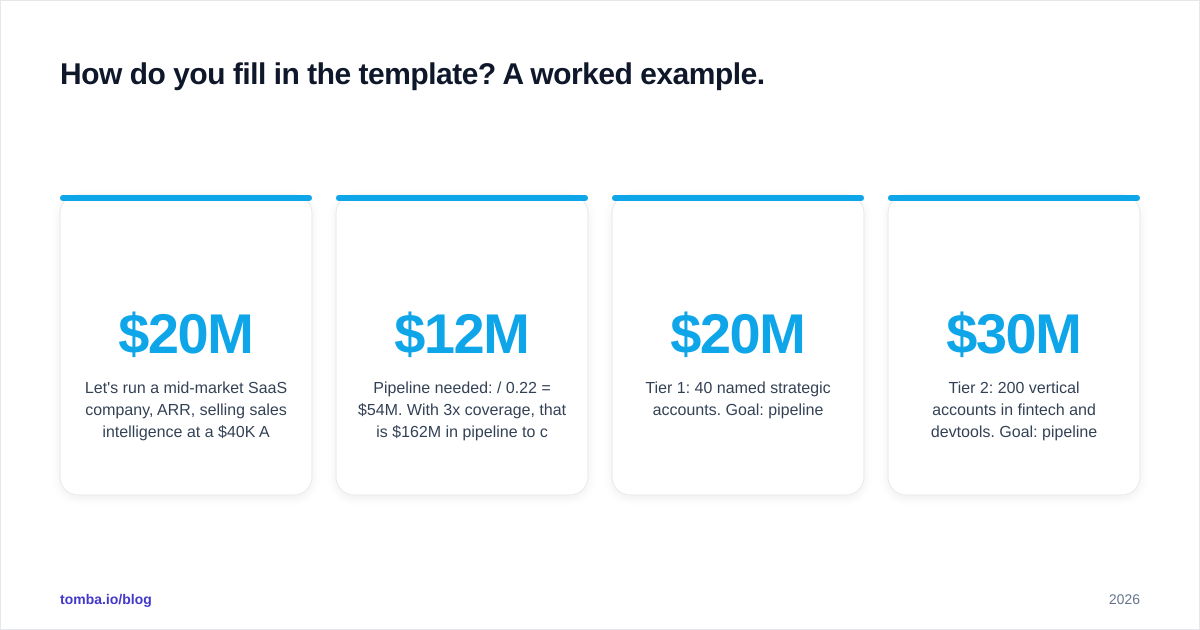
Let's run a mid-market SaaS company, $20M ARR, selling sales intelligence at a $40K ACV. Sales target for next year: $12M new ARR. Average win rate 22%, average cycle 90 days.
Pipeline needed: $12M / 0.22 = $54M. With 3x coverage, that is $162M in pipeline to create across the year.
ICP: B2B software companies, 200-2,000 employees, US/UK/Canada, using Salesforce, with a VP of Sales and an SDR team of 5+.
Tiering:
- Tier 1: 40 named strategic accounts. Goal: $20M pipeline.
- Tier 2: 200 vertical accounts in fintech and devtools. Goal: $30M pipeline.
- Tier 3: 1,500 ICP-fit accounts. Goal: $112M pipeline.
Budget (annual): $1.2M total ABM spend.
- Tier 1: $600K (50%) — 1:1 plays, direct mail, exec events
- Tier 2: $360K (30%) — paid social, vertical webinars, BDR enrichment
- Tier 3: $240K (20%) — programmatic, content syndication, retargeting
Staffing: 1 ABM lead, 4 AEs on Tier 1/2, 6 SDRs split across tiers, 1 marketing ops, 1 content lead.
This is roughly the shape every healthy ABM plan takes when you do the back-of-envelope math. If your numbers do not pencil out at the staffing or budget you have, the plan needs to shrink to fit — not the targets.
Which ABM platforms fit the template?#
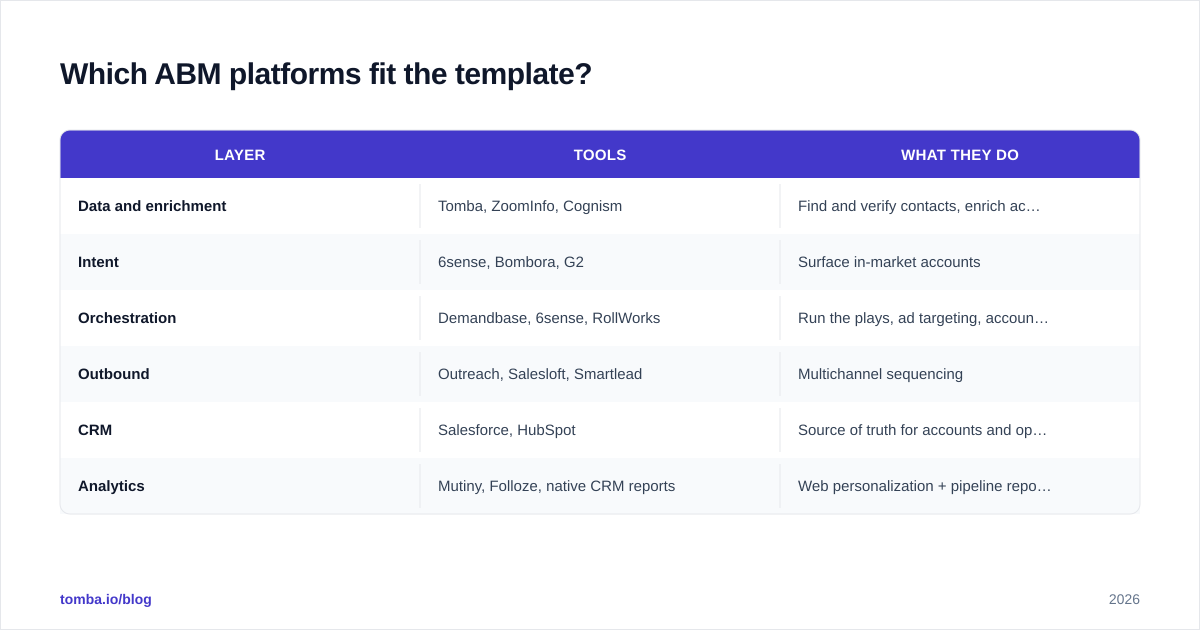
The template is platform-agnostic. The plan tells you what to do; the platforms execute it. A common stack:
| Layer | Tools | What they do |
|---|---|---|
| Data and enrichment | Tomba,ZoomInfo, Cognism | Find and verify contacts, enrich accounts |
| Intent | 6sense, Bombora, G2 | Surface in-market accounts |
| Orchestration | Demandbase, 6sense, RollWorks | Run the plays, ad targeting, account journey |
| Outbound | Outreach, Salesloft, Smartlead | Multichannel sequencing |
| CRM | Salesforce, HubSpot | Source of truth for accounts and opportunities |
| Analytics | Mutiny, Folloze, native CRM reports | Web personalization + pipeline reporting |
You do not need all of them on day one. The minimum viable stack is: CRM + a contact source like Tomba's B2B database + an outbound tool + one ad platform. Add intent and orchestration once the plan is running.
If you are evaluating swap-ins, see the Apollo alternative and Clearbit alternative comparisons — both publish their methodology and pricing in the open, which makes side-by-side math possible. The Forrester Wave for ABM platforms is a useful tiebreaker for enterprise buyers; G2 grids (g2.com) are more honest at the mid-market.
What does the actual template look like (copy this)?#
Use a single sheet — Airtable, Google Sheets, or your CRM with custom fields. Columns:
| Column | Purpose |
|---|---|
| Account name | The company |
| Domain | Used for matching across tools |
| Tier (1/2/3) | Tier assignment |
| Owner | AE or marketer responsible |
| Plays assigned | Comma-separated play IDs |
| Current stage | Engaged → Meeting → Opportunity → Closed |
| Pipeline created | Dollar amount this quarter |
| Last touch date | For SLA on Tier 1 |
| Next action | Plain English, due date |
| Notes | Free text, intel from research |
Pull the verified contacts into a linked sheet using a Sheets email finder or the Excel add-in so the contact roster regenerates whenever the account list changes. Then push the whole thing into your CRM through a HubSpot integration or Salesforce integration so reps work from one source of truth.
What are the most common ways this plan fails?#
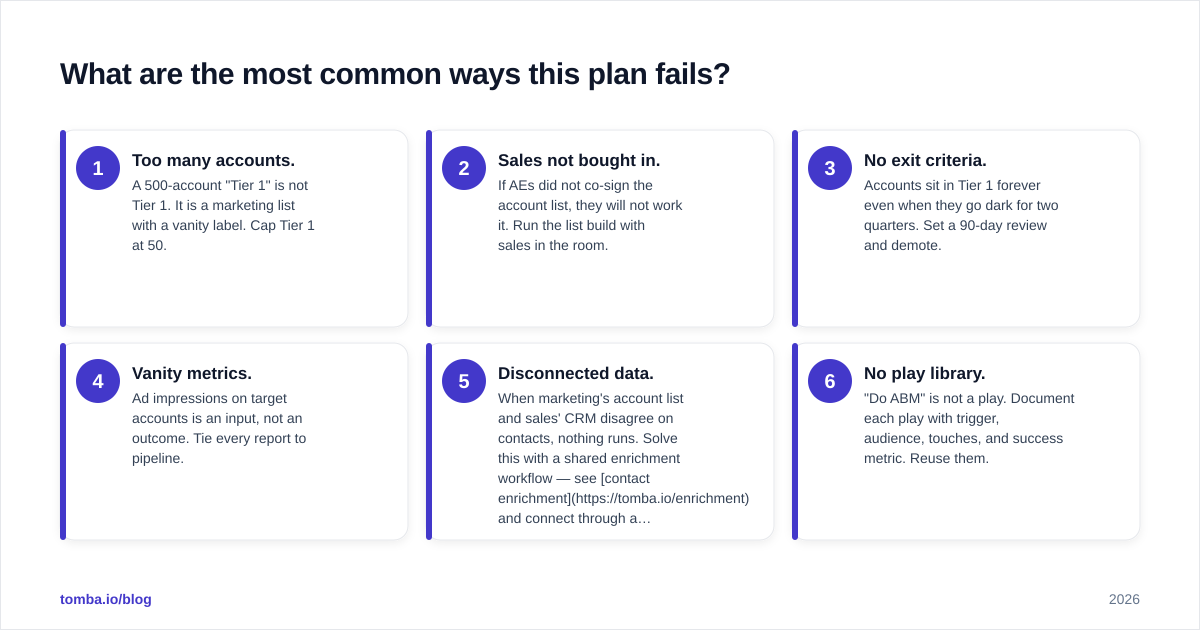
- Too many accounts. A 500-account "Tier 1" is not Tier 1. It is a marketing list with a vanity label. Cap Tier 1 at 50.
- Sales not bought in. If AEs did not co-sign the account list, they will not work it. Run the list build with sales in the room.
- No exit criteria. Accounts sit in Tier 1 forever even when they go dark for two quarters. Set a 90-day review and demote.
- Vanity metrics. Ad impressions on target accounts is an input, not an outcome. Tie every report to pipeline.
- Disconnected data. When marketing's account list and sales' CRM disagree on contacts, nothing runs. Solve this with a shared enrichment workflow — see contact enrichment and connect through a Salesforce integration.
- No play library. "Do ABM" is not a play. Document each play with trigger, audience, touches, and success metric. Reuse them.
How does this plan change in 2026 vs. previous years?#
Three shifts worth planning for:
- Buying committees are larger and more anonymous. Gartner research shows buyers complete 60-70% of the journey before talking to sales. Your Tier 3 programmatic layer matters more, not less.
- Email signal degradation. Apple Mail Privacy Protection and Gmail's tightened sender rules mean opens are unreliable. Weight clicks, replies, and meetings — not opens — in your engagement score.
- AI-driven personalization is table stakes. Generic Tier 1 outreach is dead. Use AI to draft per-account research briefs, but have humans approve every Tier 1 send.
Closing — your next 30 days#
If you are starting from zero, do not try to launch all three tiers at once. Spend week one writing the ICP and tiering rules. Week two build the Tier 1 list of 25-40 named accounts and verify the buying committee contacts for each. Week three document three Tier 1 plays end-to-end. Week four run them.
To get verified contacts into your Tier 1 and Tier 2 rows fast, use the Tomba Email Finder — free tier gives you 25 searches to test the workflow, and the Starter plan at $49/mo on Tomba pricing covers most teams through their first ABM quarter. The data feeds straight into your Sheets, CRM, or Airtable so the plan stays executable instead of becoming another deck.
// get started
Find, verify and enrich your first contacts today
Start on the free plan with 25 searches a month, then scale when your team is ready.
Free plan · No credit card required · GDPR & CCPA
// about the author