Account Based Marketing Process: The 2026 Operator's Playbook
A step-by-step account based marketing process for 2026 — from tier-1 account selection to multi-threaded plays, scoring, and revenue attribution. No fluff, real workflows.
TL;DR#
- The account based marketing process is a six-stage loop: define ICP, pick target accounts, map the buying committee, build plays, orchestrate sales + marketing, then measure pipeline impact — not opens.
- 2026 ABM lives or dies on data quality. If your account list is wrong, every downstream play burns budget. Spend 30% of your effort here.
- Multi-threaded outreach beats single-threaded by 3-5x. Target 6-9 stakeholders per tier-1 account, not just the VP.
- Intent signals (G2, Bombora, web visits) shorten cycles, but they're noisy without ICP filters layered on top.
- Measure pipeline created, pipeline velocity, and account engagement — not clicks. ABM dashboards that show MQLs are a red flag.
If your pipeline is leaning on a list of 3,000 cold contacts and a Mailchimp template, you don't have an ABM process — you have spray-and-pray with extra steps. This guide walks through the actual account based marketing process used by RevOps teams running tier-1, tier-2, and tier-3 motions in 2026, including the data plumbing, the play library, and the scoring math.
What is account based marketing in 2026?#
Account based marketing (ABM) is a B2B go-to-market motion where sales and marketing pick a finite list of high-fit accounts and treat each one as a market of one. Instead of running broad demand-gen campaigns to fill a top-of-funnel, you reverse the funnel: you start with the accounts you want to win, then build the plays, content, and outreach sequences to land them.
What changed by 2026:
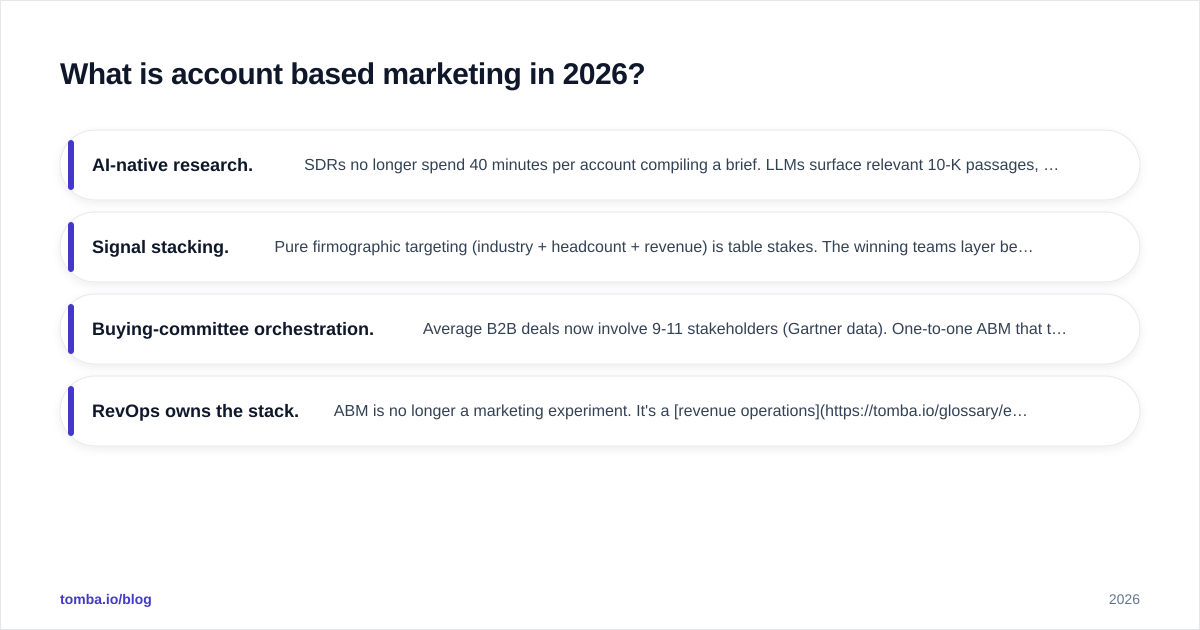
- AI-native research. SDRs no longer spend 40 minutes per account compiling a brief. LLMs surface relevant 10-K passages, recent leadership changes, and tech-stack shifts in under a minute.
- Signal stacking. Pure firmographic targeting (industry + headcount + revenue) is table stakes. The winning teams layer behavioural signals — job changes, funding rounds, intent topics, product-page visits — on top.
- Buying-committee orchestration. Average B2B deals now involve 9-11 stakeholders (Gartner data). One-to-one ABM that targets only the VP loses every time.
- RevOps owns the stack. ABM is no longer a marketing experiment. It's a revenue operations function with shared sales + marketing KPIs.
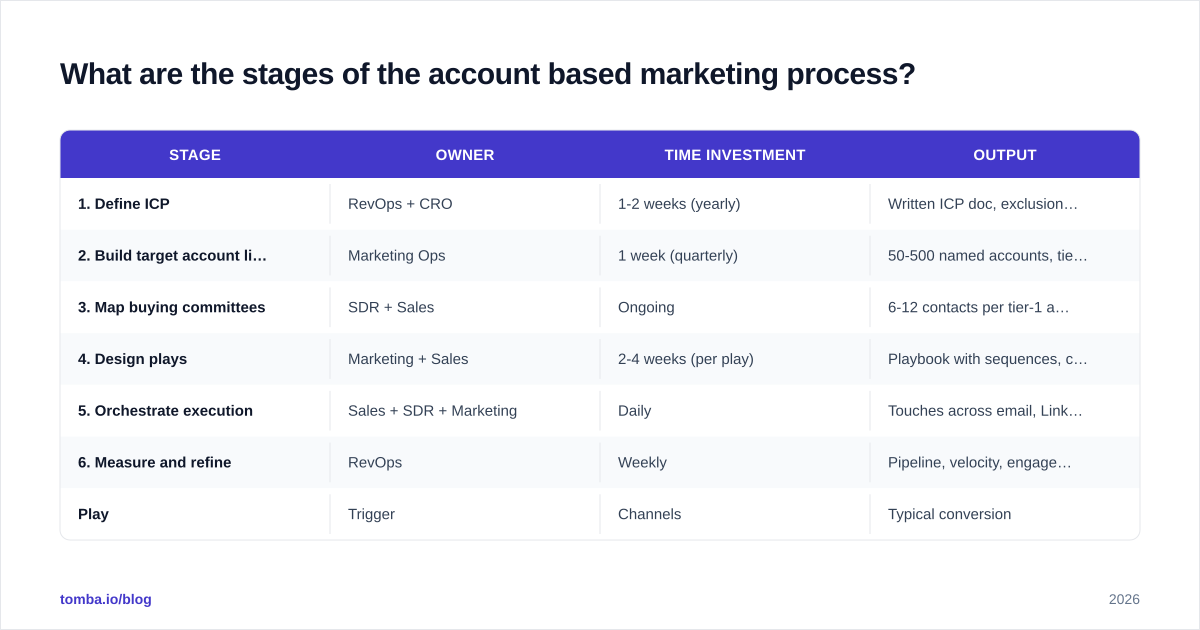
What are the stages of the account based marketing process?#
The six stages below run as a loop, not a waterfall. You'll refresh your account list quarterly, re-map committees monthly, and tune plays weekly.
| Stage | Owner | Time investment | Output |
|---|---|---|---|
| 1. Define ICP | RevOps + CRO | 1-2 weeks (yearly) | Written ICP doc, exclusion rules |
| 2. Build target account list | Marketing Ops | 1 week (quarterly) | 50-500 named accounts, tiered |
| 3. Map buying committees | SDR + Sales | Ongoing | 6-12 contacts per tier-1 account |
| 4. Design plays | Marketing + Sales | 2-4 weeks (per play) | Playbook with sequences, creative, offers |
| 5. Orchestrate execution | Sales + SDR + Marketing | Daily | Touches across email, LinkedIn, ads, direct mail |
| 6. Measure and refine | RevOps | Weekly | Pipeline, velocity, engagement scores |
Stage 1: Define your ICP#
Your ideal customer profile is a written document, not a vibe. It should specify firmographics (industry, size, geography), technographics (current stack), and behavioural signals (recent funding, hiring patterns, leadership changes). Equally important: write the exclusion rules. Who do you not want? Companies under 50 employees? Public sector? Customers of a specific competitor where switching cost is prohibitive?
Sales and marketing must sign the same document. If sales says "we can sell anything > 100 employees" and marketing targets 500+, ABM breaks before it starts.
Stage 2: Build the target account list#
Start with your CRM. Pull every closed-won deal from the last 24 months, look for the firmographic and behavioural patterns, and reverse-engineer the ICP fit. From there, build the named-account list in tiers:
- Tier 1 (1:1): 20-50 accounts. Custom plays, executive sponsors, dedicated SDR pods. Average ACV $100k+.
- Tier 2 (1:few): 100-300 accounts grouped by persona, industry, or use case. Templatised plays with light personalisation.
- Tier 3 (1:many): 500-5,000 accounts. Programmatic — ads, dynamic content, nurture sequences with firmographic personalisation only.
This is where contact data quality matters. A list of 200 tier-1 accounts is worthless if you only have email addresses for 40% of the buying committee. Use a B2B database and an email finder to fill the gaps before you launch any play.
Stage 3: Map the buying committee#
For each tier-1 account, you need names, titles, emails, and LinkedIn URLs for 6-12 stakeholders covering:
- Economic buyer (CFO, CRO, or function head with budget authority)
- Champion (the manager whose problem you solve, most likely to drive internal momentum)
- End users (the team that will actually touch the product)
- Technical evaluator (IT, security, or platform owner)
- Influencers (analysts, advisors, or adjacent leaders who shape the decision)
Tools like LinkedIn finder and domain search help you build the committee in minutes per account instead of hours.
Stage 4: Design the plays#
A "play" is a coordinated sequence of touches across channels for a specific account, persona, and trigger. Each play has:
- A trigger (intent surge, funding round, job change, product-page visit)
- A target persona within the buying committee
- A sequence (e.g., LinkedIn view → personalised email → ad retargeting → SDR call → handwritten note)
- An offer (executive briefing, custom ROI report, peer roundtable invite)
- A success metric (meeting booked, deal advanced, MQA created)
Play examples that work in 2026:
| Play | Trigger | Channels | Typical conversion |
|---|---|---|---|
| Funding announcement | Series B+ raise | Personal email + LinkedIn + targeted display | 12-18% meeting rate |
| Champion job change | New VP at target account | Warm intro email within 2 weeks | 20-25% reply rate |
| Competitive switch signal | Negative review of competitor on G2 | Custom case study landing page + SDR outreach | 8-12% meeting rate |
| Intent surge | 3+ intent topics trending on Bombora | Programmatic ads + SDR + nurture track | 6-10% meeting rate |
Stage 5: Orchestrate execution#
Orchestration is the boring part that makes everything work. You need:
- A shared account view in the CRM where sales sees marketing touches and vice versa
- A signal layer that fires alerts when a target account does something interesting
- A cadence engine that sequences touches across email, LinkedIn, calls, and direct mail
- Routing rules so the right rep gets the right account at the right moment
If your stack can't show an SDR every touch a target account has had in the last 90 days in one screen, the orchestration is broken.
Stage 6: Measure and refine#
ABM metrics that matter:
- Account engagement score — composite of website visits, content downloads, email opens, ad impressions, meetings booked per account
- Pipeline created from target accounts — dollar value, count of opportunities
- Pipeline velocity — days from first touch to closed-won, segmented by tier
- Win rate by tier — tier 1 should be 2-3x your blended win rate
- Coverage — % of target accounts with at least one meaningful interaction this quarter
Metrics that don't matter (and signal a confused team): MQLs, total email opens, ad CTR in isolation, "marketing-influenced revenue" without a methodology.
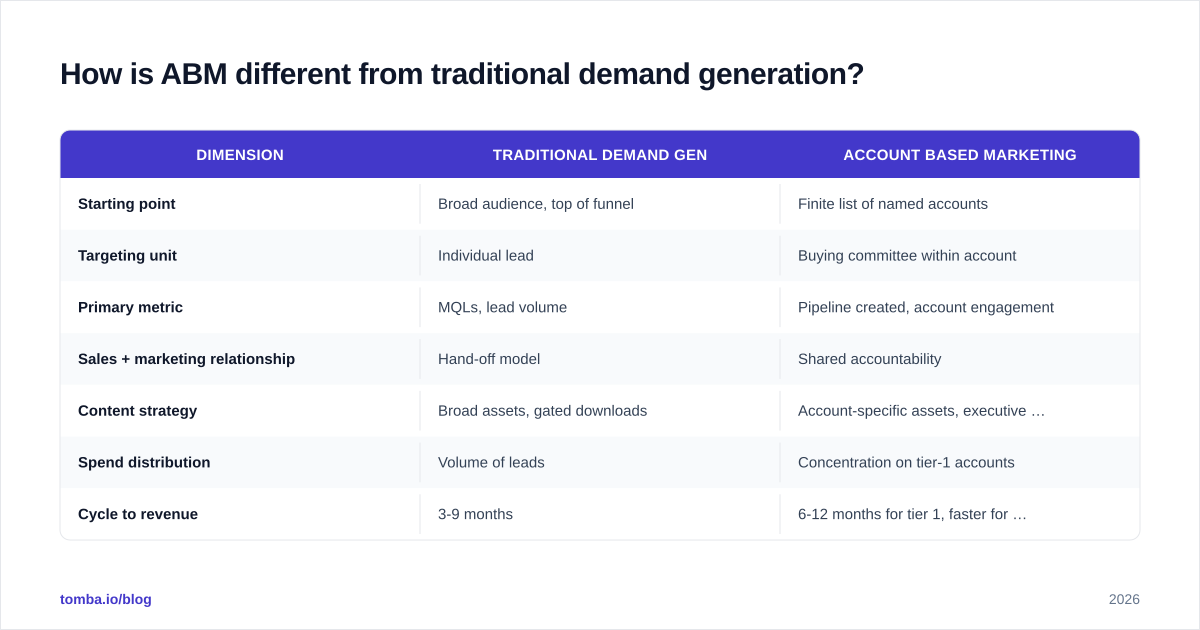
How is ABM different from traditional demand generation?#
| Dimension | Traditional Demand Gen | Account Based Marketing |
|---|---|---|
| Starting point | Broad audience, top of funnel | Finite list of named accounts |
| Targeting unit | Individual lead | Buying committee within account |
| Primary metric | MQLs, lead volume | Pipeline created, account engagement |
| Sales + marketing relationship | Hand-off model | Shared accountability |
| Content strategy | Broad assets, gated downloads | Account-specific assets, executive briefings |
| Spend distribution | Volume of leads | Concentration on tier-1 accounts |
| Cycle to revenue | 3-9 months | 6-12 months for tier 1, faster for tier 3 |
| Tech stack | MAP + CRM | MAP + CRM + ABM platform + intent + data enrichment |
Both motions can co-exist. Most mid-market teams run tier-3 ABM as a layer on top of standard demand gen, and reserve tier-1 for strategic enterprise accounts.
What tools do you need to run ABM?#
You don't need 14 logos. You need the four layers below, with as few vendors as you can get away with.
| Layer | Purpose | Representative tools |
|---|---|---|
| Data foundation | Account + contact data, enrichment, email finding | Tomba, Apollo, Cognism,ZoomInfo |
| Signal & intent | Identify accounts that are in-market | Bombora, G2, 6sense, Demandbase |
| Engagement | Multi-channel orchestration (email, ads, LinkedIn) | Outreach, Salesloft, HubSpot, Demandbase |
| Analytics & attribution | Account engagement scoring, pipeline reporting | RevSure, Dreamdata, HockeyStack |
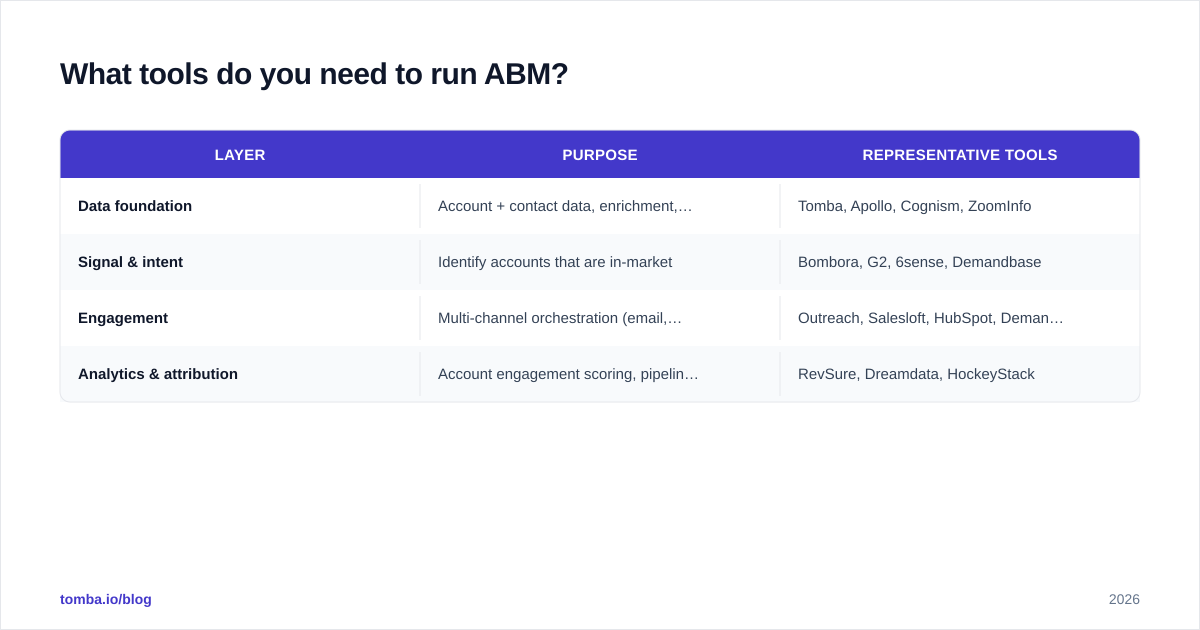
Tomba sits in the data foundation layer and feeds the other three. The data enrichment and bulk email finder tools are how you keep your tier-1 committees fully populated and the rest of the stack accurate. See our B2B database for the underlying coverage.
What does an account based marketing process look like in practice?#
Here's a condensed 90-day rollout that a mid-market team of 8 (1 PMM, 2 marketing ops, 5 SDR/AE) can actually execute:
Days 1-14: Foundation. Lock the ICP doc with the CRO. Pull closed-won data from the last 24 months. Build the first tier-1 list of 50 accounts. Provision the data stack — CRM enrichment, email verifier, and the intent layer.
Days 15-30: Committee mapping. For each of the 50 tier-1 accounts, map 8-10 stakeholders. Validate emails. Push everything into the CRM with account-level tagging.
Days 31-60: First plays live. Launch two plays — one for funding announcements, one for champion job changes. Set up alerts. Build the first round of account-specific landing pages (10-15 of them, templated).
Days 61-90: Measure and tune. Look at account engagement scores. Cull underperforming plays. Add a third play targeting competitive switch signals. Report pipeline created back to the CRO with attribution methodology spelled out.
By day 90, the loop is running. From there it's iteration, not invention.
What are the biggest mistakes teams make with ABM?#
- Treating ABM as a marketing-only initiative. Without sales accountability, plays go unused.
- Tier-1 lists that are too large. If you have 200 tier-1 accounts, none of them are actually tier 1.
- Ignoring contact data quality. Bouncing 40% of your tier-1 outreach because your emails are stale wastes both budget and reputation. Use a catch-all verifier before launch.
- Confusing engagement with intent. Someone reading your blog isn't ready to buy. Stack signals.
- Reporting MQLs. ABM is a pipeline motion. If your dashboards still lead with MQL count, leadership will treat ABM as demand gen with a different label.
- Skipping the post-mortem. Every closed-lost tier-1 deal deserves a written debrief. The patterns are where the next play comes from.
For external reading, Gartner's research on the B2B buying journey and Forrester's ABM benchmark studies are worth bookmarking. G2's ABM software category is a useful cross-check on the vendor landscape.
Frequently asked questions#
How many accounts should I target in tier 1? Between 20 and 50 for most teams. The bound is set by SDR + AE capacity, not budget. A rep can meaningfully cover 8-12 tier-1 accounts; do the math from there.
How long until ABM produces pipeline? First meetings within 30-45 days of launch. Pipeline visible at 60-90 days. Closed-won revenue typically 6-12 months out for enterprise tier-1 motions, faster for tier-3.
Is ABM only for enterprise? No. Mid-market teams run tier-2 and tier-3 motions effectively. The principles — named accounts, buying committees, shared sales + marketing accountability — scale down.
Do I need an ABM platform? Not at the start. You can run the first 60 days with a CRM, an email finder, an enrichment layer, and a sequencing tool. Add a dedicated ABM platform once you have 100+ tier-1 accounts and need orchestration at scale.
Start with the data layer#
The account based marketing process collapses if the contact data is wrong. Buying committees you can't reach, emails that bounce, and missing decision-makers eat through your tier-1 quota fast.
Tomba Email Finder is the simplest place to start: enter a target account's domain, pull the full org chart with verified emails, and feed the committee straight into your sequencing tool. Free tier covers 25 searches/month, the $49/mo Starter plan handles a focused tier-1 motion, and the API plus Salesforce integration keep your CRM enriched without manual work. Build the list, map the committees, then run the plays.
// get started
Find, verify and enrich your first contacts today
Start on the free plan with 25 searches a month, then scale when your team is ready.
Free plan · No credit card required · GDPR & CCPA
// about the author