Account-Based Prospecting in 2026: A Complete Playbook
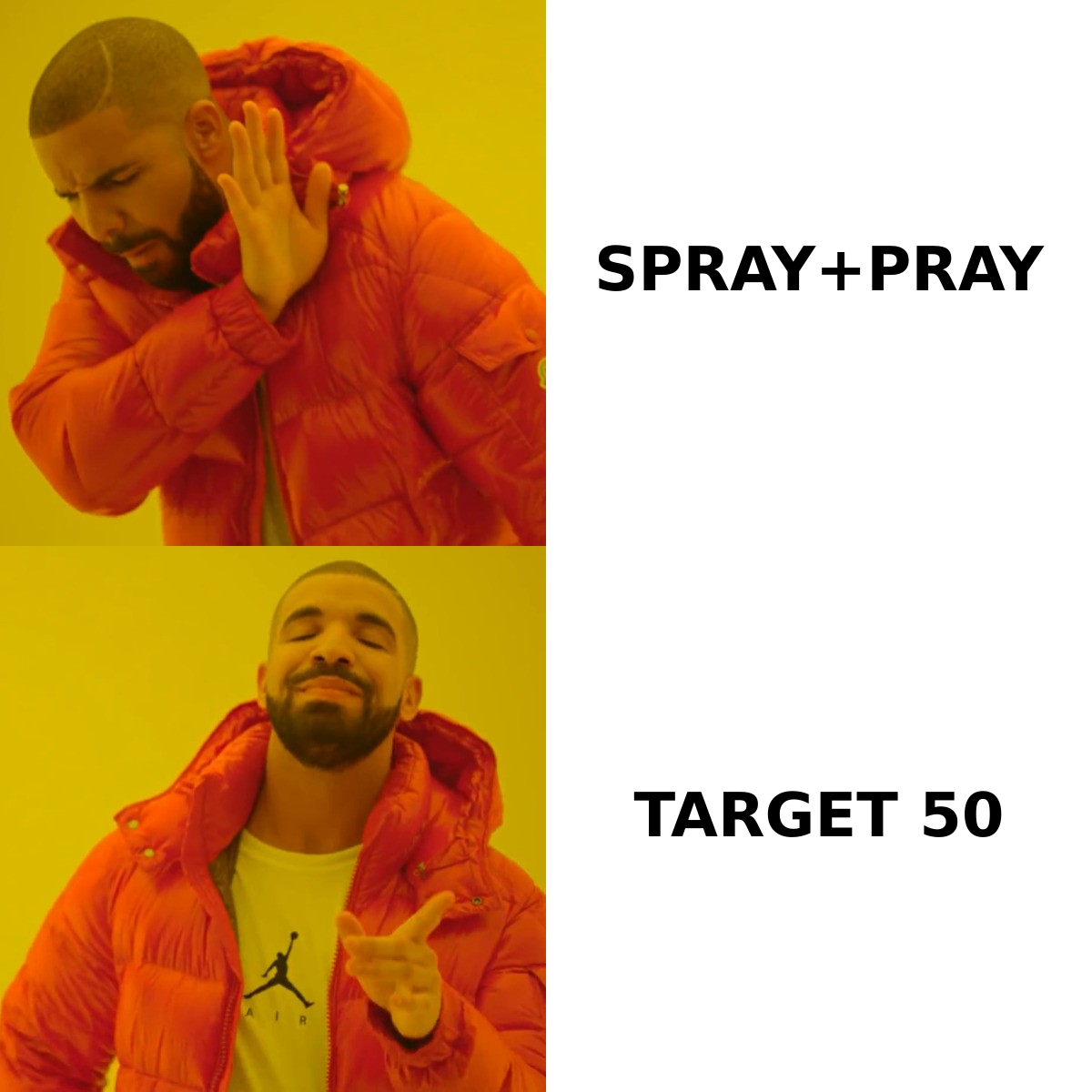
Spray-and-pray outbound is dead. Here's how account based prospecting concentrates your reps on the accounts that actually close — with a step-by-step framework, tooling, and metrics for 2026.
TL;DR
- Account based prospecting flips the funnel: you start with a short list of high-fit accounts, then find the right people inside each one — instead of blasting thousands of random contacts.
- It works best for considered B2B purchases with multiple decision-makers, longer sales cycles, and deal sizes large enough to justify research.
- The repeatable loop is: define ICP → build a named account list → score and tier → map the buying committee → multithread outreach → measure account engagement, not lead volume.
- Data quality is the whole game. Bad emails and stale titles quietly kill account based prospecting faster than a weak message ever will.
- Tools matter, but sequence matters more. This guide gives you the framework first, then where software (including Tomba) plugs in.
What is account based prospecting?#
Account based prospecting is a targeted outbound approach where you pick a finite list of high-value companies first, then identify and engage the specific people inside each one who influence the buying decision.
Think of it like fishing with a spear instead of a net. The net (traditional lead-based prospecting) drags in whatever swims by — you process volume and hope a few fit. The spear (account based prospecting) means you've already decided which fish you want, you know where it lives, and every motion is aimed. You trade reach for precision.
The distinction matters because most outbound teams still optimize for the wrong number: contacts touched. Account based prospecting optimizes for accounts penetrated. A rep who books one meeting at a perfect-fit 2,000-employee target is worth more than a rep who books five meetings at companies that will never buy.
This is the operational layer of account-based marketing. ABM sets the strategy and air cover; account based prospecting is the ground game your SDRs and AEs actually run every morning.
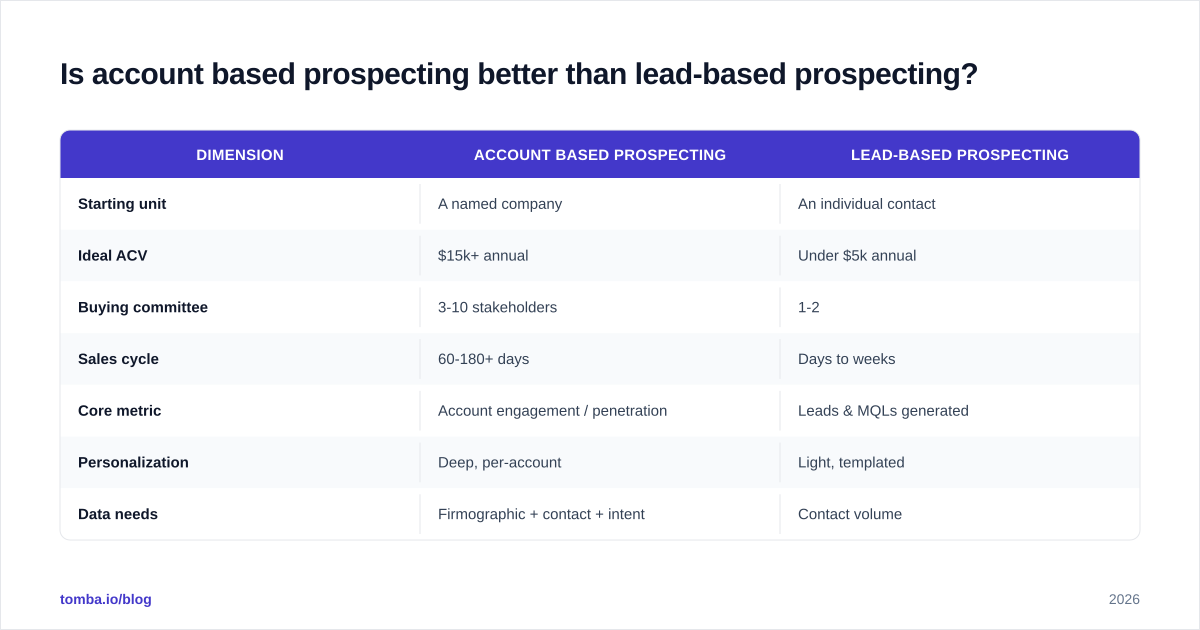
Is account based prospecting better than lead-based prospecting?#
It depends on your deal economics — there's no universal winner.
Account based prospecting wins when your average contract value is high, your sales cycle involves three or more stakeholders, and the total addressable market is small enough to name. If you can realistically list every company that should buy from you, you should be prospecting them by name.
Lead-based prospecting still wins for high-velocity, low-ACV motions — think self-serve SaaS under $50/month or transactional products where one champion can sign off. There, volume is the strategy and per-account research is wasted effort.
| Dimension | Account based prospecting | Lead-based prospecting |
|---|---|---|
| Starting unit | A named company | An individual contact |
| Ideal ACV | $15k+ annual | Under $5k annual |
| Buying committee | 3-10 stakeholders | 1-2 |
| Sales cycle | 60-180+ days | Days to weeks |
| Core metric | Account engagement / penetration | Leads & MQLs generated |
| Personalization | Deep, per-account | Light, templated |
| Data needs | Firmographic + contact + intent | Contact volume |
| Failure mode | Too few accounts, slow ramp | Wasted spend on bad fit |
Gartner's research on the B2B buying journey found that buying groups for complex solutions now involve six to ten decision-makers, each armed with their own information. That single statistic is the strongest argument for account based prospecting: you cannot win a ten-person committee by emailing one person and hoping.
How do you build an account based prospecting list?#
Start with your Ideal Customer Profile, then work outward in concentric circles of fit.
The ICP is not a buyer persona. A persona describes a person ("VP of Revenue, 40s, hates manual reporting"). An ICP describes a company — the firmographic and technographic fingerprint of an account that buys, stays, and expands. Get the ICP wrong and every downstream step amplifies the mistake.
Step 1 — Define the ICP from your best customers, not your hopes. Pull your closed-won accounts from the last 12-18 months. Look for patterns in industry, employee count, revenue band, tech stack, geography, and growth signals. Your ICP is the intersection where deals close fastest and churn lowest.
Step 2 — Generate the named account list. Now translate that ICP into actual company names. This is where a B2B database and firmographic filters earn their keep — you query for "SaaS companies, 200-1000 employees, North America, using HubSpot" and get a list instead of a guess.
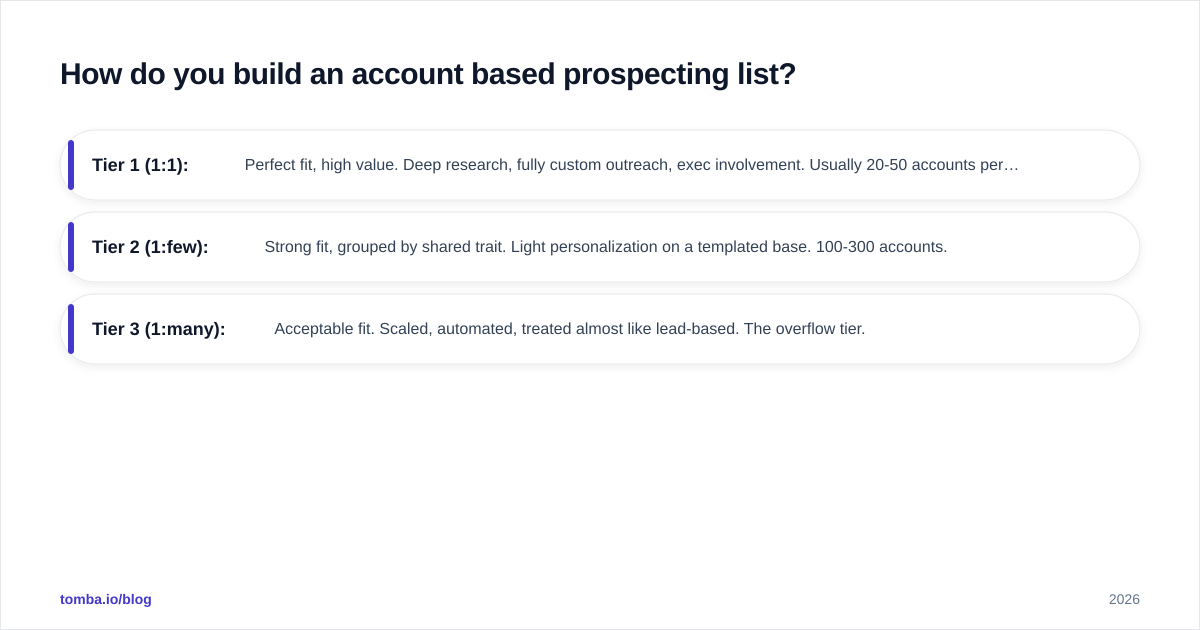
Step 3 — Tier the list. Not all good-fit accounts deserve equal effort. A common split:
- Tier 1 (1:1): Perfect fit, high value. Deep research, fully custom outreach, exec involvement. Usually 20-50 accounts per rep.
- Tier 2 (1:few): Strong fit, grouped by shared trait. Light personalization on a templated base. 100-300 accounts.
- Tier 3 (1:many): Acceptable fit. Scaled, automated, treated almost like lead-based. The overflow tier.
Step 4 — Layer in intent and triggers. Hiring sprees, funding rounds, new executive hires, tech adoption, and competitor displacement signals tell you which accounts are in-market now. Prioritize the tier list by timing, not just fit.
How do you map the buying committee inside an account?#
Once you've chosen an account, your job shifts from "find a contact" to "map the room." You need to know who holds budget, who feels the pain, who can block you, and who will champion you.
A practical committee map for most B2B deals:
- Economic buyer — signs the check, cares about ROI and risk.
- Champion — feels the pain daily, will sell internally for you.
- Technical/operational evaluators — judge whether it actually works.
- End users — live with the tool; their adoption makes or breaks renewal.
- Blockers — security, legal, procurement, or a rival vendor's incumbent fan.
To build this map you need accurate contact data for several people per account, not one. This is where prospecting tooling becomes non-negotiable. Run a domain search to pull every discoverable email at the company, use a LinkedIn finder to connect titles to verified work emails, and grab direct dials with a phone finder for the stakeholders who never answer email.
The mistake teams make here is single-threading: pouring all energy into one friendly contact. When that person changes jobs — and in 2026's market, they will — the deal evaporates. Multithreading across the committee is insurance.
According to HubSpot's sales research, deals with multiple engaged stakeholders close at materially higher rates than single-contact deals. Map the room before you knock.
What does an account based prospecting cadence look like?#
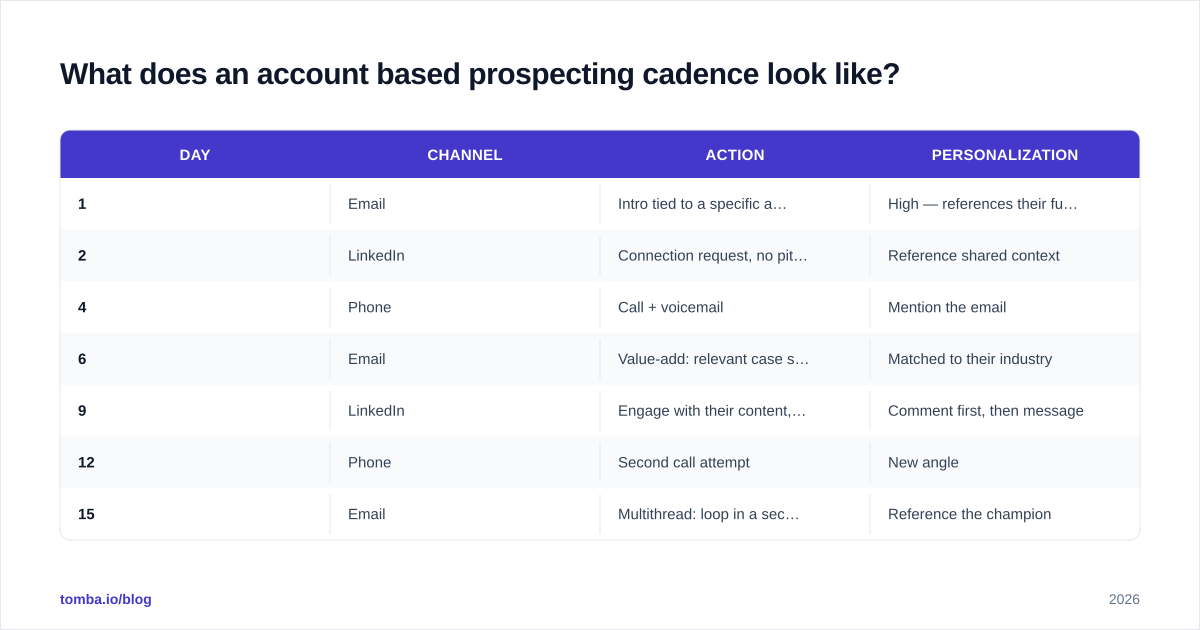
A good cadence is multichannel, multithreaded, and paced to the account's tier — not a single email blast.
Here's a representative Tier 1 cadence over three weeks, run in parallel across three to four committee members:
| Day | Channel | Action | Personalization |
|---|---|---|---|
| 1 | Intro tied to a specific account trigger | High — references their funding/hire | |
| 2 | Connection request, no pitch | Reference shared context | |
| 4 | Phone | Call + voicemail | Mention the email |
| 6 | Value-add: relevant case study | Matched to their industry | |
| 9 | Engage with their content, then DM | Comment first, then message | |
| 12 | Phone | Second call attempt | New angle |
| 15 | Multithread: loop in a second stakeholder | Reference the champion | |
| 18 | Break-up / permission-to-close | Low-pressure |
The content rule: every touch should reference something true about that account. "I saw you just opened a London office" beats "I wanted to reach out about our solution" every time. If you're stuck writing the first line, a cold email AI can draft the skeleton, but the trigger has to be real.
Which tools do you need for account based prospecting?#
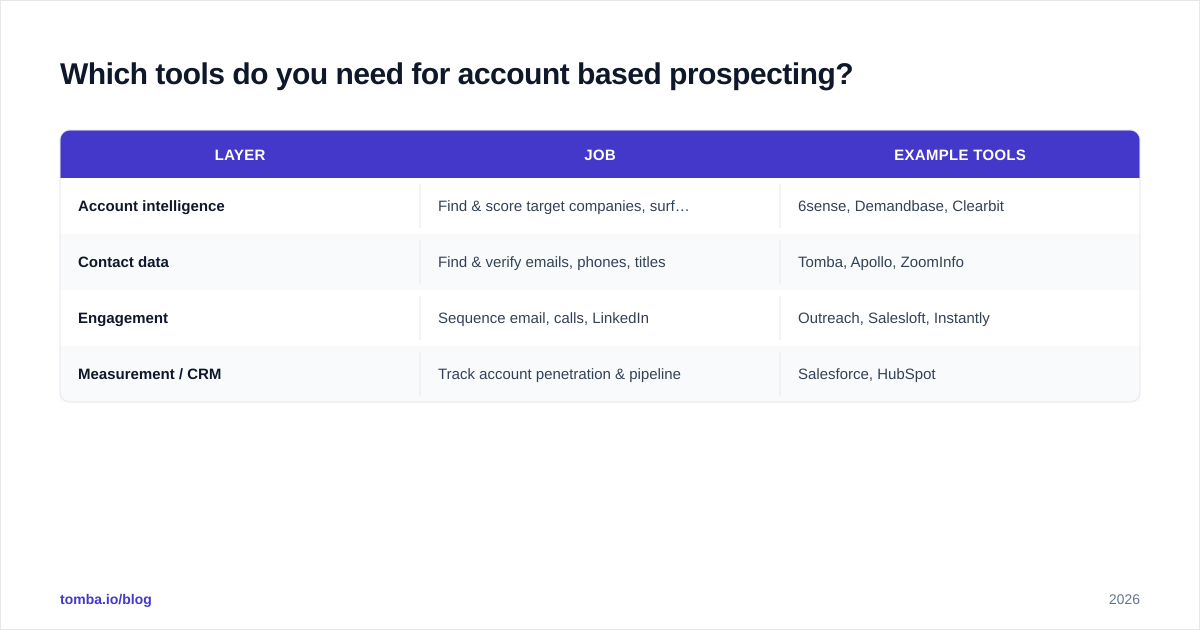
You need four layers: account data, contact data, engagement, and measurement. Most teams over-buy on engagement and under-invest in data quality — which is backwards.
| Layer | Job | Example tools |
|---|---|---|
| Account intelligence | Find & score target companies, surface intent | 6sense, Demandbase, Clearbit |
| Contact data | Find & verify emails, phones, titles | Tomba, Apollo,ZoomInfo |
| Engagement | Sequence email, calls, LinkedIn | Outreach, Salesloft, Instantly |
| Measurement / CRM | Track account penetration & pipeline | Salesforce, HubSpot |
The unglamorous truth: your engagement platform is only as good as the data feeding it. A perfectly sequenced cadence sent to a bounced email accomplishes nothing. Before any address enters a sequence, run it through an email verifier — and if your targets sit on catch-all domains (common at larger enterprises), a catch-all verifier keeps your bounce rate and sender reputation intact.
For enriching a raw account list into full committee maps at scale, batch tooling and data enrichment turn a spreadsheet of company names into verified, role-tagged contacts ready for outreach. You can sanity-check vendor accuracy claims on third-party review sites like G2 rather than taking marketing copy at face value.
How do you measure account based prospecting?#
Stop counting leads. Start counting accounts engaged, and how deeply.
Lead-based metrics actively mislead an account based motion. "300 emails sent" tells you nothing about whether your 50 target accounts are warming up. The metrics that matter:
- Account penetration — what % of your named list has at least one engaged contact?
- Committee coverage — average number of engaged stakeholders per active account (aim for 3+).
- Account engagement score — a composite of opens, replies, meetings, and site visits per account.
- Meetings booked at Tier 1 accounts — the only meeting count worth celebrating.
- Pipeline & win rate from target accounts vs. non-target — the proof the strategy works.
Set a baseline in your CRM and review by account, not by rep activity. A rep can have low send volume and still be your best performer if their target accounts are converting. Salesforce's own sales metrics guidance reinforces measuring outcomes and pipeline quality over raw activity counts — exactly the shift account based prospecting demands.
What are the most common account based prospecting mistakes?#
The failures are predictable, which means they're avoidable.
- List too big. "Account based" with 5,000 accounts is just lead-based with extra steps. If a rep can't research each Tier 1 account, the tier is too large.
- Single-threading. Betting the deal on one contact. Map and engage the committee from day one.
- Skipping verification. Sending to unverified emails tanks deliverability and burns the domain you'll need for months. Verify first, always.
- Generic "personalization." Merge tags like
{{first_name}}are table stakes, not personalization. Reference the account's actual situation. - No feedback loop. Closed-won and closed-lost data should continuously refine your ICP. A static ICP rots.
- Measuring activity, not penetration. If your dashboard shows emails sent and not accounts engaged, you're flying blind.
Avoid these six and you're ahead of most teams running "ABM" in name only.
Getting started: your first 30 days#
Keep the first month deliberately small. Pick 25-50 Tier 1 accounts, map three to five stakeholders each, verify every contact, and run one tight multichannel cadence. Measure penetration weekly. Resist the urge to scale until the motion works at small scale — a broken process scaled is just broken faster.
The single highest-leverage investment is contact data accuracy, because every other step inherits its quality. That's where Tomba's Email Finder fits an account based motion: feed it a target company domain plus a stakeholder's name, and it returns the verified professional email with a confidence score — across the whole buying committee, not one lead at a time. Pair it with the verifier and enrichment tools, start on the free tier (25 searches/month), and move to Starter at $49/month once your list is built. Spear the right accounts, reach the right people, and let everyone else keep casting nets.
// get started
Find, verify and enrich your first contacts today
Start on the free plan with 25 searches a month, then scale when your team is ready.
Free plan · No credit card required · GDPR & CCPA
// about the author