Account Identification in 2026: The Complete ABM Guide
Account identification tells you which companies are worth your team's time before a single email goes out. Here's how to build a signal-driven system in 2026.
Account identification is the practice of deciding which companies your go-to-market team should pursue before anyone spends a minute on outreach. Get it right and your reps work a short list of accounts that actually look like buyers. Get it wrong and you burn quota chasing logos that were never going to convert.
TL;DR#
- Account identification = systematically finding and ranking the companies that match your ICP and show buying intent, so you target instead of spray.
- It sits upstream of lead generation: you pick the accounts first, then find the people inside them.
- The 2026 stack blends firmographic fit, technographic signals, intent data, and anonymous website visitor reveal.
- A repeatable scoring model beats gut feel — tier accounts into A/B/C and route them differently.
- Identification is worthless without contact data; pair your account list with an email finder to make it actionable.
What is account identification?#
Account identification is the front door of account-based marketing (ABM). Think of it like a fishing guide reading the water before casting: instead of dropping a line anywhere, you find where the fish actually are, then fish there. In B2B terms, you define what a good-fit company looks like, then assemble a list of real companies that match — ranked by how likely they are to buy right now.
It is distinct from lead generation. Lead gen asks "who is this person and how do I reach them?" Account identification asks "which companies deserve a coordinated play from sales and marketing?" You answer the account question first, then drill into contacts. This ordering is the core idea behind revenue operations and modern ABM: align everyone around a shared target list instead of a pile of disconnected leads.
The discipline matters more every year because budgets are tighter and buying committees are bigger. According to Gartner, a typical B2B purchase now involves six to ten decision-makers. Identifying the account lets you map that whole committee instead of betting everything on one inbound form fill.
Why does account identification matter in 2026?#
Because the cost of a wrong target compounds. Every misfit account your SDRs work is time not spent on a real opportunity, deliverability risk from emailing people who will never reply, and noise in your CRM that corrupts your forecasting.
Three shifts make identification non-negotiable this year:
- Spam filters got stricter. Google and Yahoo enforce sender-reputation thresholds that punish low-engagement blasts. Tight targeting protects your sender reputation because you email people more likely to engage.
- Buyers research anonymously. Most of the buying journey happens before anyone fills out a form. If you only chase known leads, you miss the accounts quietly evaluating you right now.
- AI lowered the cost of personalization but raised the bar. Everyone can generate a "personalized" email. The differentiator is targeting the right account with a message that fits where they are in the journey.
What signals identify a high-value account?#
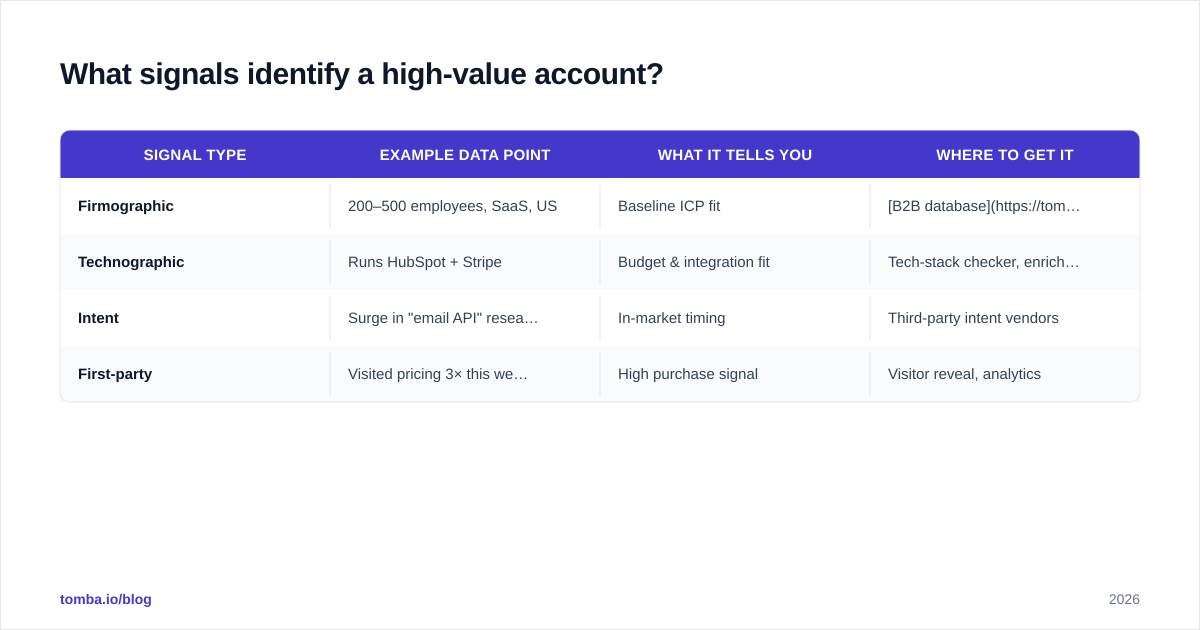
Good account identification stacks four signal types. Any one alone is weak; together they are predictive.
1. Firmographic fit — the static "does this company look like us at all" layer: industry, employee count, revenue, geography, business model. This is your baseline ICP filter.
2. Technographic signals — what tools the company already runs. If you integrate with Salesforce, companies on Salesforce are warmer. Detecting the stack tells you about budget, sophistication, and integration fit.
3. Intent data — behavioral signals that a company is researching your category: surges in relevant content consumption, review-site activity, competitor comparisons. Intent is what turns a "good fit" into a "good fit, right now."
4. Engagement and visit signals — first-party behavior: who visited your pricing page, opened your emails, or attended a webinar. Anonymous website visitor reveal turns unknown pricing-page traffic into named accounts you can actually work.
| Signal type | Example data point | What it tells you | Where to get it |
|---|---|---|---|
| Firmographic | 200–500 employees, SaaS, US | Baseline ICP fit | B2B database, enrichment |
| Technographic | Runs HubSpot + Stripe | Budget & integration fit | Tech-stack checker, enrichment |
| Intent | Surge in "email API" research | In-market timing | Third-party intent vendors |
| First-party | Visited pricing 3× this week | High purchase signal | Visitor reveal, analytics |
The practical move is to require firmographic fit as a gate, then layer intent and first-party signals on top to rank the accounts that pass.
How do you build an account identification framework?#
Here is a five-step framework you can implement this quarter. Treat each step as a filter that narrows a large universe down to a workable target list.
Step 1 — Define your ICP from won deals, not opinions. Pull your last 50–100 closed-won accounts and find the firmographic patterns: size band, industries, regions, common tech. Your ICP is what your best customers actually look like, not what you wish they looked like.
Step 2 — Build the addressable universe. Use a B2B database and domain search to list every company matching your ICP filter. This is your total addressable market in concrete, named-company form — usually a few thousand accounts.
Step 3 — Enrich and score. Run data enrichment to fill in tech stack, headcount, and funding, then apply a scoring model. A simple weighted score works well: fit (0–40), intent (0–40), engagement (0–20). Anything above 70 is a Tier A account.
Step 4 — Tier and route. Split the scored list into A/B/C tiers. Tier A gets 1:1 ABM with custom plays. Tier B gets 1:few campaigns. Tier C gets automated nurture. Routing by tier is how you spend expensive human attention only where it pays off.
Step 5 — Find the people and verify. An account list is inert until you have contacts. Pull decision-makers with an email finder, then run an email verifier so your outreach lands. Skipping verification here is the most common way teams torch deliverability on an otherwise great list.
What tools do you need for account identification?#
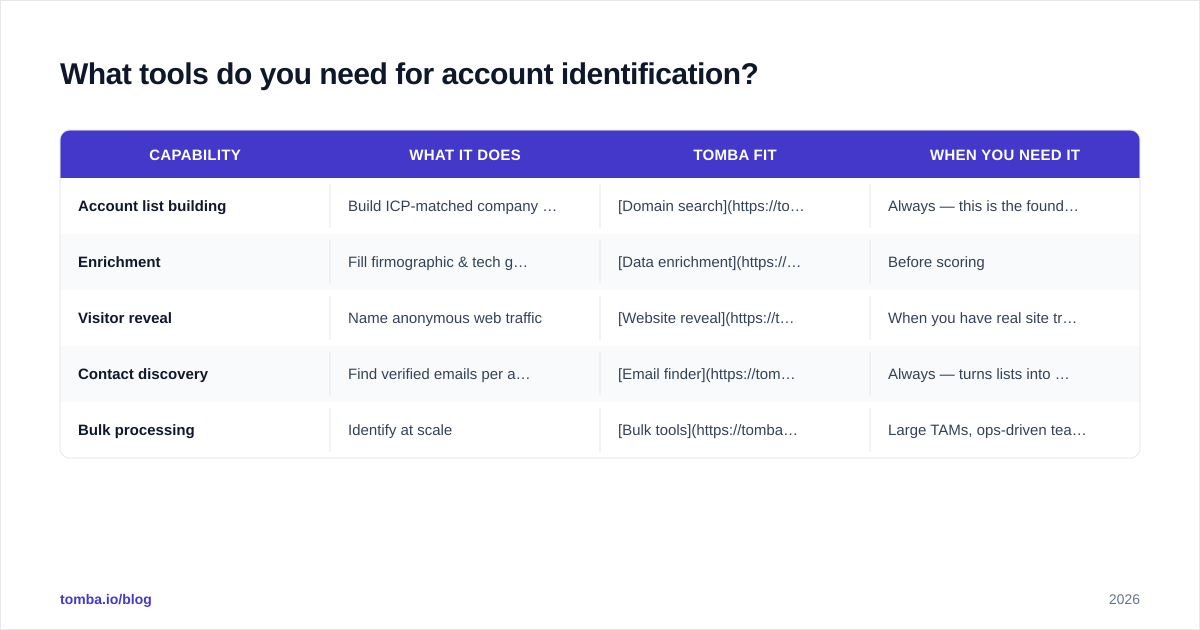
You do not need a single monolithic platform — you need coverage across four jobs: list building, enrichment, intent, and contact data. Many teams over-buy on intent and under-invest in accurate contact data, which is backwards: intent tells you who to chase, but bad emails mean you never actually reach them.
| Capability | What it does | Tomba fit | When you need it |
|---|---|---|---|
| Account list building | Build ICP-matched company lists | Domain search + database | Always — this is the foundation |
| Enrichment | Fill firmographic & tech gaps | Data enrichment | Before scoring |
| Visitor reveal | Name anonymous web traffic | Website reveal | When you have real site traffic |
| Contact discovery | Find verified emails per account | Email finder + verifier | Always — turns lists into outreach |
| Bulk processing | Identify at scale | Bulk tools | Large TAMs, ops-driven teams |
For pricing, Tomba runs a free tier (25 searches/month), then Starter at $49/mo, Growth at $99/mo, and Pro at $249/mo — full Tomba pricing is on the site. Compare contact-data vendors on a neutral source like G2 before committing; the right mix depends on whether you lead with intent, first-party traffic, or pure outbound.

How is account identification different from lead generation?#
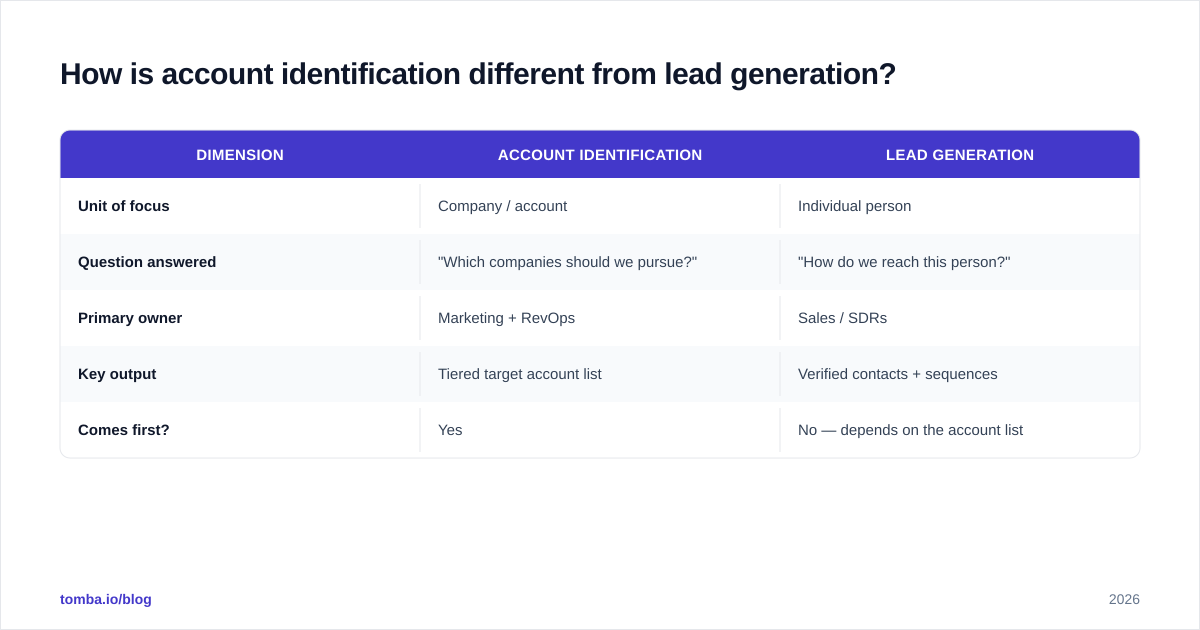
They are sequential, not interchangeable. Account identification picks the companies; lead generation finds the people inside them. Confusing the two is why so many "ABM programs" are just renamed lead lists.
| Dimension | Account identification | Lead generation |
|---|---|---|
| Unit of focus | Company / account | Individual person |
| Question answered | "Which companies should we pursue?" | "How do we reach this person?" |
| Primary owner | Marketing + RevOps | Sales / SDRs |
| Key output | Tiered target account list | Verified contacts + sequences |
| Comes first? | Yes | No — depends on the account list |
The healthiest pipeline runs both in order: identify accounts, then generate the specific contacts and book the meetings. When marketing and sales share one identified account list, you stop arguing about lead quality and start arguing about plays — a much better argument to have. This is the practical heart of aligning around revenue operations.
What mistakes kill account identification programs?#
A few patterns sink otherwise-good efforts:
- ICP by committee. When the ICP is a wish list instead of a pattern from won deals, every account "kind of" fits and nothing gets prioritized. Anchor it to closed-won data.
- Buying intent and ignoring fit. A company researching your category but five times too small for your product is a distraction, not an opportunity. Gate on fit first.
- No contact-data layer. Teams spend on intent platforms and then can't email anyone because the contact data is stale. Pair every account with verified contacts via an email verifier.
- Set-and-forget scoring. Accounts move in and out of market constantly. Re-score on a cadence (monthly is reasonable) so your A-tier reflects current intent, not last quarter's.
- Skipping the catch-all problem. Many target companies use catch-all domains that accept any address. Use a catch-all verifier so you don't assume a guessed email is valid.
The throughline: identification is a system, not a one-time list. Vendors like HubSpot build whole ABM suites around keeping that system alive, but you can run a disciplined version with focused contact-data tools and a clear scoring model.
How do you turn an identified account into a booked meeting?#
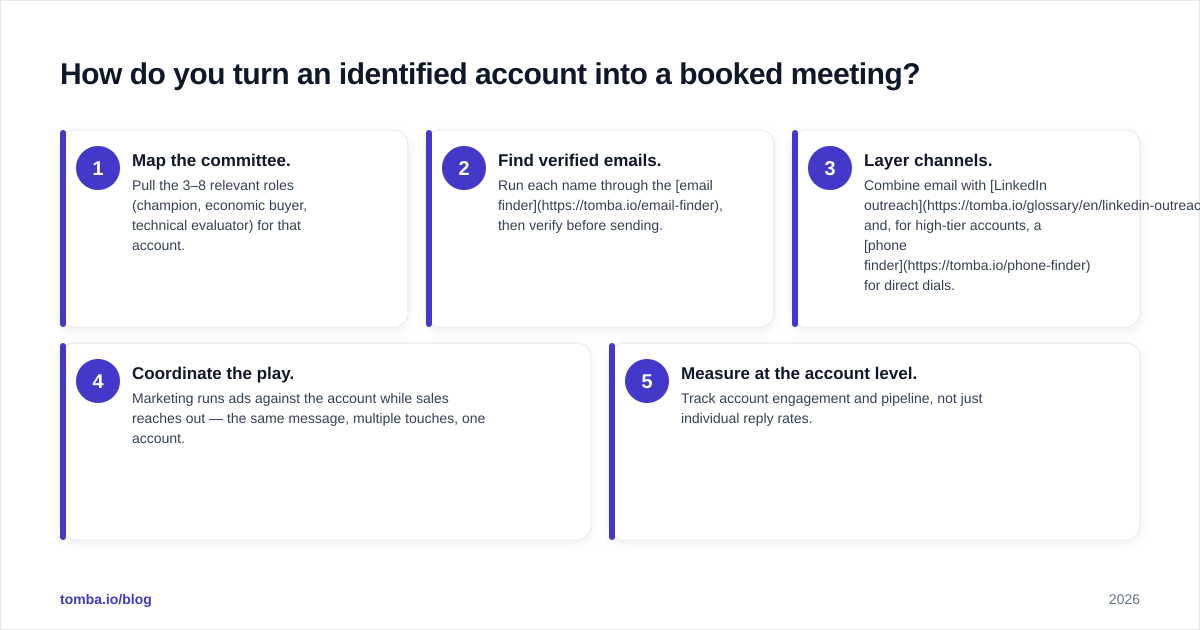
Once an account clears your scoring threshold, the path is short and mechanical:
- Map the committee. Pull the 3–8 relevant roles (champion, economic buyer, technical evaluator) for that account.
- Find verified emails. Run each name through the email finder, then verify before sending.
- Layer channels. Combine email with LinkedIn outreach and, for high-tier accounts, a phone finder for direct dials.
- Coordinate the play. Marketing runs ads against the account while sales reaches out — the same message, multiple touches, one account.
- Measure at the account level. Track account engagement and pipeline, not just individual reply rates.
This is where identification pays off: because you targeted tightly, your outreach is relevant, your deliverability stays healthy, and your reps work a list they actually believe in.
Get the contact data your account list deserves#
A perfectly scored target list is just a spreadsheet until you can reach the people inside each company. That's the gap Tomba Email Finder closes — feed it your identified accounts by domain, name, or company, and get verified professional emails for the decision-makers who matter, with built-in verification so your sends land in the inbox. Start on the free tier with 25 searches, then scale into a plan that matches your account volume. Identify the right accounts, then actually reach them.
// get started
Find, verify and enrich your first contacts today
Start on the free plan with 25 searches a month, then scale when your team is ready.
Free plan · No credit card required · GDPR & CCPA
// about the author