Account Management Strategy: A 2026 Playbook for Growth
A practical account management strategy turns one-time buyers into compounding revenue. Here's the 2026 framework, tiering model, metrics, and tools that actually move retention and expansion.
TL;DR
- An account management strategy is the deliberate plan for retaining, deepening, and expanding revenue inside accounts you've already won — not chasing new logos.
- The highest-ROI move in 2026 is shifting from reactive "check-in" account management to proactive, data-driven account planning tied to measurable outcomes.
- Tier your accounts, set a contact cadence per tier, and assign clear ownership so nobody falls through the cracks.
- Track net revenue retention (NRR), expansion rate, and account health — not just renewal counts.
- Keep contact and org data fresh; stale records quietly kill expansion plays. Tools like the Tomba Email Finder help you reach new stakeholders as buying committees shift.
What is an account management strategy?#
An account management strategy is your repeatable plan for growing revenue from existing customers. Think of it like tending an orchard instead of foraging. New-business sales is foraging — you find a tree, take the fruit, move on. Account management is planting, watering, and pruning the trees you already own so they produce more every season.
Technically, an account management strategy defines how you segment your customer base, who owns each relationship, how often you engage, what value you deliver between renewals, and how you measure account health and growth. It sits downstream of the initial sale and upstream of every renewal and upsell.
The distinction matters because the economics are lopsided. Acquiring a new customer costs far more than retaining one, and existing customers convert on expansion offers at much higher rates than cold prospects convert on first purchases. A weak account management motion means you're refilling a leaky bucket every quarter. A strong one compounds.
Why does account management strategy matter more in 2026?#
Three shifts make account management the center of gravity for B2B revenue this year.
First, buying committees keep growing. The average B2B deal now involves six to ten stakeholders, and those people change roles constantly. The champion who signed your contract may be gone in 12 months. If your account plan depends on one relationship, one departure can sink the renewal.
Second, net revenue retention is the metric boards watch. Investors increasingly value efficient growth over growth at any cost. NRR above 100% means your existing base grows even if you close zero new logos. That number is owned by account management, not new sales.
Third, product-led and usage-based pricing changed the renewal. Customers can now see exactly what they use. Vague "partnership" language doesn't survive a procurement review that has consumption data. Your strategy has to demonstrate quantified value.
Put together, account management has moved from a post-sale courtesy to a core revenue operations discipline.
What are the core components of an account management strategy?#
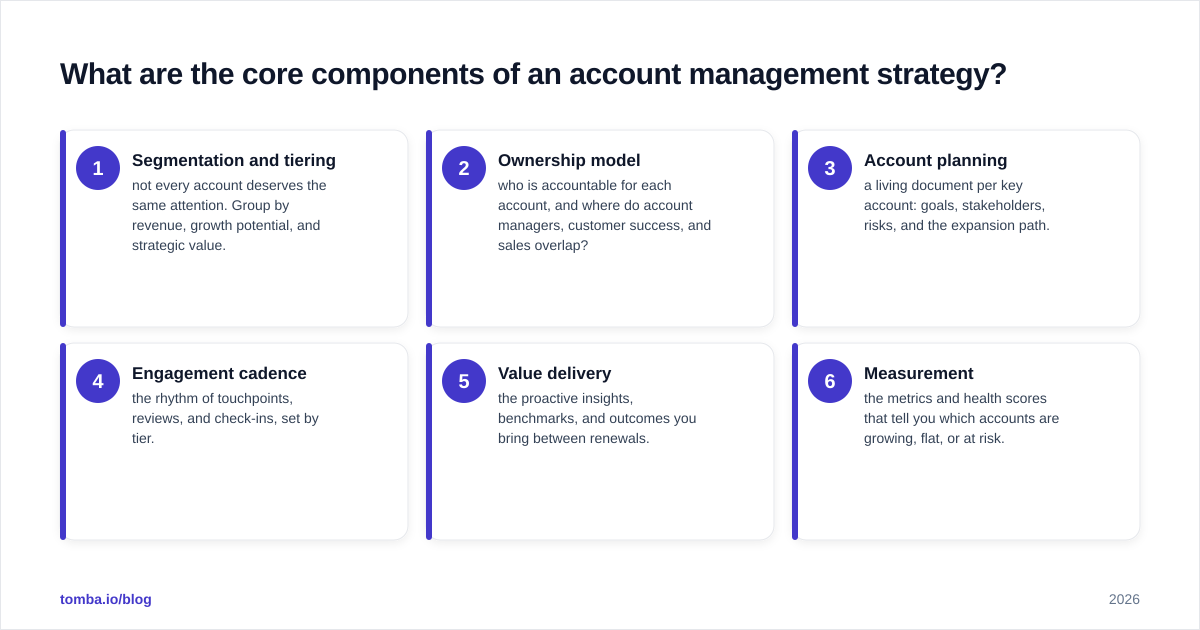
A complete strategy has six moving parts. Skip one and the others wobble.
- Segmentation and tiering — not every account deserves the same attention. Group by revenue, growth potential, and strategic value.
- Ownership model — who is accountable for each account, and where do account managers, customer success, and sales overlap?
- Account planning — a living document per key account: goals, stakeholders, risks, and the expansion path.
- Engagement cadence — the rhythm of touchpoints, reviews, and check-ins, set by tier.
- Value delivery — the proactive insights, benchmarks, and outcomes you bring between renewals.
- Measurement — the metrics and health scores that tell you which accounts are growing, flat, or at risk.
The rest of this guide unpacks the ones teams most often get wrong.
How do you tier accounts the right way?#
Conclusion first: tier by potential, not just current spend. A small account in a fast-growing company can be worth more in two years than your biggest flat account today.
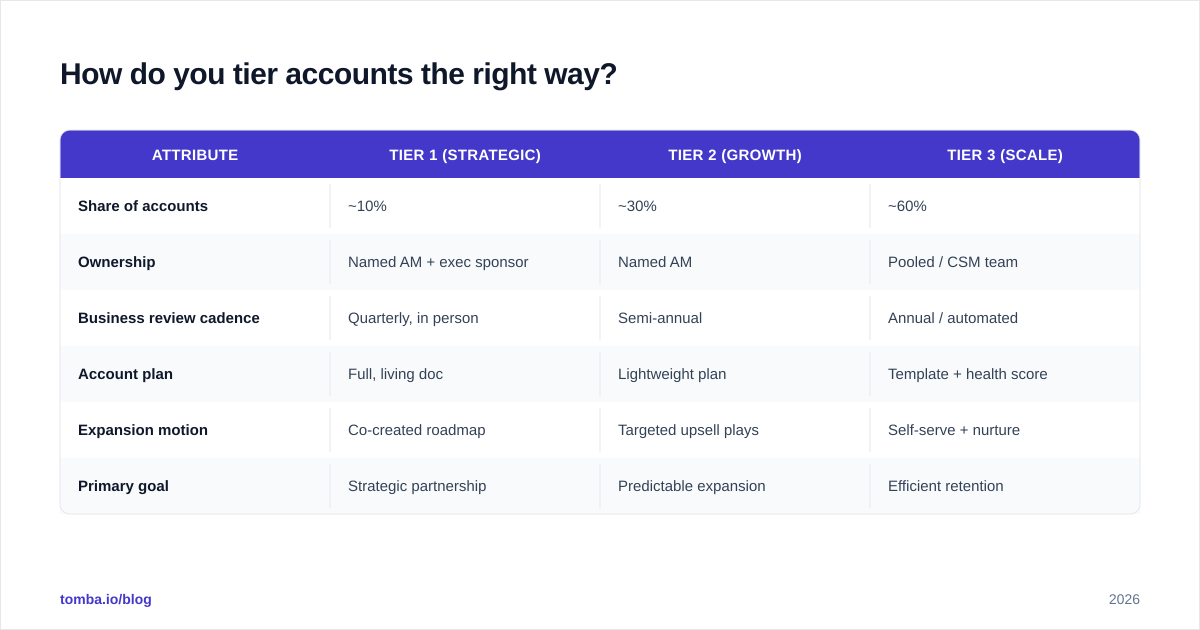
A simple, defensible model uses three tiers based on a blend of current revenue and expansion potential.
| Attribute | Tier 1 (Strategic) | Tier 2 (Growth) | Tier 3 (Scale) |
|---|---|---|---|
| Share of accounts | ~10% | ~30% | ~60% |
| Ownership | Named AM + exec sponsor | Named AM | Pooled / CSM team |
| Business review cadence | Quarterly, in person | Semi-annual | Annual / automated |
| Account plan | Full, living doc | Lightweight plan | Template + health score |
| Expansion motion | Co-created roadmap | Targeted upsell plays | Self-serve + nurture |
| Primary goal | Strategic partnership | Predictable expansion | Efficient retention |
The mistake most teams make is treating tiering as a one-time spreadsheet exercise. Re-tier at least twice a year. Accounts move up when usage and headcount grow; they move down when champions leave or usage flattens. Your B2B database and CRM should feed the signals that trigger a re-tier.
For Tier 3, lean on automation and pooled coverage. You cannot afford a named human on 60% of accounts, and you don't need one — a strong digital playbook plus health-triggered outreach covers the long tail efficiently.
What does a good account plan look like?#
A good account plan answers five questions on a single page that anyone on your team could read in two minutes:
- Where are they now? Current spend, products in use, contract dates, usage trend.
- Who matters? The decision-makers, champions, blockers, and the relationship status with each.
- What do they want? Their business goals — in their words, not your feature names.
- What's the risk? Churn signals, competitive threats, and single points of failure.
- What's the path? The specific expansion or renewal play, with owners and dates.
The stakeholder map is where plans live or die. When a champion leaves, you need a warm path to their replacement fast. This is where keeping contact data current pays off — when a new VP joins the buying committee, you can find their verified contact details with a domain search or LinkedIn finder instead of waiting weeks for an intro that may never come.
Treat the account plan as a living document reviewed in every business review, not a slide you build once for QBR theater and never touch again.
How often should you engage each account?#
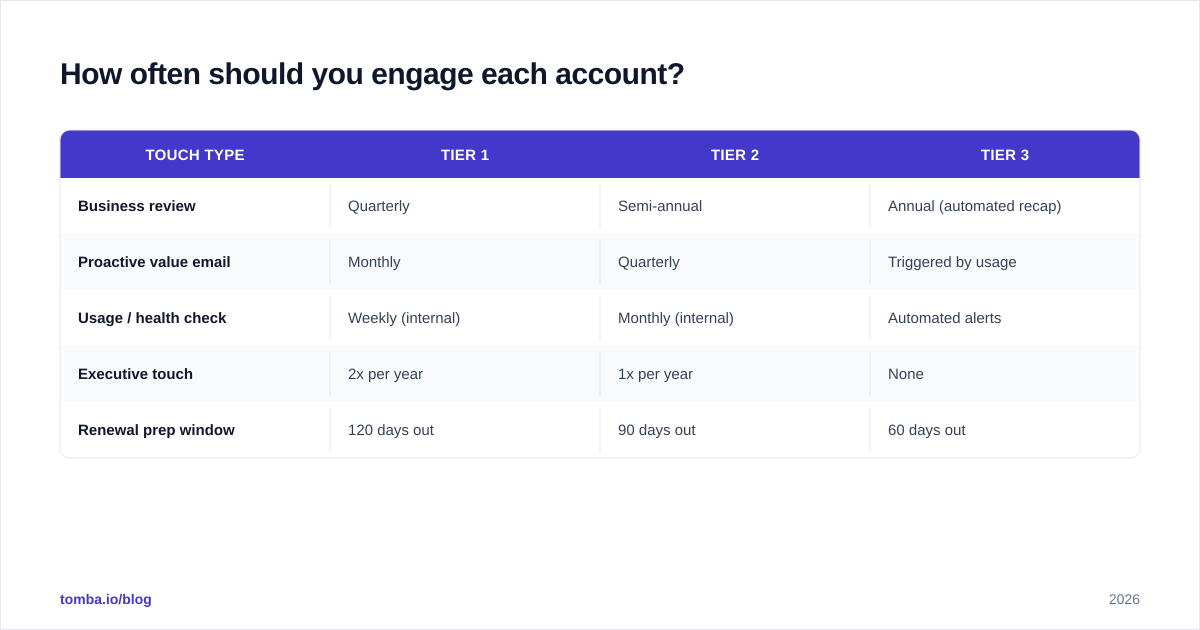
The right cadence balances value against effort. Over-contacting Tier 3 burns your team; under-contacting Tier 1 loses the relationship. Map cadence to tier and to the type of touch.
| Touch type | Tier 1 | Tier 2 | Tier 3 |
|---|---|---|---|
| Business review | Quarterly | Semi-annual | Annual (automated recap) |
| Proactive value email | Monthly | Quarterly | Triggered by usage |
| Usage / health check | Weekly (internal) | Monthly (internal) | Automated alerts |
| Executive touch | 2x per year | 1x per year | None |
| Renewal prep window | 120 days out | 90 days out | 60 days out |
Notice that most of the work is internal monitoring, not outbound contact. The goal isn't to email customers more — it's to know more about them so each touch is relevant. A monthly "just checking in" email with no substance trains customers to ignore you. A quarterly note with a benchmark, a new use case, and a quantified result earns a reply.
How do you drive expansion without being pushy?#
Expansion works when it's framed as helping the customer hit their goals, not hitting your quota. The mechanics:
Lead with outcomes, not SKUs. Open the expansion conversation with the result the customer is trying to reach, then connect the product to it. "You told us onboarding speed was the priority — here's how three similar teams cut it in half" beats "want to buy the premium tier?"
Use peer benchmarks. Customers respond to evidence that similar companies get more value from a deeper deployment. Anonymized benchmarks turn an upsell into a gap analysis they asked for.
Time it to triggers. New funding, a new executive, a hiring spike, or a usage threshold are natural expansion moments. Wire these signals into your CRM so the play fires automatically. Many teams enrich account records with firmographic and headcount data — see how data enrichment keeps those triggers accurate.
Multi-thread before you ask. Single-threaded accounts rarely expand. Map and build relationships across the org before the expansion conversation, so you're not betting the upsell on one person's mood.

What metrics actually measure account management success?#
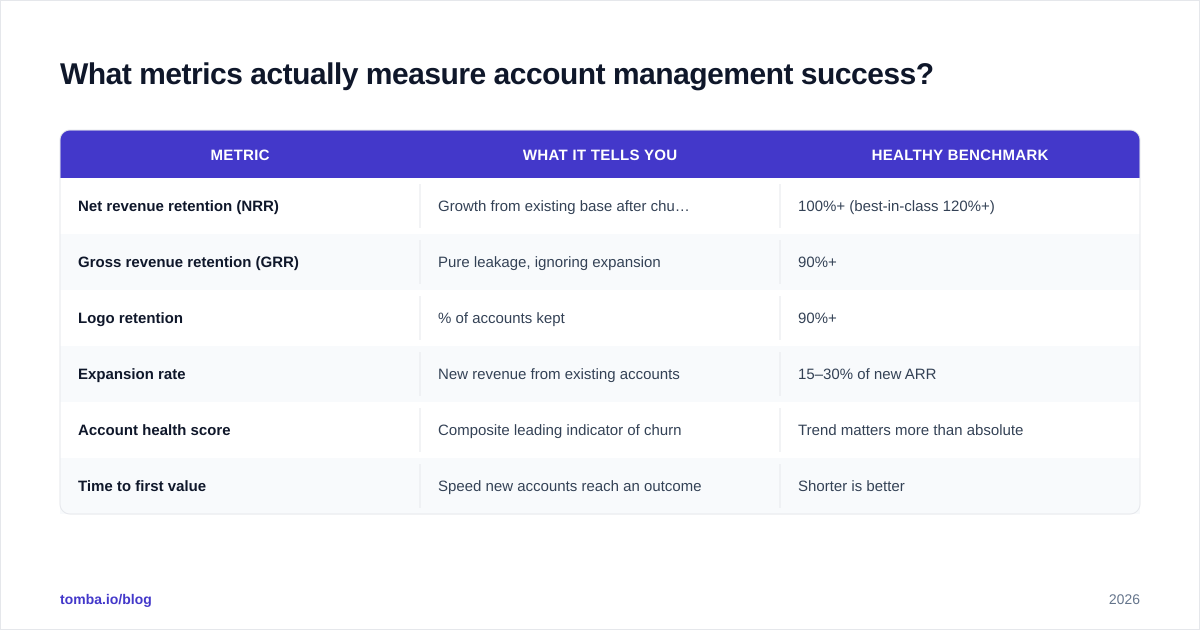
Renewal rate alone hides too much. A team can renew 95% of accounts while losing 10% of revenue through downgrades. Track a layered scorecard.
| Metric | What it tells you | Healthy benchmark |
|---|---|---|
| Net revenue retention (NRR) | Growth from existing base after churn + downgrades | 100%+ (best-in-class 120%+) |
| Gross revenue retention (GRR) | Pure leakage, ignoring expansion | 90%+ |
| Logo retention | % of accounts kept | 90%+ |
| Expansion rate | New revenue from existing accounts | 15–30% of new ARR |
| Account health score | Composite leading indicator of churn | Trend matters more than absolute |
| Time to first value | Speed new accounts reach an outcome | Shorter is better |
NRR is the headline. It captures expansion, contraction, and churn in one number, and it's the metric that most predicts efficient growth. Pair it with GRR so you can see whether expansion is masking real churn underneath. For definitions of supporting metrics, the Tomba B2B glossary is a useful reference, and HubSpot's customer retention research covers the economics in depth.
Build a health score from leading indicators — product usage, support sentiment, stakeholder coverage, executive engagement — not lagging ones like "did they renew." By the time a renewal fails, it's too late to act.
Who owns account management — sales, success, or both?#
The honest answer: it depends on your motion, and the lines are blurring. Three common models:
- AM-owned — dedicated account managers own retention and expansion. Clean accountability, but can create a handoff cliff from new sales.
- CS-owned — customer success owns the relationship and flags expansion to sales. Great for adoption, but CS teams sometimes shy from commercial conversations.
- Hybrid (pod) model — an AM, a CSM, and a support contact share a book of accounts. Best coverage, higher cost; reserve for Tier 1 and 2.
Whatever you choose, write down the rules of engagement. Most account management failures are not strategy failures — they're ownership failures, where everyone assumed someone else was watching the account. A clear RACI, shared in your CRM, prevents the silent gaps.
For broader context on how revenue teams structure these roles, Gartner's sales and customer success research is a solid neutral starting point.
What tools support an account management strategy?#
You don't need a 20-tool stack. You need clean data, a system of record, and a way to reach the right people. The essentials:
- CRM as the single source of truth for accounts, plans, and activity.
- Customer data / health platform to compute scores and fire triggers.
- Contact and enrichment data to keep stakeholder maps current as people change roles — this is the layer most teams neglect.
- Engagement tooling for cadenced, personalized outreach at scale.
The data freshness problem deserves emphasis. Your perfect account plan is worthless if half the contacts left the company. When you spot a new stakeholder, you need their verified email fast — and you need to confirm it's deliverable before you send. That's where an email verifier and a reliable finder close the loop between "we should reach them" and "we reached them." For multi-account refreshes, a bulk email finder updates an entire book at once.
How do you roll this out without boiling the ocean?#
Start small and prove the motion. A 90-day rollout that actually ships beats a perfect plan that never launches:
- Days 1–30: Tier your accounts and assign clear ownership. Just getting names against accounts surfaces the gaps.
- Days 31–60: Build full account plans for Tier 1 only. Stand up a basic health score from data you already have.
- Days 61–90: Set cadences, wire two expansion triggers, and run your first round of Tier 1 business reviews.
Then measure NRR quarter over quarter and expand the motion down-tier. Resist the urge to instrument everything at once — the teams that win treat account management as a discipline they sharpen every quarter, not a project they finish.
Final word: turn won deals into compounding revenue#
A strong account management strategy is the difference between a customer base that leaks and one that compounds. Tier with intent, plan for your strategic accounts, keep your stakeholder data fresh, and measure NRR like your growth depends on it — because it does.
The piece most teams underinvest in is contact data. Buying committees shift, champions leave, and expansion plays stall when you can't reach the new decision-maker. The Tomba Email Finder lets you find and verify professional emails by name, company, or domain — so when your account plan says "build a relationship with the new VP of Ops," you can act today instead of waiting on a warm intro that never comes. Start on the free tier and keep your account maps current as the people behind them change.
// get started
Find, verify and enrich your first contacts today
Start on the free plan with 25 searches a month, then scale when your team is ready.
Free plan · No credit card required · GDPR & CCPA
// about the author