Account Management Upsell Strategy: A 2026 Playbook
Most expansion revenue is left on the table because nobody owns it. Here's a concrete account management upsell strategy for 2026 — segmentation, timing, QBRs, and the metrics that prove it works.
Expansion revenue is the cheapest revenue you will ever book, and most teams treat it like an accident. This guide lays out an account management upsell strategy you can run in 2026 without hiring, without a new tool sprawl, and without torching the trust you spent months earning.
TL;DR#
- Upsell is owned, not hoped for. Assign expansion targets to named account managers the same way you assign new-logo quota to AEs.
- Segment before you sell. Tier accounts by fit, usage, and headroom — then match the play (upsell, cross-sell, or hold) to the tier.
- Timing beats persuasion. The best expansion conversations ride a trigger: a usage spike, a new hire, a renewal window, or a hit milestone.
- QBRs are the engine. A structured quarterly business review surfaces value, exposes gaps, and earns the right to ask for more spend.
- Measure net revenue retention (NRR), not just bookings. If NRR is below 100%, expansion is leaking faster than it grows.
What is an account management upsell strategy?#
An account management upsell strategy is a repeatable system for growing revenue inside accounts you already closed — through upsells (more of what they buy), cross-sells (adjacent products), and tier upgrades — owned by the people who manage the relationship.
Think of it like a gardener versus a hunter. New-business reps are hunters: they track, pitch, and close cold prospects. Account managers are gardeners: they tend what is already planted, notice which plots are ready to expand, and harvest at the right moment. Most companies over-invest in hunting and let the garden go to seed.
The financial case is blunt. Acquiring a new customer costs five to seven times more than retaining and growing an existing one, and existing customers are far likelier to buy again. Gartner's research on customer growth consistently shows that expansion motions carry higher win rates and shorter cycles than net-new deals — because trust, onboarding, and product fit are already solved.
Upsell vs. cross-sell vs. expansion — what's the difference?#
These get used interchangeably and shouldn't be.
- Upsell — moving a customer to a higher tier or larger volume of the same product (Starter → Growth, 5 seats → 25 seats).
- Cross-sell — selling an adjacent product the customer doesn't yet own (they have your finder, you sell them the verifier).
- Expansion — the umbrella metric that captures both, usually tracked as expansion MRR/ARR and rolled into net revenue retention.
You need all three, but you sequence them differently per account. Mixing them up is how AMs end up pitching a brand-new module to a customer who hasn't even hit the limit of their current plan.
Why do most upsell programs fail?#
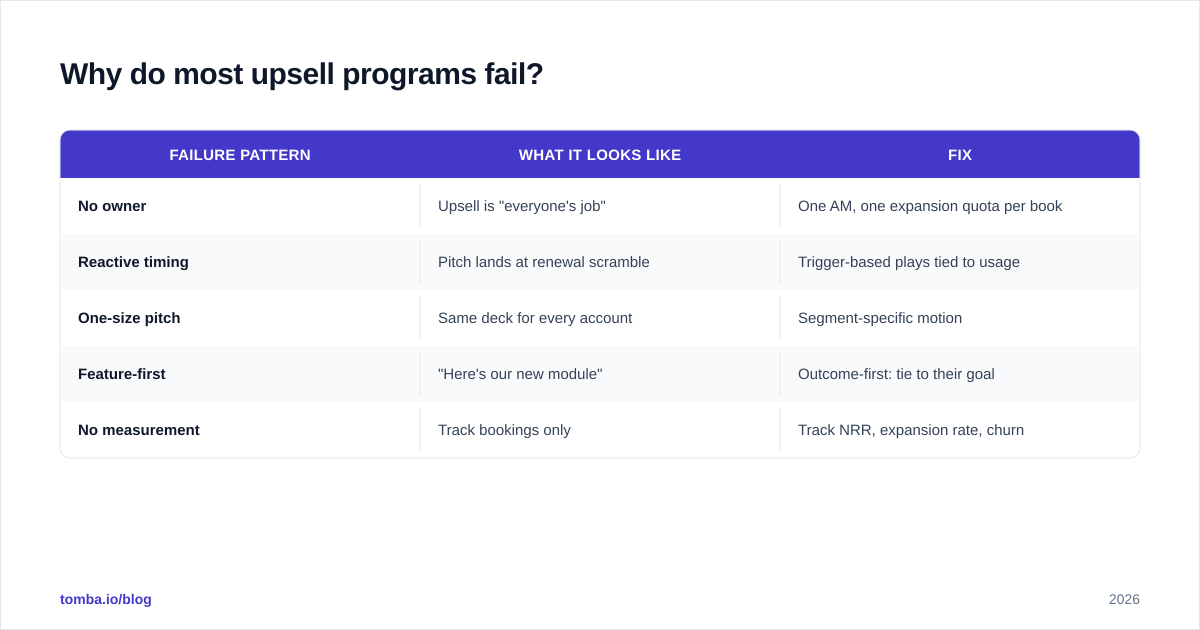
They fail because nobody owns the number, and because the motion is reactive instead of triggered.
When upsell lives "everywhere" — a little with support, a little with the CSM, a little with sales — it lives nowhere. The renewal sneaks up, someone scrambles to add a line item, and the customer feels sold-to rather than served. Compare that to a program where one AM carries an explicit expansion quota, has a named book of accounts, and reviews each one on a cadence.
)
The second failure mode is timing. Teams pitch upgrades on the vendor's calendar (end of quarter) instead of the customer's calendar (when they actually need more). That's the difference between "we'd like you to spend more" and "you're about to hit your limit — let's make sure you don't get blocked."
| Failure pattern | What it looks like | Fix |
|---|---|---|
| No owner | Upsell is "everyone's job" | One AM, one expansion quota per book |
| Reactive timing | Pitch lands at renewal scramble | Trigger-based plays tied to usage |
| One-size pitch | Same deck for every account | Segment-specific motion |
| Feature-first | "Here's our new module" | Outcome-first: tie to their goal |
| No measurement | Track bookings only | Track NRR, expansion rate, churn |
How do you segment accounts for upsell?#
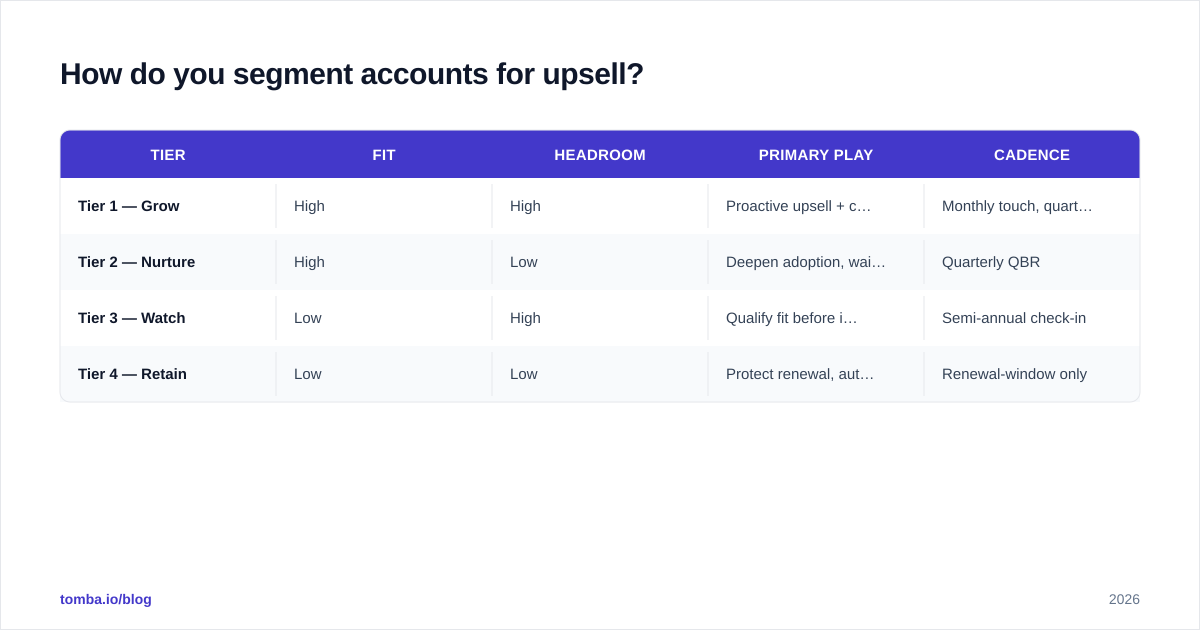
Score every account on two axes — fit (how well they match your ideal profile) and headroom (how much room to grow) — then act on the quadrant.
Don't treat the book as a flat list. A 12-seat account at 95% feature adoption with a flat headcount is a very different play from a 12-seat account that just tripled its team. Good segmentation needs current, accurate firmographic and usage signals, which is why expansion programs lean hard on data enrichment to keep account records fresh — headcount, funding, tech stack, and new decision-makers change constantly.
Here's a workable four-tier model:
| Tier | Fit | Headroom | Primary play | Cadence |
|---|---|---|---|---|
| Tier 1 — Grow | High | High | Proactive upsell + cross-sell | Monthly touch, quarterly QBR |
| Tier 2 — Nurture | High | Low | Deepen adoption, wait for trigger | Quarterly QBR |
| Tier 3 — Watch | Low | High | Qualify fit before investing time | Semi-annual check-in |
| Tier 4 — Retain | Low | Low | Protect renewal, automate | Renewal-window only |
The point isn't the exact labels — it's that your highest-fit, highest-headroom accounts get human time and a deliberate expansion plan, while low-fit accounts get efficient, mostly automated retention. Spreading AM effort evenly across the book is the most common waste in the entire motion.
When is the right time to upsell?#
The right time is when a trigger says the customer's need just grew — not when your quarter is ending.
Triggers are observable events that signal expanded need. Wire your CRM and product analytics to surface them automatically so AMs act on signal, not vibes:
- Usage triggers — account hits 80% of plan limit, adds users rapidly, or activates an advanced feature.
- Company triggers — new funding round, headcount growth, a new VP in the buying center, expansion into a new market.
- Value triggers — customer hits a milestone you helped create (first 1,000 leads enriched, a reported win), making ROI tangible.
- Relationship triggers — a glowing support ticket, an NPS promoter score, a renewal 90 days out.
The strongest play stacks triggers: a Tier 1 account that just raised a Series B and crossed 80% of its seat limit is a near-automatic expansion conversation. You're not convincing them of anything — you're removing a constraint they're already feeling.
)
How do you run a QBR that drives expansion?#
Run the quarterly business review as a value-proof session first and an expansion conversation second — in that order, never reversed.
A QBR that opens with "here's what we'd like to sell you" fails. A QBR that opens with "here's the measurable value you got this quarter, here's where you're underutilizing what you already pay for, and here's what's next" earns the upsell. Structure it in four parts:
- Outcomes delivered — quantified. Tie usage to the goals the customer stated at the start. Bring receipts: leads sourced, hours saved, pipeline influenced.
- Adoption gaps — features they pay for but don't use. Closing these increases stickiness and sets up the next tier naturally.
- Roadmap & goals — where is their business going next quarter? Their goals define your expansion thesis.
- The recommendation — a specific, outcome-tied proposal: "To support the new SDR team you're hiring, the Growth plan gives you bulk search and the seats you'll need."
This same value-first logic is what protects your win rate on expansion deals. When the customer already sees ROI in black and white, the upgrade reads as the obvious next step, not a vendor cash grab. HubSpot's research on customer success underscores the same theme: retention and expansion follow demonstrated value, not feature pitches.
What metrics prove the strategy works?#
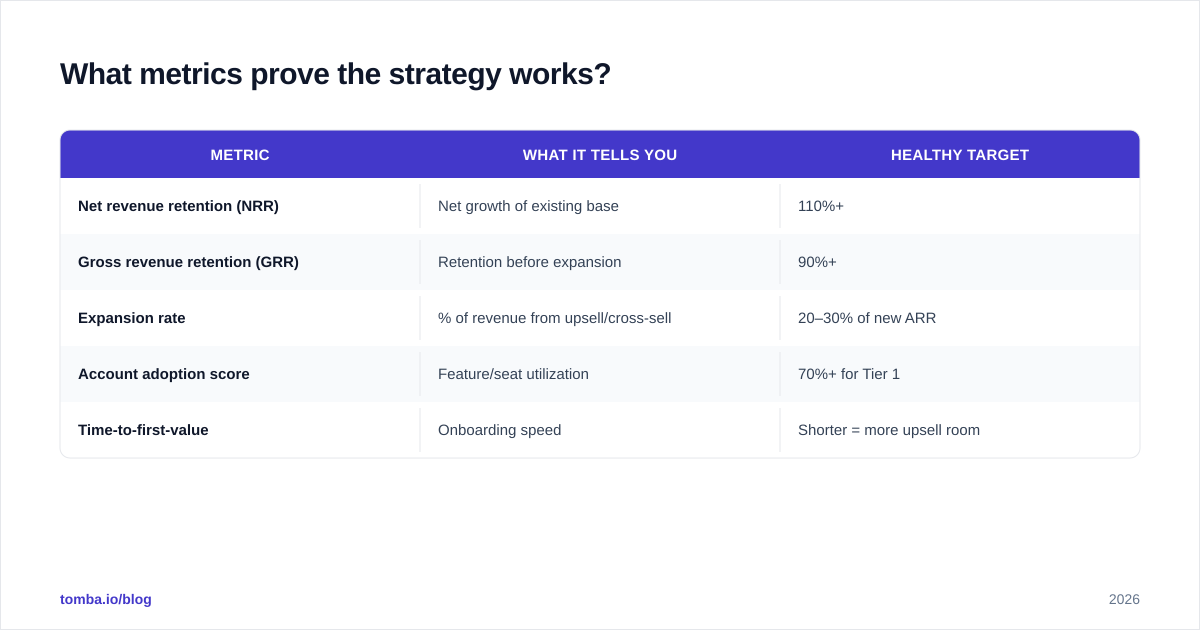
The headline metric is net revenue retention; everything else is a leading indicator that feeds it.
NRR measures revenue from your existing base over a period, including expansion and after subtracting churn and contraction. Above 100% means your customer base grows revenue even if you never sign another logo. Best-in-class B2B SaaS targets 110–130%. Below 100% means expansion isn't keeping pace with leakage, and no amount of new-logo hustle fully fixes that.
| Metric | What it tells you | Healthy target |
|---|---|---|
| Net revenue retention (NRR) | Net growth of existing base | 110%+ |
| Gross revenue retention (GRR) | Retention before expansion | 90%+ |
| Expansion rate | % of revenue from upsell/cross-sell | 20–30% of new ARR |
| Account adoption score | Feature/seat utilization | 70%+ for Tier 1 |
| Time-to-first-value | Onboarding speed | Shorter = more upsell room |
Track these per segment, not just in aggregate. An NRR of 105% can hide a Tier 1 book growing at 130% while a Tier 4 book contracts at 85% — and the fix for each is completely different. Validate the underlying account data too; stale contacts and wrong headcounts quietly corrupt every one of these numbers. Tools like G2's grid reports can help you benchmark which analytics stacks peers trust for this.
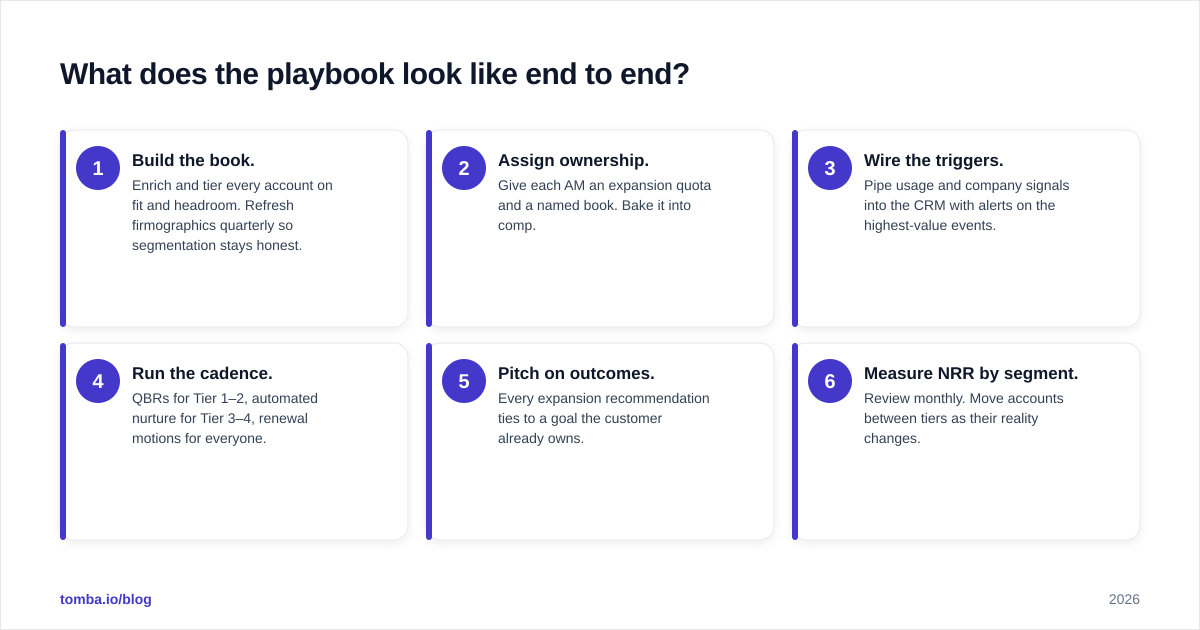
What does the playbook look like end to end?#
Put it together and the motion is short enough to run with the team you already have:
- Build the book. Enrich and tier every account on fit and headroom. Refresh firmographics quarterly so segmentation stays honest.
- Assign ownership. Give each AM an expansion quota and a named book. Bake it into comp.
- Wire the triggers. Pipe usage and company signals into the CRM with alerts on the highest-value events.
- Run the cadence. QBRs for Tier 1–2, automated nurture for Tier 3–4, renewal motions for everyone.
- Pitch on outcomes. Every expansion recommendation ties to a goal the customer already owns.
- Measure NRR by segment. Review monthly. Move accounts between tiers as their reality changes.
The teams that win expansion aren't smarter negotiators — they're more organized. They know which accounts are ready, when the moment is, and what to say. The strategy is the system, not the silver tongue.
A quick note on data, because it underpins all of this: expansion plays only fire correctly if your account records are accurate. New decision-makers, fresh funding, and the right contact details are what turn a trigger into a booked upsell. If a champion leaves and you're still emailing them, the play dies silently. Keeping the buying center current is non-negotiable — review your Tomba pricing options against how many accounts you actually need to keep enriched each month.
Where does the right data tooling fit?#
Start by closing the data gap that quietly kills expansion: knowing who to talk to as accounts grow and reshape. When a Tier 1 account hires a new VP of Sales, that's a buying-center change and an expansion trigger in one — but only if you can reach them.
Tomba's Email Finder lets your account managers find the verified work emails of new stakeholders the moment they appear in a growing account, so the QBR invite, the upgrade proposal, and the renewal conversation all reach the people who actually sign. Pair it with enrichment to keep your segmentation tiers accurate, and your upsell strategy runs on signal instead of guesswork. Start free with 25 searches a month, then scale to the Starter plan at $49/mo as your book of expanding accounts grows.
// get started
Find, verify and enrich your first contacts today
Start on the free plan with 25 searches a month, then scale when your team is ready.
Free plan · No credit card required · GDPR & CCPA
// about the author