Account Manager Tips: 12 Habits That Retain Revenue in 2026
Renewals are won months before the contract date. These 12 account manager tips show you how to retain, expand, and de-risk your book of business in 2026.
TL;DR
- Renewals are decided months before the renewal date — your job is to make the outcome obvious long before procurement gets involved.
- The highest-leverage account manager habits are proactive: stakeholder mapping, structured QBRs, and an early-warning churn signal you actually watch.
- Expansion revenue (upsell + cross-sell) is cheaper to win than new logos, but only if you tie it to outcomes the customer already cares about.
- Keep your contact data clean. Champions change jobs, buyers get reorged, and a stale CRM quietly kills renewals.
- Measure net revenue retention (NRR), not just logo retention — it's the metric your leadership and board actually grade you on.
What does a great account manager actually do?#
A great account manager protects and grows revenue inside accounts the company already won. Think of it like tending an orchard instead of clearing new land: the trees are planted, but fruit only comes from consistent pruning, watering, and watching for disease. New-logo sales clears the land; account management makes it produce year after year.
That distinction matters because most account managers drift into a reactive role — answering tickets, chasing renewals two weeks before they lapse, and reacting to escalations. The tips below are about flipping that posture from reactive to proactive, which is where retention and expansion both come from.
How is account management different from sales and customer success?#
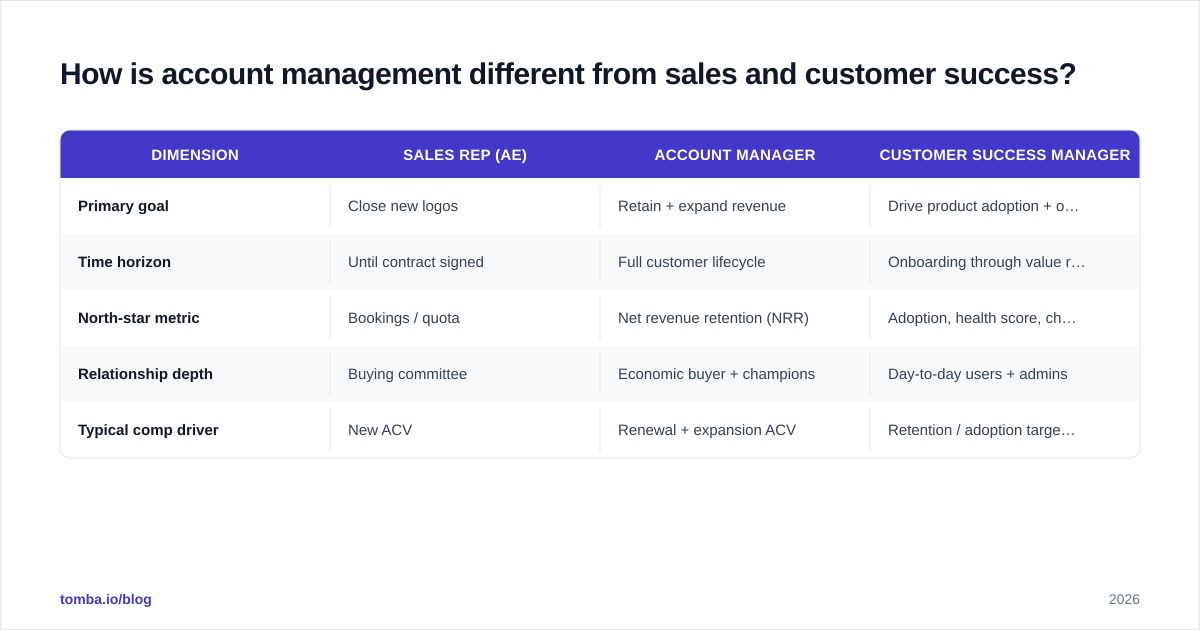
The three roles overlap, and at smaller companies one person wears all three hats. But the goals, time horizons, and primary metrics are genuinely different, and confusing them is how accounts fall through the cracks.
| Dimension | Sales Rep (AE) | Account Manager | Customer Success Manager |
|---|---|---|---|
| Primary goal | Close new logos | Retain + expand revenue | Drive product adoption + outcomes |
| Time horizon | Until contract signed | Full customer lifecycle | Onboarding through value realization |
| North-star metric | Bookings / quota | Net revenue retention (NRR) | Adoption, health score, churn risk |
| Relationship depth | Buying committee | Economic buyer + champions | Day-to-day users + admins |
| Typical comp driver | New ACV | Renewal + expansion ACV | Retention / adoption targets |
The practical takeaway: if you're an account manager, your scorecard is retention and expansion, not activity. Closing a renewal at flat value is a partial loss when your peers are growing the same accounts 20%.
What are the most important account manager tips for 2026?#
1. Map every stakeholder, not just your champion#
Single-threaded accounts are the number-one churn risk. If your only relationship is one champion and they leave, your renewal leaves with them. Gartner's research on buying groups shows enterprise decisions involve six to ten stakeholders — your account map should reflect that reality.
Build a living map of the economic buyer, technical owner, day-to-day users, and any executive sponsor. When a contact gets promoted or leaves, you need their replacement's details fast — this is where keeping clean contact enrichment data inside your account plan pays off. A champion who jumps to a new company is also your warmest new-logo lead.
2. Run QBRs that the customer would attend voluntarily#
Most quarterly business reviews are vendor theater: a deck of usage stats nobody asked for. A QBR worth the calendar slot answers one question for the customer's executive: "Is this investment paying off, and what should we do next?"
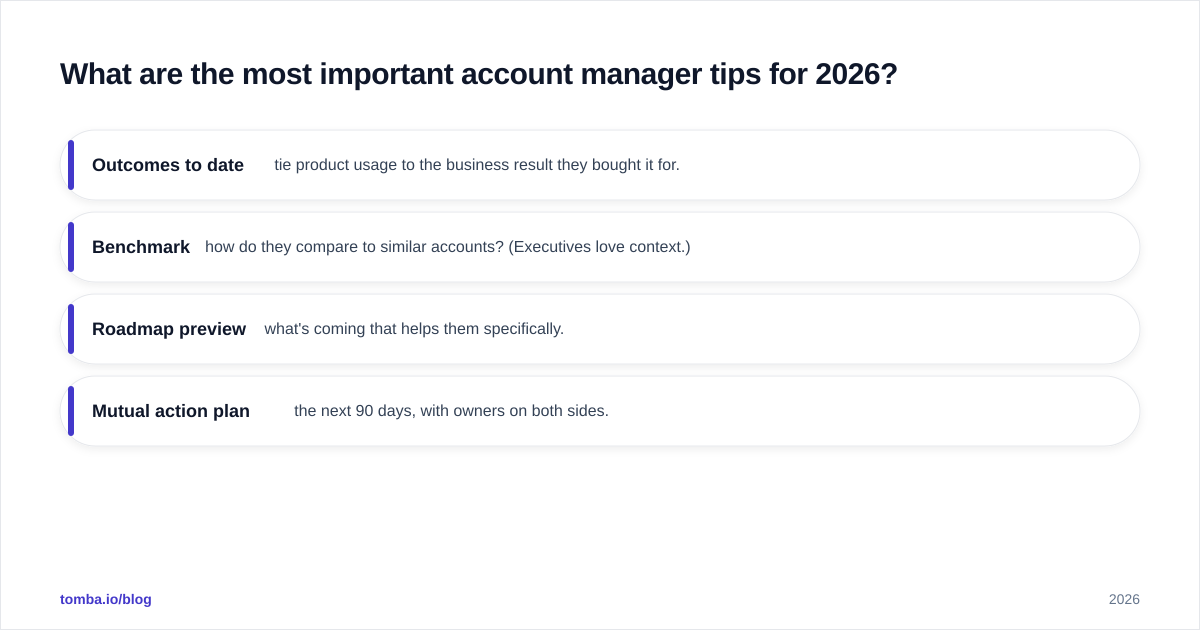
Structure it around their goals, not your features:
- Outcomes to date — tie product usage to the business result they bought it for.
- Benchmark — how do they compare to similar accounts? (Executives love context.)
- Roadmap preview — what's coming that helps them specifically.
- Mutual action plan — the next 90 days, with owners on both sides.
3. Build a churn early-warning system#
By the time a customer asks to "discuss the renewal," the decision is often already made. The signals were there months earlier: declining logins, a champion who stopped replying, a support ticket that escalated, a missed milestone.
Pick three to five leading indicators you can actually track and review them weekly. Product usage decline and champion disengagement are the two most predictive. The point isn't a fancy health-score model — it's that you look at the signals before the renewal date instead of after.
4. Treat expansion as a planned motion, not an accident#
Expansion revenue is the cheapest revenue you'll ever generate, because the trust and integration work is already done. HubSpot's research on customer retention consistently shows that increasing retention by a few points compounds into outsized profit growth.
But expansion only works when it's anchored to an outcome the customer already wants. "You're hitting your seat limit because adoption is up 40%" is a conversation. "We have a new tier" is a pitch they'll ignore.

5. Keep your contact and account data clean#
Your account plan is only as good as the data behind it. People change roles constantly, companies reorg, and email addresses go dead. When your main contact bounces, you can't afford a two-week scramble to find the new decision-maker.
Use a reliable email finder to re-establish contact when a champion moves, and keep B2B phone numbers on file for the high-value accounts where a call beats an email. A clean CRM is the unglamorous foundation every other tip on this list depends on.
6. Document a mutual success plan#
A mutual success plan is a shared, written document of what success looks like, who owns each step, and by when. It turns a vague relationship into an accountable partnership — and it gives you a renewal narrative grounded in commitments both sides agreed to.
7. Become genuinely useful between touchpoints#
The account managers who retain best aren't the ones who show up only at renewal. They forward a relevant article, make a useful introduction, flag a feature that solves a problem the customer mentioned in passing. This "give without asking" cadence builds the goodwill you'll draw on when you need a tough renewal or a price increase to land.
8. Prepare for the renewal 120 days out#
Start the renewal conversation a full quarter before the date. That gives you time to surface objections, line up an expansion case, secure executive alignment, and avoid the discount-under-pressure trap that happens when procurement controls the clock.
9. Quantify value in the customer's language#
ROI you calculate is marketing; ROI the customer agrees to is leverage. Co-build the value story with your champion so the numbers are theirs when they defend the renewal internally. Hours saved, revenue influenced, risk avoided — in their units, not your feature names.
10. Have a plan for the price increase#
Price increases are inevitable. The account managers who handle them well do three things: give plenty of notice, tie the increase to added value delivered or roadmap coming, and protect the most strategic accounts with grandfathering or phased steps. Surprise increases are how you turn a renewal into a competitive evaluation.
11. Build a referral and reference engine#
Your happiest accounts are your best growth channel. Systematically ask for referrals, case-study participation, and reference calls — but only after you've banked real value (see tip 7). A reference program also strengthens the relationship, because public advocacy makes a customer's own switching costs higher.
12. Measure NRR, not just logo retention#
Logo retention tells you who stayed. Net revenue retention tells you whether your book is growing. An NRR above 100% means expansion is outrunning churn — the single clearest sign of a healthy account management motion. If you track one number, track that one.
How do you prioritize accounts when you can't do all of this for everyone?#
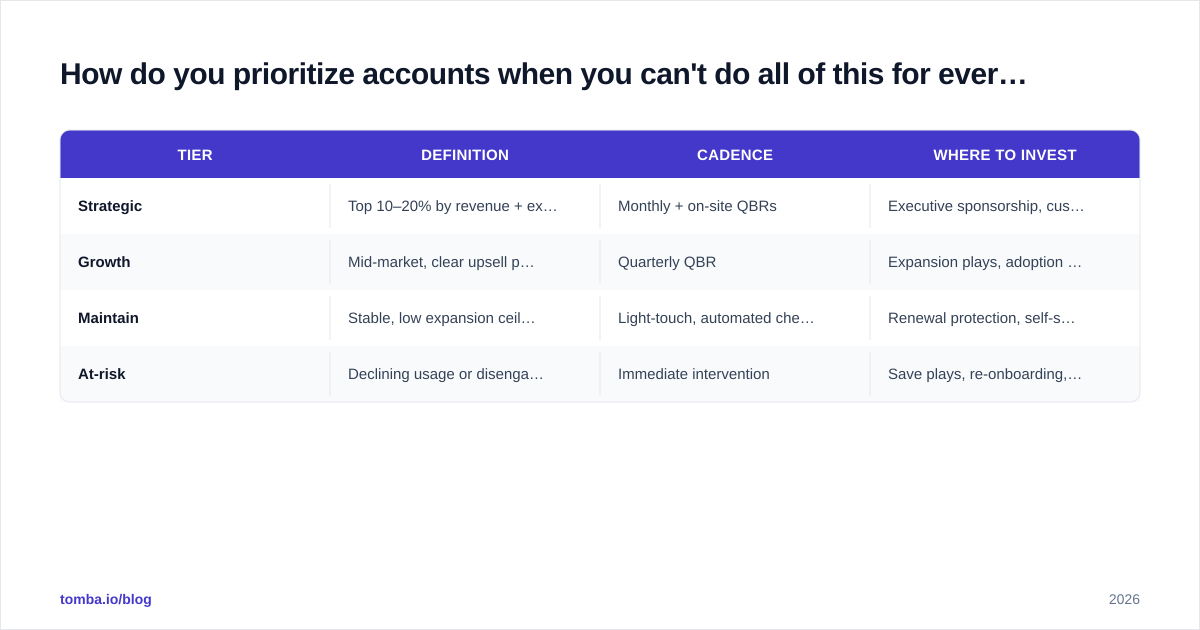
You can't run a 90-day mutual success plan for 200 accounts. Tier your book and match effort to potential.
| Tier | Definition | Cadence | Where to invest |
|---|---|---|---|
| Strategic | Top 10–20% by revenue + expansion potential | Monthly + on-site QBRs | Executive sponsorship, custom value plans |
| Growth | Mid-market, clear upsell path | Quarterly QBR | Expansion plays, adoption pushes |
| Maintain | Stable, low expansion ceiling | Light-touch, automated check-ins | Renewal protection, self-serve enablement |
| At-risk | Declining usage or disengaged champion | Immediate intervention | Save plays, re-onboarding, exec escalation |
The mistake most account managers make is spreading attention evenly. Your strategic tier deserves five times the effort of your maintain tier, and your at-risk accounts need intervention before they ever reach the renewal screen.
What tools and data does a modern account manager need?#
You don't need a 12-tool stack. You need a CRM you keep clean, a way to track health signals, and reliable contact data so a reorg never costs you an account. Most account management failures trace back to stale data or a missed signal — not a missing feature.
The data layer is the part teams under-invest in. When a champion moves companies, when a buying committee reshuffles after an acquisition, or when you inherit a book with half-empty contact records, the speed at which you can rebuild accurate contacts directly determines whether you save the renewal. That's a data enrichment and contact-discovery problem, and it's worth solving once rather than firefighting every quarter. (You can compare plans on the Tomba pricing page — the Free tier covers 25 searches a month if you just want to test the data quality.)
How do you turn a saved account into an expansion win?#
Sequence matters: stabilize, then prove value, then expand. Trying to upsell an at-risk account is how you lose it faster. Once usage is healthy and your QBR has documented a real outcome, the expansion conversation becomes a natural next step rather than a pitch. Anchor it to the metric the customer already celebrates, bring the numbers your champion helped you build, and give them an internal business case they can forward without editing. For a deeper look at how messaging affects this, our notes on response rate benchmarks are a useful reference for the outreach side.
The compounding effect is the whole game: a 110% NRR book doubles roughly every seven years from expansion alone — before you sign a single new logo. As Salesforce's account-management guidance puts it, the relationship is the asset. Account management is how you keep that asset appreciating.
Closing: keep your accounts — and their contacts — in reach#
The throughline across all 12 tips is the same: account management rewards consistency and accurate information. You can't run a great QBR, catch churn early, or re-engage a departed champion if your contact data is six months stale.
When a key contact leaves, gets promoted, or your inherited book is full of dead addresses, the Tomba Email Finder gets you the right person's verified email in seconds — by name, company, or domain — so a reorg never costs you a renewal. Start free with 25 searches a month, then scale up as your book grows. Protect the relationships you've earned, and let clean data do the unglamorous work that keeps revenue retained.
Ready to find emails that actually work?
Join 150,000+ professionals who stopped guessing and started sending. Free credits on signup — no credit card required.
Get the Tomba newsletter
Practical outbound tactics and product updates — once every two weeks.
About the author