Accutrend Pricing, Reviews, Pros and Cons: 2026 Guide
A neutral, buyer-first breakdown of Accutrend in 2026: how its pricing is structured, what reviewers actually say, the real pros and cons, and the alternatives worth testing before you sign.
This Accutrend pricing reviews pros and cons guide gives you a neutral, buyer-first look at the platform in 2026. We cover how the plans are built, what real users say, and the trade-offs to weigh before you commit.
Accutrend pricing reviews pros and cons: the quick verdict#
TL;DR
- Accutrend is a B2B data and sales-intelligence platform. Its pricing leans toward quote-based, seat-plus-credit contracts, not a clean public price list. That opacity is the single biggest friction point in reviews.
- Reviewers praise the breadth of data and integrations. They criticize annual lock-in, uneven data freshness, and credit systems that are hard to forecast.
- The honest pros: solid coverage and enrichment workflows. The honest cons: opaque cost, contract pressure, and accuracy that varies by region and seniority.
- Maybe you mainly need accurate email discovery and verification, with no annual commitment. A focused finder like Tomba Email Finder covers that core job for far less.
- Always run a side-by-side trial on your own target list before you sign. Vendor benchmarks rarely match your exact ICP.
What is Accutrend?#
Accutrend is marketed as a B2B contact-data and sales-intelligence tool. These products help you find prospect emails, phone numbers, firmographics, and enrichment fields. Then they push that data into your CRM or outreach sequence. Think of it like a wholesale grocery supplier versus a corner store. It wants to be the one bulk source your whole go-to-market team buys from, not a single-purpose utility.
That framing matters because it shapes the pricing and the reviews. Platforms that sell themselves as "the data layer for your entire revenue team" almost always price like enterprise software. Expect per-seat licenses, annual contracts, and a credit or export cap on top. Single-purpose tools price like utilities: a clear monthly number and a credit count you can read off a page.
One honesty note before the specifics. Vendor data products change pricing and packaging often. Much of Accutrend's pricing is gated behind a sales conversation. Treat the numbers here as representative of how the category is structured. Confirm live figures with the vendor and on review sites before you buy. For independent feedback, the most reliable public sources are category review hubs like G2 and Capterra.
How does Accutrend pricing work in 2026?#
The recurring theme across sales-intelligence tools in Accutrend's tier is that pricing is constructed, not posted. Instead of a single monthly price, you're typically quoted on three stacked variables:
- Seats — how many users need login access.
- Credits or exports — how many records you can reveal, enrich, or download per month.
- Contract term — month-to-month is rare; annual is the default, and the friendliest per-unit price almost always requires a 12-month commitment.
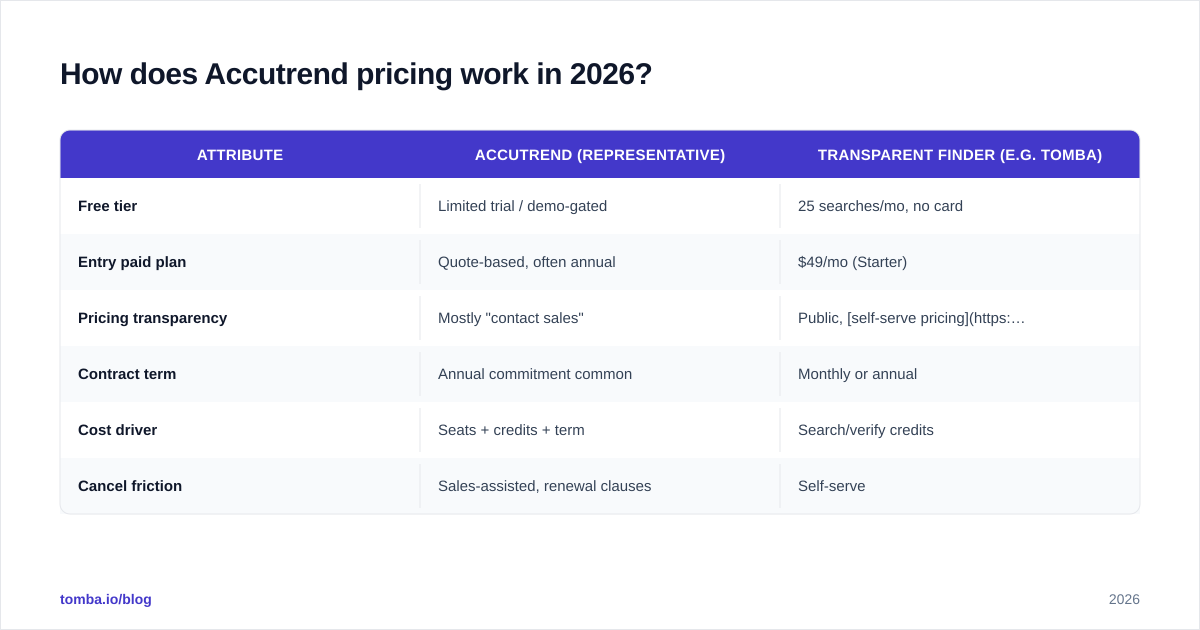
This is the part buyers find frustrating. You can't easily answer "what will this cost me?" without booking a demo. And the demo is where upsell pressure lives. Here's a representative shape of how these contracts tend to land, alongside a transparent utility-style finder for contrast:
| Attribute | Accutrend (representative) | Transparent finder (e.g. Tomba) |
|---|---|---|
| Free tier | Limited trial / demo-gated | 25 searches/mo, no card |
| Entry paid plan | Quote-based, often annual | $49/mo (Starter) |
| Pricing transparency | Mostly "contact sales" | Public, self-serve pricing |
| Contract term | Annual commitment common | Monthly or annual |
| Cost driver | Seats + credits + term | Search/verify credits |
| Cancel friction | Sales-assisted, renewal clauses | Self-serve |
The practical takeaway is simple. If you're a small team or solo operator, the seat-plus-annual model can mean you pay for capacity you never use. Are you a larger org that genuinely needs many seats and a shared data layer? Then the bundled model can make sense. But negotiate the credit cap to match real usage first, not the inflated number a rep proposes.
Watch the credit math#
Credits are where budgets quietly blow up. A "5,000 credits/month" number sounds generous. But a single enriched record can consume multiple credits — one for the email, one for a phone, one for enrichment fields. Ask the vendor for the effective cost per fully-enriched contact, not the headline credit count. Then compare that to a dedicated email verifier and data enrichment step at the same volume.
What do Accutrend reviews actually say?#
Patterns matter more than individual star ratings. Across public review sites for tools in this class, four themes repeat often enough to be predictive:
What reviewers like:
- Breadth. When the database has your target accounts, the one-stop convenience is real — emails, phones, and firmographics in one export.
- CRM workflow. Native pushes to common CRMs save manual cleanup. Reviewers already deep in a sales stack value this.
- Bulk operations. Teams running large list builds appreciate not stitching together five tools.
What reviewers criticize:
- Pricing opacity and renewals. The most common complaint is feeling locked in. Buyers are surprised by renewal terms, or unable to right-size a plan after signing.
- Data freshness and accuracy variance. Coverage is often strong for US mid-market and thin for smaller regions, niche industries, or senior-but-not-C-suite titles. Bounce rates climb when you push unverified records straight to send.
- Support during the contract. Pre-sale responsiveness sometimes outshines post-sale support — a familiar pattern in annual-contract SaaS.
When you read reviews, weight them by recency and similarity to your use case. A glowing 2023 review from a 200-seat enterprise tells you little about a 3-person team buying in 2026. Filter by your company size and industry on G2 and Capterra. Read the 3-star reviews first. They're usually the most honest about trade-offs.
What are the real pros and cons of Accutrend?#
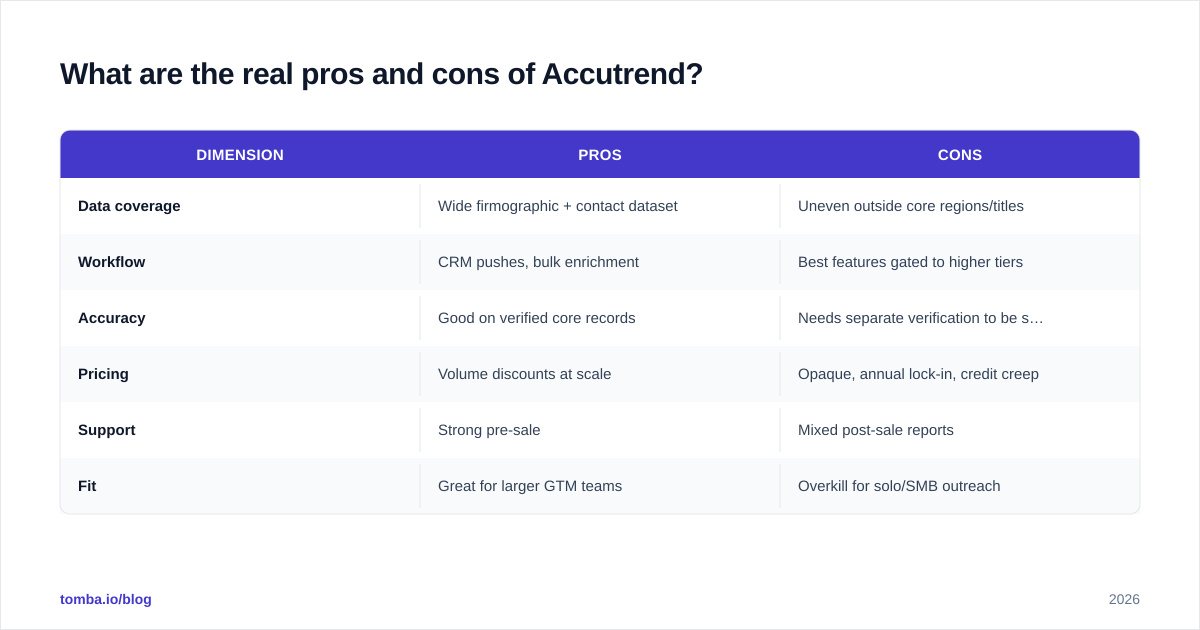
Here's the balanced version, stripped of marketing gloss.
| Dimension | Pros | Cons |
|---|---|---|
| Data coverage | Wide firmographic + contact dataset | Uneven outside core regions/titles |
| Workflow | CRM pushes, bulk enrichment | Best features gated to higher tiers |
| Accuracy | Good on verified core records | Needs separate verification to be safe |
| Pricing | Volume discounts at scale | Opaque, annual lock-in, credit creep |
| Support | Strong pre-sale | Mixed post-sale reports |
| Fit | Great for larger GTM teams | Overkill for solo/SMB outreach |
Here's the honest summary. Accutrend is a reasonable fit if you're a multi-seat revenue team that wants a single bundled data layer. You also need to be ready to negotiate an annual contract. It's a poor fit if you want predictable monthly costs. It's also wrong if you need only email discovery and verification, or can't commit to a year before proving ROI.
That last point is where a lot of buyers get burned. They sign annually to "unlock the good price." Three months in, they discover their real need was 80% email finding and 20% enrichment. A focused tool does that job cheaper, without the lock-in.

Is Accutrend better than the alternatives?#
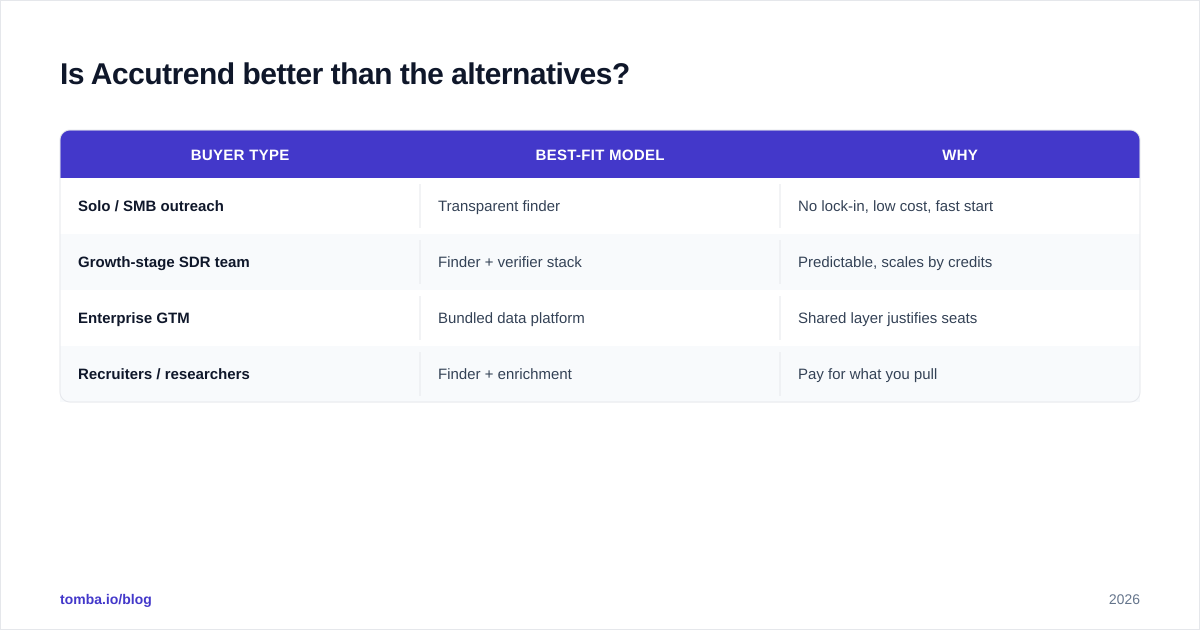
"Better" depends entirely on the job. Split the decision by what you actually do most days:
- If your core job is finding and verifying emails at a predictable cost, a dedicated finder wins on price and simplicity. Tomba's published tiers run Free (25 searches/mo), Starter $49/mo, Growth $99/mo, and Pro $249/mo. A domain search and bulk tools are included, not bolted on.
- If you live inside an all-in-one prospecting platform, you're really comparing Accutrend to suites like Apollo. A focused Apollo alternative breakdown shows where bundled suites help and where they add cost you don't use.
- If you need a full shared data layer across many seats, that's the one scenario where Accutrend's model is defensible. Just get the credit cap and renewal terms in writing.
| Buyer type | Best-fit model | Why |
|---|---|---|
| Solo / SMB outreach | Transparent finder | No lock-in, low cost, fast start |
| Growth-stage SDR team | Finder + verifier stack | Predictable, scales by credits |
| Enterprise GTM | Bundled data platform | Shared layer justifies seats |
| Recruiters / researchers | Finder + enrichment | Pay for what you pull |
Here's a quick analogy. Choosing Accutrend for pure email finding is like buying a warehouse membership for one weekly grocery run. If you're feeding a restaurant, the membership pays off. If you're cooking for one, you're paying for the building.
How should you evaluate Accutrend before buying?#
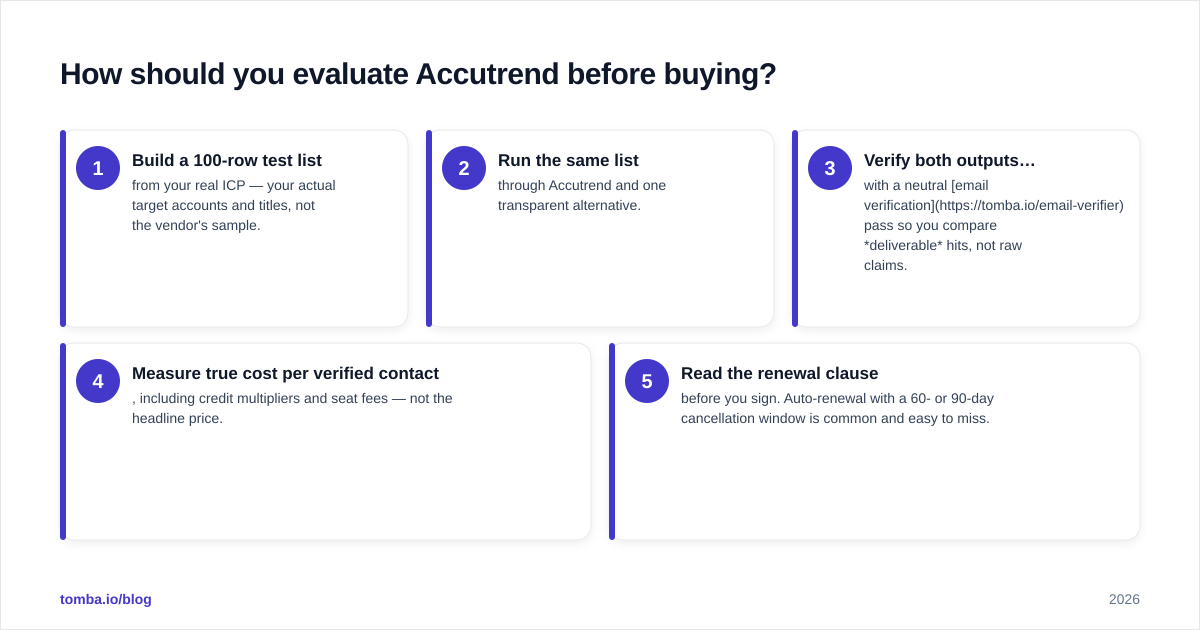
Run a structured trial, not a vibe check. Here's a five-step process that protects your budget:
- Build a 100-row test list from your real ICP — your actual target accounts and titles, not the vendor's sample.
- Run the same list through Accutrend and one transparent alternative.
- Verify both outputs independently with a neutral email verification pass. Compare deliverable hits, not raw claims.
- Measure true cost per verified contact, including credit multipliers and seat fees — not the headline price.
- Read the renewal clause before you sign. Auto-renewal with a 60- or 90-day cancellation window is common and easy to miss.
Want to understand the data-quality side before you test? The data sources explainer covers why coverage and freshness vary between providers. The mechanics apply to any vendor in this space, Accutrend included. Also sanity-check the vendor's claims against third-party analyst coverage on sites like Gartner. Don't rely on the marketing site alone.
Frequently asked questions#
Does Accutrend have a free trial? Trials in this category are typically demo-gated rather than fully self-serve. Expect to talk to sales for meaningful access. Want a no-friction free tier to test data quality first? A self-serve finder lets you start without a call.
Why isn't Accutrend pricing public? Bundled, seat-based data platforms price by negotiation because cost depends on seats, credits, and term. That's standard for the tier. But it makes apples-to-apples comparison harder, which is why running your own test list matters.
Is Accutrend accurate? Accuracy is strongest on its core dataset (often US mid-market) and weaker on niche regions and titles. Treat any provider's records as candidates to verify, not finished sends.
What's the cheapest way to cover the same core job? For most teams, the real need is email discovery and verification. A transparent finder at a fixed monthly price covers it, without annual lock-in. See current Tomba plans for the published numbers.
The bottom line#
Accutrend is a credible bundled B2B data platform with the classic trade-off of its category. You get good coverage and workflow. In exchange, you accept opaque, annual, seat-based pricing and accuracy that varies by segment. It earns its keep for multi-seat revenue teams that genuinely need a shared data layer. It tends to overcharge solo operators and small teams whose job is simpler. That tension is the heart of any honest Accutrend pricing reviews pros and cons verdict.
If that simpler job describes you — find the right email, verify it's deliverable, move on — skip the demo cycle and start with the Tomba Email Finder. You get 25 free searches to test on your own list today. Pricing is transparent from $49/mo when you scale. And there's no annual contract to escape if it isn't the right fit. Prove the accuracy on your ICP first, then decide whether you ever needed the warehouse membership at all.
// get started
Find, verify and enrich your first contacts today
Start on the free plan with 25 searches a month, then scale when your team is ready.
Free plan · No credit card required · GDPR & CCPA
// about the author