Accutrend vs Bytemine: Email Finder Showdown (2026)
A neutral, data-driven breakdown of Accutrend vs Bytemine — accuracy, pricing, verification, and which email finder actually fits your 2026 outbound stack.
Choosing between Accutrend and Bytemine usually comes down to one quiet question your CFO will ask later: how many of these emails actually landed? Both tools promise to turn a name and a company into a working inbox. They do it differently, they price it differently, and they fail differently. This breakdown walks through accuracy, verification, pricing, and coverage so you can pick without burning a month of trial credits to find out the hard way.
TL;DR#
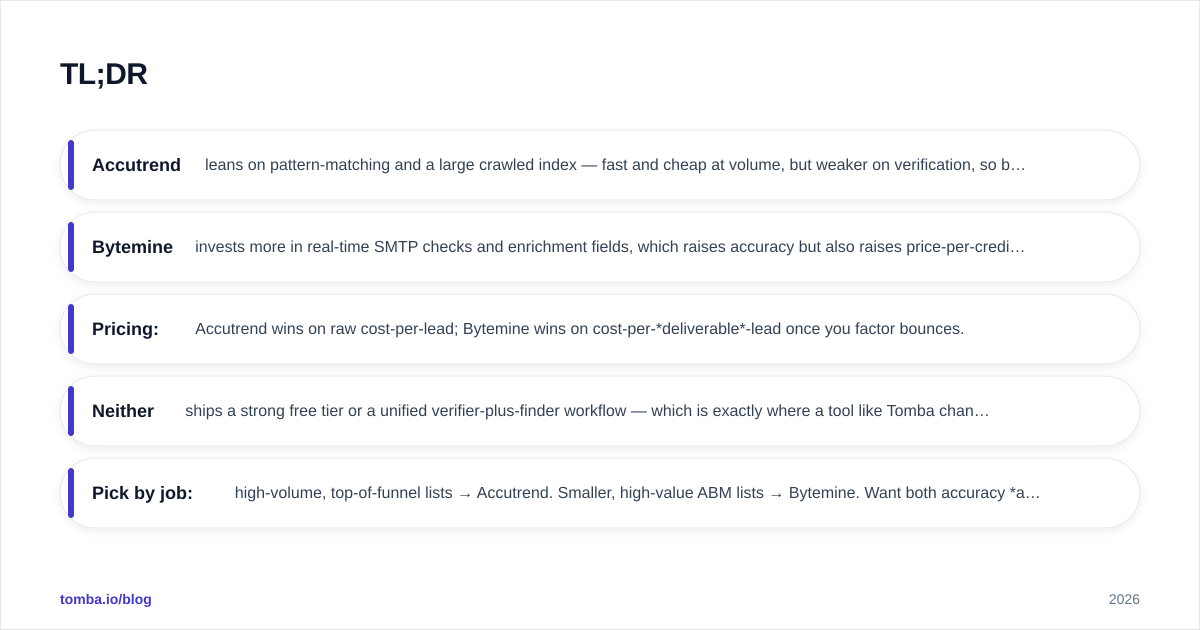
- Accutrend leans on pattern-matching and a large crawled index — fast and cheap at volume, but weaker on verification, so bounce risk climbs on catch-all domains.
- Bytemine invests more in real-time SMTP checks and enrichment fields, which raises accuracy but also raises price-per-credit and slows bulk jobs.
- Pricing: Accutrend wins on raw cost-per-lead; Bytemine wins on cost-per-deliverable-lead once you factor bounces.
- Neither ships a strong free tier or a unified verifier-plus-finder workflow — which is exactly where a tool like Tomba changes the math.
- Pick by job: high-volume, top-of-funnel lists → Accutrend. Smaller, high-value ABM lists → Bytemine. Want both accuracy and a free tier → keep reading.
What do Accutrend and Bytemine actually do?#
Both are B2B email-finder tools. You feed them a person (name + company, or a LinkedIn URL, or a domain) and they return a best-guess business email, usually with a confidence score.
Think of it like two locksmiths. Accutrend carries a giant ring of keys it has collected over years and tries the one most likely to fit — fast, but it doesn't always jiggle the handle to confirm the door opens. Bytemine cuts a fresh key on the spot and tests the lock before handing it over — slower, but you're more confident it works.
Technically, the difference is pattern inference versus live validation. Accutrend infers first.last@company.com from observed patterns across a domain and scores it. Bytemine does the same inference but then runs an email verification step — SMTP handshake, MX lookup, catch-all detection — before it reports the address as valid.
That single architectural choice cascades into everything else: accuracy, speed, price, and how each tool behaves on tricky domains.
Which is more accurate, Accutrend or Bytemine?#
Bytemine is more accurate per address; Accutrend is more accurate at scale per dollar. Those aren't the same claim, and conflating them is how teams pick wrong.
Accuracy in email finding has two halves: find rate (did it return any address?) and hit rate (was that address real and deliverable?). Accutrend tends to win find rate because its index is broad and it will return a pattern-based guess even when confidence is moderate. Bytemine tends to win hit rate because it suppresses low-confidence guesses and verifies what's left.
The trap is the catch-all domain. Many corporate mail servers accept every address at the domain, so a naive finder marks everything "valid." Accutrend's lighter verification can over-report here, inflating its apparent accuracy while quietly raising your bounce rate. Bytemine's catch-all handling is more conservative — closer to what a dedicated catch-all verifier would tell you — so it reports "accept-all / risky" instead of a false green light.

If you only measure raw "emails returned," Accutrend looks like the winner. If you measure "emails that didn't bounce," the gap narrows or flips. Always benchmark on deliverable addresses, not returned ones. The accepted industry framing of email deliverability makes this distinction the whole ballgame.
How do Accutrend and Bytemine compare on features?#
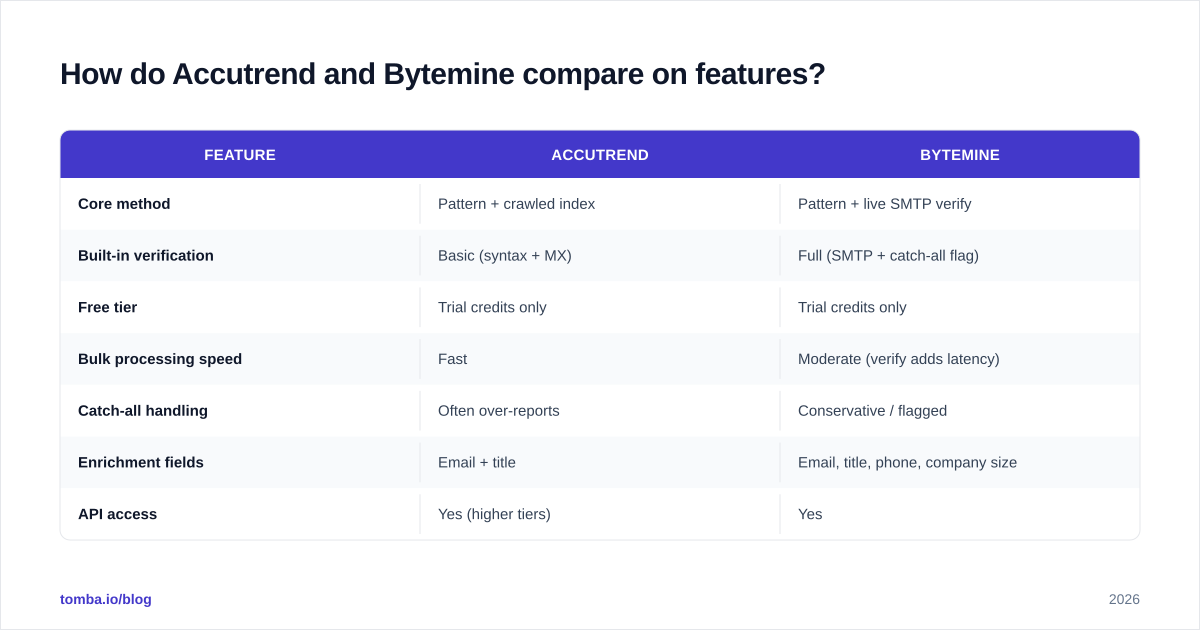
Here's the side-by-side. Figures reflect each vendor's published positioning as of 2026; confirm current limits on their own pricing pages before you commit.
| Feature | Accutrend | Bytemine |
|---|---|---|
| Core method | Pattern + crawled index | Pattern + live SMTP verify |
| Built-in verification | Basic (syntax + MX) | Full (SMTP + catch-all flag) |
| Free tier | Trial credits only | Trial credits only |
| Bulk processing speed | Fast | Moderate (verify adds latency) |
| Catch-all handling | Often over-reports | Conservative / flagged |
| Enrichment fields | Email + title | Email, title, phone, company size |
| API access | Yes (higher tiers) | Yes |
| Best for | High-volume TOFU lists | Targeted ABM / high-value |
| Cost-per-credit | Lower | Higher |
The pattern is consistent: Accutrend optimizes for throughput and price, Bytemine for confidence and enrichment depth. Neither is "better" in the abstract — it depends on whether your bottleneck is list size or list quality.
Which is cheaper — and is cheaper actually cheaper?#
Accutrend is cheaper per credit. Bytemine is often cheaper per meeting booked. This is the most expensive mistake teams make when comparing email finders, so it's worth doing the arithmetic.
Say you need 1,000 verified contacts:
- Accutrend returns, hypothetically, 1,000 addresses at a low per-credit rate. But if 18% bounce, you've got ~820 usable contacts — and those bounces dent your sender reputation, which costs you on every future send.
- Bytemine might return only 870 addresses (it suppressed the risky ones) at a higher per-credit rate, but 96% land. That's ~835 usable contacts and a cleaner sending domain.
The headline price favored Accutrend. The cost-per-deliverable favored Bytemine. Add the hidden tax of a damaged domain reputation and the picture shifts further. This is why the smart move is to run a dedicated email verifier over any finder's output before you send — regardless of which tool you pick.
When should you pick Accutrend?#
Pick Accutrend when volume is the constraint and your sending infrastructure can absorb some bounce risk.
- You're building large top-of-funnel lists where a 10–15% miss rate is acceptable.
- You verify separately anyway (so the finder's weak verification doesn't matter).
- Budget is tight and you optimize for cost-per-lead at the discovery stage.
- You run mostly standard domains, not catch-all-heavy enterprise targets.
Where Accutrend hurts you: cold-email programs on a young domain, ABM motions where each contact is expensive to acquire, or any workflow where a bounce burns a hard-won account.
When should you pick Bytemine?#
Pick Bytemine when each contact is valuable and deliverability is non-negotiable.
- Account-based selling where you have 50–500 named targets, not 50,000.
- New sending domains that can't afford reputation damage from bounces.
- Workflows that benefit from the extra enrichment fields (phone, company size) without bolting on a second tool.
- Teams that would otherwise pay separately for verification — Bytemine bundles more of it.
Where Bytemine hurts you: massive list builds where the per-credit premium compounds, or speed-sensitive bulk jobs where live verification latency slows the pipeline.
Is there a better alternative to both?#
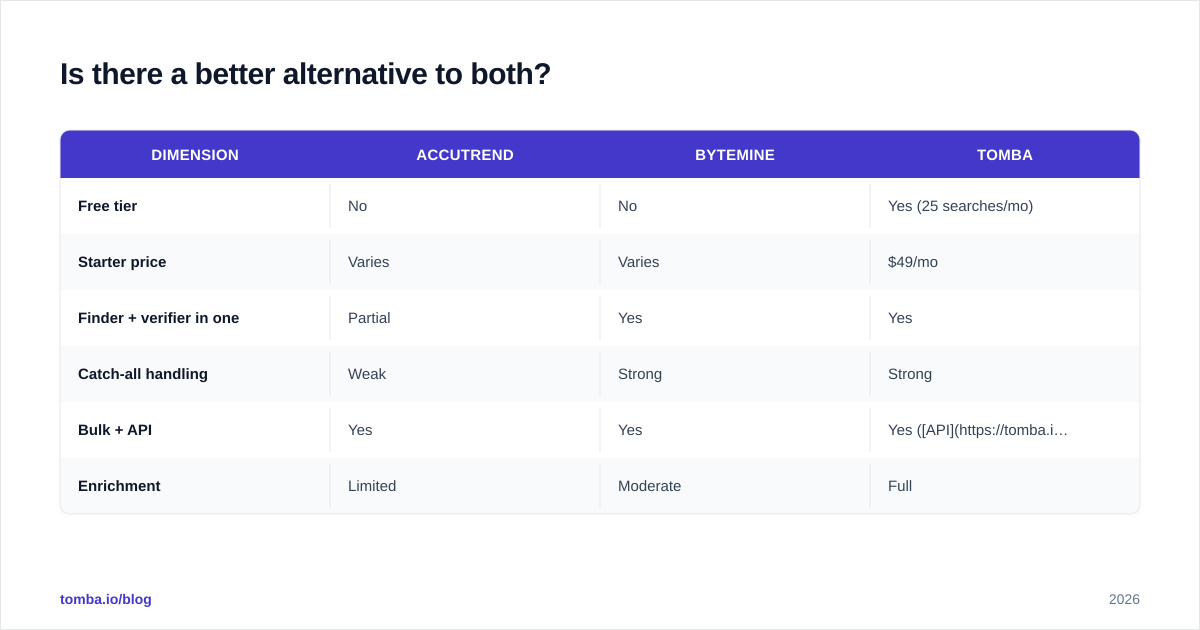
Yes — if your real requirement is "accurate and affordable and unified," a single finder-plus-verifier platform beats picking sides. The Accutrend-vs-Bytemine debate is essentially "cheap but risky" vs "accurate but pricey." A tool that gives you both removes the trade-off.
This is where Tomba is worth a look. It combines a domain-search-backed email finder with a built-in verifier, catch-all detection, and data enrichment under one roof — so you get Accutrend-style coverage with Bytemine-style confidence, and you don't stitch two subscriptions together.

Here's how the three stack up on the dimensions that actually drive ROI:
| Dimension | Accutrend | Bytemine | Tomba |
|---|---|---|---|
| Free tier | No | No | Yes (25 searches/mo) |
| Starter price | Varies | Varies | $49/mo |
| Finder + verifier in one | Partial | Yes | Yes |
| Catch-all handling | Weak | Strong | Strong |
| Bulk + API | Yes | Yes | Yes (API) |
| Enrichment | Limited | Moderate | Full |
Tomba's published pricing runs Free (25 searches/mo), Starter $49/mo, Growth $99/mo, Pro $249/mo, and Enterprise custom — and the free tier alone lets you benchmark accuracy against your existing tool before spending a dollar. Independent reviews on G2 and Capterra are a useful sanity check on any vendor's accuracy claims, including this one — read them before you trust a marketing number.
How should you actually run the comparison?#
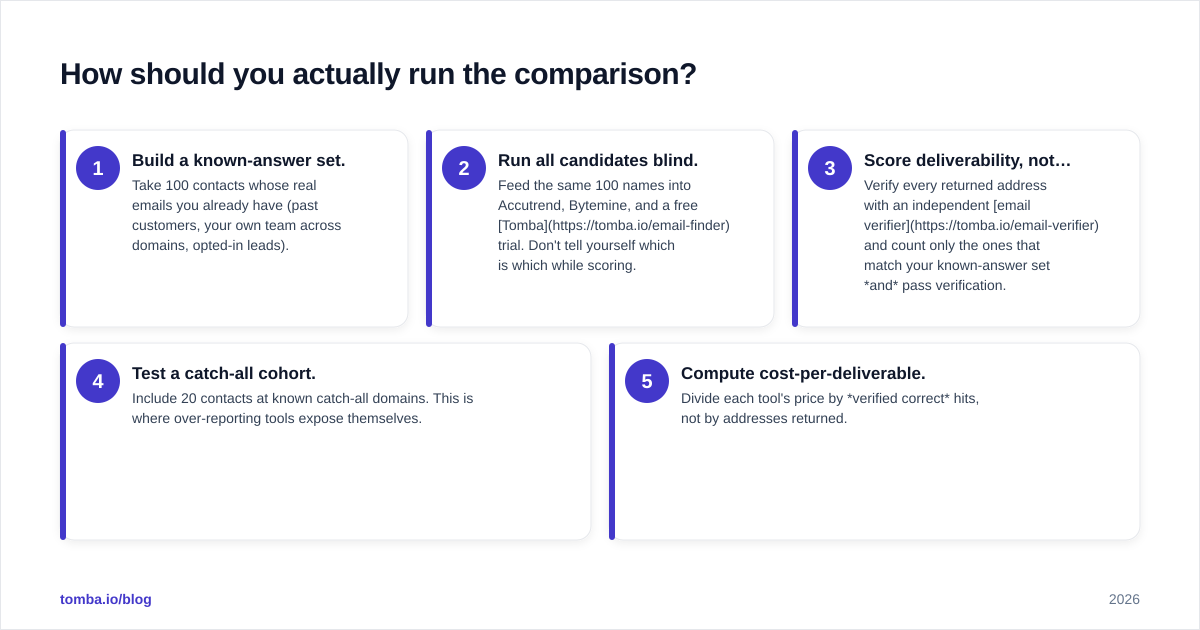
Don't take any vendor's accuracy claim — including the ones above — at face value. Run a controlled bake-off:
- Build a known-answer set. Take 100 contacts whose real emails you already have (past customers, your own team across domains, opted-in leads).
- Run all candidates blind. Feed the same 100 names into Accutrend, Bytemine, and a free Tomba trial. Don't tell yourself which is which while scoring.
- Score deliverability, not returns. Verify every returned address with an independent email verifier and count only the ones that match your known-answer set and pass verification.
- Test a catch-all cohort. Include 20 contacts at known catch-all domains. This is where over-reporting tools expose themselves.
- Compute cost-per-deliverable. Divide each tool's price by verified correct hits, not by addresses returned.
The winner of that test — your test, on your domains — beats any blog's verdict, including this one. The methodology matters more than the brand. A tool's job, as the broader practice of data enrichment shows, is to make your pipeline data trustworthy, not just abundant.
The bottom line#
Accutrend and Bytemine solve the same problem from opposite ends. Accutrend gives you reach and a low sticker price but pushes verification onto you. Bytemine gives you confidence and richer fields but charges for it. If you're forced to choose between only those two, match the tool to your motion: volume → Accutrend, value → Bytemine.
But you're rarely forced to choose between only two. Before you commit a quarter's budget, run the 100-contact bake-off above and add a free option to the mix so you have a true baseline.
If you want the coverage of a high-volume finder and the deliverability of a verification-first tool — without paying for two subscriptions — start with Tomba's Email Finder. The free tier gives you 25 searches a month to benchmark it head-to-head against Accutrend and Bytemine on your own list, with the email verifier and catch-all detection built in. Test it on real contacts, score the deliverable hits, and let the numbers — not the marketing — pick your winner.
Ready to find emails that actually work?
Join 150,000+ professionals who stopped guessing and started sending. Free credits on signup — no credit card required.
Get the Tomba newsletter
Practical outbound tactics and product updates — once every two weeks.
About the author