Accutrend vs Datanyze: B2B Data Tools Compared (2026)
Accutrend sells static B2B mailing lists; Datanyze sells live technographics and contact data. Here's which one fits modern outbound in 2026 — and where both fall short.
Choosing between Accutrend and Datanyze is really a choice between two different eras of B2B data. One sells you a list. The other sells you a live signal. Picking the wrong model can quietly tank your outbound numbers for a quarter before you notice.
This guide breaks down both tools on the attributes that actually move pipeline — data freshness, technographics, contact accuracy, pricing model, and how each one slots into a modern outbound workflow — so you can decide which (if either) belongs in your 2026 stack.
TL;DR — Accutrend vs Datanyze in 30 seconds#
- Accutrend is a traditional B2B list and direct-mail data provider. You buy a file (postal, phone, sometimes email) filtered by industry, geography, and firmographics. Best for direct mail, broad ABM seeding, and offline campaigns.
- Datanyze is a sales-intelligence tool focused on technographics — what software a company runs — plus a Chrome extension that surfaces contact emails and phone numbers while you browse LinkedIn and company sites. Best for tech-targeted outbound.
- Freshness is the dividing line. Datanyze data is pulled and refreshed continuously; Accutrend lists are point-in-time snapshots that decay the moment they're delivered.
- Neither is a complete outbound engine. Datanyze's contact coverage is thin outside North America, and Accutrend has no real-time enrichment or email verification. Both usually need a dedicated email finder and verifier bolted on.
- For email-led outbound in 2026, pair whichever data source you pick with a high-accuracy email finder and email verifier so you're not sending into dead inboxes.
What is Accutrend?#
Accutrend Data Corporation is an old-school B2B data compiler. Think of it like a phone book publisher that never stopped — it aggregates business records (company name, address, phone, SIC/NAICS codes, employee count, revenue band, and sometimes contact names and emails) and sells them as filtered lists or licensed databases.
The classic Accutrend use case is direct mail and offline campaigns: a roofing-supply distributor wants every general contractor in five states with 10–50 employees, mailed a postcard. Accutrend hands over a clean file matching that filter. You pay per record or per license.
The strength is breadth of firmographic coverage and the ability to get postal-grade business records at scale. The weakness is structural: a list is a snapshot. The day it's delivered, people have already changed jobs, companies have moved, and domains have lapsed. There's no live refresh, no technographic layer, and no built-in verification telling you which emails still resolve.
What is Datanyze?#
Datanyze, now part of ZoomInfo, built its reputation on technographics — detecting the technologies a website runs (CRM, analytics, e-commerce platform, hosting, chat widgets, ad tech) and turning that into a targeting signal. If you sell a Shopify app, Datanyze can tell you which prospects actually run Shopify.
On top of technographics, Datanyze ships a Chrome extension that pulls contact details — work emails, direct dials, mobile numbers — as you browse LinkedIn profiles and company websites. It runs on a monthly credit model: you "unlock" contacts and spend credits.
The mental model: Accutrend is a warehouse of pre-packed boxes; Datanyze is a scanner you point at a target to get a live readout. That live readout is the whole value proposition. The trade-off is coverage — Datanyze is strongest for US tech companies and gets patchy for international, SMB, and non-tech verticals.

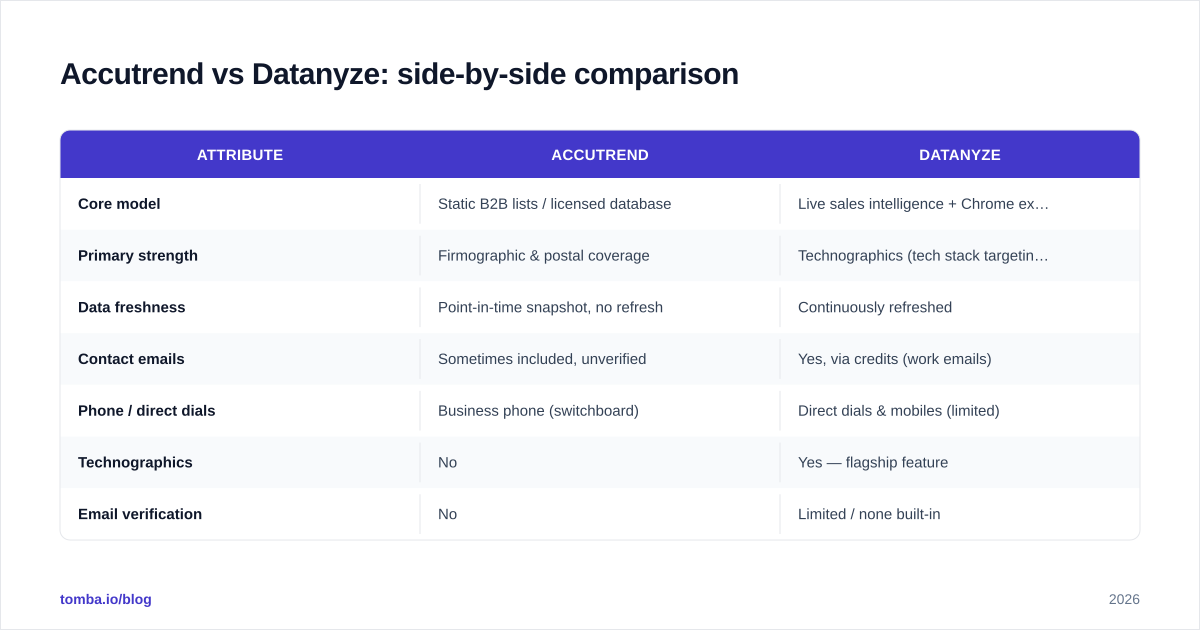
Accutrend vs Datanyze: side-by-side comparison#
Here's how the two stack up on the attributes that matter for a 2026 outbound team.
| Attribute | Accutrend | Datanyze |
|---|---|---|
| Core model | Static B2B lists / licensed database | Live sales intelligence + Chrome extension |
| Primary strength | Firmographic & postal coverage | Technographics (tech stack targeting) |
| Data freshness | Point-in-time snapshot, no refresh | Continuously refreshed |
| Contact emails | Sometimes included, unverified | Yes, via credits (work emails) |
| Phone / direct dials | Business phone (switchboard) | Direct dials & mobiles (limited) |
| Technographics | No | Yes — flagship feature |
| Email verification | No | Limited / none built-in |
| Geographic strength | North America | North America (US tech-heavy) |
| Pricing model | Per-record / per-license quote | Monthly credit-based subscription |
| Best for | Direct mail, offline ABM seeding | Tech-targeted digital outbound |
| API / live enrichment | Limited | Yes (within |
ZoomInfo ecosystem) |
The pattern is clear: Accutrend wins on cheap, broad, offline reach; Datanyze wins on precision targeting and freshness for digital outbound. They're not really competing for the same job — which is why teams often think they need one when they actually need the other.
Which has better data accuracy?#
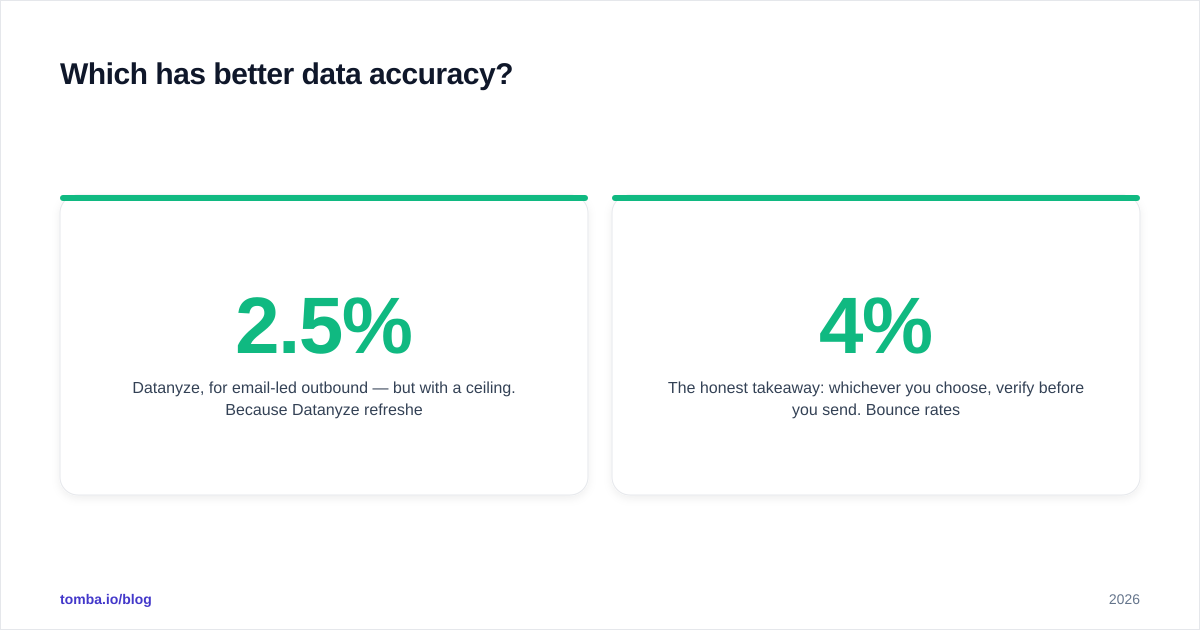
Datanyze, for email-led outbound — but with a ceiling. Because Datanyze refreshes continuously and verifies at the point of unlock, its contact records are generally fresher than a delivered Accutrend file. A static list starts decaying at roughly 2–2.5% per month as people change roles, so a six-month-old Accutrend file can be 12–15% stale before you send the first email.
But "fresher" isn't "accurate enough." Independent reviews on G2 consistently flag Datanyze for inconsistent email and direct-dial accuracy outside its core US-tech wheelhouse. And Accutrend's emails, when included, ship unverified — you're trusting a compiler's last touch with no SMTP check.
The honest takeaway: whichever you choose, verify before you send. Bounce rates above 3–4% start hurting your sender reputation, and a single bad list can drag your domain into spam folders for weeks. Running every address through a dedicated email verifier — including a catch-all verifier for domains that accept everything — is the difference between a list you trust and a list you hope about.
Which is better for technographic targeting?#
Datanyze, with no real contest. This is its entire reason for existing. If your value proposition depends on what software a prospect already runs — you sell an integration, a migration service, a competitive rip-and-replace, or a complement to a specific platform — technographics turn a cold list into a warm one.
Accutrend has nothing equivalent. You can filter by industry and size, but you can't ask "show me companies running HubSpot but not Salesforce." For tech-stack-driven sales motions, that gap alone decides the matchup.
That said, technographic detection is probabilistic. Datanyze infers the stack from public signals (page scripts, DNS, job postings), so treat its readouts as strong hints, not gospel — confirm on a discovery call before you build a whole pitch around "we saw you use X."
Which is better for pricing and value?#
It depends on volume and motion, and the two models barely overlap.
- Accutrend quotes per record or per license. For a one-time direct-mail blast of 50,000 records, the per-record model can be very cheap. For ongoing digital outbound, you're re-buying decayed data repeatedly, and the math gets ugly.
- Datanyze runs a monthly credit subscription. Predictable for steady prospecting, but credits get expensive at scale, and you're paying for the technographic layer even if you only want contacts.
Neither publishes fully transparent enterprise pricing, so expect a sales call. If your priority is predictable per-seat cost for digital outbound, Datanyze's model fits better. If you need a one-off bulk file for offline use, Accutrend likely wins on raw cost.
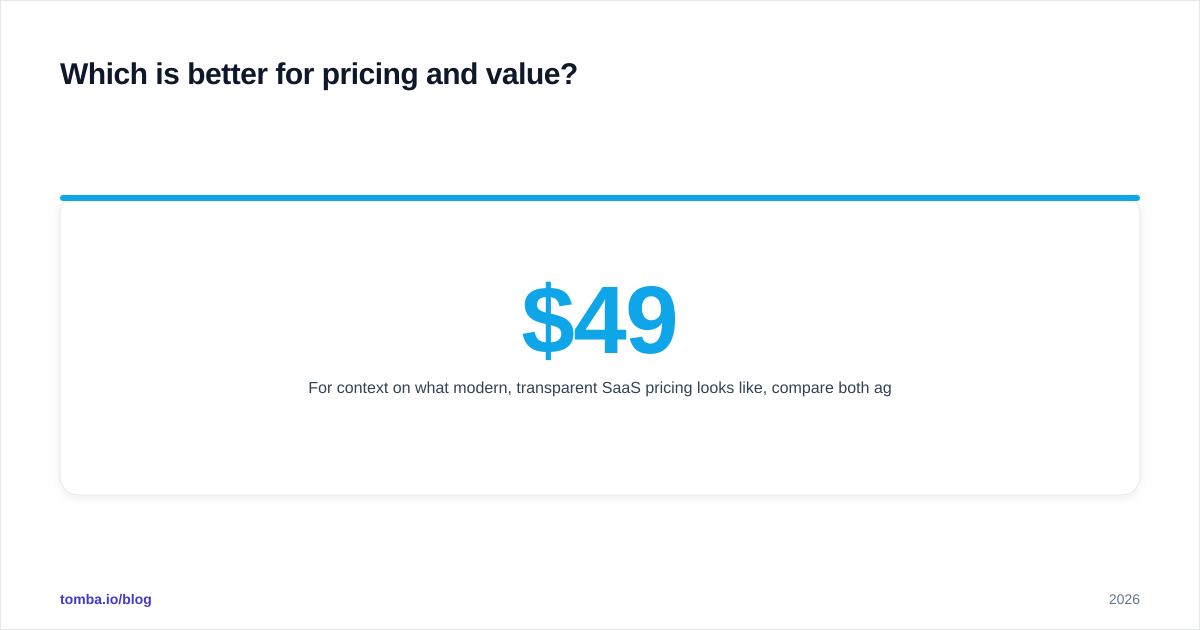
For context on what modern, transparent SaaS pricing looks like, compare both against published Tomba pricing: a free tier with 25 searches/month, Starter at $49/mo, Growth at $99/mo, and Pro at $249/mo — no quote required to know what you'll pay.

A simple framework for choosing#
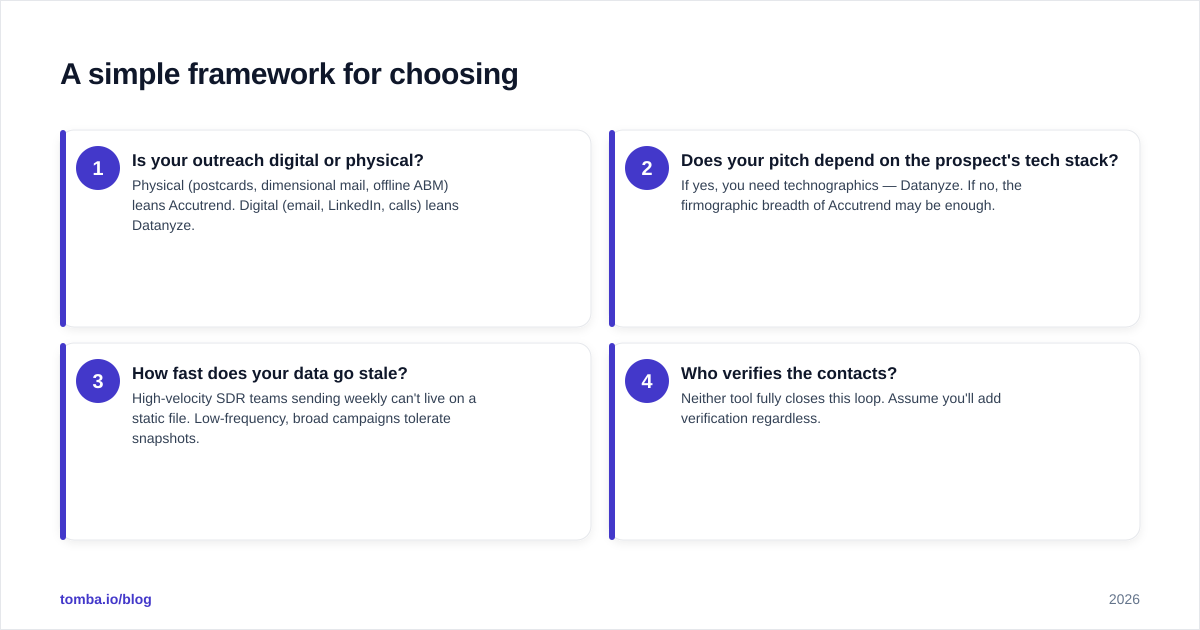
Don't pick on brand reputation. Pick on motion. Run your use case through these four questions:
- Is your outreach digital or physical? Physical (postcards, dimensional mail, offline ABM) leans Accutrend. Digital (email, LinkedIn, calls) leans Datanyze.
- Does your pitch depend on the prospect's tech stack? If yes, you need technographics — Datanyze. If no, the firmographic breadth of Accutrend may be enough.
- How fast does your data go stale? High-velocity SDR teams sending weekly can't live on a static file. Low-frequency, broad campaigns tolerate snapshots.
- Who verifies the contacts? Neither tool fully closes this loop. Assume you'll add verification regardless.
If you answered "digital, tech-targeted, high-velocity," Datanyze is the better core — then layer enrichment and verification on top. If you answered "physical, broad, low-frequency," Accutrend does the job cheaply. If you're somewhere in the middle (most teams are), you'll likely skip both as a primary contact engine and build around a dedicated finder-and-verifier, using technographics only where they sharpen targeting.
Where both tools leave a gap (and how to close it)#
Here's the uncomfortable truth neither vendor leads with: neither Accutrend nor Datanyze is a reliable, end-to-end email outbound engine on its own.
- Accutrend gives you records but no freshness and no verification.
- Datanyze gives you freshness and technographics but thin international coverage and shaky email accuracy outside US tech.
In practice, high-performing outbound teams treat sales intelligence and email sourcing as two separate jobs:
- Targeting & signals — use technographics/firmographics (Datanyze, or a B2B database) to build the right account and contact list.
- Find & verify the actual email — use a purpose-built finder that searches by name and domain, then validate every address before it enters a sequence.
This is where a focused email-finding tool earns its place. Instead of trusting whatever address rode along with a list, you find the current professional email by domain search, confirm it, and only then send. You can also enrich thin records — adding titles, LinkedIn URLs, and phone numbers — with data enrichment so a bare company-and-name row becomes a full, sendable contact.
For teams running large lists, doing this one record at a time is a non-starter; a bulk email finder processes thousands of rows and returns verified addresses in one pass, which is exactly the gap a static Accutrend file or a credit-metered Datanyze export leaves open.
Accutrend vs Datanyze: final verdict#
| Your situation | Better fit |
|---|---|
| Direct mail / offline ABM at scale | Accutrend |
| Tech-stack-targeted digital outbound | Datanyze |
| High-velocity SDR email motion | Neither alone — add a dedicated finder + verifier |
| International / SMB contact coverage | Neither is strong — verify and enrich |
| Predictable, transparent pricing | Neither publishes it openly |
Bottom line: Accutrend and Datanyze solve different problems. Accutrend is a list provider for offline reach; Datanyze is a technographic intelligence tool for digital, tech-targeted selling. Choose by motion, not by brand — and whatever you choose, assume you'll need to find and verify the real, current email before you hit send, because that's the step both tools quietly leave to you.
Ready to fix the email gap both tools leave open?#
If your real bottleneck is getting accurate, deliverable emails into your sequences — not just more rows in a CSV — start with the Tomba Email Finder. Find professional email addresses by name, company, or domain, verify them in the same workflow, and enrich the gaps your list provider left behind. Spin up the free tier (25 searches/month, no card) to test accuracy against your current Accutrend or Datanyze data, then scale on a plan with pricing you can actually see before you commit. Stop sending into stale inboxes and start landing in real ones.
// get started
Find, verify and enrich your first contacts today
Start on the free plan with 25 searches a month, then scale when your team is ready.
Free plan · No credit card required · GDPR & CCPA
Get the Tomba newsletter
Product and data updates
// about the author