Accutrend vs Finderio: Email Finder Showdown for 2026
Accutrend and Finderio both promise accurate B2B emails, but they win on different fronts. We compare accuracy, pricing, coverage, and verification to help you pick—and show where Tomba beats both.
Choosing between Accutrend and Finderio comes down to one question most review posts dodge: which one actually returns a deliverable email when you hit "search," and which one quietly hands you a guess? Both tools market themselves as accurate, affordable B2B email finders. Under the hood, they make very different trade-offs on data freshness, verification, and pricing.
This breakdown compares the two on the metrics that change your bounce rate and your bill—then shows where a third option, Tomba, fits if neither one clears your bar.
TL;DR#
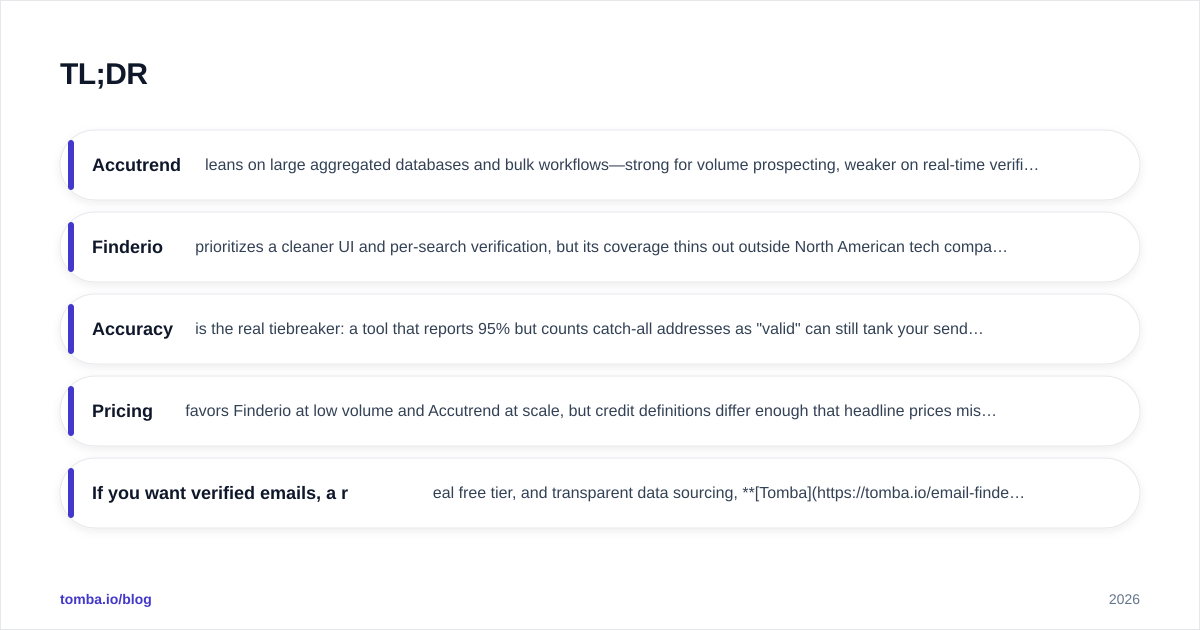
- Accutrend leans on large aggregated databases and bulk workflows—strong for volume prospecting, weaker on real-time verification of fringe domains.
- Finderio prioritizes a cleaner UI and per-search verification, but its coverage thins out outside North American tech companies.
- Accuracy is the real tiebreaker: a tool that reports 95% but counts catch-all addresses as "valid" can still tank your sender reputation.
- Pricing favors Finderio at low volume and Accutrend at scale, but credit definitions differ enough that headline prices mislead.
- If you want verified emails, a real free tier, and transparent data sourcing, Tomba is worth testing against both before you commit a budget.
What are Accutrend and Finderio?#
Both are B2B email-finding tools. You give them a name and a company (or just a domain), and they return the most likely professional email address, usually with a confidence score.
Accutrend positions itself around database scale. The pitch is breadth: millions of contacts pre-indexed, so a lookup is mostly a database read plus a pattern match. That makes bulk jobs fast and cheap per record, but pre-indexed data ages, and aged B2B data decays fast—roughly 22–30% of contacts change roles or companies each year, according to widely cited HubSpot research on database decay.
Finderio leans the other way: smaller index, more emphasis on verifying each address at request time with an SMTP check before it shows you a result. That tends to produce cleaner output on the domains it covers, at the cost of slower bulk runs and patchier coverage on long-tail companies.
Neither approach is "right." They optimize for different buyers. The trick is matching the tool to how you actually prospect.
How accurate are Accutrend and Finderio?#
Accuracy is where marketing copy and reality diverge most, so define your terms before you trust any vendor's number.
A "95% accuracy" claim is meaningless unless you know what the denominator is. Some tools count a catch-all domain (one that accepts mail to any address) as a hit, even though they can't confirm the specific mailbox exists. Others only count addresses confirmed by SMTP. Same word, very different bounce rates.
In practice:
- Accutrend reports high accuracy, but a meaningful slice of its "valid" results on catch-all domains are unverified guesses. If you don't run those through a separate email verifier, your bounce rate will be higher than the dashboard implies.
- Finderio verifies more aggressively before returning a result, so its hit rate looks lower but its delivered emails bounce less. You're trading quantity for confidence.

The lesson: never judge an email finder on hit rate alone. Judge it on deliverable hit rate—results that actually land in an inbox. A tool that finds 80 emails where 78 deliver beats one that finds 95 where 70 deliver, every time. The second tool also burns your sender reputation, which costs you far more than a few missed leads.

If you handle catch-all domains often (common in enterprise outbound), confirm how each tool treats them. A dedicated catch-all verifier is the only honest way to resolve those, and not every finder includes one.
Accutrend vs Finderio: feature and pricing comparison#
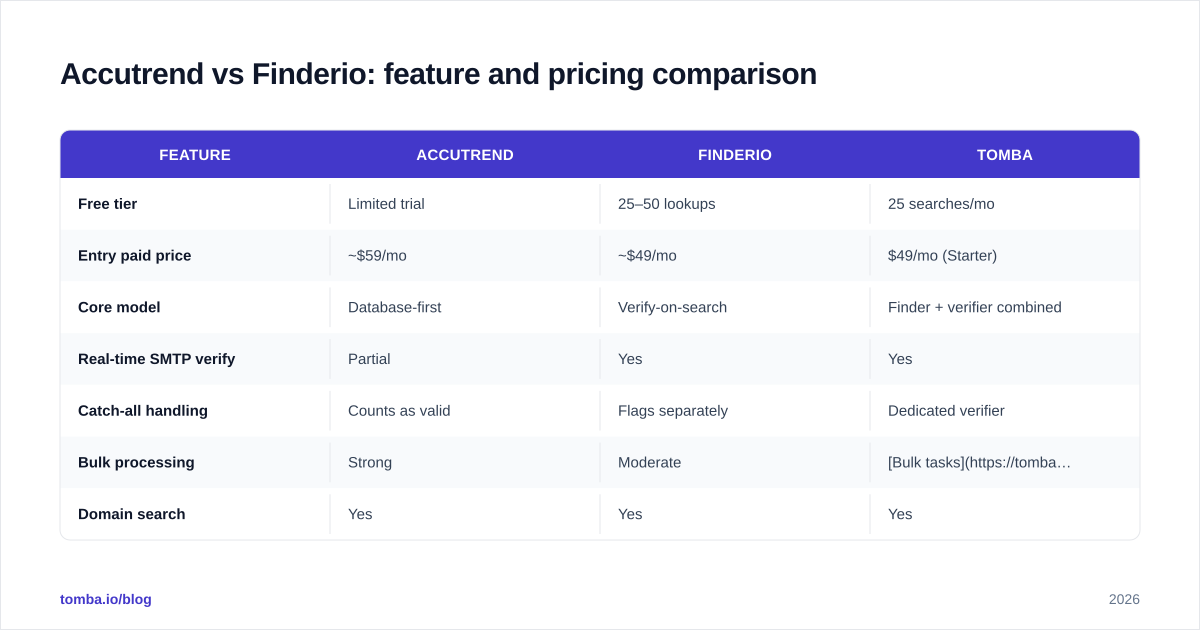
Here's the side-by-side. Treat pricing as directional—both vendors adjust tiers, and "credits" don't mean the same thing across tools.
| Feature | Accutrend | Finderio | Tomba |
|---|---|---|---|
| Free tier | Limited trial | 25–50 lookups | 25 searches/mo |
| Entry paid price | ~$59/mo | ~$49/mo | $49/mo (Starter) |
| Core model | Database-first | Verify-on-search | Finder + verifier combined |
| Real-time SMTP verify | Partial | Yes | Yes |
| Catch-all handling | Counts as valid | Flags separately | Dedicated verifier |
| Bulk processing | Strong | Moderate | Bulk tasks |
| Domain search | Yes | Yes | Yes |
| Phone numbers | No | Limited | Phone finder |
| API access | Yes | Yes | Full REST API |
| Data sourcing transparency | Low | Medium | Published data sources |
A few things worth flagging:
Credit math is the hidden cost. Accutrend's lower per-record cost at scale only holds if a high share of records return usable emails. If 30% come back empty or bounce, your effective cost per deliverable email can exceed Finderio's. Always compute cost-per-verified-email, not cost-per-search.
Verification is sometimes a separate line item. Some tools charge for finding and again for verifying. Bundle pricing matters: if you have to pay a second vendor to clean Accutrend's output, the "cheaper" tool isn't cheaper. This is where a combined finder-plus-verifier setup—like Tomba's—changes the spreadsheet.
For full current numbers, check each vendor directly and compare against Tomba pricing, since published tiers move quarterly.
Which tool is better for bulk prospecting?#
Accutrend wins on raw throughput; Finderio wins on list cleanliness.
If you're building a 10,000-row list and plan to verify everything afterward anyway, Accutrend's database-first model is fast and economical. You accept some noise upfront and clean it in a second pass.
If you're running smaller, higher-stakes campaigns—say, a founder doing 200 hand-picked accounts—Finderio's verify-on-search approach saves you the cleanup step and protects deliverability from the first send.
That said, the "find now, clean later" workflow has a trap: many teams skip the cleaning step under deadline pressure and send to raw data. That's how you end up on a blacklist. If you go the bulk route with any tool, treat verification as mandatory, not optional. Run the export through a bulk verify pass before a single email goes out.
What about data coverage and freshness?#
Coverage is where both tools show their seams.
Finderio is strong on North American SaaS and tech but thins out on European SMBs, non-English company names, and traditional industries (manufacturing, logistics, regional services). If your ICP lives outside the tech bubble, test coverage on your accounts before subscribing—vendor-reported coverage is an average that hides the gaps that matter to you.
Accutrend covers more breadth by volume, but breadth and freshness are different axes. A large index full of two-year-old role data produces confident-looking emails for people who left the company. This is the decay problem again: scale without refresh cadence is a liability.
The honest test for either tool: pull 50 contacts you already know are correct (from past deals or your CRM), run them through the tool, and measure the real hit-and-deliver rate on your segment. Thirty minutes of testing beats any review—including this one.
If author or content-site outreach is part of your motion, also check whether the tool resolves bylines; a dedicated author finder handles that better than a generic name-plus-domain lookup.
Where does Tomba fit against Accutrend and Finderio?#
Tomba is the option to test when you want Finderio's verification rigor with broader coverage and a genuinely free starting tier.
Tomba combines the two functions most teams end up paying separate vendors for: it finds the email and verifies it in the same flow, with a separate catch-all verifier for the domains that trip up other tools. That collapses the "find with tool A, clean with tool B" tax that makes Accutrend's headline price misleading.
What stands out against this specific pair:
- Real free tier: 25 searches per month, no trial clock—useful for testing coverage on your ICP before paying.
- Transparent sourcing: Tomba publishes where its data comes from, which neither Accutrend nor Finderio does in detail.
- One platform: email finder, domain search, verifier, phone finder, and data enrichment under one bill, plus a documented API if you're wiring this into your own stack.
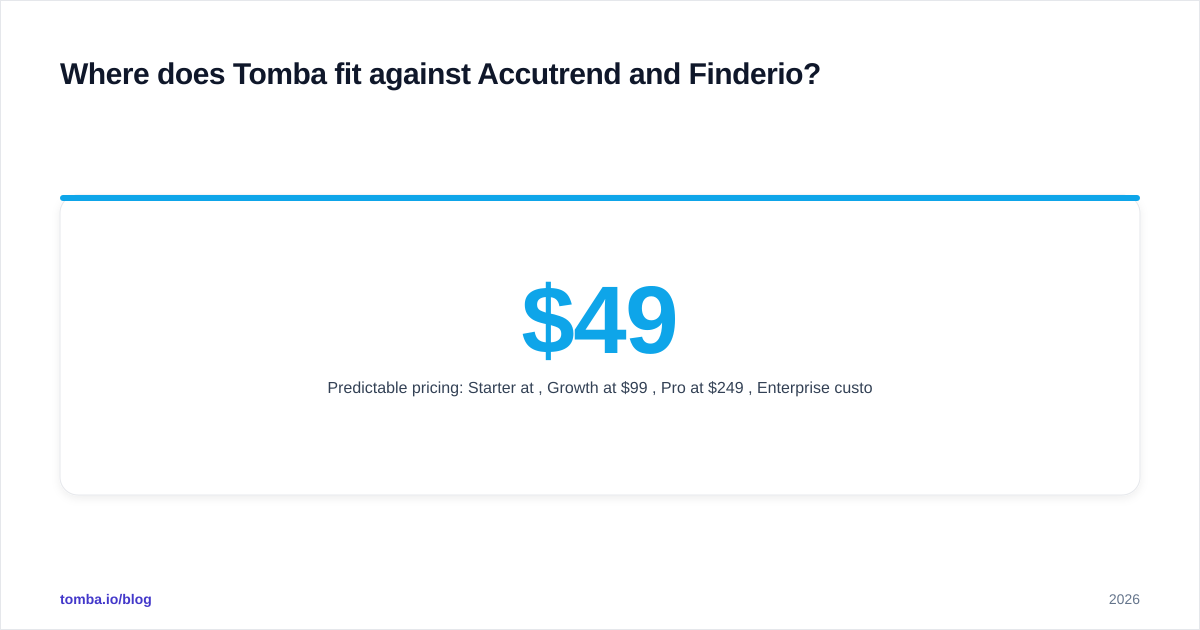
- Predictable pricing: Starter at $49/mo, Growth at $99/mo, Pro at $249/mo, Enterprise custom—credits that cover both finding and verifying.
Tomba isn't automatically the winner for every team. If you only need raw North American tech contacts and already own a verifier you love, Finderio may be enough. If you live entirely in high-volume database pulls and have a mature cleaning pipeline, Accutrend's economics can work. But for most B2B teams that want deliverable emails without stitching two tools together, Tomba removes a step.
You can sanity-check vendor claims independently on G2 and Capterra, where verified-user reviews tend to surface the coverage gaps that landing pages omit.
How to choose: a quick decision guide#
Run your decision through three filters, in order:
- Coverage on your ICP. Test 50 known contacts in each tool. Whichever returns the highest deliverable rate on your actual segment wins—ignore global averages.
- Bundled verification. Confirm whether verification is included or a separate charge. Compute cost-per-verified-email, not cost-per-search.
- Workflow fit. Bulk-and-clean teams skew Accutrend. Precision-outbound teams skew Finderio. Teams that want both in one place skew Tomba.
If two tools tie on coverage, let pricing and bundled verification break the tie. If they tie on price, let data transparency break it—a vendor that won't tell you where the data comes from is a vendor you can't audit when bounce rates spike.
The bottom line#
Accutrend and Finderio are both legitimate email finders that win for different buyers: Accutrend for high-volume, clean-it-later workflows, Finderio for precision outbound on North American tech accounts. The deciding factor isn't the headline accuracy number—it's the deliverable hit rate on your specific ICP and whether verification is bundled or billed twice.
Before you lock in either, run the same 50 test contacts through Tomba's Email Finder. It finds and verifies in one pass, ships a real free tier so the test costs nothing, and publishes its data sources so you can audit accuracy instead of trusting it. Start free, compare the deliverable rate against both tools, and let your own list decide.
// get started
Find, verify and enrich your first contacts today
Start on the free plan with 25 searches a month, then scale when your team is ready.
Free plan · No credit card required · GDPR & CCPA
// about the author