Accutrend vs Leadmine 2026: Which B2B Data Tool Wins?
Accutrend vs Leadmine, compared head-to-head on accuracy, pricing, coverage, and compliance — plus where a leaner email finder beats both in 2026.
Choosing between Accutrend and Leadmine usually comes down to one quiet question your finance team will ask three months from now: did the contact data actually convert, or did we just pay for a bigger list? This guide answers that before you sign anything.
Both tools promise the same thing — accurate B2B contacts you can email or call today. They get there differently, charge differently, and fail differently. Below is a neutral, attribute-by-attribute breakdown, plus an honest note on where a focused email finder beats a heavyweight data suite for most outbound teams.
TL;DR — Accutrend vs Leadmine in 60 seconds#
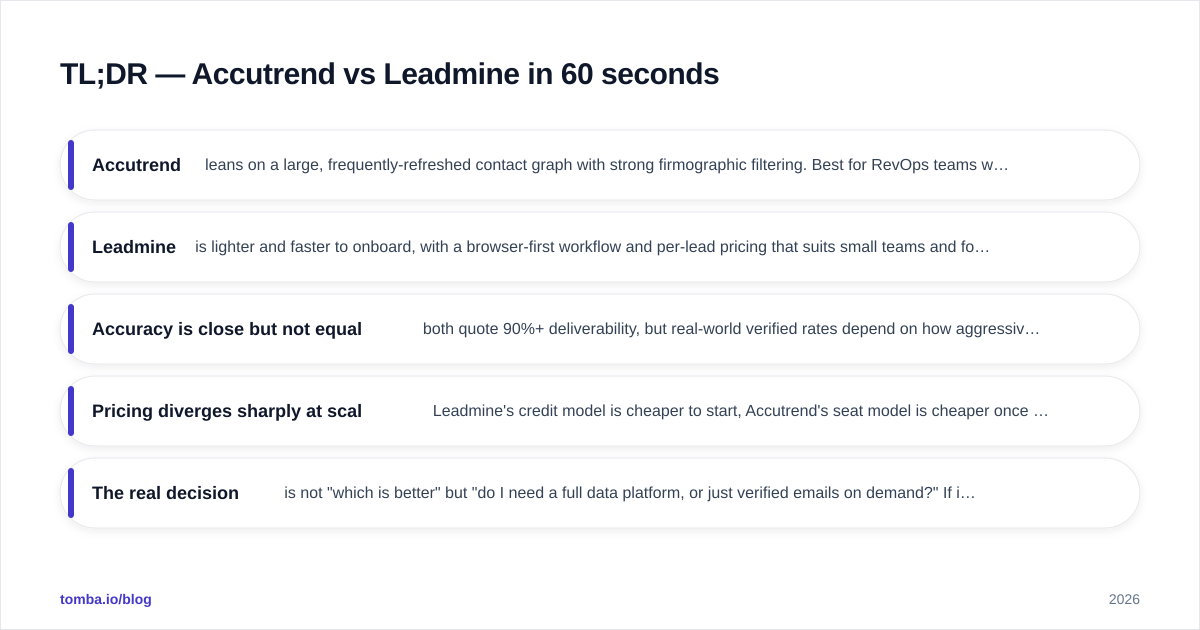
- Accutrend leans on a large, frequently-refreshed contact graph with strong firmographic filtering. Best for RevOps teams who want one platform to slice TAM and export segments.
- Leadmine is lighter and faster to onboard, with a browser-first workflow and per-lead pricing that suits small teams and founders doing their own prospecting.
- Accuracy is close but not equal — both quote 90%+ deliverability, but real-world verified rates depend on how aggressively each one re-validates before export.
- Pricing diverges sharply at scale: Leadmine's credit model is cheaper to start, Accutrend's seat model is cheaper once you exceed roughly 5,000 contacts a month.
- The real decision is not "which is better" but "do I need a full data platform, or just verified emails on demand?" If it's the latter, a dedicated finder like Tomba is cheaper and more accurate per contact.
What are Accutrend and Leadmine?#
Think of these two as different kitchens serving the same dish. Accutrend is the big restaurant with a stocked walk-in fridge — a large pre-built database you query and filter. Leadmine is the food-truck model — it grabs and verifies contacts on demand, closer to the moment you need them.
Technically, Accutrend is a B2B sales-intelligence platform: a contact and company database with firmographic, technographic, and intent layers, plus enrichment and list-building. Leadmine is a contact-discovery tool focused on finding and verifying business emails (and some phone numbers) through a web app and browser extension, with lighter database depth but faster individual lookups.
That architectural difference drives almost every trade-off that follows — coverage, freshness, pricing, and how each handles the dreaded catch-all domain.
How accurate is the data — Accutrend vs Leadmine?#
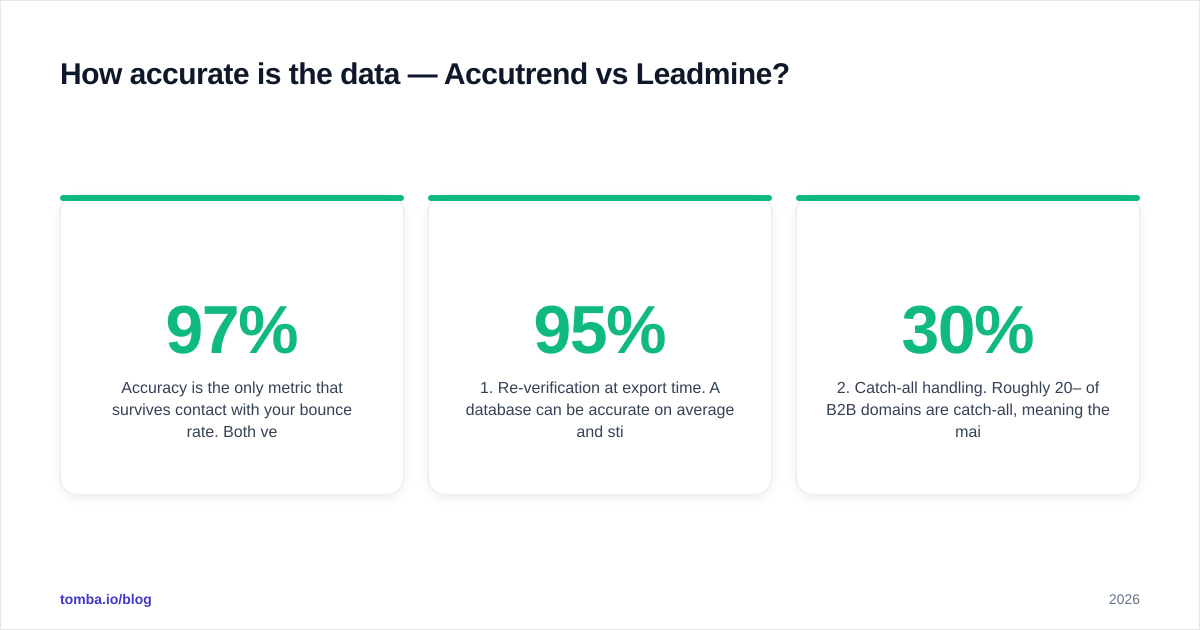
Accuracy is the only metric that survives contact with your bounce rate. Both vendors advertise 90–97% deliverability, but those numbers describe claimed accuracy at the database level, not the verified accuracy of the specific 500 contacts you export on a Tuesday.
Two things separate marketing accuracy from real accuracy:
- Re-verification at export time. A database can be 95% accurate on average and still hand you a segment that's 80% stale if those records haven't been touched in nine months. Accutrend re-validates on a rolling schedule; Leadmine verifies more at the moment of lookup. For fast-moving roles (sales, marketing leaders who job-hop), on-demand verification tends to win.
- Catch-all handling. Roughly 20–30% of B2B domains are catch-all, meaning the mail server accepts everything and tells you nothing. How a tool labels these — "valid," "risky," or "unknown" — massively changes your usable list size. A catch-all verifier that actually probes the domain beats one that guesses.

The practical move: don't trust either vendor's headline number. Run a 200-contact pilot through each, send to a seed list or a third-party email verifier, and measure your bounce rate. The tool that wins your pilot wins your budget.

Accutrend vs Leadmine: feature and pricing comparison#
Here's the head-to-head on the attributes that actually change a buying decision. Prices are representative of published 2026 tiers and entry points; confirm current numbers on each vendor's site before you commit.
| Attribute | Accutrend | Leadmine |
|---|---|---|
| Core model | Full B2B database + enrichment | On-demand finder + extension |
| Entry price | ~$99/seat/mo | ~$49/mo (credit-based) |
| Free tier | Limited trial, no free plan | Small monthly free credits |
| Best for | RevOps, mid-market, list-building | Founders, SMB, individual reps |
| Claimed accuracy | 95%+ | 92%+ |
| Catch-all handling | Labeled, partial probing | Verified on lookup |
| Phone numbers | Yes (mobile + direct) | Limited |
| Intent / technographics | Yes | No |
| CRM integrations | Native (Salesforce, HubSpot) | Zapier + a few native |
| Bulk export | Yes, segment-level | Yes, capped by credits |
| API access | Higher tiers only | Mid tier and up |
| Onboarding time | Days (sales-led) | Minutes (self-serve) |
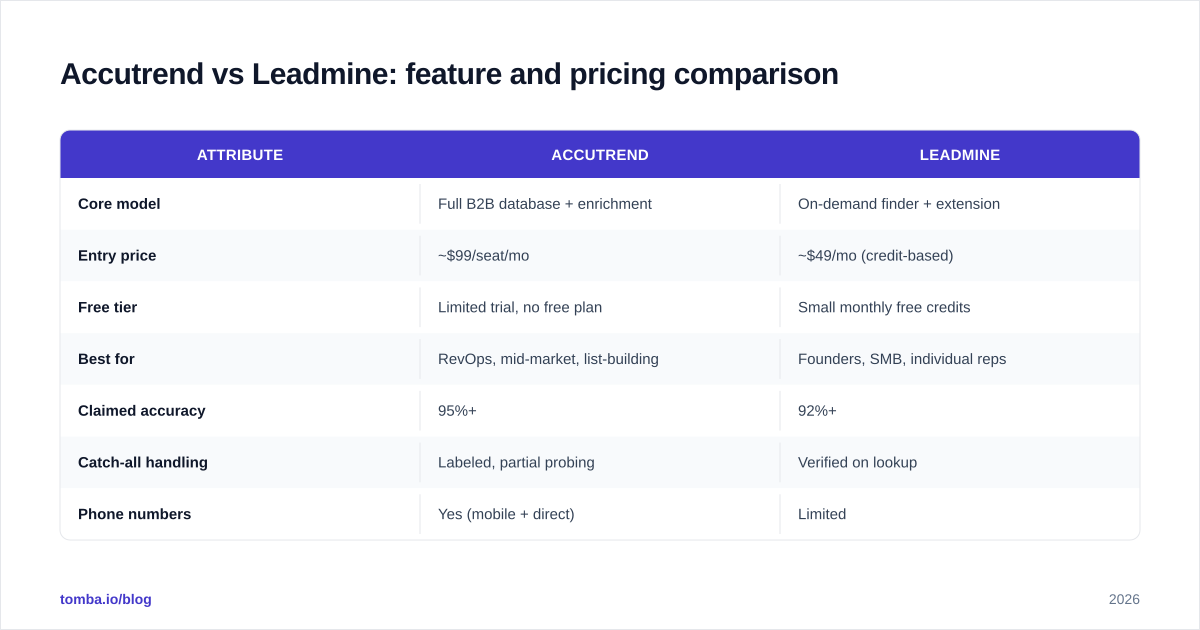
The pattern is clear: Accutrend is the platform you adopt company-wide; Leadmine is the tool an individual rep starts using on a Tuesday afternoon. Neither is wrong — they're built for different buyers.
Which is better for small teams and founders?#
Leadmine, in most cases. If you're a founder or a two-person sales team, you want speed, a low monthly floor, and a browser extension that grabs a contact while you're already on a LinkedIn profile. Leadmine's credit model means you pay for what you use, and the self-serve onboarding gets you prospecting the same day.
Accutrend's strength — a deep, filterable database — is partly wasted on a small team that isn't building 10,000-row segments. You'd be paying platform pricing for finder-tier needs.
That said, even Leadmine can be overkill if all you need is verified emails by name and domain. This is where a focused tool earns its place: Tomba's domain search pulls every public email pattern for a company, and the bulk email finder processes a CSV of names without a per-seat platform fee. For pure email discovery, that's a tighter loop than either Accutrend or Leadmine.
Which is better for RevOps and mid-market teams?#
Accutrend, when you need orchestration. Once you have multiple reps, a marketing team running ABM, and a RevOps function defining ICP segments, the value flips. You want:
- One source of truth for firmographics and data enrichment, pushed natively into your CRM
- Intent and technographic layers to prioritize accounts
- Segment-level exports tied to territory rules
- Admin controls, audit trails, and a defensible compliance posture
Leadmine can support a small sales team, but it isn't designed to be the data backbone for a 30-person revenue org. Accutrend is. If you've read up on revenue operations as a discipline, you'll recognize that the platform's real value is workflow consolidation, not just raw records.
Check peer reviews on G2 and Capterra for your specific segment — enterprise reviewers and SMB reviewers often rate the same tool very differently, and the average score hides that split.

What about compliance — GDPR, CCPA, and data sourcing?#
This is the section most comparison posts skip, and it's the one that can cost you a fine. Both Accutrend and Leadmine operate in the B2B contact-data space, which under regimes like the EU's GDPR requires a lawful basis (typically legitimate interest for B2B outreach), transparency, and a working opt-out path.
When you evaluate either tool, ask three direct questions:
- Where does the data come from? Public web, partner contributions, user-contributed contact books, or a mix? Transparent sourcing is a good sign. Tomba publishes its approach on its data sources page — use that as a benchmark for what "transparent" looks like.
- Is there a suppression and deletion workflow? When someone requests removal, can the vendor purge them across your exports?
- Do they offer a DPA? A data processing agreement is table stakes for mid-market and up.
Neither tool is inherently non-compliant, but you remain the data controller once you import contacts into your CRM. Compliance is a shared responsibility, not a checkbox the vendor handles for you.
A simple framework to decide#
Skip the feature-by-feature paralysis. Answer these in order:
- Do you need intent data, technographics, and CRM-native orchestration? → Accutrend. The platform premium is justified.
- Are you a small team that wants fast, self-serve contact discovery? → Leadmine. Lower floor, quicker start.
- Do you mostly just need verified business emails by name and domain, at a predictable price? → A dedicated email finder. You're overbuying with either platform.
Most teams that think they need a full data suite actually fall into the third bucket. They buy the platform for the database, then use 10% of it to do what a finder does for a fraction of the cost. Audit your last quarter: if 80% of your usage was "find this person's email," you don't need a data warehouse — you need a reliable finder.
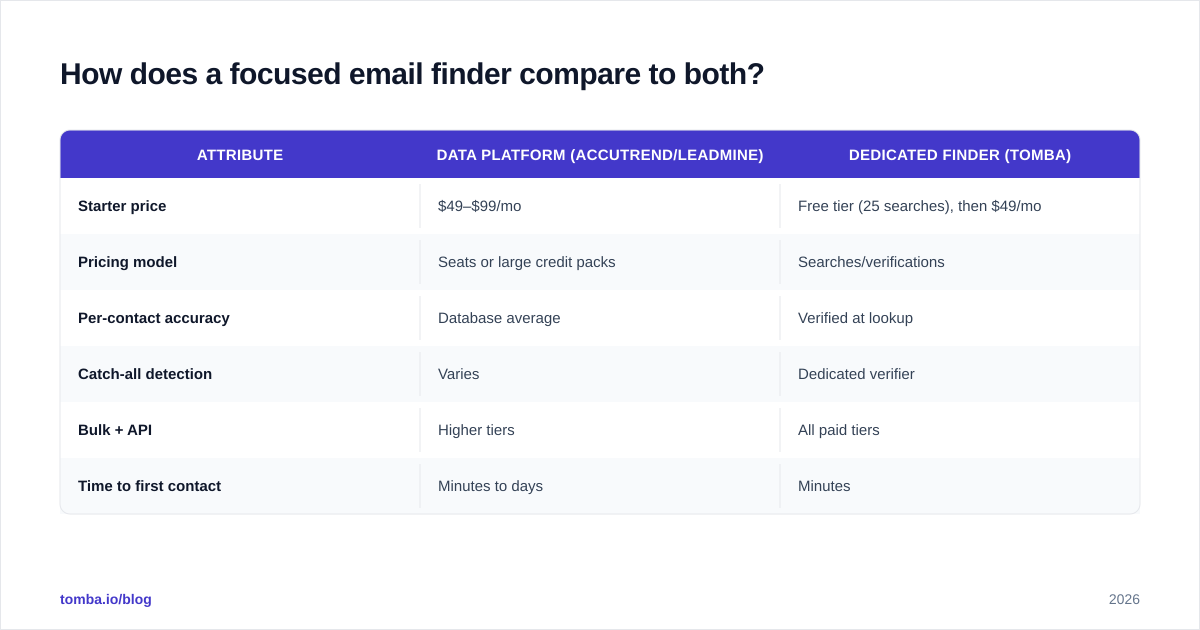
How does a focused email finder compare to both?#
A dedicated finder trades breadth for precision and price. You lose the intent layer and the giant pre-built database; you gain higher per-contact accuracy, simpler pricing, and verification baked into the lookup.
| Attribute | Data platform (Accutrend/Leadmine) | Dedicated finder (Tomba) |
|---|---|---|
| Starter price | $49–$99/mo | Free tier (25 searches), then $49/mo |
| Pricing model | Seats or large credit packs | Searches/verifications |
| Per-contact accuracy | Database average | Verified at lookup |
| Catch-all detection | Varies | Dedicated verifier |
| Bulk + API | Higher tiers | All paid tiers |
| Time to first contact | Minutes to days | Minutes |
Tomba's plans run Free (25 searches/mo), Starter $49/mo, Growth $99/mo, Pro $249/mo, and Enterprise custom — full Tomba pricing is public, no sales call required. The model is built around the thing you do most: find and verify a real email, then move on.
This isn't to say a finder replaces a true data platform for every team. If you genuinely run intent-based ABM across thousands of accounts, Accutrend's depth matters. But for the common job — turning a name and a company into a deliverable email — a finder is faster, cheaper, and usually more accurate on that one task.
Accutrend vs Leadmine: the verdict#
There's no universal winner, only a winner for your setup:
- Pick Accutrend if you're mid-market or larger and need a consolidated data platform with intent, enrichment, and deep CRM integration.
- Pick Leadmine if you're a small team or founder who values speed, self-serve onboarding, and a low monthly floor.
- Pick a dedicated finder if your real need is verified emails on demand, and you'd rather not pay platform pricing for finder-tier work.
Run the pilot. Measure your own bounce rate. Let the data — not the demo — decide.
Start with verified emails today#
If your honest audit lands you in the "I just need reliable emails" camp, start there before committing to a six-figure data platform. Tomba's Email Finder turns a name and domain into a verified, deliverable address in seconds, with a free tier to test accuracy on your own list and a bulk email finder for when you're ready to scale. Verify what works on real contacts, keep your bounce rate low, and upgrade to a heavier platform only if and when intent data actually moves your pipeline. Try it free, run your own benchmark, and let the deliverability numbers make the call.
// get started
Find, verify and enrich your first contacts today
Start on the free plan with 25 searches a month, then scale when your team is ready.
Free plan · No credit card required · GDPR & CCPA
// about the author