Accutrend vs LeadRocks 2026: Which B2B Data Tool Wins?
Accutrend and LeadRocks both promise affordable B2B contact data, but they solve different problems. Here's a side-by-side breakdown of accuracy, pricing, and fit for 2026.
Accutrend vs LeadRocks: The Honest 2026 Comparison
Choosing between Accutrend and LeadRocks usually comes down to one question: do you need a broad data-enrichment layer, or a cheap stockpile of B2B contacts to fuel cold outreach? They sound similar in the demo, but they sit in different parts of the go-to-market stack — and picking the wrong one wastes both budget and deliverability.
TL;DR — Accutrend vs LeadRocks at a glance#
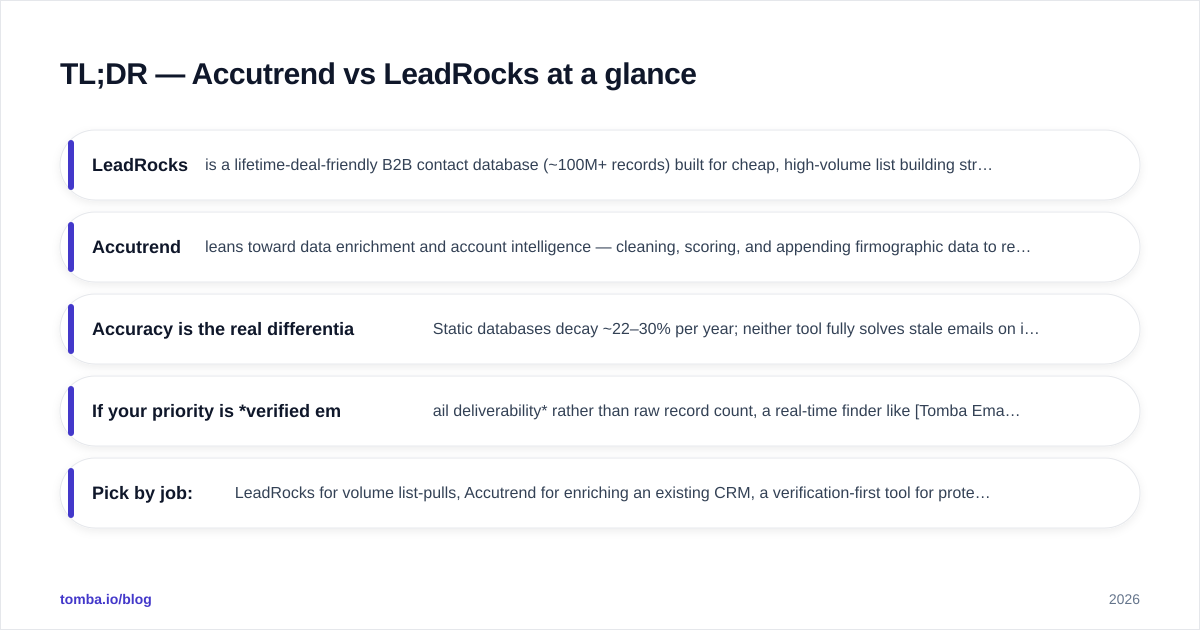
- LeadRocks is a lifetime-deal-friendly B2B contact database (~100M+ records) built for cheap, high-volume list building straight from LinkedIn URLs.
- Accutrend leans toward data enrichment and account intelligence — cleaning, scoring, and appending firmographic data to records you already have.
- Accuracy is the real differentiator. Static databases decay ~22–30% per year; neither tool fully solves stale emails on its own.
- If your priority is verified email deliverability rather than raw record count, a real-time finder like Tomba Email Finder beats either at the moment of send.
- Pick by job: LeadRocks for volume list-pulls, Accutrend for enriching an existing CRM, a verification-first tool for protecting sender reputation.
What is Accutrend?#
Accutrend positions itself as a B2B data and enrichment platform. Think of it less like a phone book and more like a research assistant: you hand it a partial record — a domain, a company name, a half-filled CRM row — and it appends firmographic and contact details, then flags what looks outdated.
That framing matters. Enrichment tools are judged on fill rate (how many blank fields they complete) and match accuracy (how often the appended data is correct for the right person). They are not primarily built to generate net-new prospect lists from scratch, though most bolt on some lookup capability.
If you already run a CRM with thousands of half-complete contacts, an enrichment-first tool is the natural fit. You are paying to make existing data usable, not to discover strangers.
What is LeadRocks?#
LeadRocks is a B2B contact database. Its pitch is volume and price: search a database of roughly 100M+ contacts, paste LinkedIn profile or company URLs, and pull emails and phone numbers in bulk. It became popular through lifetime deals, which makes it attractive to bootstrapped founders and agencies who hate recurring SaaS bills.
The mental model here is a warehouse. You walk in, grab records that match your filters (title, industry, location, company size), and walk out with a CSV. Speed and cost-per-record are the headline strengths. The trade-off — and it's the same trade-off every static database carries — is freshness. A contact pulled today might have changed jobs three months ago.
You can read independent user sentiment on LeadRocks' G2 listing and the official LeadRocks site to sanity-check current claims before you buy.
Accutrend vs LeadRocks: how do they actually differ?#
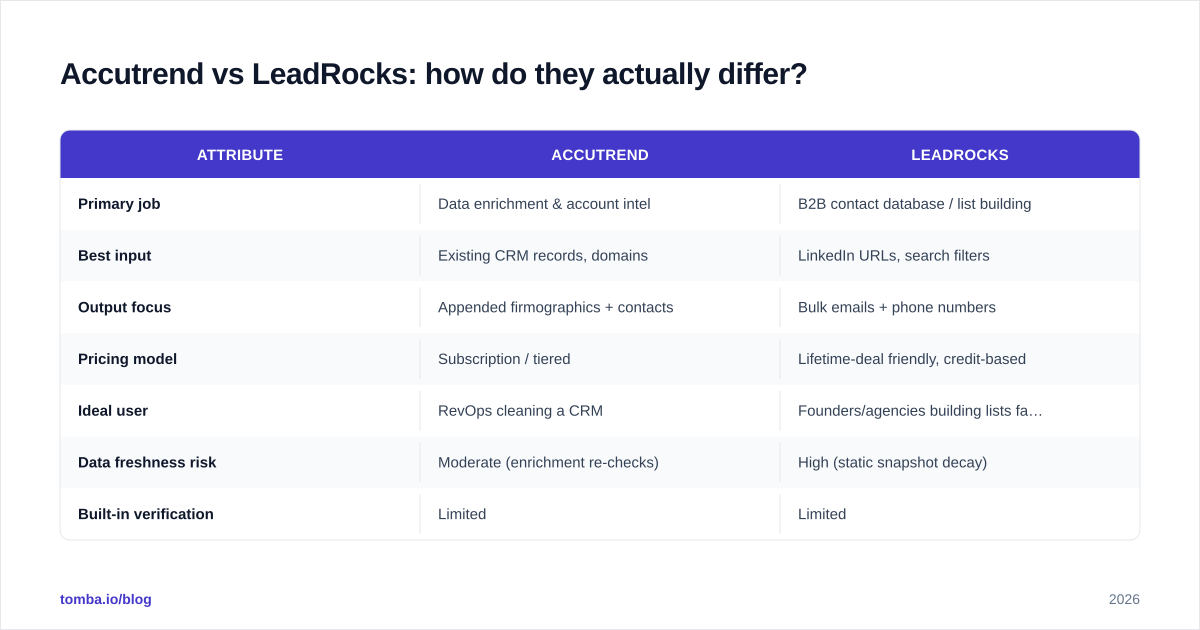
The cleanest way to see the gap is to line up what each one optimizes for. One is built to improve records; the other is built to supply them.
| Attribute | Accutrend | LeadRocks |
|---|---|---|
| Primary job | Data enrichment & account intel | B2B contact database / list building |
| Best input | Existing CRM records, domains | LinkedIn URLs, search filters |
| Output focus | Appended firmographics + contacts | Bulk emails + phone numbers |
| Pricing model | Subscription / tiered | Lifetime-deal friendly, credit-based |
| Ideal user | RevOps cleaning a CRM | Founders/agencies building lists fast |
| Data freshness risk | Moderate (enrichment re-checks) | High (static snapshot decay) |
| Built-in verification | Limited | Limited |
| Net-new prospecting | Secondary | Primary |
Notice that the bottom three rows are weaknesses for both tools. Neither is engineered as a verification-first system, and both inherit the core problem of any database-driven approach: the data was true when it was scraped, not necessarily when you hit send.

Which one is more accurate?#
Neither tool eliminates the decay problem, so "accuracy" depends on when the data was last touched. This is the single most expensive line item people ignore.
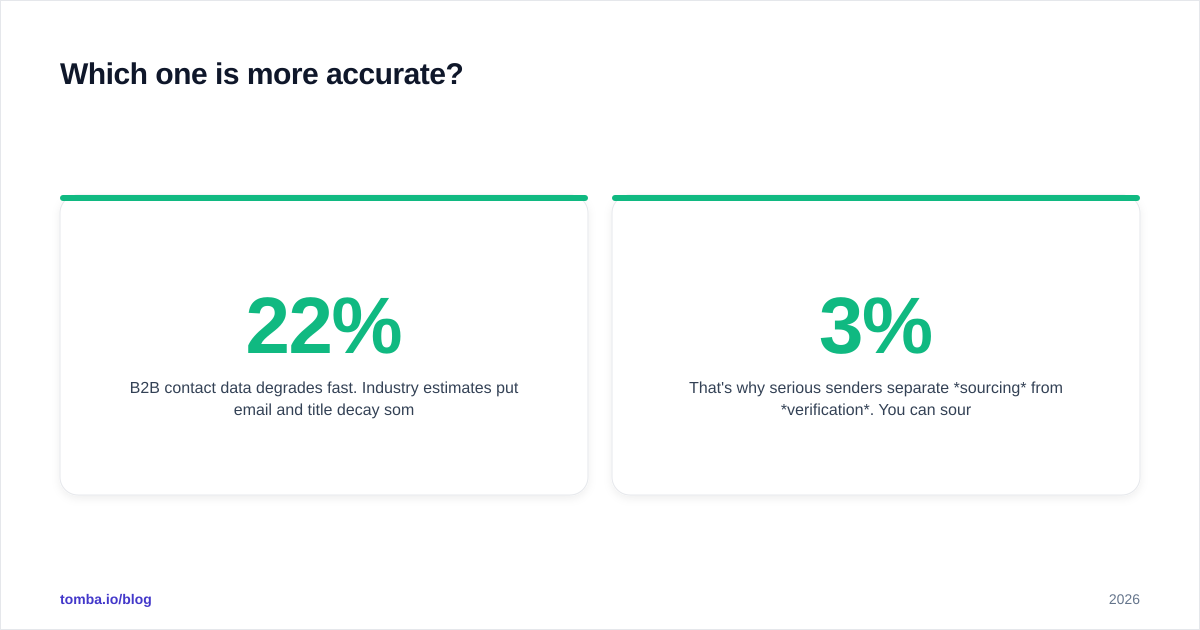
B2B contact data degrades fast. Industry estimates put email and title decay somewhere between 22% and 30% per year as people change roles, companies rebrand, and domains migrate. A 100M-record database is impressive on the pricing page and irrelevant if 1 in 4 emails bounce. (For background on what enrichment can and can't fix, see the overview of data enrichment on Wikipedia.)
That's why serious senders separate sourcing from verification. You can source a contact from LeadRocks or enrich it through Accutrend, but you should still re-verify the email immediately before it enters a sequence. A bounce rate above ~3% drags your sender reputation down and threatens overall email deliverability for your whole domain.

This is where a real-time tool earns its place in the stack. Instead of trusting a snapshot, a live finder queries current sources at the moment you ask and runs SMTP-level checks. If you're choosing primarily on deliverability, that workflow beats either Accutrend or LeadRocks on the metric that actually costs you money: bounces.
How do pricing and value compare?#
Pricing is where the two diverge most, and where the "lifetime deal" framing can mislead.
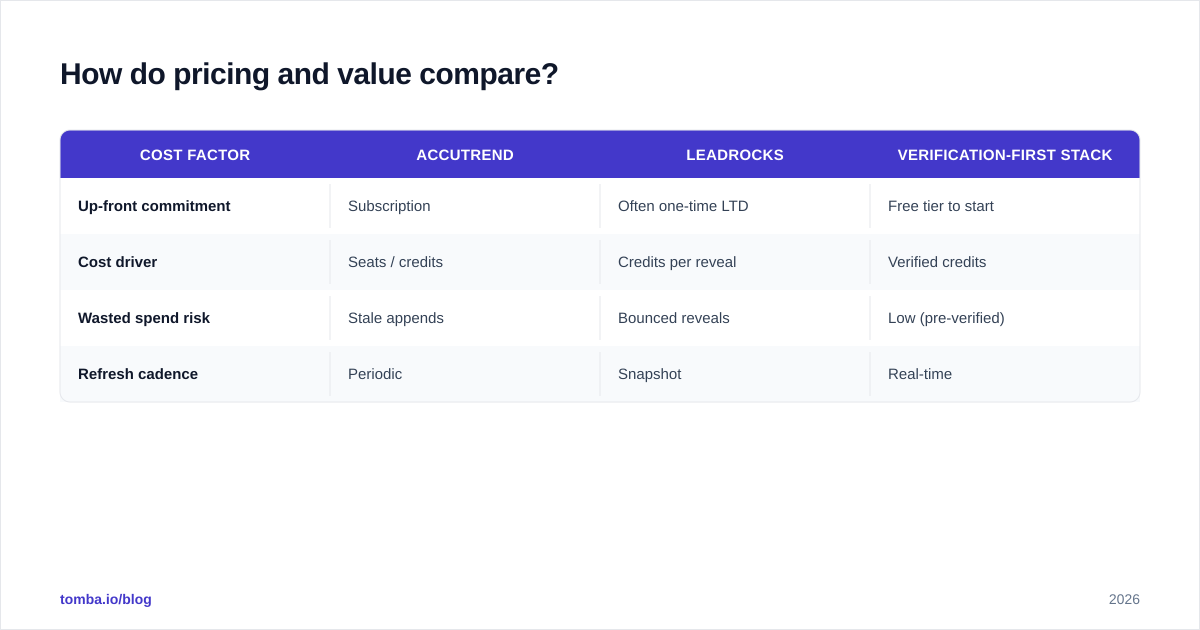
LeadRocks' lifetime-deal model looks cheaper because you pay once. But credits are consumed per reveal, and a record that bounces still burns a credit. The effective cost is cost-per-usable-contact, not cost-per-record. Accutrend's subscription model spreads cost over time but typically refreshes data as part of the service, which softens the decay problem.
| Cost factor | Accutrend | LeadRocks | Verification-first stack |
|---|---|---|---|
| Up-front commitment | Subscription | Often one-time LTD | Free tier to start |
| Cost driver | Seats / credits | Credits per reveal | Verified credits |
| Wasted spend risk | Stale appends | Bounced reveals | Low (pre-verified) |
| Refresh cadence | Periodic | Snapshot | Real-time |
For a transparent, usage-based reference point, Tomba pricing starts with a free tier of 25 searches per month, then Starter at $49/mo, Growth at $99/mo, and Pro at $249/mo — every result run through verification before it counts against you. Compare that against the usable output of a cheaper database, not the sticker price.

Is there a better workflow than either tool alone?#
Yes — and it's not "pick one." The strongest 2026 setup treats sourcing, enrichment, and verification as three separate steps rather than expecting one vendor to nail all three.
Here's a practical sequence that works regardless of which side you lean toward:
- Source the raw list. Use a database (LeadRocks-style) or your existing CRM export. This gets you names, companies, and LinkedIn URLs.
- Enrich the firmographics. Append company size, industry, and role context — Accutrend's lane — so segmentation is accurate.
- Find and verify the email at send-time. This is the step both tools under-serve. Run each contact through a live finder and verifier so only deliverable addresses enter your sequence.
For step three, you can pull verified emails by company with domain search, confirm each address with the email verifier, and even resolve tricky catch-all domains using the catch-all verifier. That last point matters: many database tools mark catch-all domains as "valid" when they're actually unverifiable, which is exactly how a clean-looking list still bounces.

Which should you choose — Accutrend or LeadRocks?#
Match the tool to the job, not the marketing.
Choose LeadRocks if: you're a founder or agency that needs to assemble large prospect lists fast, you're price-sensitive, and you have a separate verification step in place. The lifetime-deal economics genuinely help early-stage budgets — just don't skip re-verification.
Choose Accutrend if: your pain is a messy CRM full of half-complete records. Enrichment is its strength, and cleaning existing data usually delivers faster ROI than buying more raw contacts you can't trust.
Choose a verification-first finder if: deliverability is your bottleneck — high bounce rates, blacklisting risk, or a warmed domain you can't afford to burn. In that case the database you source from matters less than the verification layer that protects your sender reputation.
For most outbound teams, the honest answer is a hybrid: source cheaply, enrich where it helps, and always verify at the end. The verification step is non-negotiable because it's the only one that directly protects revenue — a damaged domain can take months to recover.
Frequently asked questions#
Is LeadRocks accurate enough for cold email? It's accurate enough to source from, but not to send to blind. Re-verify every address before a campaign; static databases carry meaningful decay.
Does Accutrend find net-new leads? Its core strength is enrichment, not net-new prospecting. If discovery is your main need, a dedicated finder or database is a better primary tool.
What's the cheapest safe way to test both approaches? Start with free tiers. Pull a small sample from each, run all results through an email verifier, and compare usable contacts — not raw counts.
Can I just use one tool for everything? You can, but you'll over-pay on one axis. Most teams get better economics splitting sourcing, enrichment, and verification.
The bottom line#
Accutrend and LeadRocks aren't really competitors — they're neighbors solving adjacent problems. LeadRocks supplies volume; Accutrend improves what you already have. Both leave the same gap: neither is built to guarantee an email is deliverable at the moment you press send.
That gap is where bounces, blacklists, and wasted credits live. If you only fix one thing in your stack this quarter, make it verification. Start free with the Tomba Email Finder — find professional email addresses by domain, name, or company, verify each one before it enters a sequence, and keep your sender reputation intact while LeadRocks and Accutrend do the parts they're actually good at. Twenty-five free searches a month is enough to A/B your current list against verified results and see the bounce difference for yourself.
// get started
Find, verify and enrich your first contacts today
Start on the free plan with 25 searches a month, then scale when your team is ready.
Free plan · No credit card required · GDPR & CCPA
// about the author