Accutrend vs Oceanio 2026: B2B Data Platform Compared
Accutrend vs Oceanio for 2026 — compare data accuracy, coverage, pricing, and integrations to decide which B2B sales intelligence platform actually fits your pipeline.
TL;DR
- Accutrend leans toward depth: large firmographic and intent datasets, enterprise pricing, and a heavier onboarding curve. Best for RevOps teams that live in dashboards.
- Oceanio leans toward speed: faster contact lookups, lighter UI, and friendlier mid-market pricing — but thinner intent and account data.
- Neither is a clear winner for everyone. Your pick depends on whether you optimize for account intelligence (Accutrend) or contact reach and simplicity (Oceanio).
- Data accuracy is the deciding factor for most teams, and both platforms degrade on niche regions and SMB records — always verify before you send.
- If your real bottleneck is finding and verifying email addresses cheaply, a focused tool like the Tomba Email Finder often beats paying enterprise rates for features you won't touch.
If you're comparing Accutrend vs Oceanio, you've probably already realized the marketing pages won't tell you which one fits. Both promise "the most accurate B2B data." Both show logos. This post strips that away and looks at where each platform actually earns its price — and where you're better off with a leaner stack.
What are Accutrend and Oceanio?#
Accutrend and Oceanio are both B2B sales intelligence platforms. In plain terms, they're databases of companies and the people who work at them, wrapped in tools that help sales and marketing teams find, score, and reach those people.
Think of them like two competing phone books for the business world. One is a thick, annotated encyclopedia with margins full of notes about each company (that's Accutrend). The other is a slim, fast directory you can flip through in seconds (that's Oceanio). Both list contacts — but they're built for different reading habits.
Accutrend positions itself around account intelligence: firmographics, technographics, buying-intent signals, and org charts. It wants to be the system of record your whole revenue operations function plugs into.
Oceanio positions itself around contact velocity: get a name, get an email and phone, push it to your CRM, move on. It trades analytical depth for fewer clicks.
How do Accutrend and Oceanio compare on features?#
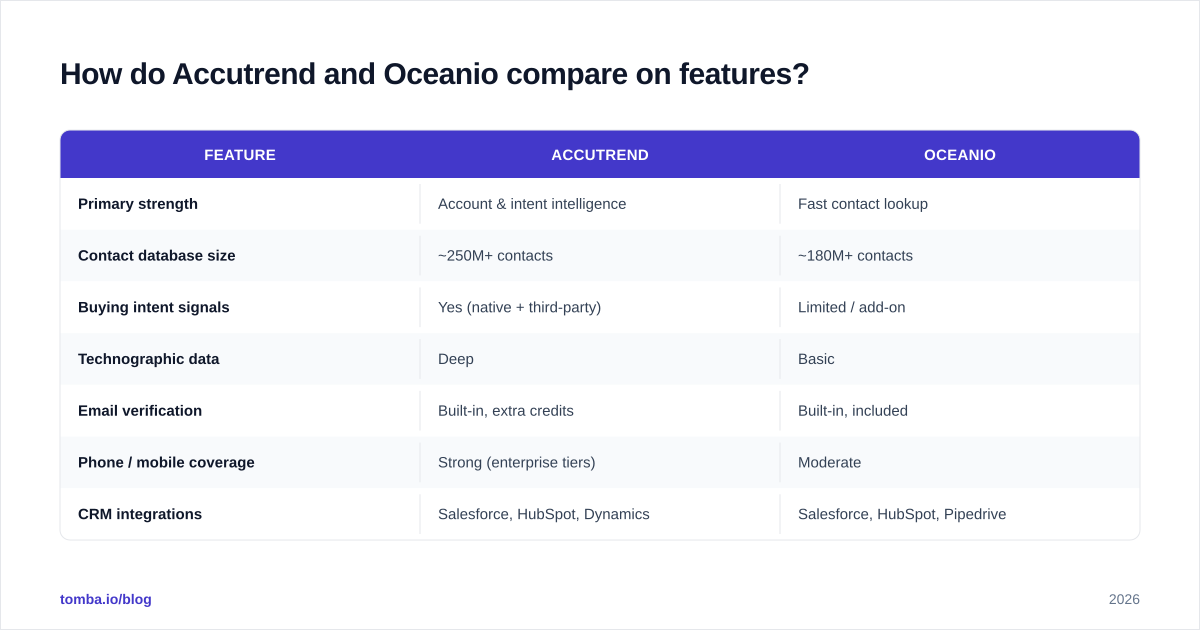
Here's the side-by-side. Numbers reflect typical 2026 positioning for each platform's mid-tier plan; always confirm current terms directly, since both vendors negotiate heavily on annual contracts.
| Feature | Accutrend | Oceanio |
|---|---|---|
| Primary strength | Account & intent intelligence | Fast contact lookup |
| Contact database size | ~250M+ contacts | ~180M+ contacts |
| Buying intent signals | Yes (native + third-party) | Limited / add-on |
| Technographic data | Deep | Basic |
| Email verification | Built-in, extra credits | Built-in, included |
| Phone / mobile coverage | Strong (enterprise tiers) | Moderate |
| CRM integrations | Salesforce, HubSpot, Dynamics | Salesforce, HubSpot, Pipedrive |
| Chrome extension | Yes | Yes |
| Entry price (per seat) | ~$99–$149/mo | ~$59–$89/mo |
| Annual commitment | Usually required | Monthly available |
| Best for | Enterprise RevOps & ABM | SMB / mid-market sales |
The pattern is consistent: Accutrend gives you more signal per record, Oceanio gives you more records per minute. If your sales motion is account-based marketing across a defined target list, the extra intent and technographic layers in Accutrend justify the cost. If you're running high-volume outbound and just need reachable contacts, Oceanio's simplicity wins.
Which has better data accuracy?#
Neither platform is accurate enough to skip verification — and that's true of every vendor in this category, not a knock on these two specifically.
Independent reviews on G2 and Capterra tend to show the same thing: both Accutrend and Oceanio post strong accuracy on large enterprise records in North America and degrade noticeably on SMB, EMEA, and APAC contacts. Accutrend's intent data carries the usual caveat that intent is probabilistic — it tells you a company is researching a topic, not that a specific person will reply.
A few honest realities about B2B data accuracy:
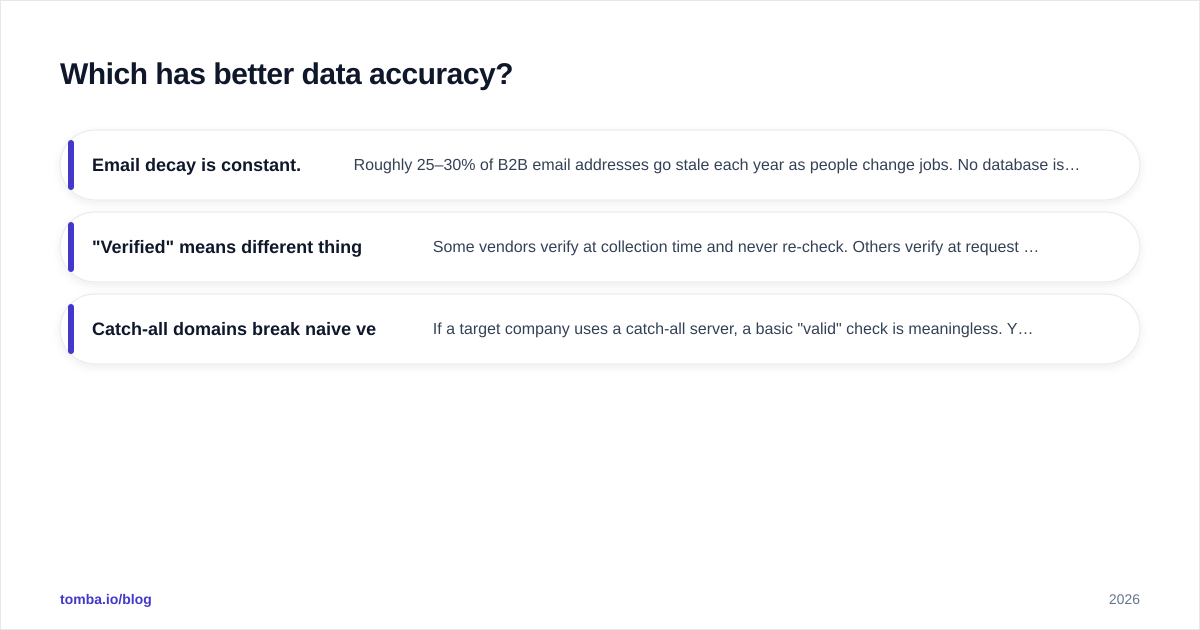
- Email decay is constant. Roughly 25–30% of B2B email addresses go stale each year as people change jobs. No database is immune; the question is how fast each vendor re-crawls.
- "Verified" means different things. Some vendors verify at collection time and never re-check. Others verify at request time. Always ask which.
- Catch-all domains break naive verification. If a target company uses a catch-all server, a basic "valid" check is meaningless. You need a dedicated catch-all verifier to get a real signal.
This is the single most important takeaway in the Accutrend vs Oceanio debate: whichever you choose, run exports through an independent email verifier before you load them into a sending tool. Bouncing 8% of a cold campaign will wreck your sender reputation faster than any data gap costs you in coverage.

Is Accutrend better than Oceanio for enterprise teams?#
For enterprise and dedicated ABM motions, yes — Accutrend is usually the stronger fit, with one caveat.
The caveat: you have to actually use the depth. Accutrend's value is concentrated in features that smaller teams rarely operationalize — intent scoring models, technographic filtering, org-chart mapping, and territory planning. If you buy Accutrend and use it as a glorified contact lookup, you're paying enterprise rates for a job Oceanio does for half the price.
Accutrend makes sense when:
- You run account-based marketing against a fixed target account list.
- You have a RevOps or marketing-ops person who can build and maintain scoring models.
- Intent signals feed a real workflow (alerting, routing, prioritization) — not just a dashboard nobody opens.
- You need deep integration with Salesforce or Dynamics as a system of record.
Oceanio makes sense when:
- Your reps need contacts now, with minimal training.
- You're running volume outbound or SMB-focused sales prospecting.
- Monthly billing and per-seat flexibility matter more than analytical depth.
- You don't have a dedicated ops person to babysit the platform.
Gartner's broader research on sales technology consistently makes the same point: tool ROI tracks adoption, not feature count. The "better" platform is the one your team will actually open every day.
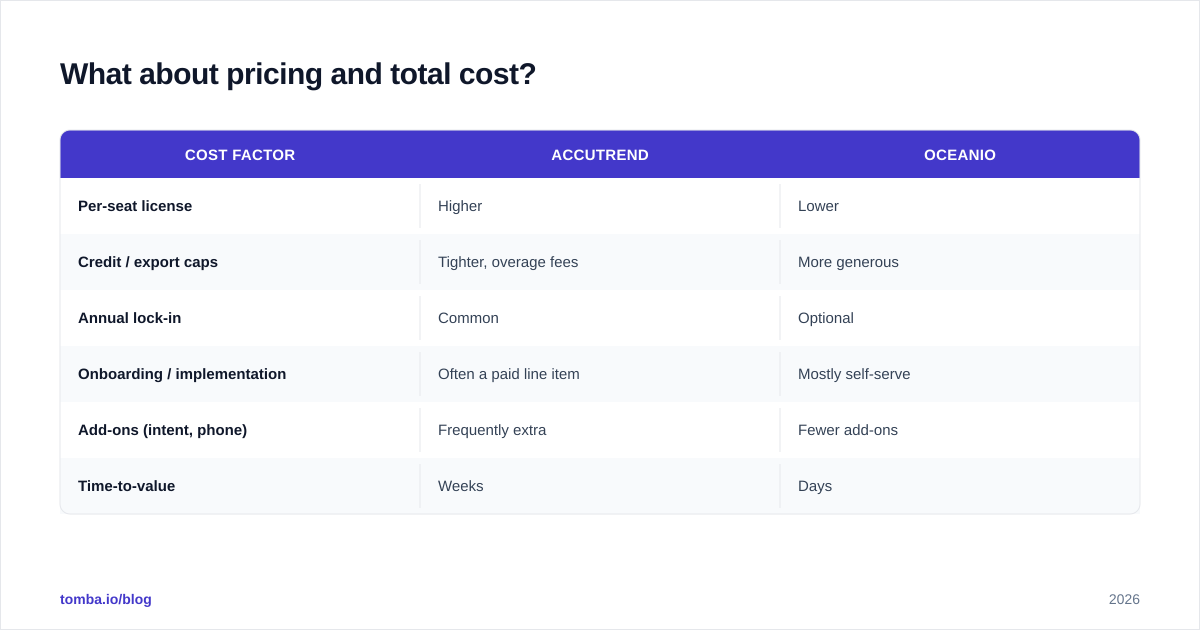
What about pricing and total cost?#
Sticker price is only half the story. Here's where the real money goes on each side.
| Cost factor | Accutrend | Oceanio |
|---|---|---|
| Per-seat license | Higher | Lower |
| Credit / export caps | Tighter, overage fees | More generous |
| Annual lock-in | Common | Optional |
| Onboarding / implementation | Often a paid line item | Mostly self-serve |
| Add-ons (intent, phone) | Frequently extra | Fewer add-ons |
| Time-to-value | Weeks | Days |
Accutrend's total cost of ownership is meaningfully higher once you factor in implementation and the add-ons that make the platform worth buying in the first place. Oceanio's costs are flatter and more predictable, which matters for teams without a procurement process to absorb surprise overages.
A third path many teams miss: unbundle the contact data from the intelligence layer. You don't have to buy a monolithic platform to get reachable emails. A pay-as-you-go finder with transparent Tomba pricing — a free tier of 25 searches, then Starter at $49/mo and Growth at $99/mo — covers the "find and verify the email" job without the enterprise contract. You keep your existing CRM and intent tooling and stop paying for overlapping databases.
How do they fit into your existing stack?#
Both platforms integrate with the major CRMs, but the integration philosophy differs.
Accutrend wants to be the source of truth — it pushes enriched records into Salesforce/HubSpot and expects to own the data layer. That's powerful if you commit to it and painful if you're juggling another data vendor, because you'll fight over which system "wins" on conflicting fields.
Oceanio behaves more like a point tool — grab a contact, push it to the CRM, done. Less governance, less friction, less control.
If your stack is already assembled and you just need a clean way to enrich or fill gaps, a focused data enrichment API or a bulk email finder often slots in with less disruption than re-platforming onto a full sales-intelligence suite. The best architecture for most mid-market teams in 2026 is a thin one: CRM as the system of record, a finder/verifier for contact data, and a single intent source only if you'll act on it.
Accutrend vs Oceanio: which should you choose?#
Choose Accutrend if you're an enterprise or ABM-driven team with the ops maturity to operationalize intent and technographic data, and the budget to cover implementation. You're buying intelligence, not just contacts — make sure you'll use it.
Choose Oceanio if you're a mid-market or SMB sales team that values speed, predictable pricing, and a tool reps can use on day one without training. You're buying reach and simplicity.
Choose neither — and assemble a lean stack if your honest bottleneck is just finding accurate, verified email addresses at a fair price. Most teams comparing these two platforms are really trying to solve a contact-data problem, and a dedicated finder solves it for a fraction of the cost. (For background on what separates the categories, the Wikipedia overview of sales intelligence is a neutral primer.)
The bottom line#
The Accutrend vs Oceanio decision comes down to one question: are you buying intelligence or reach? Accutrend wins on depth and enterprise integration; Oceanio wins on speed and price. Both require independent verification before you send, and both ask you to pay for a database you may already be duplicating elsewhere.
Before you sign an annual contract with either, test the cheaper hypothesis first. Spin up the Tomba Email Finder on your free tier, pull the exact contacts you need by name or domain, and run them through Tomba's built-in verification. If that closes the gap, you've just saved yourself a five-figure platform commitment. If it doesn't, you'll know precisely which premium features you're actually paying for — and that clarity is worth more than any vendor demo. Start free, find real emails, and let your pipeline decide.
// get started
Find, verify and enrich your first contacts today
Start on the free plan with 25 searches a month, then scale when your team is ready.
Free plan · No credit card required · GDPR & CCPA
// about the author