Accutrend vs OneMoreLead 2026: B2B Lead Data Providers Compared
Accutrend and OneMoreLead both sell B2B lead data, but they solve different problems. Here's an honest 2026 breakdown of pricing, accuracy, coverage, and fit.
Choosing a B2B lead data provider is really a choice about where your pipeline starts. Pick the wrong list source and every downstream metric — deliverability, reply rate, win rate — inherits the rot. Accutrend and OneMoreLead both promise to hand you contacts in bulk, but they come at the problem from different angles, and neither is a drop-in replacement for a real-time email finder.
This is a neutral breakdown of how the two compare in 2026, where each one earns its price, and where you'll want a verification layer no matter which you choose.
TL;DR#
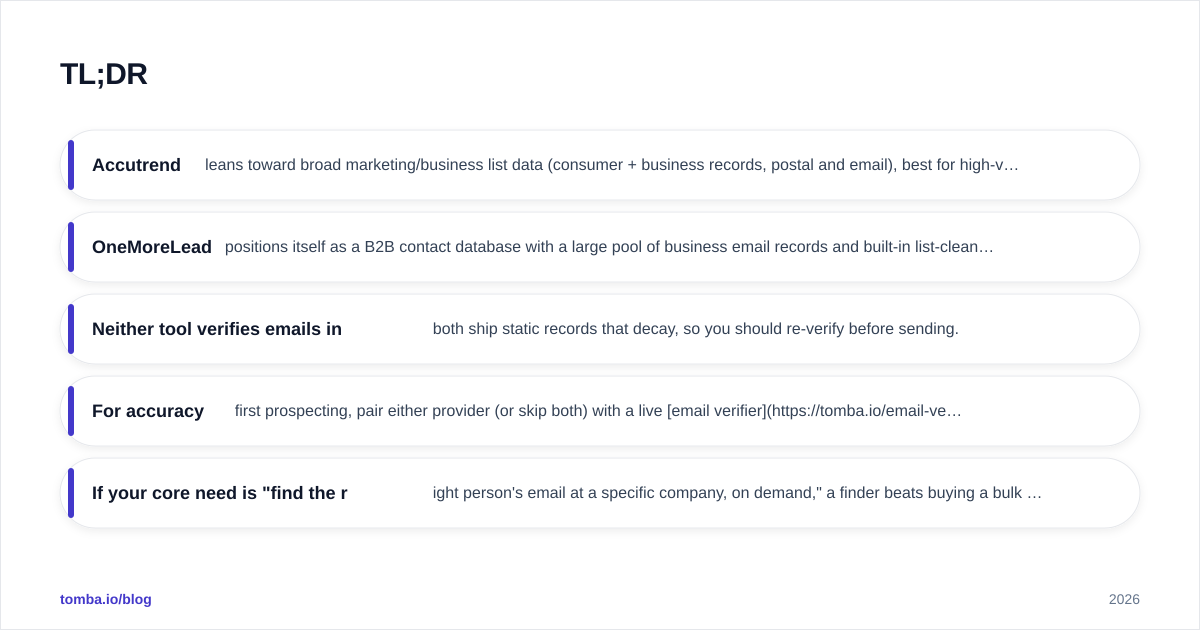
- Accutrend leans toward broad marketing/business list data (consumer + business records, postal and email), best for high-volume, multi-channel campaigns where coverage matters more than per-record freshness.
- OneMoreLead positions itself as a B2B contact database with a large pool of business email records and built-in list-cleaning, aimed at outbound sales teams who want filtered lists fast.
- Neither tool verifies emails in real time the way a dedicated finder does — both ship static records that decay, so you should re-verify before sending.
- For accuracy-first prospecting, pair either provider (or skip both) with a live email verifier and a real-time email finder.
- If your core need is "find the right person's email at a specific company, on demand," a finder beats buying a bulk list outright.
What are Accutrend and OneMoreLead?#
Accutrend Data is a marketing-data company that sells business and consumer lists across channels — email, direct mail, and phone. Its center of gravity is volume and segmentation: you describe an audience (industry, geography, title, household attributes for consumer data) and buy records that match. That model suits agencies and marketers running multi-channel or direct-mail campaigns, not just cold email.
OneMoreLead is built more narrowly for B2B outbound. It markets a large database of business contacts with email addresses, plus filtering by role, industry, and company size, and an emphasis on "clean" lists you can push into a sequencer. The pitch is speed: define a segment, export verified-at-export-time contacts, and start emailing.
The honest framing: both are list providers, not live lookup engines. You're buying a snapshot of a database. That distinction drives everything below, so keep it in mind before you compare line items.

How do Accutrend and OneMoreLead compare head-to-head?#
Pricing and packaging for both companies are quote-driven and change often, so treat the figures below as directional and confirm current terms directly. The structural differences, though, are stable.
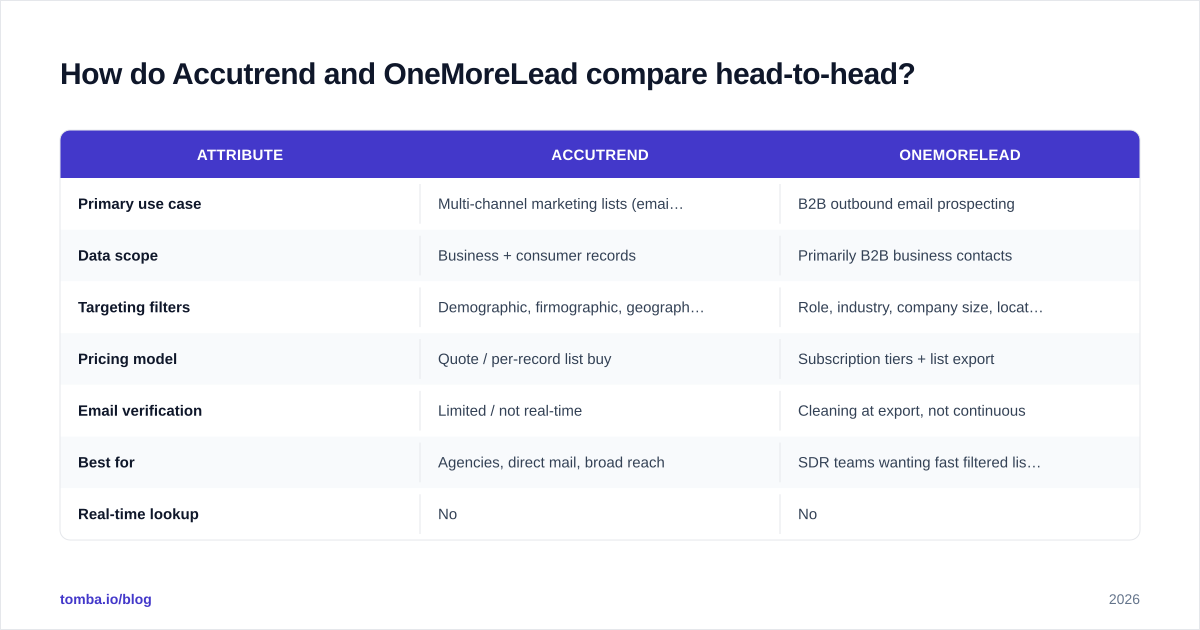
| Attribute | Accutrend | OneMoreLead |
|---|---|---|
| Primary use case | Multi-channel marketing lists (email + postal + phone) | B2B outbound email prospecting |
| Data scope | Business + consumer records | Primarily B2B business contacts |
| Targeting filters | Demographic, firmographic, geographic | Role, industry, company size, location |
| Pricing model | Quote / per-record list buy | Subscription tiers + list export |
| Email verification | Limited / not real-time | Cleaning at export, not continuous |
| Best for | Agencies, direct mail, broad reach | SDR teams wanting fast filtered lists |
| Real-time lookup | No | No |
| Re-verification needed | Yes | Yes |
A few takeaways from the table:
- Accutrend is wider, OneMoreLead is more B2B-focused. If you need consumer or postal data, Accutrend is the only one of the two that plays there. If you're a pure outbound SaaS team, OneMoreLead's filtering is more aligned to your motion.
- Both ship static data. "Cleaned at export" is not the same as "valid when you hit send three weeks later." B2B contact data decays roughly 22–30% per year as people change jobs, so a list bought in Q1 is materially worse by Q3.
- Pricing isn't apples-to-apples. A per-record list buy (Accutrend) versus a subscription with export caps (OneMoreLead) means the cheaper option depends entirely on your volume and cadence.
For an independent read on either vendor, check verified reviews on G2 and Capterra rather than relying on the vendors' own case studies.
Is Accutrend or OneMoreLead more accurate?#
Accuracy is the question that actually matters, and it's also where both list-buying models are structurally weak.
The core issue: a bulk list is a photograph of a database taken at the moment of export. Even a provider with excellent sourcing can't keep your downloaded CSV current. Once it's in your hands, every job change, every disconnected mailbox, and every spun-up catch-all domain degrades it silently.
OneMoreLead's "verified list" framing means records pass a check at export time, which is better than nothing. Accutrend's strength is breadth and segmentation rather than per-record email validation, so for email specifically you should assume a meaningful invalid rate. In both cases the safe assumption is the same: re-verify before you send.
A practical accuracy workflow regardless of provider:
- Export the segment.
- Run the full list through a dedicated email verification pass to drop hard bounces and flag risky addresses.
- Use a catch-all verifier to separately handle catch-all domains, which most list tools mark as "valid" when they're actually unknown.
- Only then load the survivors into your sequencer.
This step routinely removes 15–40% of a purchased list. That sounds painful, but sending to those addresses is what tanks your domain reputation — protecting email deliverability is worth more than the raw contact count.
When should you buy a list instead of finding emails?#
List buying makes sense in a narrow set of cases:
- You need volume fast for a broad awareness or direct-mail campaign and per-record precision is secondary.
- You're targeting a well-defined firmographic segment (e.g., "US manufacturing companies, 50–200 employees") and don't have specific named accounts yet.
- You're doing multi-channel outreach (postal + phone + email), where Accutrend's broader data shines.
List buying is the wrong call when:
- You have a named-account list and need the right contact at each one.
- You care about per-contact freshness and reply rates over raw volume.
- Your domain reputation can't absorb the bounce risk of unverified bulk data.
In that second world, a real-time finder is the better primitive. Instead of buying 50,000 records and hoping, you look up exactly the people you want, when you want them, against live sources. That's the difference between data enrichment on your existing target list and renting someone else's database wholesale.
How do Accutrend and OneMoreLead fit into a modern outbound stack?#
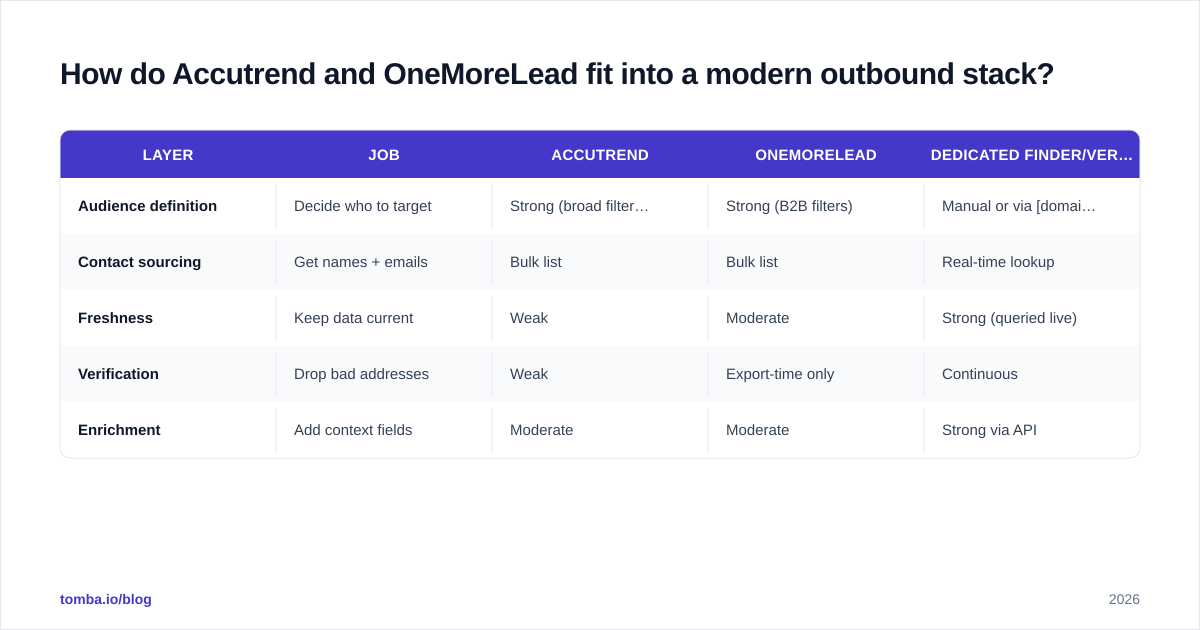
Think in layers, not single tools. A durable 2026 outbound stack usually looks like this:
| Layer | Job | Accutrend | OneMoreLead | Dedicated finder/verifier |
|---|---|---|---|---|
| Audience definition | Decide who to target | Strong (broad filters) | Strong (B2B filters) | Manual or via domain search |
| Contact sourcing | Get names + emails | Bulk list | Bulk list | Real-time lookup |
| Freshness | Keep data current | Weak | Moderate | Strong (queried live) |
| Verification | Drop bad addresses | Weak | Export-time only | Continuous |
| Enrichment | Add context fields | Moderate | Moderate | Strong via API |
The pattern most teams converge on: use a list provider (if you use one at all) for the first two layers, then bolt on dedicated verification and enrichment for the rest. Many teams skip the bulk list entirely and run a finder-plus-verifier loop, because it produces fewer, fresher, more accurate contacts — which sequencers and inboxes reward.
If you operate at scale, a bulk email finder lets you upload a list of companies or names and resolve current emails in one pass, then push them straight into your CRM via native integrations. That's a cleaner architecture than maintaining a decaying purchased database and patching it with manual verification.
What about coverage and compliance?#
Two things buyers under-weight:
Coverage gaps. Big databases look impressive in aggregate, but the question is coverage for your specific segment. Accutrend's broad consumer/business mix may be thin in a niche B2B vertical; OneMoreLead's B2B focus may be deeper there but thinner on SMB or international records. Always test a sample export against accounts you already know before committing budget.
Compliance. Buying lists carries GDPR/CAN-SPAM exposure that finding a publicly available business email on demand handles more cleanly. List provenance matters: ask any vendor where the data comes from and how consent is handled. For context on how a transparent sourcing model reads, see how Tomba documents its data sources. If a vendor can't explain provenance, that's a signal.
For broader vendor due diligence, analyst-style overviews from sites like Gartner's peer reviews can help you sanity-check claims that aren't on the vendor's own site.
Accutrend vs OneMoreLead: which should you pick?#
Conclusion first: pick based on channel, not brand.
- Choose Accutrend if you run multi-channel or direct-mail campaigns, need consumer data, and value breadth and segmentation over per-record email freshness.
- Choose OneMoreLead if you're a B2B SDR/founder doing email-first outbound, want fast filtered lists, and will add your own verification step.
- Choose neither, and use a finder if your motion is named-account, accuracy-sensitive, or reputation-constrained — which describes most modern outbound teams.
There's no universally "better" tool here. There's a better fit for your channel mix and your tolerance for data decay. What's non-negotiable in every scenario is the verification layer: whatever list you start from, treat it as raw material, not a finished product.
How to validate any provider before you commit#
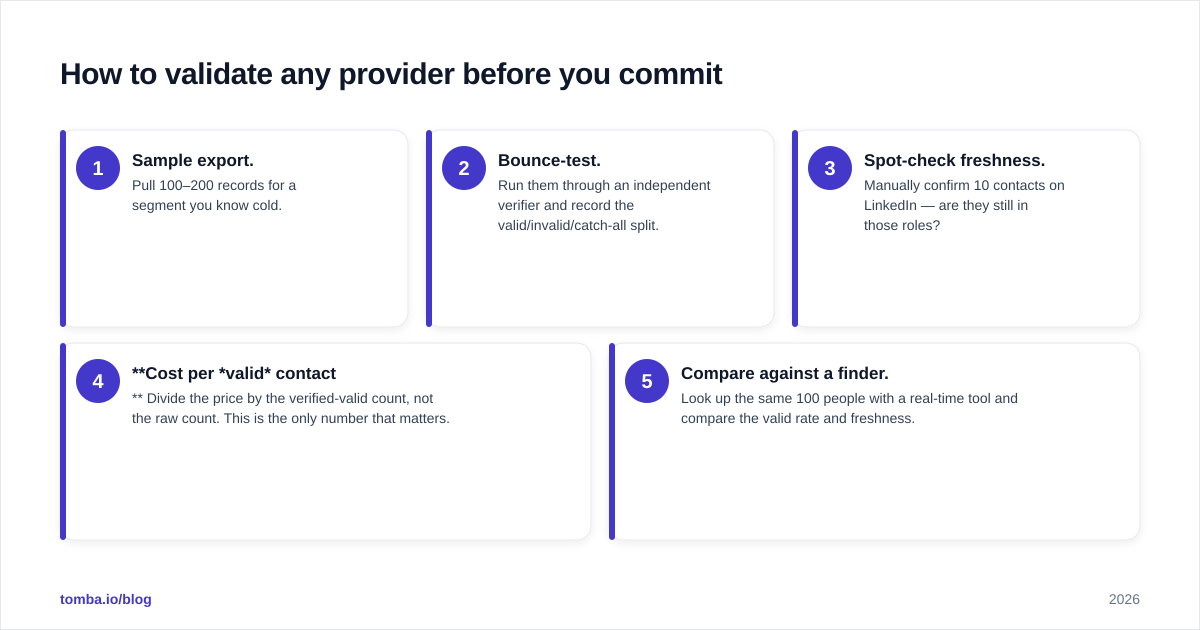
Run this quick test on Accutrend, OneMoreLead, or any finder before signing:
- Sample export. Pull 100–200 records for a segment you know cold.
- Bounce-test. Run them through an independent verifier and record the valid/invalid/catch-all split.
- Spot-check freshness. Manually confirm 10 contacts on LinkedIn — are they still in those roles?
- Cost per valid contact. Divide the price by the verified-valid count, not the raw count. This is the only number that matters.
- Compare against a finder. Look up the same 100 people with a real-time tool and compare the valid rate and freshness.
That last step is usually the eye-opener — live lookups tend to win on freshness because they aren't selling you a months-old snapshot.
The bottom line#
Accutrend and OneMoreLead are both legitimate ways to acquire B2B contacts, and the right one depends on whether you're running broad multi-channel campaigns (Accutrend) or focused B2B email outbound (OneMoreLead). But both share the same structural ceiling: static lists decay, and they put your deliverability at risk if you send without re-verifying.
If accuracy and freshness are what you're really buying, start at the source instead. Tomba's Email Finder resolves current, verified business emails on demand — by name, company, or domain — so you skip the decaying-list problem entirely and build prospect lists that don't bounce. It's free to start (25 searches/month), with paid plans from $49/mo; full details are on the Tomba pricing page. Find the people you actually want, verify them in the same workflow, and let your inbox reputation thank you.
// get started
Find, verify and enrich your first contacts today
Start on the free plan with 25 searches a month, then scale when your team is ready.
Free plan · No credit card required · GDPR & CCPA
// about the author