Acquisition Email Guide: Win New B2B Customers in 2026
An acquisition email only works when the right message hits a verified inbox. Here's the 2026 playbook for targeting, copy, timing, and the data layer that makes it convert.
TL;DR
- An acquisition email is a cold outreach message built to turn a stranger into a customer — not a newsletter, not a nurture drip.
- The reply rate is decided before you write a word: bad targeting and unverified addresses cap your ceiling no matter how good the copy is.
- Use a four-part structure — relevance hook, proof, single ask, easy exit — and keep it under 120 words.
- Verify every address and warm your domain first; deliverability problems kill more acquisition campaigns than weak writing.
- Tools like Tomba Email Finder plus a verifier give you the clean, targeted list the whole system depends on.
What is an acquisition email?#
An acquisition email is a cold message sent to a prospect you have no prior relationship with, designed to start a conversation that ends in a sale. Think of it like knocking on a stranger's door versus chatting with a neighbor you already know — the newsletter goes to neighbors, the acquisition email knocks on new doors.
That distinction matters because it changes every decision downstream. A retention or nurture email can lean on shared history and brand familiarity. An acquisition email has none of that. It has to earn attention in the first line, prove relevance in the second, and make the next step frictionless — all before the reader's thumb reaches the archive button.
Three things separate acquisition email from the rest of your sending:
- No prior consent or relationship. You found this person; they didn't ask to hear from you. That raises the bar for relevance and compliance.
- One clear conversion goal. A reply, a booked call, a free-trial signup — not "engagement."
- Cold-start deliverability risk. New conversations to unknown inboxes are exactly what spam filters scrutinize hardest.
Why do most acquisition emails fail before they're written?#
Most acquisition emails fail at the list, not the copy. You can A/B test subject lines forever, but if 30% of your addresses bounce and half the rest are the wrong persona, you're optimizing the paint job on a car with no engine.
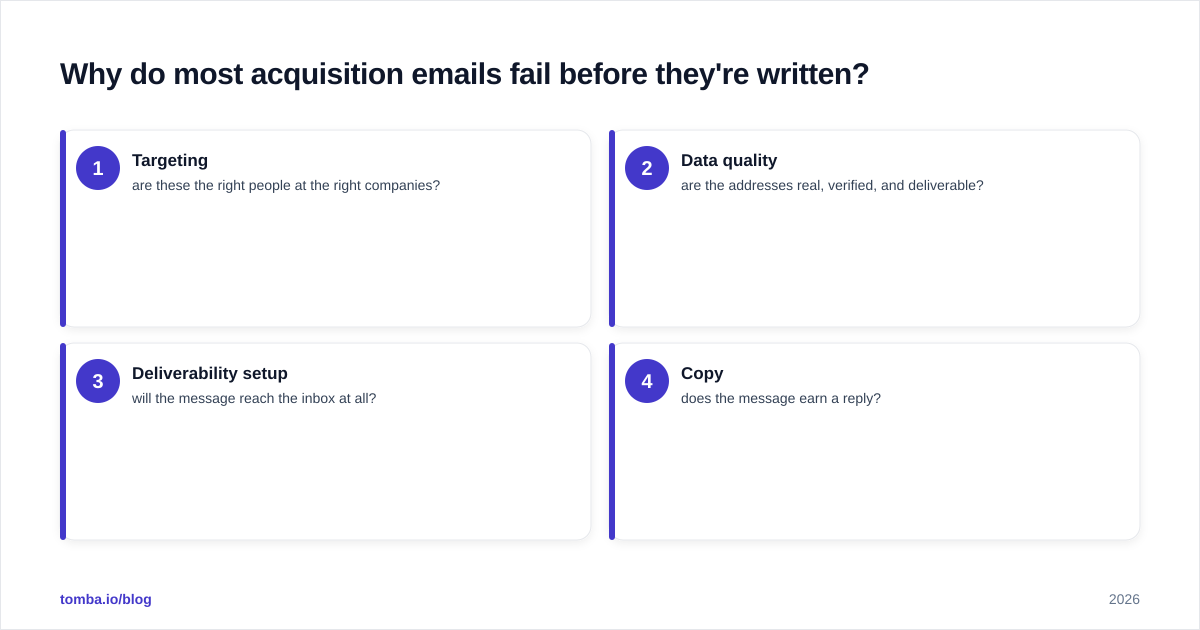
Here's the order of impact, from biggest lever to smallest:
- Targeting — are these the right people at the right companies?
- Data quality — are the addresses real, verified, and deliverable?
- Deliverability setup — will the message reach the inbox at all?
- Copy — does the message earn a reply?
Notice copy is last. That's not because writing doesn't matter — it's because the first three set the ceiling on what writing can achieve. A brilliant email to a bad list still loses.
)
This is also where sender reputation enters the picture. Every hard bounce and spam complaint chips away at your domain's standing with mailbox providers. Clean data protects sender reputation, and reputation is what gets your next campaign delivered. Treat your list as an asset you're protecting, not a resource you're burning.
How do you build a targeted acquisition list?#
Start from your Ideal Customer Profile and work backward to individual contacts. The goal is a tight list of people who match a specific, demonstrable need — not the biggest list you can scrape.
A practical workflow:
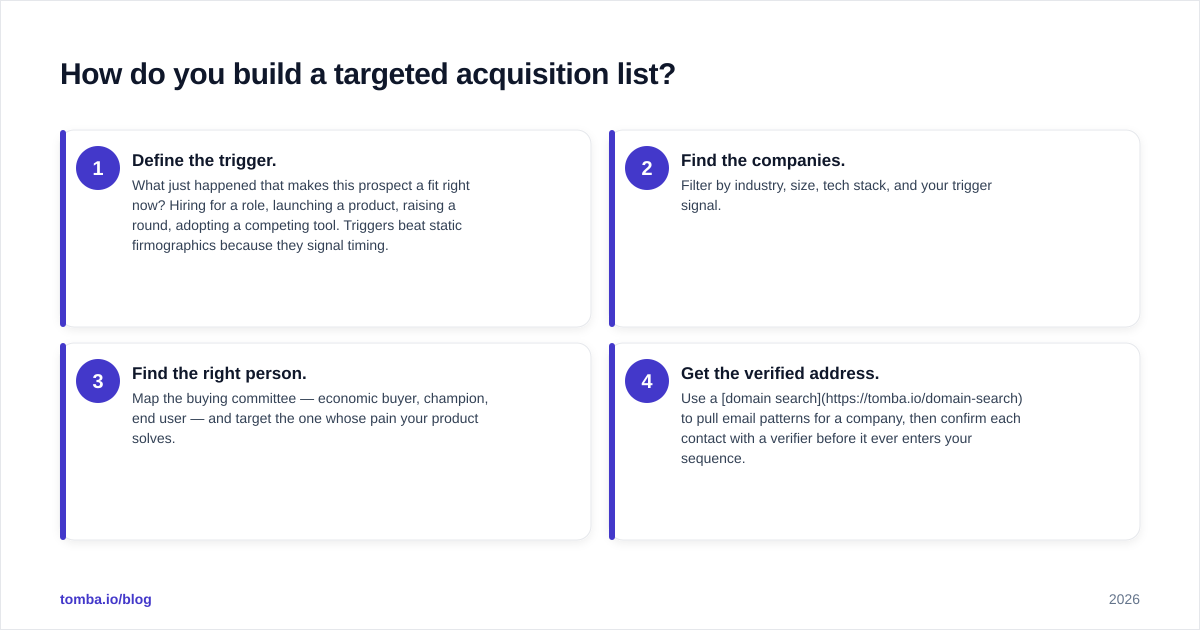
- Define the trigger. What just happened that makes this prospect a fit right now? Hiring for a role, launching a product, raising a round, adopting a competing tool. Triggers beat static firmographics because they signal timing.
- Find the companies. Filter by industry, size, tech stack, and your trigger signal.
- Find the right person. Map the buying committee — economic buyer, champion, end user — and target the one whose pain your product solves.
- Get the verified address. Use a domain search to pull email patterns for a company, then confirm each contact with a verifier before it ever enters your sequence.
For the last step, an email finder resolves a name and company into a professional address, and an email verifier confirms it's live before you send. Catch-all domains — where the server accepts everything and verifies nothing — deserve special handling with a dedicated catch-all verifier so you don't treat a guess as a confirmed hit.
What does a high-converting acquisition email look like?#
A high-converting acquisition email is short, specific, and asks for one easy thing. The structure that consistently outperforms has four parts:
1. Relevance hook (1 sentence). Open with them, not you. Reference the trigger you identified — their new VP of Sales, their recent funding, the role they're hiring for. This proves the email isn't a blast.
2. Proof or insight (1–2 sentences). Give a reason to keep reading: a relevant result, a specific observation about their situation, or a number that matters to their role. Avoid adjectives; use evidence.
3. Single ask (1 sentence). One call to action. "Open to a 15-minute call Thursday?" converts better than "Let me know if you'd like to learn more about our platform and explore synergies."
4. Easy exit. A soft P.S. or one-line opt-out lowers resistance and protects your response rate by filtering out non-fits cleanly.
Keep the whole thing under 120 words. Mobile is where most B2B email gets read first, and a wall of text on a phone screen gets archived. If you want a fast first draft, a tool like cold email AI can scaffold the structure, but always rewrite for the specific trigger — generic AND generated reads as exactly that.
A quick before/after on the ask:
Weak: "I'd love to hop on a quick call to discuss how our solution can help your team achieve its goals."
Strong: "Worth a 15-minute call next Tuesday to see if we can cut your onboarding time the way we did for [similar company]?"
The strong version names the outcome, names a time, and references proof. It's a question a busy person can answer in five seconds.
Acquisition email vs. other email types: how do they compare?#
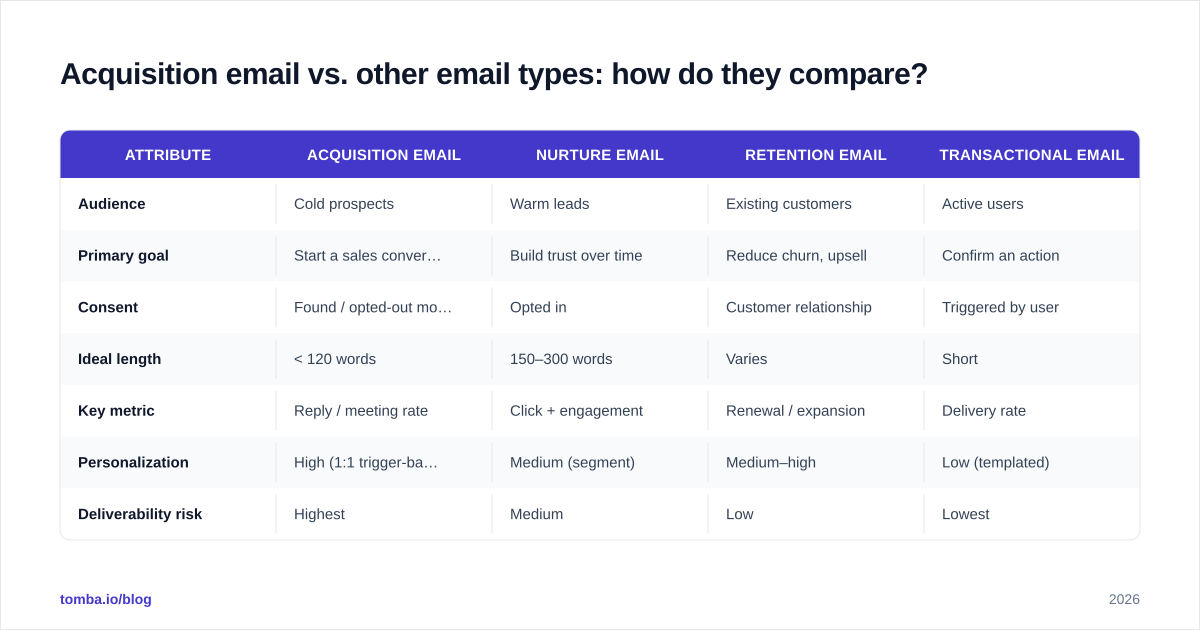
It helps to see where acquisition email sits relative to the other messages you send. Each has a different goal, audience temperature, and success metric — and confusing them is how teams end up sending nurture-style fluff to cold prospects.
| Attribute | Acquisition email | Nurture email | Retention email | Transactional email |
|---|---|---|---|---|
| Audience | Cold prospects | Warm leads | Existing customers | Active users |
| Primary goal | Start a sales conversation | Build trust over time | Reduce churn, upsell | Confirm an action |
| Consent | Found / opted-out model | Opted in | Customer relationship | Triggered by user |
| Ideal length | < 120 words | 150–300 words | Varies | Short |
| Key metric | Reply / meeting rate | Click + engagement | Renewal / expansion | Delivery rate |
| Personalization | High (1:1 trigger-based) | Medium (segment) | Medium–high | Low (templated) |
| Deliverability risk | Highest | Medium | Low | Lowest |
The takeaway: acquisition email carries the most deliverability risk and demands the most personalization, yet it's where teams most often reach for batch-and-blast tactics. That mismatch is the opportunity. Do the unglamorous targeting and verification work and you'll outperform competitors who only polish their subject lines.
How do you make sure acquisition emails actually land in the inbox?#
Deliverability is won in setup, not in the send. Before you run a single campaign, get the infrastructure right — otherwise your perfectly targeted emails route straight to spam.
The non-negotiable checklist:
- Authenticate your domain. Publish a valid SPF record, DKIM, and DMARC. Mailbox providers treat unauthenticated cold mail as guilty until proven innocent. Google and Yahoo's bulk sender requirements make this mandatory, not optional.
- Warm the sending domain. Ramp volume gradually over 2–4 weeks so providers learn your domain sends wanted mail.
- Use a separate domain for cold sending. Protect your primary domain's reputation by sending acquisition campaigns from a dedicated alternative.
- Verify before every send. Bounces above ~2–3% signal abuse to filters. A pre-send verification pass keeps you well under that line.
- Cap daily volume per inbox. Spread sends across mailboxes and keep per-inbox volume conservative.
If you want the full mechanics, our breakdown of email deliverability covers authentication and reputation in depth. The short version: deliverability is a prerequisite, not a tactic. No copy survives the spam folder.
)
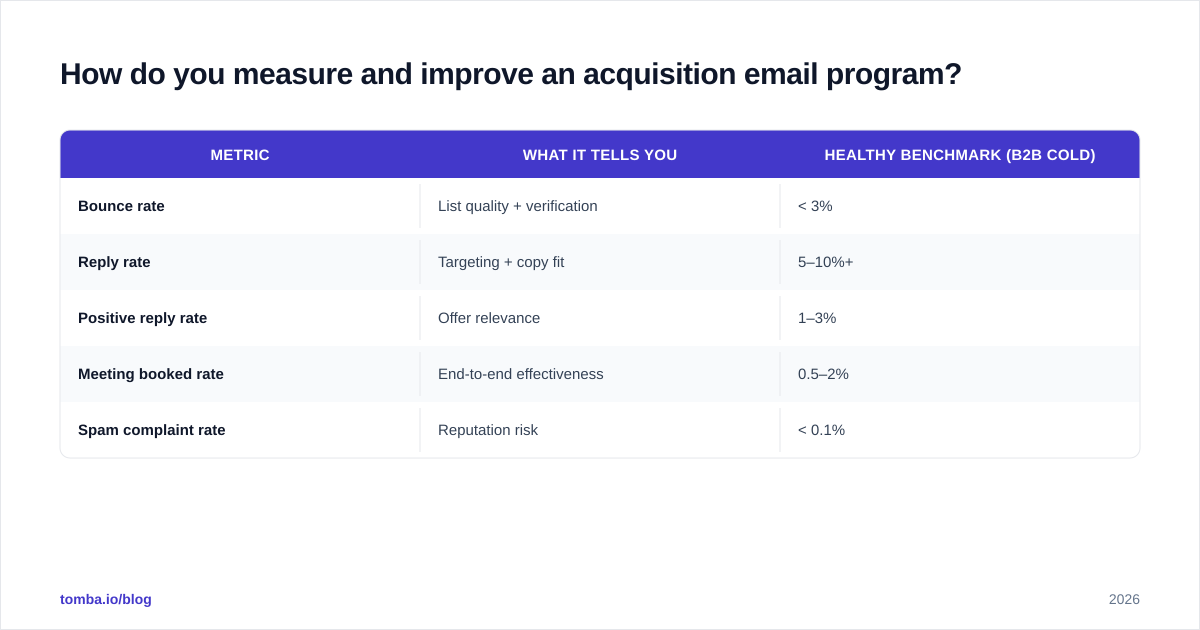
How do you measure and improve an acquisition email program?#
Measure replies and meetings, not opens. Open tracking has become unreliable since Apple Mail Privacy Protection inflates open rates with bot prefetches, and a high open rate with zero replies tells you nothing actionable.
The metrics that actually drive decisions:
| Metric | What it tells you | Healthy benchmark (B2B cold) |
|---|---|---|
| Bounce rate | List quality + verification | < 3% |
| Reply rate | Targeting + copy fit | 5–10%+ |
| Positive reply rate | Offer relevance | 1–3% |
| Meeting booked rate | End-to-end effectiveness | 0.5–2% |
| Spam complaint rate | Reputation risk | < 0.1% |
Improve in this order, one variable at a time:
- If bounces are high → fix the data. Re-verify and tighten sourcing. This is almost always a data enrichment and verification problem, not a copy problem.
- If replies are low but bounces are fine → fix targeting first, then the relevance hook.
- If positive replies are low → your offer or persona is off. Revisit the ICP.
- If complaints climb → pull back volume, tighten relevance, and check your opt-out is working.
Test one element per cycle and give each test enough volume to be meaningful. Changing subject line, opener, and CTA simultaneously tells you nothing about which lever moved the result.
What tools do you actually need to run acquisition email at scale?#
You need three layers: a data layer, a sending layer, and a verification layer that sits between them. Many teams over-invest in the sending platform and under-invest in data — which is backward, since data quality sets the ceiling.
- Data layer — find and enrich contacts. Tomba's email finder, domain search, and bulk email finder build the targeted list. If you work in spreadsheets, the Google Sheets add-on and Tomba API push verified contacts straight into your workflow.
- Verification layer — confirm deliverability before sending with the email verifier and handle ambiguous domains with the catch-all verifier.
- Sending layer — your sequencer or CRM. Tomba's HubSpot integration and other integrations connect enriched data to wherever you send.
You can compare data-provider options on independent marketplaces like G2 before committing, and standard cold-outreach norms are well documented across vendors such as HubSpot. The point isn't to buy the most tools — it's to make sure the data feeding your sends is verified, because every other investment compounds on top of it. Check Tomba pricing to see where the data layer fits your volume.
Frequently asked questions#
How many acquisition emails should be in a sequence? Three to five touches over two to three weeks is the common range. Each follow-up should add a new angle or proof point — never just "bumping this to the top of your inbox."
Is cold acquisition email legal? B2B cold email is permitted in most jurisdictions when you honor opt-outs, identify yourself, and follow local rules (CAN-SPAM in the US, GDPR's legitimate-interest basis in the EU). Always include a clear way to unsubscribe and respect it immediately.
How long should an acquisition email be? Under 120 words for the first touch. You're earning a reply, not closing the deal in one message.
Start with the list, not the send#
The fastest way to improve acquisition email results isn't a clever subject line — it's a verified, tightly targeted list. Get the right person, confirm the address is real, warm your domain, then send a short message built around a specific trigger.
That data foundation is exactly what Tomba Email Finder is built for: turn a name and company into a verified, deliverable address, enrich it with the context your copy needs, and feed it straight into your sequencer. Start free with 25 searches a month and scale up as your pipeline grows — because the best acquisition email in the world still needs to reach a real inbox.
// get started
Find, verify and enrich your first contacts today
Start on the free plan with 25 searches a month, then scale when your team is ready.
Free plan · No credit card required · GDPR & CCPA
// about the author