Active Listening Sales: The 2026 Guide to Closing More Deals
Reps who listen close more than reps who pitch. Here's the 2026 active listening sales framework, scripts, and metrics that turn discovery calls into signed deals.
TL;DR
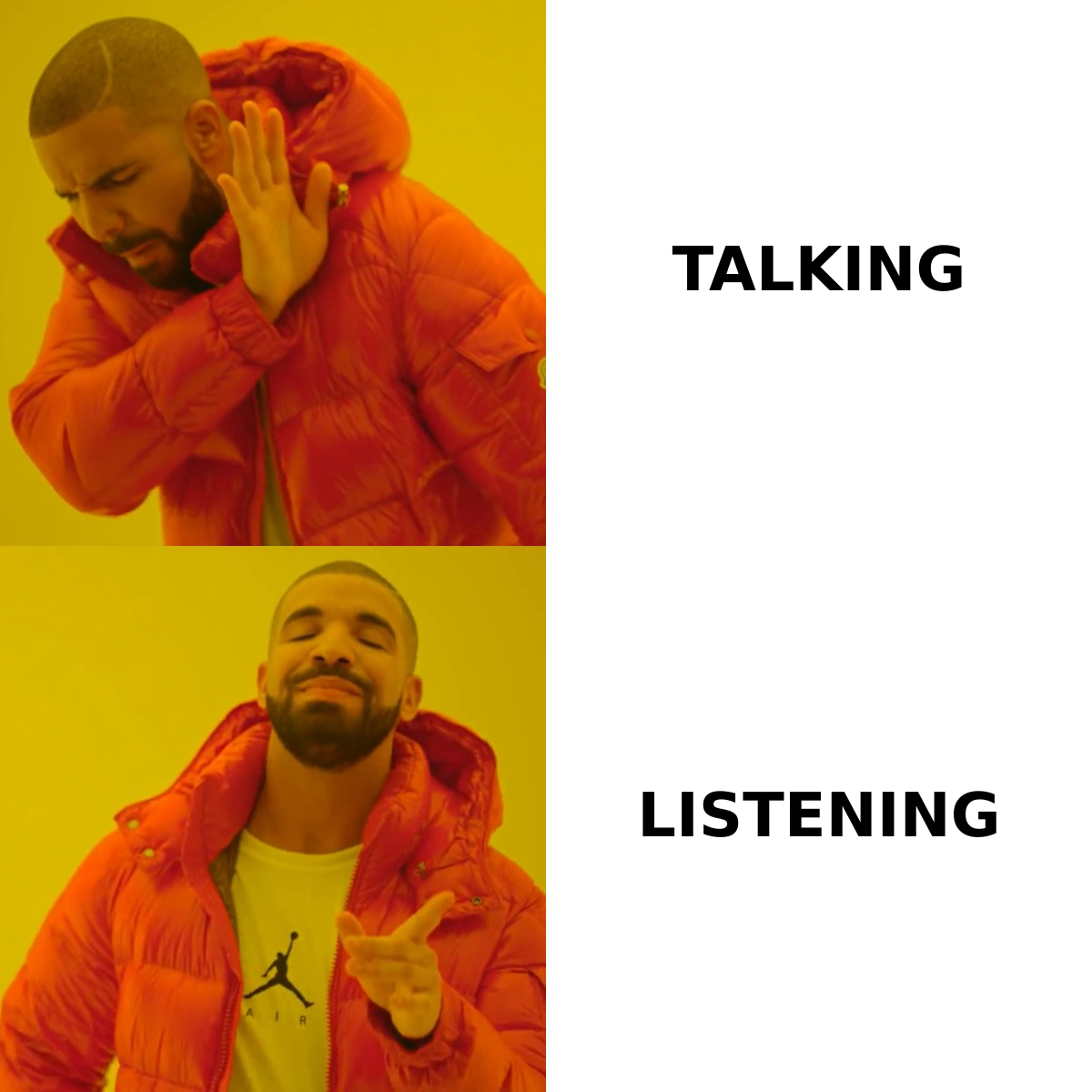
- Active listening sales is the discipline of fully concentrating on, understanding, and responding to a prospect — instead of waiting for your turn to pitch. It's the single highest-leverage soft skill in modern selling.
- Top reps talk roughly 43% of a discovery call and listen 57%; losing reps flip that ratio. The talk-to-listen ratio is the most measurable predictor of win rate.
- A repeatable 5-step framework — Attend, Decode, Reflect, Clarify, Confirm — turns listening from a personality trait into a coachable process.
- Active listening directly raises response rates, shortens sales cycles, and surfaces the buying criteria that generic pitches miss.
- You still need clean contact data to get on the call in the first place — that's where tooling like a reliable email finder earns its keep before the conversation even starts.
What is active listening in sales?#
Active listening in sales is the practice of giving a prospect your complete attention, decoding both what they say and what they mean, and reflecting it back so they feel understood before you ever propose a solution.
Think of it like a doctor's appointment. A bad doctor hears "my back hurts" and immediately prescribes painkillers. A good doctor asks where, how long, what makes it worse, and what you've already tried — then diagnoses. Selling without active listening is prescribing painkillers. Selling with it is diagnosing the real problem so your solution actually fits.
Technically, active listening combines three behaviors: full attention (no multitasking, no rehearsing your rebuttal), reflective feedback (paraphrasing and labeling emotions), and clarifying inquiry (open questions that go a layer deeper). Passive listening is hearing. Active listening is processing and proving you processed it.
The payoff is concrete. When prospects feel heard, they disclose more — budget realities, competing priorities, the political landmines that kill deals in procurement. That disclosure is the raw material of every accurate forecast and every tailored proposal.
Why does active listening matter more in 2026?#
Buyers have changed. By 2026, the average B2B buyer completes the majority of their research before they ever speak to a rep, and they arrive on calls allergic to generic pitches they've already seen on your website. The information advantage reps once held is gone. What's left — the thing software can't replicate — is the ability to understand a specific human's specific situation in real time.
There's also an AI paradox at play. As more outreach gets automated and templated, the calls that convert are the ones that feel unmistakably human. Active listening is the clearest signal that a real person is paying attention to a real problem. It's a differentiator precisely because automation made everything else cheap.
Research from sales-intelligence vendors backs this up. Gong's analysis of millions of sales calls consistently shows that talk-to-listen ratio correlates with deal outcomes, and that asking the right follow-up questions at the right moment separates closers from order-takers. The behavior is learnable, measurable, and coachable — which is exactly why it belongs in your enablement program rather than your "soft skills nice-to-have" pile.
What is the active listening sales framework?#
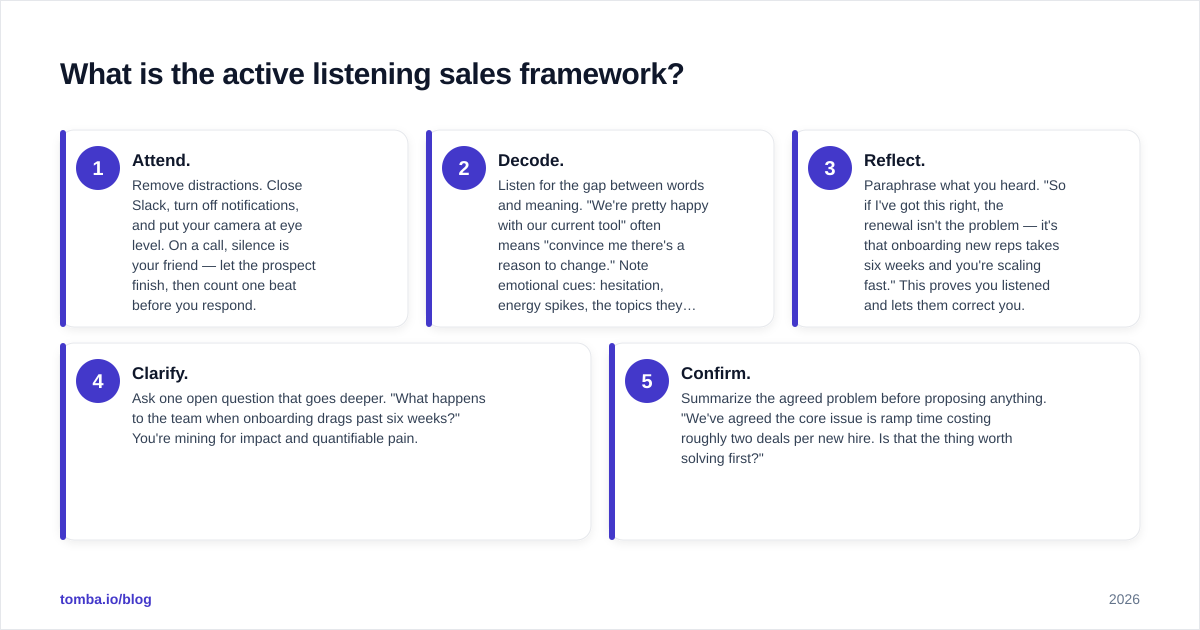
Use a five-step loop on every customer conversation: Attend, Decode, Reflect, Clarify, Confirm. Run it continuously, not once — each prospect answer feeds the next loop.
- Attend. Remove distractions. Close Slack, turn off notifications, and put your camera at eye level. On a call, silence is your friend — let the prospect finish, then count one beat before you respond.
- Decode. Listen for the gap between words and meaning. "We're pretty happy with our current tool" often means "convince me there's a reason to change." Note emotional cues: hesitation, energy spikes, the topics they return to.
- Reflect. Paraphrase what you heard. "So if I've got this right, the renewal isn't the problem — it's that onboarding new reps takes six weeks and you're scaling fast." This proves you listened and lets them correct you.
- Clarify. Ask one open question that goes deeper. "What happens to the team when onboarding drags past six weeks?" You're mining for impact and quantifiable pain.
- Confirm. Summarize the agreed problem before proposing anything. "We've agreed the core issue is ramp time costing roughly two deals per new hire. Is that the thing worth solving first?"
This loop is what separates a discovery call from an interrogation. Interrogations extract information. The loop builds a shared diagnosis the buyer co-authored — and people don't argue with conclusions they helped write.
How do you measure active listening on sales calls?#
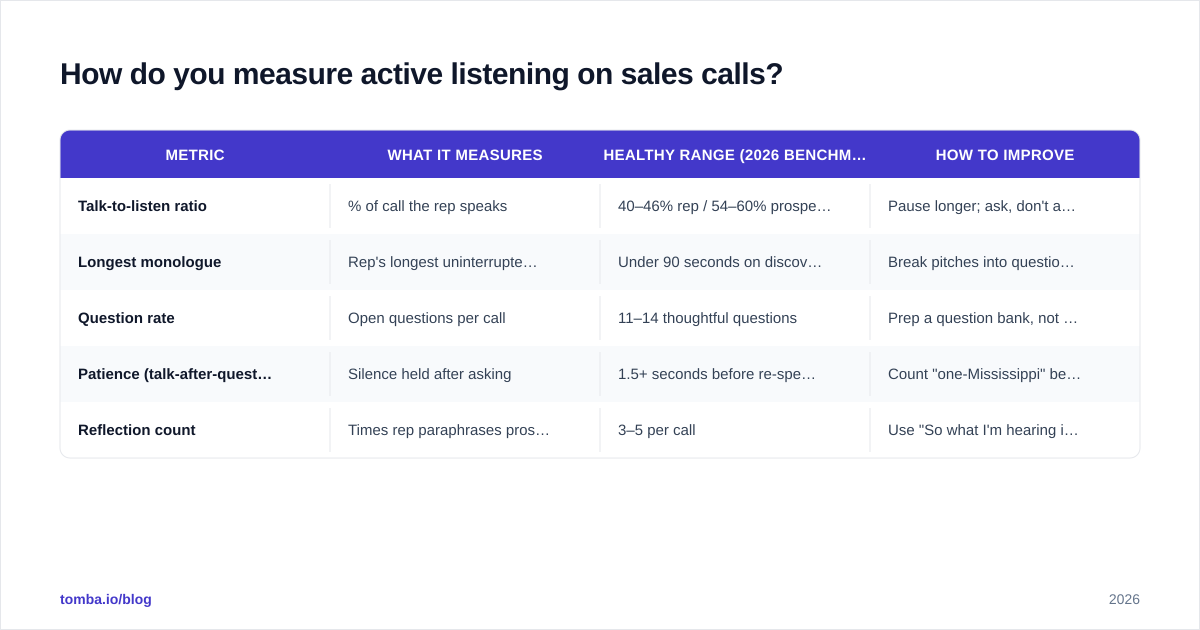
You measure it with conversation analytics, not vibes. The metrics below turn an abstract skill into numbers you can coach against.
| Metric | What it measures | Healthy range (2026 benchmarks) | How to improve |
|---|---|---|---|
| Talk-to-listen ratio | % of call the rep speaks | 40–46% rep / 54–60% prospect | Pause longer; ask, don't assert |
| Longest monologue | Rep's longest uninterrupted stretch | Under 90 seconds on discovery | Break pitches into question-gated chunks |
| Question rate | Open questions per call | 11–14 thoughtful questions | Prep a question bank, not a script |
| Patience (talk-after-question) | Silence held after asking | 1.5+ seconds before re-speaking | Count "one-Mississippi" before filling air |
| Reflection count | Times rep paraphrases prospect | 3–5 per call | Use "So what I'm hearing is…" |
Most modern call-recording platforms (Gong, Chorus, and similar) compute talk ratio and monologue length automatically. If you don't have one yet, a manual tally on five recorded calls per rep per month is enough to spot the pattern. Pair these with downstream outcomes — win rate and response rate — and you'll quickly see that the reps who listen are the reps who close.
A word of caution: ratios are a guardrail, not a goal. A rep can hit 55% listening by going silent and disengaged. The metrics flag a problem; the recordings diagnose it.
What questions trigger the best active listening moments?#
Great active listening starts with questions that can't be answered in one word. The goal is to open a door, then follow the prospect through it.
- Problem-expansion: "Walk me through what happens today when that breaks."
- Impact: "What does that cost you — in time, money, or headcount?"
- Priority: "Of everything on your plate this quarter, where does this rank?"
- Consequence: "What happens if you do nothing for another six months?"
- Decision: "Besides you, who needs to be comfortable with this before it moves forward?"
Notice none of these mention your product. The discipline is to resist the urge to solve. Each answer is a thread — pull it with a reflection and a clarifying follow-up before moving on. Reps who jump straight from "what's the problem" to "here's our feature" skip the part where the buyer convinces themselves.
A practical tip: store your best-performing questions in your CRM call template so they're visible during the conversation, not buried in a doc you forgot to open. Make listening the path of least resistance.
How is active listening different from just being quiet?#
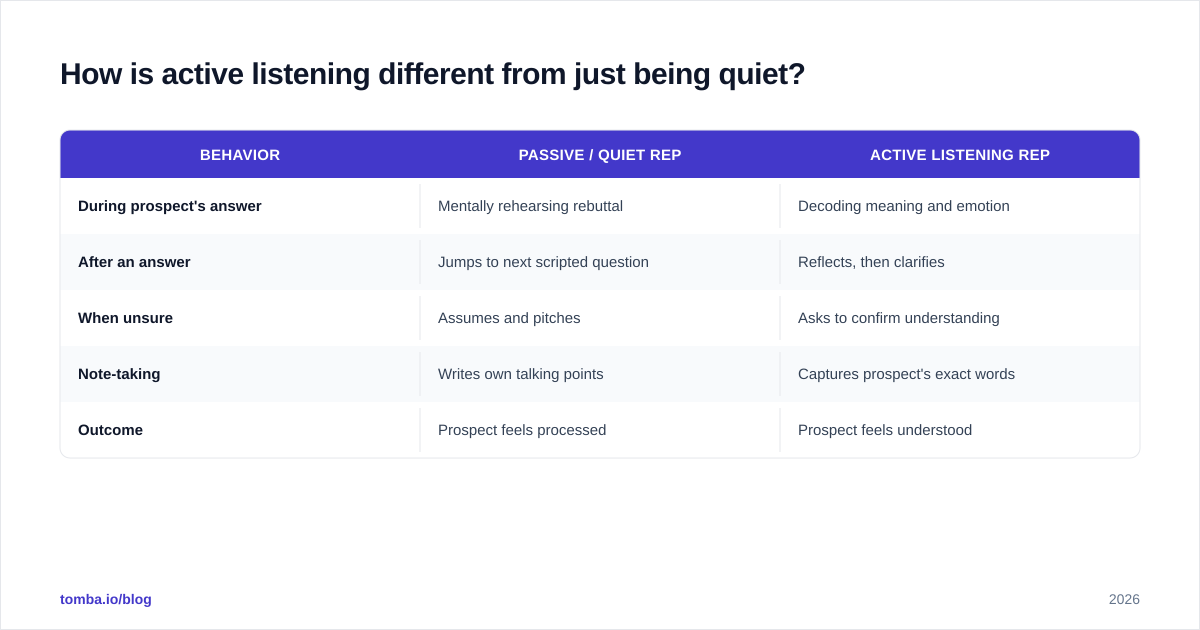
Being quiet is the absence of talking. Active listening is the presence of understanding. The difference shows up in what you do with the silence.
| Behavior | Passive / quiet rep | Active listening rep |
|---|---|---|
| During prospect's answer | Mentally rehearsing rebuttal | Decoding meaning and emotion |
| After an answer | Jumps to next scripted question | Reflects, then clarifies |
| When unsure | Assumes and pitches | Asks to confirm understanding |
| Note-taking | Writes own talking points | Captures prospect's exact words |
| Outcome | Prospect feels processed | Prospect feels understood |
The exact-words detail matters more than it looks. When you mirror a prospect's own language — "ramp time," "renewal fatigue," "tool sprawl" — back to them in your proposal and follow-up email, you signal that the solution was built for them, not pulled from a template. That's why disciplined note-taking of the buyer's vocabulary is a quiet superpower in negotiation.
How do you build active listening into your sales process?#
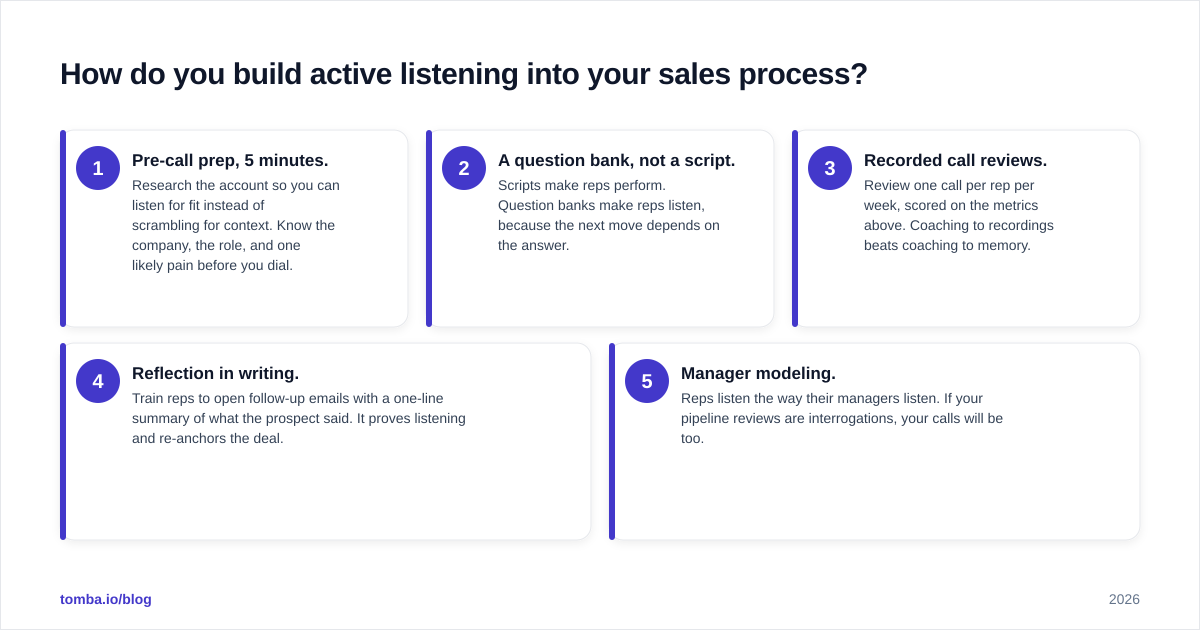
Make it a system, not a hope. Five moves embed listening into the sales pipeline so it survives a busy quarter.
- Pre-call prep, 5 minutes. Research the account so you can listen for fit instead of scrambling for context. Know the company, the role, and one likely pain before you dial.
- A question bank, not a script. Scripts make reps perform. Question banks make reps listen, because the next move depends on the answer.
- Recorded call reviews. Review one call per rep per week, scored on the metrics above. Coaching to recordings beats coaching to memory.
- Reflection in writing. Train reps to open follow-up emails with a one-line summary of what the prospect said. It proves listening and re-anchors the deal.
- Manager modeling. Reps listen the way their managers listen. If your pipeline reviews are interrogations, your calls will be too.
This is fundamentally a sales enablement problem: give reps the tooling, the question banks, and the feedback loop, and listening becomes the default rather than the exception. The companies that treat it as a trainable competency — with rubrics and reps practicing on recorded calls — see it compound across the whole team, not just their two naturals.
For a deeper foundation on running disciplined discovery, vendor playbooks like HubSpot's sales resources and the broader concept of active listening outside of sales are worth borrowing from — the core skill predates SaaS by decades.
What mistakes kill active listening on calls?#
Even well-intentioned reps sabotage their listening. Watch for these five.
- The rebuttal reflex. You hear an objection and immediately counter. Instead, reflect it first: "It sounds like budget timing is the real blocker — tell me more." The objection often softens once it's acknowledged.
- Feature-vomit on the first signal. A prospect mentions one pain and the rep launches a five-minute demo. Hold. Confirm scope before solving.
- Closed questions. "Does that make sense?" gets a yes and teaches you nothing. "How would that play out on your team?" opens a door.
- Filling silence. The two seconds after a question feel like an eternity to the rep and like thinking time to the prospect. Let them think.
- Listening to respond, not to understand. If you're composing your next line while they talk, you've stopped listening. The note-taking habit forces your attention back to them.
The common thread is impatience. Active listening sales is mostly the discipline of slowing down at the exact moments your instinct screams to speed up.
How does data quality support active listening?#
You can't actively listen to a conversation you never get. The best discovery skills in the world are wasted if your outreach bounces or never reaches a decision-maker. Clean, accurate contact data is the unglamorous prerequisite that gets you on the call where listening pays off.
That's the connection between the top and bottom of the funnel: accurate targeting earns the meeting, and active listening converts it. If half your outreach hits dead inboxes, your reps spend their energy chasing connects instead of perfecting conversations. Verified contacts mean more real conversations per hour — and more reps for your listening framework to compound across. Tools that combine an email verifier with finding contacts by company keep your pipeline full of reachable, relevant humans.
Conclusion: listen your way to a better close rate#
Active listening sales isn't a personality trait you're born with — it's a five-step loop you can run on every call, measure with conversation analytics, and coach to a rubric. Reps who talk less and understand more close more, full stop. Start by recording five calls, checking your talk-to-listen ratio, and adding three reflective summaries per conversation. The numbers move fast.
But great conversations start with reaching the right person. Before you can listen, you have to connect — and that means accurate, verified contact data at the top of your funnel. Tomba's Email Finder helps your team find and verify decision-maker emails by name, company, or domain, so your reps spend less time hunting contacts and more time on the calls where active listening turns prospects into customers. Check Tomba pricing — including a free tier with 25 searches a month — and put more real conversations on your calendar.
// get started
Find, verify and enrich your first contacts today
Start on the free plan with 25 searches a month, then scale when your team is ready.
Free plan · No credit card required · GDPR & CCPA
// about the author