ActiveCampaign vs RD Station 2026: Which CRM Wins?
ActiveCampaign vs RD Station, compared head-to-head on automation, pricing, CRM depth, and fit for global vs LATAM teams. See which platform earns your 2026 stack.
Choosing between ActiveCampaign and RD Station usually comes down to one question: do you need deep, flexible automation that scales globally, or an all-in-one platform tuned for Portuguese-speaking and Latin American funnels? Both are mature marketing automation platforms, but they were built for different buyers, and picking the wrong one means rebuilding your stack a year later.
This guide compares the two on pricing, automation depth, CRM, deliverability, integrations, and real-world fit, so you can decide before you sign an annual contract.
TL;DR — ActiveCampaign vs RD Station at a glance#
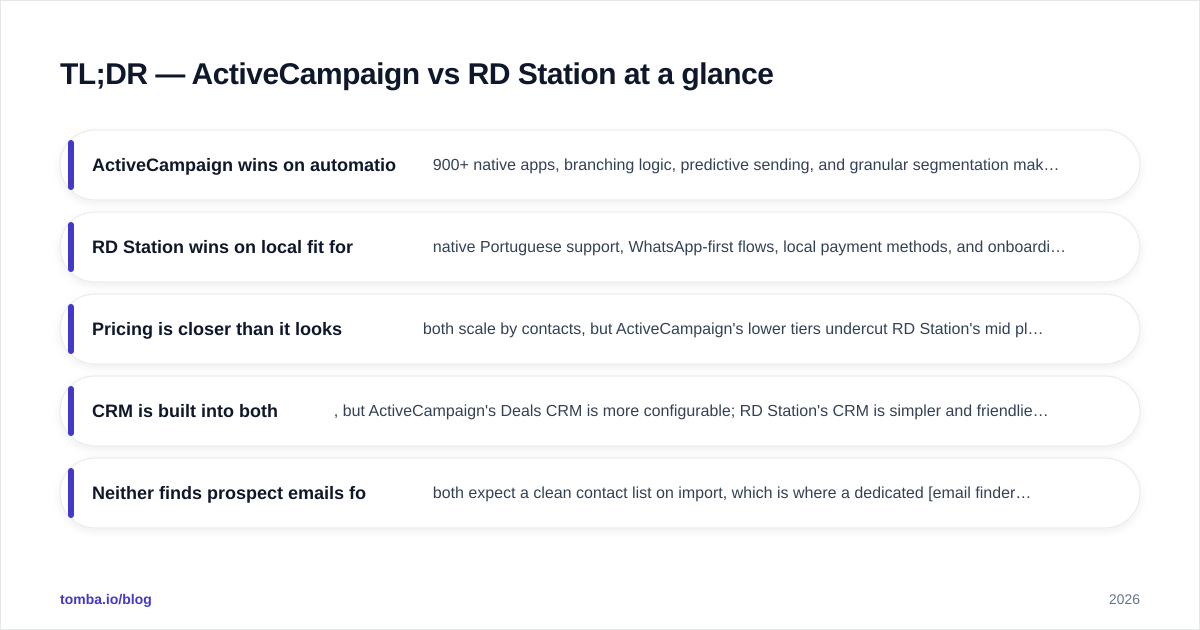
- ActiveCampaign wins on automation depth and integrations — 900+ native apps, branching logic, predictive sending, and granular segmentation make it the stronger engine for complex lifecycles.
- RD Station wins on local fit for Brazil and LATAM — native Portuguese support, WhatsApp-first flows, local payment methods, and onboarding tuned for the region.
- Pricing is closer than it looks — both scale by contacts, but ActiveCampaign's lower tiers undercut RD Station's mid plans while offering more automation per dollar.
- CRM is built into both, but ActiveCampaign's Deals CRM is more configurable; RD Station's CRM is simpler and friendlier for first-time sales teams.
- Neither finds prospect emails for you — both expect a clean contact list on import, which is where a dedicated email finder fills the gap.
What is ActiveCampaign?#
ActiveCampaign is a marketing automation and CRM platform built around what it calls "customer experience automation." Its core strength is the visual automation builder: you can chain triggers, conditions, wait steps, A/B splits, and goal tracking into flows that react to behavior across email, SMS, site tracking, and your CRM.
It serves a global audience, with the majority of its customer base in North America and Europe, and it leans technical — marketers who like building intricate logic get the most out of it. The platform pairs email marketing with a sales CRM, landing pages, forms, and predictive features like send-time optimization and win probability scoring.
If your growth motion depends on segmenting thousands of contacts by dozens of attributes and triggering different journeys for each, ActiveCampaign is purpose-built for that.
What is RD Station?#
RD Station (RD Station Marketing, plus the separate RD Station CRM) is the dominant marketing automation platform in Brazil and a strong player across Latin America. It was designed from the ground up for Portuguese- and Spanish-speaking markets, which shows in everything from its UI language to local payment support to WhatsApp being a first-class channel rather than an add-on.
The platform bundles email marketing, landing pages, lead scoring, social media management, and conversion tracking. Its automation builder is capable but deliberately simpler than ActiveCampaign's — the trade-off favors faster onboarding for teams that don't have a dedicated marketing-ops person.
For a Brazilian SMB running inbound campaigns, hosting events, and nurturing leads through WhatsApp and email, RD Station removes a lot of friction that a US-centric tool would introduce.
ActiveCampaign vs RD Station: side-by-side comparison#
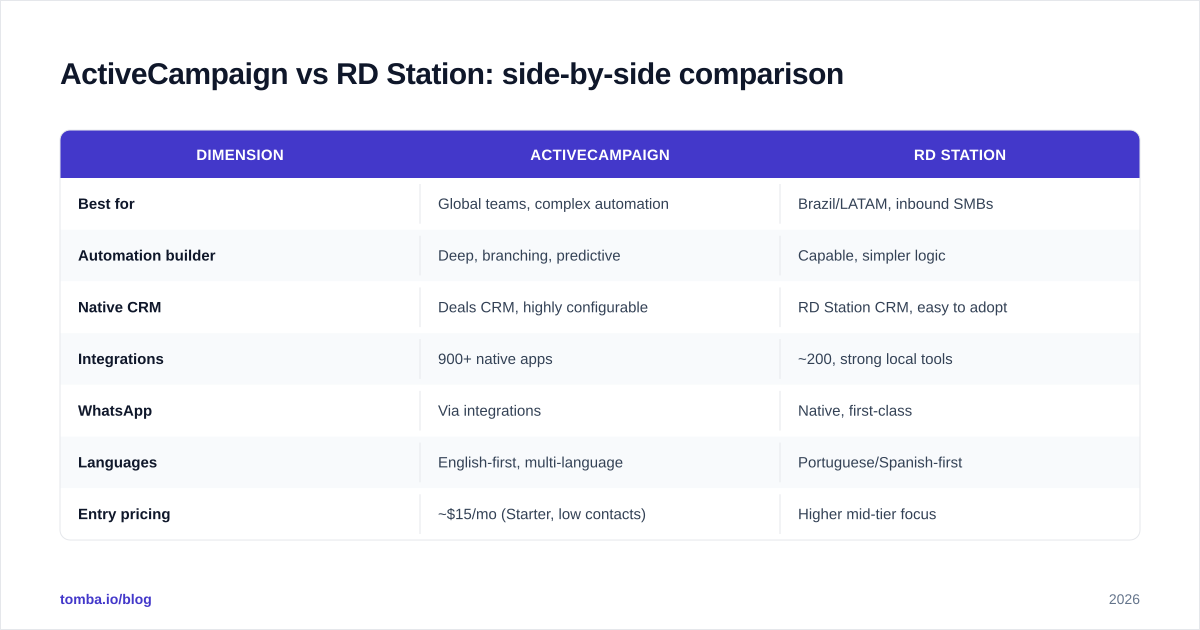
Here's how the two stack up on the dimensions that actually affect your daily work and your budget.
| Dimension | ActiveCampaign | RD Station |
|---|---|---|
| Best for | Global teams, complex automation | Brazil/LATAM, inbound SMBs |
| Automation builder | Deep, branching, predictive | Capable, simpler logic |
| Native CRM | Deals CRM, highly configurable | RD Station CRM, easy to adopt |
| Integrations | 900+ native apps | ~200, strong local tools |
| Via integrations | Native, first-class | |
| Languages | English-first, multi-language | Portuguese/Spanish-first |
| Entry pricing | ~$15/mo (Starter, low contacts) | Higher mid-tier focus |
| Deliverability tooling | Predictive sending, A/B | Standard sending, A/B |
| Free tier | 14-day trial | Free Light plan available |
The headline: ActiveCampaign gives you more automation horsepower and a far larger integration ecosystem, while RD Station gives you a smoother path if your market, language, and channels are regional.
Is ActiveCampaign better than RD Station for automation?#
Yes, if "better" means more powerful and flexible. ActiveCampaign's builder supports conditional branches, nested logic, math operations on custom fields, and goal-based path correction. You can build a flow that watches a contact's behavior across your site, scores it, waits for a trigger, then routes the deal to the right rep with a personalized SMS — all in one canvas.
RD Station's automation is closer to a clean if-this-then-that model. It covers the common cases — welcome series, lead nurturing, re-engagement, lead handoff to sales — without the steep learning curve. For many SMBs that's exactly right; complexity you never use is just risk and overhead.
Think of it like transmissions: ActiveCampaign is a manual gearbox that rewards a skilled driver with precise control, while RD Station is a smooth automatic that gets most teams where they're going with less effort. Neither is wrong. The question is who's driving.
A practical tell: if your team includes someone who enjoys mapping customer journeys and debugging logic, ActiveCampaign's ceiling pays off. If your marketers want to launch a nurture sequence this afternoon and move on, RD Station's floor is lower.
How do ActiveCampaign and RD Station compare on pricing?#
Both price primarily by number of contacts and feature tier, which makes apples-to-apples comparison tricky — but some patterns hold.
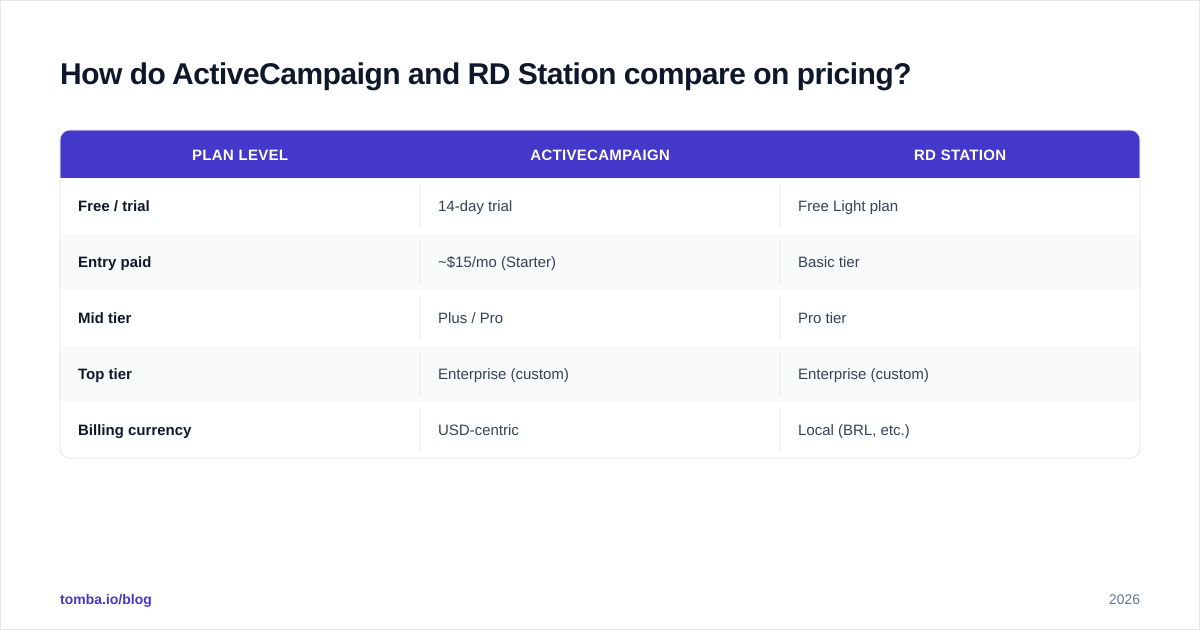
ActiveCampaign's Starter plan begins around $15/month for a small contact list and unlocks more automation actions, advanced reporting, and predictive features as you climb to Plus, Pro, and Enterprise. Costs rise with contact volume, and the most valuable automation features sit in mid-to-upper tiers.
RD Station Marketing offers a free Light plan with limited features, then Basic, Pro, and Enterprise tiers priced in local currency for its core markets. Its sweet spot is the mid-tier, where lead scoring, automation, and reporting come together. Pricing is competitive regionally and includes local billing that global tools often lack.
| Plan level | ActiveCampaign | RD Station |
|---|---|---|
| Free / trial | 14-day trial | Free Light plan |
| Entry paid | ~$15/mo (Starter) | Basic tier |
| Mid tier | Plus / Pro | Pro tier |
| Top tier | Enterprise (custom) | Enterprise (custom) |
| Billing currency | USD-centric | Local (BRL, etc.) |
Two cautions. First, both platforms bill on total contacts, not active ones — so list hygiene directly controls cost. Carrying dead or invalid addresses inflates your bill on either tool. Running your imports through an email verifier before they hit the platform keeps you on a lower pricing tier and protects your sender reputation at the same time. Second, the cheapest plan rarely includes the automation that made you consider these tools in the first place — price the tier you'll actually use, not the entry point.
Which has the better CRM and sales features?#
ActiveCampaign's Deals CRM is the more configurable of the two. You get custom pipelines, deal automation (move a deal stage based on email engagement, for example), lead scoring, and task automation that ties tightly to the marketing side. Because marketing and sales live in the same platform, the handoff is seamless — a behavior on the marketing side can instantly trigger a sales action.
RD Station CRM is sold as a companion to RD Station Marketing and is intentionally straightforward: pipelines, activity tracking, WhatsApp and email logging, and reporting that a sales manager can read without training. It's a strong fit for teams adopting their first real CRM, and the WhatsApp integration is genuinely better than what you'll stitch together on ActiveCampaign.
If you already run a dedicated CRM like Salesforce or HubSpot, note that both platforms integrate outward — but ActiveCampaign's larger connector library (including a deeper HubSpot integration) gives you more room to keep your existing system of record.
What about deliverability and data quality?#
Deliverability is where many marketing automation comparisons quietly fall apart, because the platform isn't the only variable — your list is. Both ActiveCampaign and RD Station maintain solid sending infrastructure, offer A/B testing, and ActiveCampaign adds predictive send-time optimization. But no platform can save you from a list full of invalid, spam-trap, or catch-all addresses.
If you import a dirty list, your bounce rate spikes, your sender reputation drops, and your carefully built automations land in spam regardless of which tool you chose. The fix lives upstream of both platforms:
- Verify every address before import to cut hard bounces.
- Separate risky catch-all domains and treat them cautiously.
- Re-verify your list on a schedule, since data decays roughly 25–30% per year.
- Warm new sending domains gradually rather than blasting day one.
Neither ActiveCampaign nor RD Station builds your prospect list for you — both assume you arrive with contacts in hand. That sourcing step is a separate job, and doing it well is what makes either automation engine worth paying for.
Integrations and ecosystem: who connects to more?#
ActiveCampaign wins on raw breadth, with 900+ native integrations spanning e-commerce, CRMs, support tools, and analytics, plus a robust API and webhook support. If your stack is unusual, the odds of a native connector are high. You can also pipe data in through Zapier or Make for anything missing.
RD Station's integration count is smaller (roughly 200) but well-targeted to its markets, with strong native ties to local e-commerce, payment, and messaging tools that global platforms ignore. For a Brazilian operation, RD Station's "smaller" library often covers more of the tools you actually use.
According to independent review aggregators like G2, both platforms hold high satisfaction scores, with ActiveCampaign frequently cited for automation flexibility and RD Station praised for regional support and ease of use. Vendor documentation backs this up — see the ActiveCampaign and RD Station sites for current feature matrices.
Which should you choose in 2026?#
Decide by your market and your appetite for complexity:
Choose ActiveCampaign if you operate globally (or plan to), your funnels are complex enough to need branching automation, you want the largest integration ecosystem, and you have someone who can own marketing operations. It's the stronger long-term engine for teams that will keep adding sophistication.
Choose RD Station if your primary market is Brazil or Latin America, WhatsApp is central to how you sell, you want fast onboarding without a specialist, and you value local billing and Portuguese-language support. For regional SMBs, the friction it removes is worth more than the automation ceiling it gives up.
Many teams that outgrow RD Station's automation eventually migrate to ActiveCampaign; few go the other direction unless they're entering LATAM. Buy for where you'll be in two years, not just where you are today.
| Your situation | Better pick |
|---|---|
| Global / multi-region growth | ActiveCampaign |
| Brazil / LATAM focus | RD Station |
| Complex branching automation | ActiveCampaign |
| Fast onboarding, lean team | RD Station |
| WhatsApp-first selling | RD Station |
| Largest integration library | ActiveCampaign |
Whichever you choose, remember that the platform is only the engine — it runs on the fuel you feed it.
Fill the gap both platforms leave: sourcing accurate contacts#
Here's the part the comparison usually skips: ActiveCampaign and RD Station are both demand-capture and nurture engines. Neither one sources new prospect emails — they assume you already have a clean, verified list to import and automate against. That sourcing step is where most pipelines actually leak.
That's exactly the gap Tomba's Email Finder fills. Use it to find verified professional email addresses by name, company, or domain, run domain search to pull every reachable contact at a target account, and push clean, verified records straight into ActiveCampaign or RD Station so your automations start with deliverable data instead of guesses. Tomba's Free plan gives you 25 searches a month to test it, with Starter at $49/mo when you scale up — a small line item next to the deliverability and pricing-tier costs a dirty list creates downstream. Source clean, verify before import, then let your automation platform do what it's good at.
// get started
Find, verify and enrich your first contacts today
Start on the free plan with 25 searches a month, then scale when your team is ready.
Free plan · No credit card required · GDPR & CCPA
// about the author