Adaptio vs Aidentified 2026: Relationship Data Showdown
A neutral, side-by-side breakdown of Adaptio vs Aidentified in 2026 — relationship intelligence, data coverage, pricing models, and which fits your GTM motion.
Choosing between Adaptio and Aidentified comes down to one question most buyers skip: are you buying a relationship graph or a prospecting database? They look similar in a demo, but they solve different problems. This guide breaks down where each platform wins, where it stalls, and how to fill the gaps either one leaves in your contact data.
TL;DR — Adaptio vs Aidentified at a glance#
- Aidentified is built around relationship and connection intelligence — mapping who-knows-who across professional and personal networks, with a strong following in wealth management and financial services.
- Adaptio leans toward adaptive go-to-market signals and segmentation — surfacing accounts and contacts that match your ICP and reshaping lists as buyer behavior changes.
- Neither is primarily an email-finding tool. Both can hand you a contact record, but accuracy and deliverability of those emails is where teams most often get burned.
- Pricing for both is quote-based (annual contracts, seat- or record-tiered). Expect a sales call, not a self-serve checkout.
- The practical answer for most teams: pick the platform that matches your motion, then layer a dedicated email verifier and data enrichment step so the contacts you act on are actually reachable.
What is Adaptio?#
Adaptio positions itself as an adaptive go-to-market and audience intelligence platform. The core idea is movement: instead of a static list you export once and let rot, Adaptio continuously re-scores accounts and contacts against your ideal customer profile as firmographic, technographic, and behavioral signals shift.
In practice that means a marketing or RevOps team defines a target segment — say, mid-market SaaS companies hiring for security roles — and the platform keeps the matching set current. When a company crosses a threshold (headcount growth, a funding event, a tech-stack change), it bubbles up; when it no longer fits, it drops off. That adaptive segmentation is the headline feature and the reason the name fits.
The trade-off is that signal-driven platforms are only as good as the contact layer underneath them. Knowing an account is in-market is valuable; it does nothing for your sequence if the contact's email bounces. That's a recurring theme in this comparison.
What is Aidentified?#
Aidentified is a relationship intelligence platform best known in financial services, wealth management, and high-touch B2B sales. Its differentiator is the connection graph: it maps the relationships between people — shared employers, board overlaps, alumni networks, professional and personal ties — so a rep can find the warmest path into an account rather than cold-calling a stranger.
For a financial advisor trying to reach a newly liquid executive, or an AE who wants an intro instead of an interruption, that graph is the product. Aidentified enriches a contact with net-worth signals, life events (a job change, an IPO, an acquisition), and the people most likely to open a door.
The catch mirrors Adaptio's: a relationship map tells you who and why now, but the email or phone number attached to that person still needs to be current and deliverable before the warm intro turns into a booked meeting.
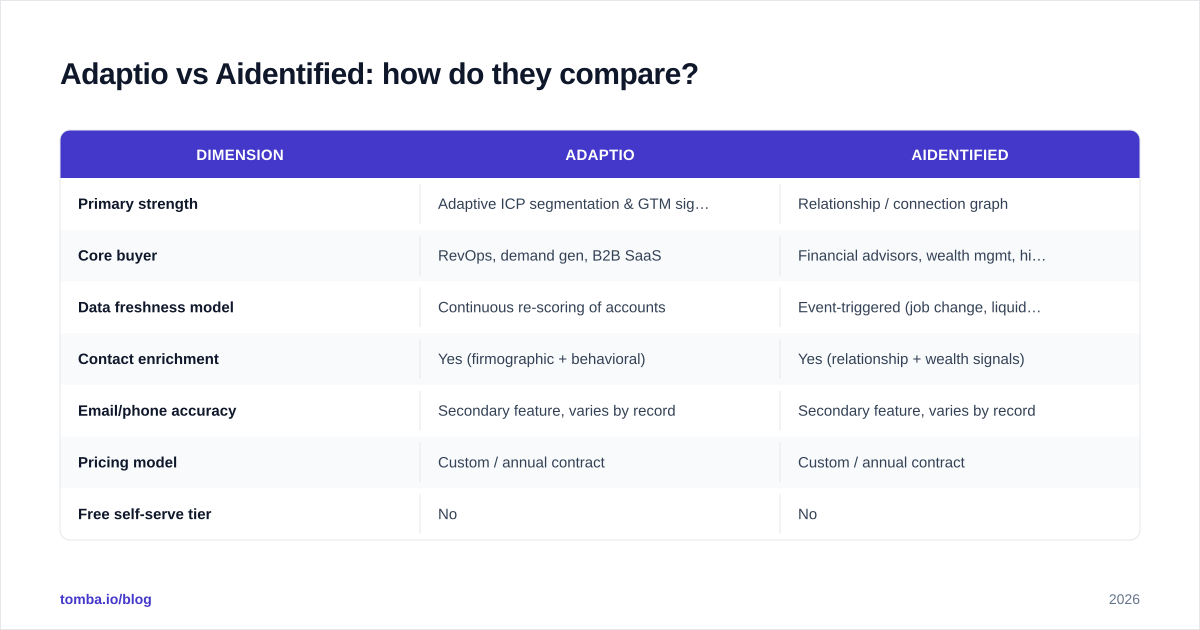
Adaptio vs Aidentified: how do they compare?#
The two overlap in the middle — both enrich contacts and both want to be your top-of-funnel intelligence layer — but they pull from opposite ends.
| Dimension | Adaptio | Aidentified |
|---|---|---|
| Primary strength | Adaptive ICP segmentation & GTM signals | Relationship / connection graph |
| Core buyer | RevOps, demand gen, B2B SaaS | Financial advisors, wealth mgmt, high-touch sales |
| Data freshness model | Continuous re-scoring of accounts | Event-triggered (job change, liquidity, life events) |
| Contact enrichment | Yes (firmographic + behavioral) | Yes (relationship + wealth signals) |
| Email/phone accuracy | Secondary feature, varies by record | Secondary feature, varies by record |
| Pricing model | Custom / annual contract | Custom / annual contract |
| Free self-serve tier | No | No |
| Best when you need | In-market accounts that fit your ICP now | The warmest human path into an account |
The honest summary: Adaptio answers "which accounts should I work this quarter?" while Aidentified answers "who do I already have a path to, and why is now the moment?" If you force one to do the other's job, you'll be disappointed in the demo-to-deployment gap.

Which one is better for relationship-led selling?#
If your motion depends on warm introductions and trust transfer — wealth management, private banking, executive recruiting, high-ACV enterprise — Aidentified is the more natural fit. The connection graph is genuinely hard to replicate, and the life-event triggers (someone changing jobs, a company getting acquired) are exactly the moments relationship sellers want to act on.
Adaptio can support relationship-led selling, but it isn't its center of gravity. You'd be using it to find the right accounts, then sourcing the human connections elsewhere. For teams whose entire premise is "who do we know," that's backwards.
A quick gut check: if your reps' first question on a new account is "do we have a connection here?" — lean Aidentified. If it's "is this account even a fit right now?" — lean Adaptio. Read more on the broader category in our B2B data and intelligence glossary if you're still scoping the space.
Which one is better for volume outbound and demand gen?#
For programmatic outbound, paid demand gen, and RevOps-driven list building, Adaptio's adaptive segmentation is the stronger engine. The continuous re-scoring means your sales and marketing teams aren't working a list that was accurate six months ago. You can route freshly-qualified accounts into sequences, ABM ads, or SDR queues as they enter the segment.
Aidentified can feed outbound too, but the relationship graph is overkill (and over-priced) if you're sending thousands of touches a month and don't need a warm-path overlay on every contact. You'd be paying for intelligence you won't use.
This is also where the contact-data weakness bites hardest. High-volume outbound multiplies the cost of bad emails: every bounce dings your sender reputation, and a few hundred bounces can quietly tank a domain's email deliverability. Neither platform was built to be your deliverability safety net, which is why a verification layer is non-negotiable at volume.
How accurate is the contact data in each?#
This is the question that decides ROI, and it's the one demos gloss over. Both Adaptio and Aidentified are intelligence platforms first — their value is the signal and the graph. The email and phone fields are derived, often from third-party data partners, and accuracy varies record by record, industry by industry, and geography by geography.
What that means for you:
- Expect strong coverage on the who and why, more variable coverage on the how to reach them.
- Catch-all domains, role-based addresses, and recently-changed jobs are where derived contact data goes stale fastest.
- Neither platform guarantees a verified, deliverable email on every record — and you shouldn't assume one.
The fix is a dedicated verification and enrichment step before anything hits a sequence. Run your exported list through an email verifier to catch invalid and risky addresses, and use a catch-all verifier for the domains that block standard SMTP checks. If a record has a name and company but no usable email, a domain search or email finder can recover it rather than dropping the lead.
What about pricing — Adaptio vs Aidentified?#
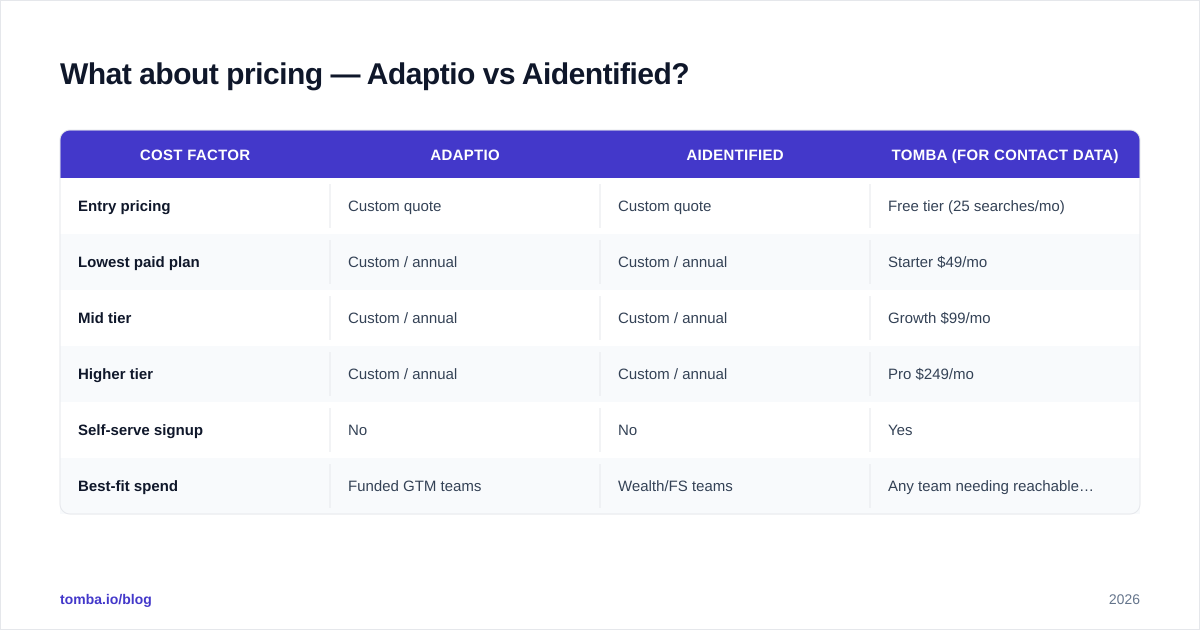
Both vendors run on the enterprise playbook: custom quotes, annual commitments, and tiering by seats and/or data volume. You won't find a public price sheet for either, and you won't find a self-serve free tier. Plan for a sales cycle, a usage estimate, and likely a minimum annual spend.
| Cost factor | Adaptio | Aidentified | Tomba (for contact data) |
|---|---|---|---|
| Entry pricing | Custom quote | Custom quote | Free tier (25 searches/mo) |
| Lowest paid plan | Custom / annual | Custom / annual | Starter $49/mo |
| Mid tier | Custom / annual | Custom / annual | Growth $99/mo |
| Higher tier | Custom / annual | Custom / annual | Pro $249/mo |
| Self-serve signup | No | No | Yes |
| Best-fit spend | Funded GTM teams | Wealth/FS teams | Any team needing reachable emails |
The takeaway isn't that one is cheaper — it's that intelligence platforms and contact-data tools are priced for different jobs. You can pair a high-end intelligence platform with an affordable, accurate contact layer instead of overpaying one vendor to be mediocre at both. See full Tomba pricing for how a dedicated contact-data spend compares.
When should you use a dedicated email finder instead — or alongside?#
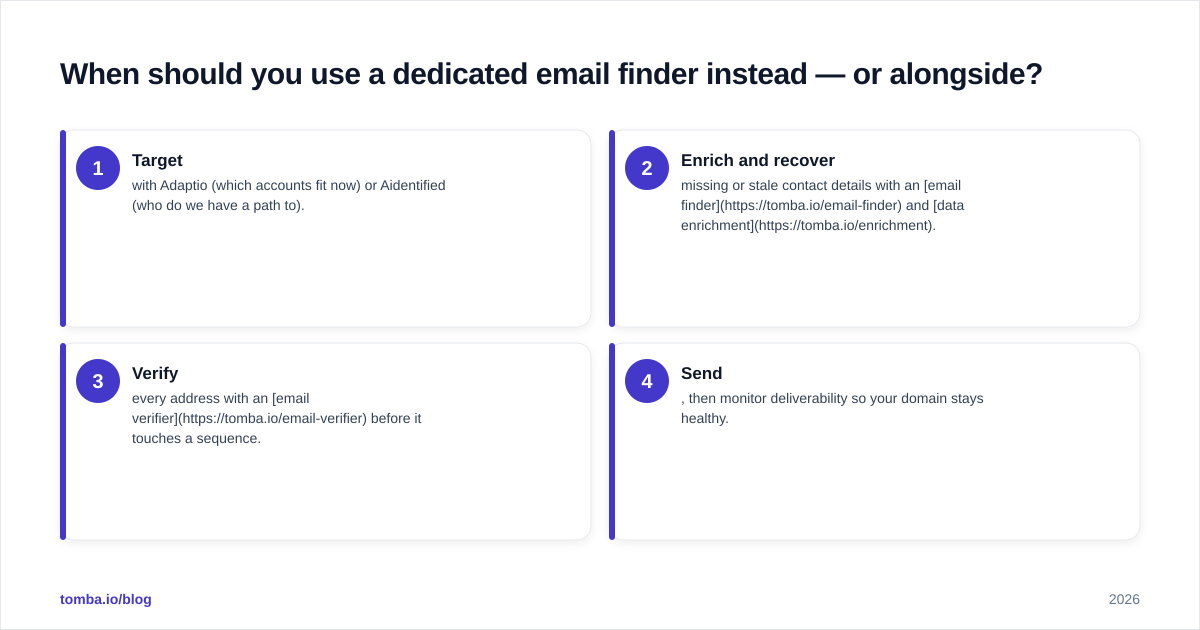
Use a dedicated contact-data tool alongside either platform whenever your success metric is replies and booked meetings rather than dashboards. The pattern that works:
- Target with Adaptio (which accounts fit now) or Aidentified (who do we have a path to).
- Enrich and recover missing or stale contact details with an email finder and data enrichment.
- Verify every address with an email verifier before it touches a sequence.
- Send, then monitor deliverability so your domain stays healthy.
Use a dedicated tool instead of these platforms when you don't need the heavy intelligence layer at all — for example, an early-stage team that knows exactly who it's targeting and just needs accurate emails and phone numbers at a reasonable price. In that case a bulk email finder plus verification may be the entire stack you need, and you can revisit relationship or signal intelligence once volume justifies it.
It's also worth checking how each tool sources its records. Transparency on data provenance and refresh cadence — like Tomba's published data sources — is a fair thing to demand from any vendor in this category, including Adaptio and Aidentified. For an outside view on how buyers rate these platforms, cross-reference reviews on G2 before you commit to an annual contract.
Adaptio vs Aidentified: the verdict#
There's no universal winner — there's a winner for your motion:
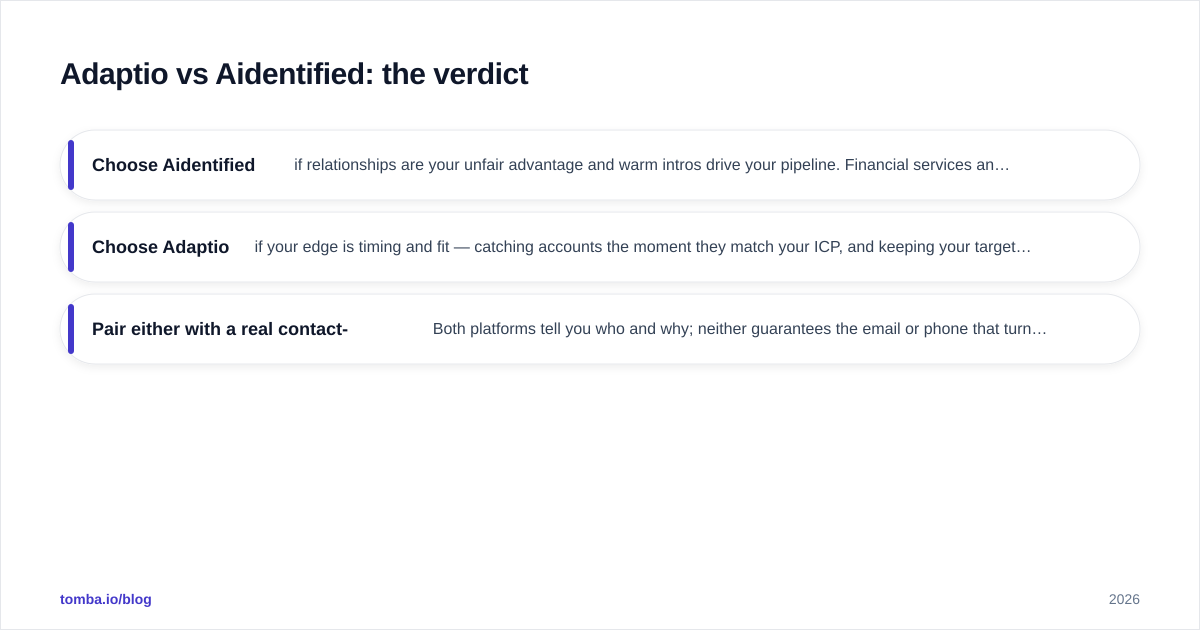
- Choose Aidentified if relationships are your unfair advantage and warm intros drive your pipeline. Financial services and high-ACV enterprise teams get the most from the connection graph and life-event triggers.
- Choose Adaptio if your edge is timing and fit — catching accounts the moment they match your ICP, and keeping your target lists from going stale. RevOps and demand-gen teams will feel that adaptive segmentation most.
- Pair either with a real contact-data layer. Both platforms tell you who and why; neither guarantees the email or phone that turns intelligence into a conversation.
The most common mistake is treating the intelligence platform as the whole stack. The signal and the graph get you to the right door — but a bounced email means no one's home. Keep the targeting smart and the contact data verified, and you get the best of both.
Make every contact reachable with Tomba#
Whichever platform you land on, your sequences only convert if the emails are real. Tomba's Email Finder recovers and verifies professional email addresses by name, domain, or company — so the in-market accounts and warm connections your intelligence platform surfaces actually turn into replies. Start free with 25 searches a month, scale to the Starter plan at $49/mo when you're ready, and connect it to your stack through the Tomba API or native HubSpot integration. Let Adaptio or Aidentified pick the targets — let Tomba make sure you can reach them.
// get started
Find, verify and enrich your first contacts today
Start on the free plan with 25 searches a month, then scale when your team is ready.
Free plan · No credit card required · GDPR & CCPA
// about the author