Adaptio vs Bounceless: Email Verification Compared (2026)
Adaptio vs Bounceless, broken down by accuracy, catch-all handling, pricing, and bulk speed — plus where a finder-plus-verifier stack beats either one alone.
You collected 8,000 leads, hit send, and 1,400 of them bounced. Your domain reputation tanked, your next campaign landed in spam, and now you're shopping for an email verification tool to stop the bleeding. Two names keep surfacing: Adaptio and Bounceless. This breakdown compares them on the things that actually move your bounce rate — not the marketing copy.
TL;DR#
- Bounceless is a mature, verification-first platform: bulk list cleaning, real-time API, catch-all detection, and deduplication, priced per credit with pay-as-you-go options.
- Adaptio positions itself as a leaner, automation-friendly verifier aimed at teams who want verification baked into their sending workflow rather than as a separate cleaning step.
- On core accuracy for standard mailboxes, both land in the same ballpark; the real differences show up in catch-all handling, bulk speed, and pricing transparency.
- Neither tool finds emails — they only validate the ones you already have. If your list is thin or stale, you need a finder + verifier together.
- For most outbound teams, the smarter move is pairing a high-accuracy email verifier with a finder so you never feed garbage addresses into the verifier in the first place.
What do Adaptio and Bounceless actually do?#
Both are email verification tools. Think of them as a bouncer at the door of your campaign: before an address gets in, they check whether the mailbox is real, the domain accepts mail, and the syntax is valid. They do not write your emails, find new contacts, or warm up your domain. They take a list you already have and tell you which addresses are safe to send to.
The verification process, under the hood, is roughly the same across the industry:
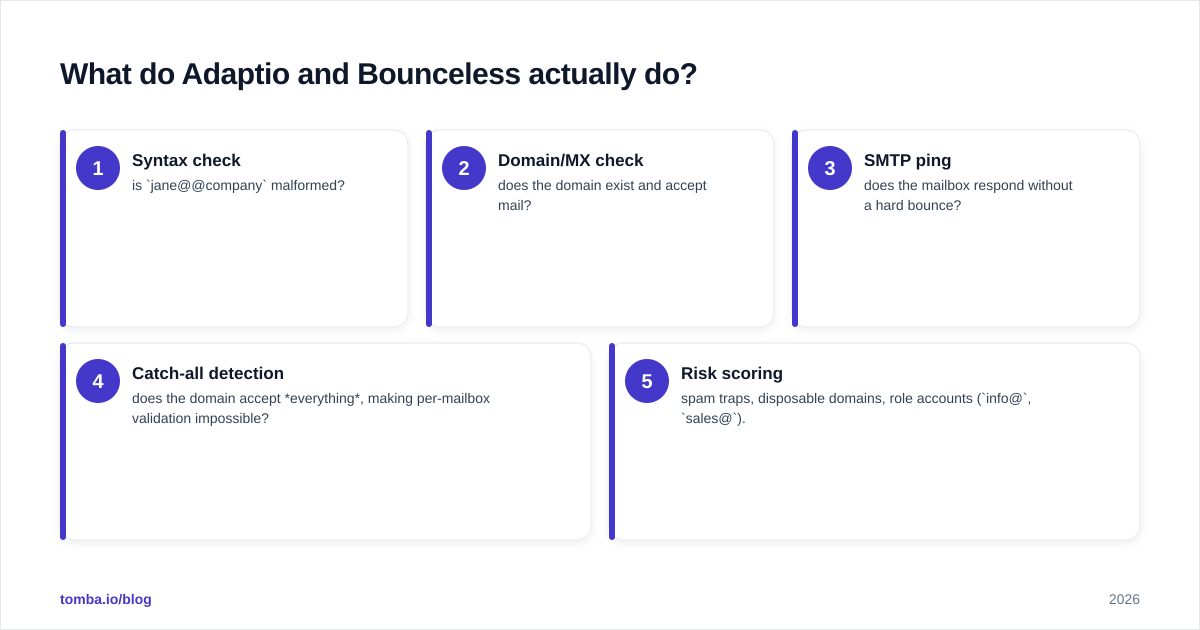
- Syntax check — is
jane@@companymalformed? - Domain/MX check — does the domain exist and accept mail?
- SMTP ping — does the mailbox respond without a hard bounce?
- Catch-all detection — does the domain accept everything, making per-mailbox validation impossible?
- Risk scoring — spam traps, disposable domains, role accounts (
info@,sales@).
Where vendors differ is the depth of each step, how they handle the ambiguous cases (catch-all and greylisting), and how fast they can run all of this across a list of 100,000 addresses without getting their probing IPs blocked. That's the lens for the rest of this comparison.
How do Adaptio and Bounceless compare head to head?#
Here's the side-by-side on the attributes that change your results. Treat specific numbers as directional — verification vendors update pricing and limits frequently, so confirm against each vendor's current page before you buy.
| Attribute | Adaptio | Bounceless |
|---|---|---|
| Primary focus | Verification + workflow automation | Verification + bulk list cleaning |
| Bulk list upload | Yes (CSV/XLS) | Yes (CSV/XLS, drag-and-drop) |
| Real-time API | Yes | Yes |
| Catch-all detection | Yes | Yes, with confidence scoring |
| Disposable/spam-trap filtering | Yes | Yes |
| Deduplication | Yes | Yes |
| Free trial | Limited free credits | 100 free verifications |
| Pricing model | Subscription-leaning | Pay-as-you-go + subscription |
| Typical entry price | ~$0.0008–$0.004 / verification tier | ~$0.0007–$0.0039 / verification tier |
| Integrations | Native +Zapier/API | Zapier, API, major ESPs |
| Best for | Teams automating verification in-flow | One-off and recurring list cleans |
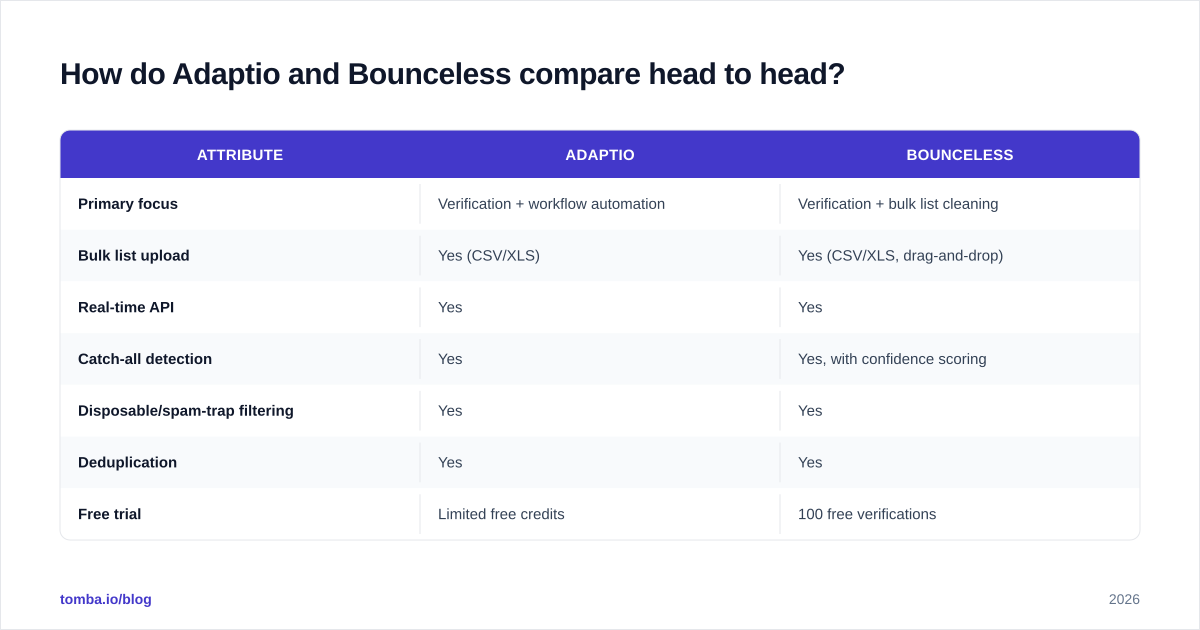
The headline: these tools are close enough on core verification that price-per-credit and catch-all handling should decide it, not a feature checkbox. If you clean lists in big occasional batches, Bounceless's pay-as-you-go and 100 free verifications make it easy to test. If you want verification fired automatically every time a lead enters your funnel, Adaptio's automation-first framing fits better.
Which one is more accurate?#
Accuracy is the only metric that matters, and it's the hardest to pin down because every vendor benchmarks on a different list. Here's the honest version: for standard, non-catch-all corporate mailboxes, mainstream verifiers — including both Adaptio and Bounceless — typically agree 95%+ of the time. A jane.doe@acme.com on Google Workspace either resolves or it doesn't, and both tools will tell you the same thing.
The accuracy gap opens up in three messy zones:
- Catch-all domains. When a domain accepts all mail, no verifier can confirm a specific mailbox via SMTP. The differentiator is whether the tool says so honestly (marking it "catch-all / risky" with a confidence score) or guesses "valid" to inflate its pass rate. Bounceless leans toward explicit confidence scoring here. Always treat catch-all "valid" results with suspicion regardless of vendor — and consider a dedicated catch-all verifier for high-stakes lists.
- Greylisting. Some servers temporarily reject the first probe. A good verifier retries; a cheap one returns a false "invalid." This is where bulk speed and accuracy trade off.
- Spam traps and recycled addresses. These don't hard-bounce but wreck your reputation. Coverage depends on the vendor's threat database, which you can't see from the outside.
The practical takeaway: don't choose on a vendor's self-reported "99% accuracy" claim — every tool prints one. Run the same 500-address sample through both free tiers, compare the disagreements, and spot-check 20 of them manually. The tool that's honest about its uncertain results is worth more than the one with the prettier pass rate.
What about pricing — which is cheaper?#
Pricing is where the two diverge most, and it depends entirely on your volume pattern.
Bounceless uses a credit model with pay-as-you-go packs and monthly subscriptions. Per-verification cost drops as you buy bigger packs — roughly from ~$0.0039 at the small end toward ~$0.0007 at high volume. The pay-as-you-go option is the draw: if you clean a list once a quarter, you don't pay for a monthly seat you won't use. The 100 free verifications let you test before spending anything. You can see their current tiers on the Bounceless site and cross-check reviews on G2.
Adaptio leans toward subscription pricing, which rewards teams running continuous, automated verification but penalizes occasional one-off cleans. If verification is a standing part of your funnel, a flat monthly cost is predictable and often cheaper per-credit at steady volume.
Quick decision rule:
- Occasional, lumpy cleaning → pay-as-you-go (Bounceless-style) wins.
- Continuous, automated verification → subscription (Adaptio-style) wins.
One caveat that catches teams off guard: verification credits get wasted on bad inputs. If half your list is made of guessed or scraped addresses that were never deliverable, you're paying to verify junk. Cleaning the source of your list — using a real finder instead of permutator guesses — cuts verification spend more than any per-credit discount. That's where a combined bulk email finder and verifier changes the math.

Where do both tools fall short?#
Here's the limitation neither vendor leads with: a verifier is only as good as the list you feed it. Both Adaptio and Bounceless are reactive — they grade a list you already built. They don't help you build a better list. If your addresses came from a scraper, an old export, or an email permutator that generated 12 guesses per person, the verifier just confirms that 11 of them are dead. You paid for the privilege.
This is the gap that turns a two-tool decision into a three-part stack:
- Find verified-at-source addresses (a finder that checks deliverability as it discovers).
- Verify the final list right before sending (catch-all, spam traps, freshness).
- Monitor deliverability over time (sender reputation, blacklist status).
Standalone verifiers cover step 2 well. They do nothing for step 1, which is where most bounce problems are created. A platform that combines discovery and verification — like Tomba's email finder paired with its verifier — eliminates the "verify a list of guesses" tax entirely, because the addresses are validated the moment they're found.
When should you choose Adaptio vs Bounceless vs an all-in-one?#
Match the tool to your actual workflow, not to a feature count.
Choose Adaptio if:
- Verification is a continuous, automated step in your funnel.
- You value workflow integration over per-clean cost.
- You're already on a subscription budget and want predictable monthly cost.
Choose Bounceless if:
- You clean lists in occasional large batches.
- You want pay-as-you-go with no standing commitment.
- You want to test free (100 verifications) before paying.
- Explicit catch-all confidence scoring matters to you.
Choose an all-in-one finder + verifier (like Tomba) if:
- Your real problem is list quality at the source, not just grading a bad list.
- You want to find emails by domain or name and verify them in one workflow.
- You'd rather pay for clean discovery than pay twice — once to find, once to verify junk.
- You need adjacent data: domain search, enrichment, or phone numbers alongside email.
| Scenario | Best fit |
|---|---|
| One-off list clean, no commitment | Bounceless (pay-as-you-go) |
| Always-on automated verification | Adaptio (subscription) |
| Building lists from scratch | Finder + verifier (Tomba) |
| Mixed: find, verify, enrich | All-in-one platform |
| Tight budget, tiny volume | Free tiers of any (test first) |
How should you actually test these before buying?#
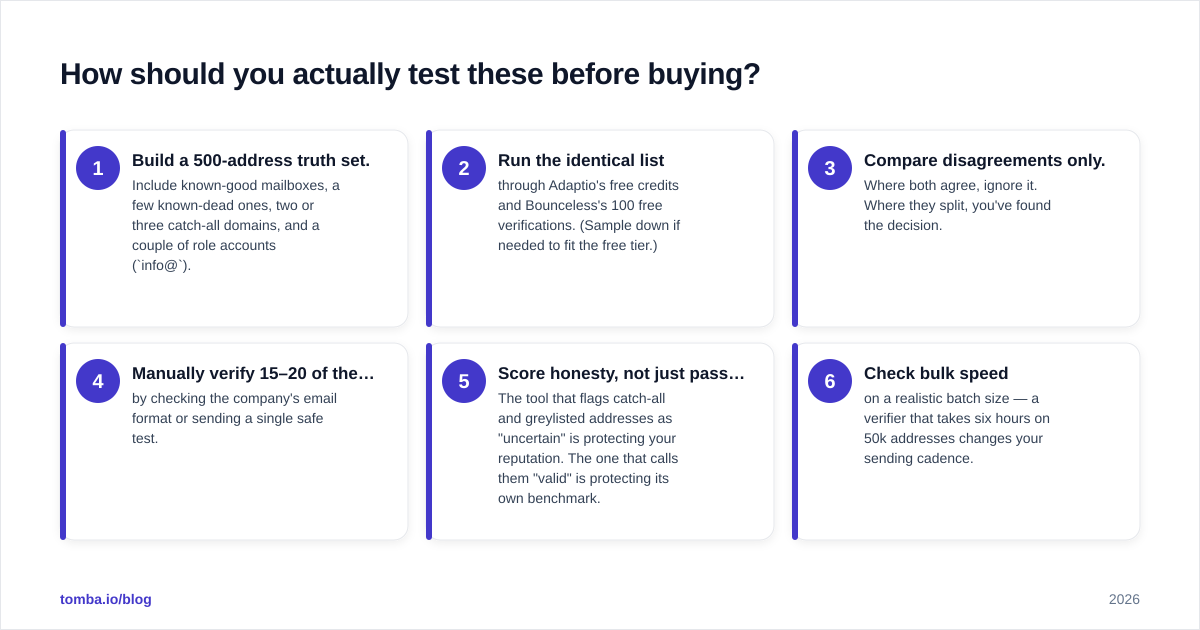
Don't trust any vendor's accuracy claim, including the ones in this article. Run a controlled bake-off:
- Build a 500-address truth set. Include known-good mailboxes, a few known-dead ones, two or three catch-all domains, and a couple of role accounts (
info@). - Run the identical list through Adaptio's free credits and Bounceless's 100 free verifications. (Sample down if needed to fit the free tier.)
- Compare disagreements only. Where both agree, ignore it. Where they split, you've found the decision.
- Manually verify 15–20 of the disagreements by checking the company's email format or sending a single safe test.
- Score honesty, not just pass rate. The tool that flags catch-all and greylisted addresses as "uncertain" is protecting your reputation. The one that calls them "valid" is protecting its own benchmark.
- Check bulk speed on a realistic batch size — a verifier that takes six hours on 50k addresses changes your sending cadence.
This costs you an afternoon and saves you a quarter of bounced campaigns. For more on why deliverability hinges on list hygiene, the basics of email deliverability are worth a five-minute read before you commit.
The verdict#
Adaptio and Bounceless are both competent verifiers, and for grading an existing list, you won't go badly wrong with either. Pick Bounceless for occasional, pay-as-you-go cleans with transparent catch-all scoring; pick Adaptio if you want verification automated into a continuous workflow on a subscription. Run the 500-address bake-off before you decide — the disagreement set will tell you more than any review.
But step back first. If you're shopping for a verifier because campaigns keep bouncing, the verifier is treating a symptom. The disease is usually list quality at the source — guessed addresses, stale exports, permutator junk. Fixing that upstream cuts your bounce rate and your verification bill.
That's the case for not buying a standalone verifier at all. Tomba finds professional email addresses by name, domain, or company and verifies them in the same workflow — so the addresses entering your campaigns were validated the moment they were discovered, not graded after the damage. Start with the Tomba Email Finder on the free tier (25 searches/month), and when you're ready to scale, the Tomba plans run from $49/mo Starter to $99/mo Growth and $249/mo Pro — finder, verifier, and catch-all checks bundled, so you stop paying twice to clean a list you never needed to dirty.
Ready to find emails that actually work?
Join 150,000+ professionals who stopped guessing and started sending. Free credits on signup — no credit card required.
Get the Tomba newsletter
Practical outbound tactics and product updates — once every two weeks.
About the author