Adaptio vs Bytemine 2026: Which B2B Sales Tool Wins?
Adaptio vs Bytemine, broken down by data accuracy, workflow fit, pricing, and integrations — plus where a dedicated email finder beats both for outbound teams.
Choosing between two emerging B2B sales tools is rarely about which has the longer feature list. It is about which one actually fits the way your team prospects, the systems you already pay for, and the data quality your sequences live or die on. This is a neutral, criteria-first breakdown of Adaptio vs Bytemine — how to evaluate them, where each tends to shine, and the questions that matter more than the marketing copy.
TL;DR#
- Adaptio leans toward workflow and signal orchestration — fitting teams that want intent, scoring, and automation layered on top of contact data.
- Bytemine leans toward raw data access and enrichment — fitting teams that want volume and flexible exports into an existing stack.
- Neither is automatically "better." The right pick depends on your motion: signal-led selling vs. high-volume list building.
- Whichever you choose, data accuracy and deliverability decide ROI — a fast tool feeding bad emails just burns your domain faster.
- If your core need is simply finding and verifying business emails at a fair price, a focused email finder like Tomba often beats a broad platform you only half-use.
What are Adaptio and Bytemine?#
Both Adaptio and Bytemine sit in the broad "B2B sales intelligence" category — software that helps revenue teams find the right accounts and contacts, enrich what they know, and act on it. But they emphasize different parts of the funnel.
Think of it like kitchen gear. Bytemine is the bulk pantry: lots of raw ingredients (companies, contacts, firmographics) you can pull in volume and prep however you like. Adaptio is the meal-kit-plus-timer: it cares less about hoarding ingredients and more about telling you when to cook and what to make — signals, scoring, and orchestrated next steps.
That framing matters because it predicts who is happy with each tool. A list-building SDR team optimizing for coverage will judge a platform on database size and export flexibility. A RevOps-led team running account-based plays will judge it on signal quality and how cleanly it routes work into the CRM.
How should you compare Adaptio vs Bytemine?#
Resist scoring tools by feature count. Score them against the five dimensions that actually move pipeline:
- Data accuracy — what percentage of contacts are reachable and current? Stale data quietly destroys deliverability and rep trust.
- Coverage — does the database cover your ICND's regions, company sizes, and roles? A huge global database is useless if it is thin in your niche.
- Workflow fit — does it push work into the tools your reps already live in, or does it become another tab nobody opens?
- Integrations — native CRM sync, enrichment APIs, and automation hooks (
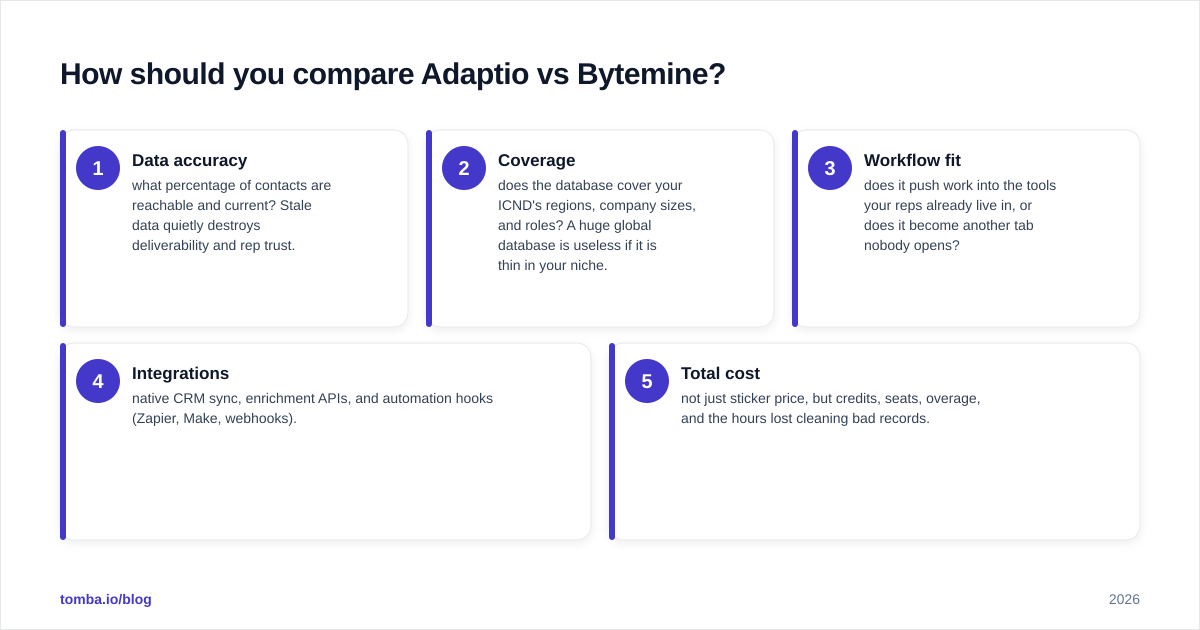
Zapier, Make, webhooks). 5. Total cost — not just sticker price, but credits, seats, overage, and the hours lost cleaning bad records.
Run any "Adaptio vs Bytemine" decision through those five and the noise clears fast.
Adaptio vs Bytemine: feature comparison#
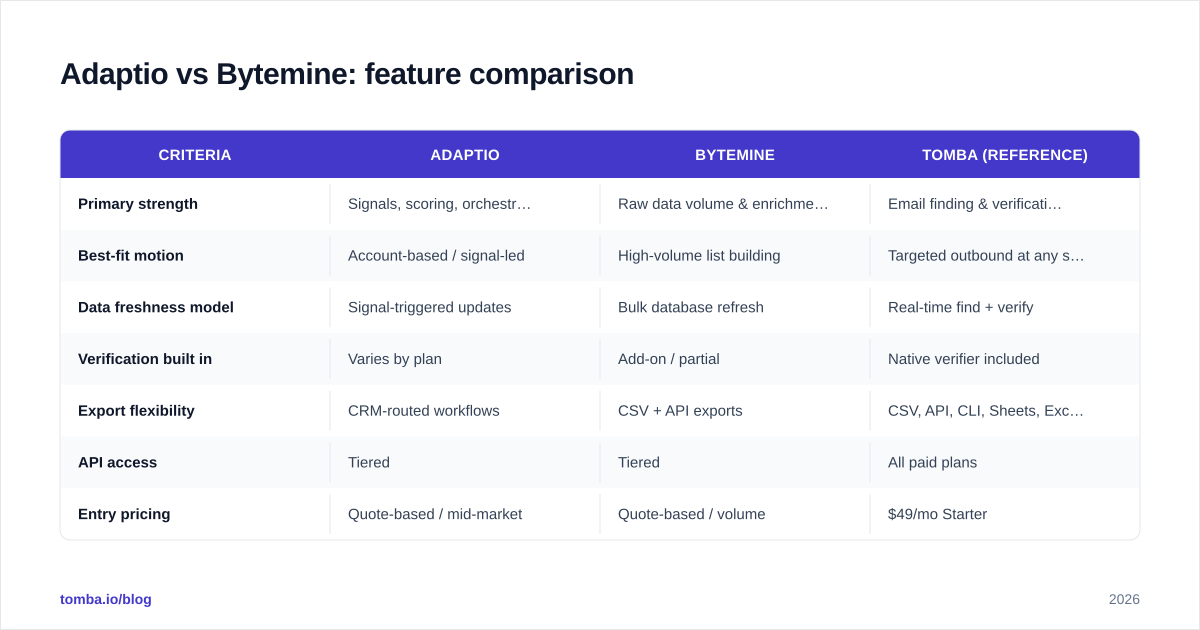
The table below is a structured way to think about the trade-offs. Treat the positioning as directional — always confirm current specifics on each vendor's own site and on review platforms like G2 before you commit budget.
| Criteria | Adaptio | Bytemine | Tomba (reference) |
|---|---|---|---|
| Primary strength | Signals, scoring, orchestration | Raw data volume & enrichment | Email finding & verification |
| Best-fit motion | Account-based / signal-led | High-volume list building | Targeted outbound at any scale |
| Data freshness model | Signal-triggered updates | Bulk database refresh | Real-time find + verify |
| Verification built in | Varies by plan | Add-on / partial | Native verifier included |
| Export flexibility | CRM-routed workflows | CSV + API exports | CSV, API, CLI, Sheets, Excel |
| API access | Tiered | Tiered | All paid plans |
| Entry pricing | Quote-based / mid-market | Quote-based / volume | $49/mo Starter |
| Free tier | Limited trial | Limited trial | 25 free searches/mo |
The pattern most teams discover: broad platforms bundle a lot you will not use, while a focused tool nails the one job — finding a valid address — for a fraction of the cost. That is why so many buyers cross-shop a dedicated email verifier alongside any all-in-one suite.
Which has better data accuracy?#
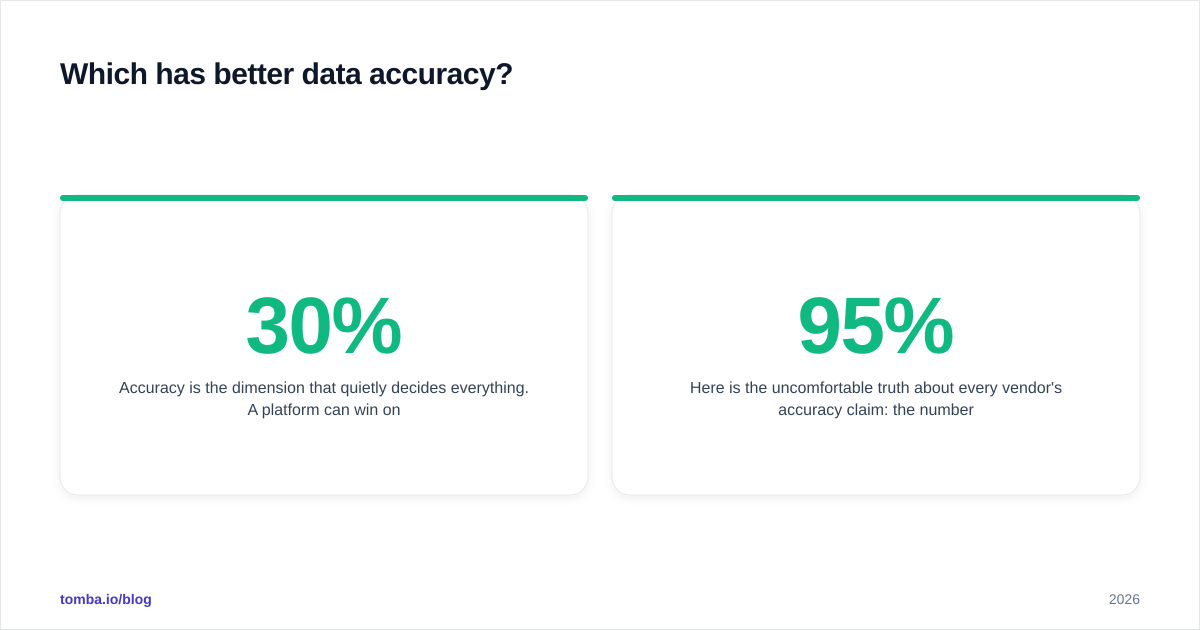
Accuracy is the dimension that quietly decides everything. A platform can win on UI, dashboards, and intent scoring, but if 30% of its emails bounce, your sender reputation tanks and your reps stop trusting the queue.
Here is the uncomfortable truth about every vendor's accuracy claim: the number on the marketing page is a best-case lab figure. What matters is accuracy on your segment — your industries, your geographies, your seniority levels. A database that is 95% accurate for US enterprise tech might be 60% accurate for European mid-market manufacturing.
Three things to test before trusting either Adaptio or Bytemine:
- Run a sample. Pull 100 contacts in your exact ICND and verify them independently. Measure real bounce rate, not the dashboard's promise.
- Check the catch-all handling. Catch-all domains accept everything at the SMTP layer, so naive tools mark them "valid." A serious stack uses a catch-all verifier to separate real mailboxes from traps.
- Look at recency. Ask how often records are re-verified. Quarterly is weak; continuous re-verification is the standard you want.
This is the area where a specialist earns its keep. Tomba's approach to where its data comes from is documented openly on its data sources page — a transparency test you should apply to any vendor before you wire money.
Adaptio vs Bytemine on pricing and value#
Both Adaptio and Bytemine trend toward quote-based or volume-tiered pricing, which is common for mid-market sales-intelligence platforms. That model has two consequences:
- Hard to compare apples to apples. Credits, seats, enrichment add-ons, and API limits all vary, so the "cheaper" tool on paper can cost more once you hit real usage.
- Annual lock-in is common. You often commit before you have proven the data works on your segment — which is exactly backwards.
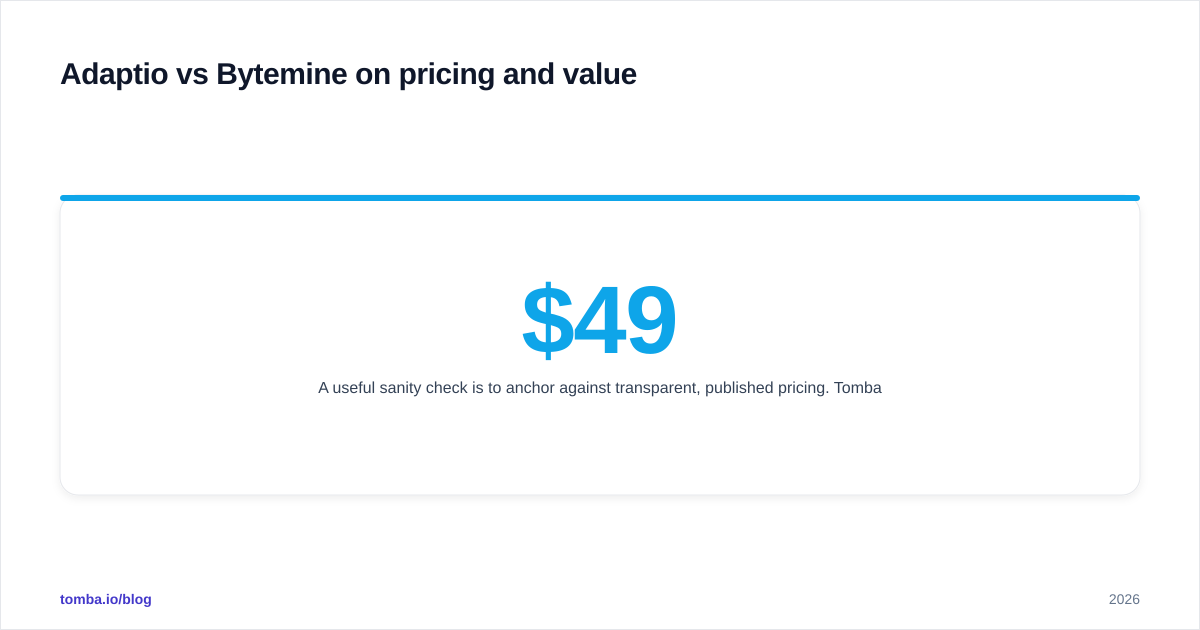
A useful sanity check is to anchor against transparent, published pricing. Tomba lists every tier publicly: a Free plan with 25 searches a month, Starter at $49/mo, Growth at $99/mo, Pro at $249/mo, and custom Enterprise. You can see the full breakdown on the Tomba pricing page. When a vendor will not show you a price without a sales call, factor the negotiation friction and lock-in risk into your decision.
The value question is not "which is cheapest" but "which gets a usable, deliverable contact into my sequence for the lowest all-in cost." Count the cleanup hours, not just the invoice.
Which fits your workflow better?#
Workflow fit is where Adaptio and Bytemine genuinely diverge, and it is the most personal part of the decision.
Choose the Adaptio-style approach if:
- You run account-based or signal-led plays and want timing cues (job changes, funding, intent) baked in.
- Your RevOps team will actually configure scoring and routing — orchestration tools punish teams that set them and forget them.
- You value fewer, better-timed touches over raw volume.
Choose the Bytemine-style approach if:
- Your motion is volume outbound and you need large, exportable lists fast.
- You already own your sequencing and CRM logic and just want a clean data feed.
- Your team is comfortable doing its own enrichment and hygiene downstream.
Whichever way you lean, the integration surface decides daily friction. Confirm native sync with your CRM and automation layer — for example, a HubSpot integration or Zapier hooks — so enriched contacts land where reps work instead of in an orphaned export.
Is there a better alternative to both?#
Sometimes the honest answer to "Adaptio vs Bytemine" is "neither, for what you actually need."
If your bottleneck is genuinely finding and verifying business email addresses — not orchestrating a 12-step ABM motion — a broad platform is overkill. You pay for intent dashboards and scoring engines you barely touch, while the one job you care about (a deliverable address) is something a focused tool does better and cheaper.
That is the niche a dedicated finder fills. Tomba's stack covers the core outbound data jobs without the suite tax:
- Find emails by name or company with the email finder, or sweep a whole company with domain search.
- Verify before you send so bounces never touch your domain reputation.
- Scale with the Tomba API, CLI, Google Sheets, and Excel add-ons when you outgrow manual lookups.
- Enrich existing records with data enrichment instead of buying a second platform.
For teams already invested in a suite, these can run alongside it — using the specialist for accuracy and the platform for orchestration. Compare independent reviews on Capterra and the vendors' own sites before deciding; the goal is the right tool for your motion, not the most logos on the page.
How do you actually run the decision?#
A simple, evidence-based process beats a feature spreadsheet every time:
- Define your ICND precisely — industries, regions, company sizes, target roles.
- Pull a 100-contact sample from each tool in that exact ICND.
- Verify independently and record real bounce and reachability rates.
- Map the integration path into your CRM and sequencer; note every manual step.
- Calculate all-in cost per usable contact, including cleanup time.
- Pilot for 30 days before any annual commitment.
This turns "Adaptio vs Bytemine" from a vibes-based debate into a measured one. The tool that produces the most deliverable contacts, lands them in your workflow with the least friction, and does it at the lowest all-in cost — that is your winner, regardless of which has the slicker demo.
The bottom line#
Adaptio and Bytemine serve overlapping but distinct buyers. Pick Adaptio's style for signal-led, orchestrated, account-based selling. Pick Bytemine's style for high-volume list building you control downstream. But validate both on your segment's data accuracy before you sign anything — the prettiest dashboard cannot rescue a list that bounces.
And if, after running the test above, your real need is just accurate, verified business emails without the platform overhead, start with the focused option. Spin up the Tomba Email Finder on the free tier — 25 searches a month, no card — find your next 25 prospects, verify them, and measure the bounce rate yourself. Let the deliverability numbers, not the sales deck, make the call.
Ready to find emails that actually work?
Join 150,000+ professionals who stopped guessing and started sending. Free credits on signup — no credit card required.
Get the Tomba newsletter
Practical outbound tactics and product updates — once every two weeks.
About the author