Adaptio vs Coldlytics: B2B Lead Data Compared (2026)
Adapt.io gives you a self-serve 150M-contact database; Coldlytics hand-builds verified lists in 24 hours. Here's which B2B prospecting model wins in 2026 — and where a dedicated email finder beats both.
Choosing between Adaptio (Adapt.io) and Coldlytics feels like comparing a self-serve grocery store to a personal shopper. One hands you the aisles and lets you grab what you want; the other takes your list and does the hunting for you. Both end with leads in your inbox — but the route, the cost, and the data quality differ in ways that decide whether your next cold campaign lands or bounces.
TL;DR — Adaptio vs Coldlytics#
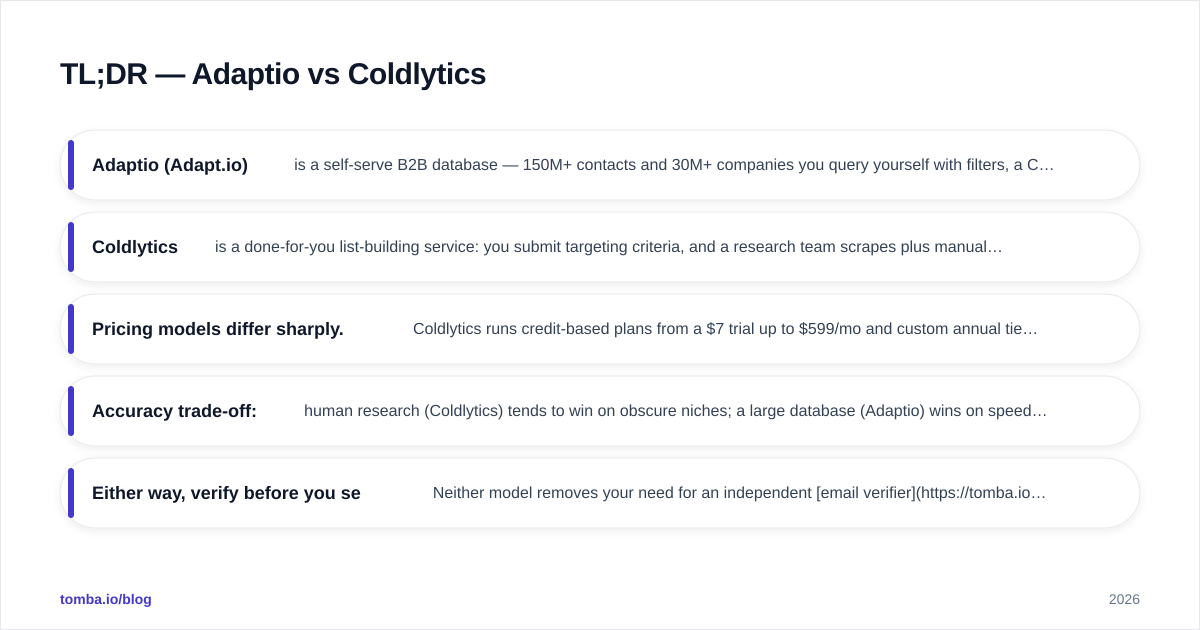
- Adaptio (Adapt.io) is a self-serve B2B database — 150M+ contacts and 30M+ companies you query yourself with filters, a Chrome extension, and a REST API. Best for teams that want instant volume and control.
- Coldlytics is a done-for-you list-building service: you submit targeting criteria, and a research team scrapes plus manually verifies a custom list, usually within 24 hours. Best for niche or hard-to-find targets.
- Pricing models differ sharply. Coldlytics runs credit-based plans from a $7 trial up to $599/mo and custom annual tiers; Adapt.io uses quote-based seat/credit pricing you request from sales.
- Accuracy trade-off: human research (Coldlytics) tends to win on obscure niches; a large database (Adaptio) wins on speed and scale but carries more stale records.
- Either way, verify before you send. Neither model removes your need for an independent email verifier to protect deliverability.
What are Adaptio and Coldlytics?#
Adaptio is how most people misspell Adapt.io, a B2B lead intelligence platform. Its pitch is scale and self-service: a database of 150M+ contacts and 30M+ companies, advanced filters to slice by title, industry, headcount, and geography, plus products it brands as Lead Builder, Prospector, and Engage. You get verified emails, direct dials, and social profiles, with a Chrome extension for LinkedIn prospecting and an API for enrichment at volume.
Coldlytics sits at the opposite end of the spectrum. Instead of handing you a database, it hands you a research team. You submit your ideal-customer criteria through a self-serve dashboard, and Coldlytics fires proprietary scrapers across sources like Google Maps, LinkedIn, Clutch, and Dun & Bradstreet, then a human researcher manually hunts down decision-maker contact details and verifies each email for deliverability. Turnaround is roughly 24 hours per request.
The core distinction: Adaptio sells access to data; Coldlytics sells the labor of producing data. That single difference drives almost every other comparison point below.
How does each one actually get your data?#
Understanding the mechanics matters more than the marketing, because it predicts where each tool fails.
Adaptio's model is index-then-serve. It continuously crawls and aggregates public and licensed data into one searchable index, then refreshes records on a schedule. When you run a search, you're querying a snapshot. The upside is speed — thousands of matching contacts in seconds. The downside is decay: any large static database accumulates stale titles, job-changers, and dead inboxes between refresh cycles. Adapt.io users on G2 frequently praise the speed but note accuracy dips on smaller or lesser-known companies.
Coldlytics' model is research-on-demand. Nothing is pre-built. Each list is assembled when you ask, so the data is fresh by definition — a researcher confirmed it days or hours ago, not months ago. The trade-off is throughput: human research can't deliver 10,000 contacts in the next five minutes, and you pay per researched contact rather than per database seat.
Neither approach is universally "better." A self-serve index wins when your targets are common and you need volume now. On-demand research wins when your targets are obscure, your spend is precise, or you simply don't have the headcount to build lists in-house.
Adaptio vs Coldlytics: the full comparison table#
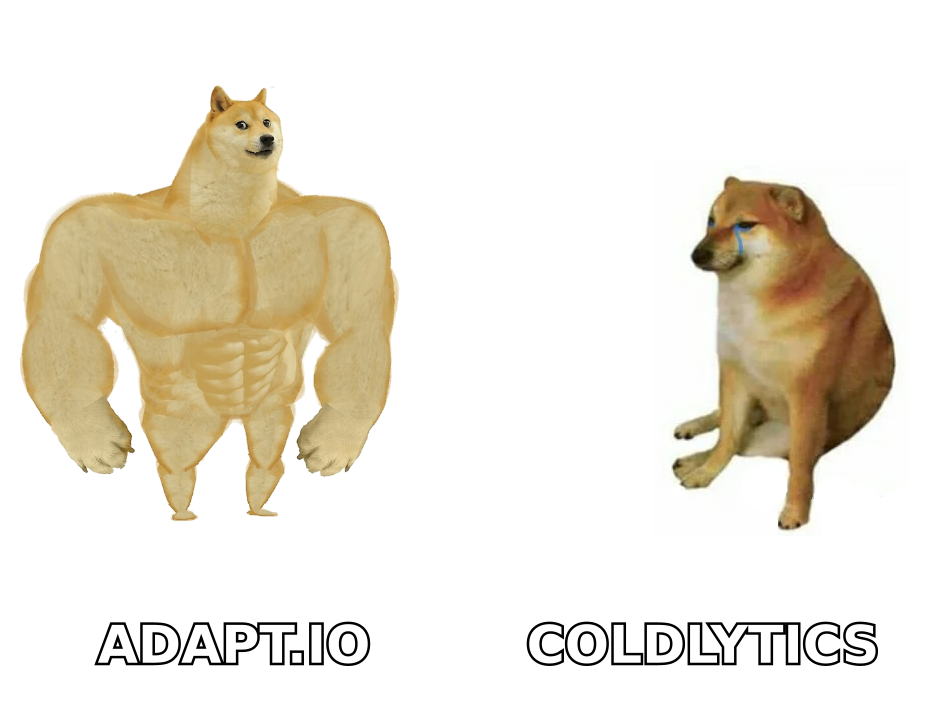
Here's how the two stack up across the attributes that actually affect a prospecting workflow. Where a vendor publishes figures, they're listed; where pricing is quote-based, that's noted so you verify on the source.
| Attribute | Adaptio (Adapt.io) | Coldlytics |
|---|---|---|
| Model | Self-serve database | Done-for-you research service |
| Database size | 150M+ contacts, 30M+ companies | No fixed database — built per request |
| Data freshness | Periodic refresh of a static index | Researched fresh per list (~24h) |
| Entry price | Quote-based (request from sales) | $7 for a 7-day trial (25 leads) |
| Typical plans | Seat/credit tiers, custom quote | $99 / $299 / $599 per month |
| Enterprise | Custom | Custom annual (10,000+ leads/mo) |
| Credit refund on misses | Not specified | Unused credits returned if data not found |
| Speed to first list | Seconds | ~24 hours |
| Best for | Volume, broad ICPs, API enrichment | Niche, hard-to-find, precise spend |
| API / integrations | REST API, Chrome extension | Self-serve platform, list delivery |
A few rows deserve emphasis. Coldlytics' credit-refund-on-miss policy is unusual and genuinely buyer-friendly — you don't pay for contacts the team couldn't find. Adaptio's API and Chrome extension are the standout for ops teams that want to bake enrichment into their stack rather than export CSVs.
Which is more accurate — database or human research?#
Conclusion first: for mainstream B2B titles at well-known companies, Adaptio's database is accurate enough and far faster. For niche verticals, local businesses, or roles that aren't well-represented online, Coldlytics' manual research will usually beat a static index.
The reason is structural. Any database the size of Adapt.io's must trade freshness for breadth — it can't re-verify 150 million records continuously, so a slice of any export will be outdated. Coldlytics avoids that by never storing a stale record in the first place; every contact is researched at request time. That's why done-for-you services tend to post lower bounce rates on tricky segments, while databases win on coverage of common roles.
But "accurate at delivery" and "accurate at send" aren't the same thing. Email addresses decay roughly 2–3% per month as people change jobs. Whatever you buy this week should still pass an independent check before it hits your sequencer. Running every list through a dedicated email verifier — regardless of which vendor sourced it — is the single cheapest insurance you can buy against a damaged sender reputation. For lists with ambiguous catch-all domains, a catch-all verifier closes a gap both Adaptio and Coldlytics can leave open.
When should you choose Adaptio?#
Pick Adaptio (Adapt.io) when these describe you:
- You need volume and you need it now. Building a 5,000-contact list for a broad ICP is a few minutes of filtering, not a 24-hour wait.
- Your targets are mainstream. VPs of Sales at funded SaaS companies, marketing directors at mid-market firms — the kinds of roles a large index covers well.
- You want enrichment in your stack. The REST API and Chrome extension let you enrich CRM records and prospect on LinkedIn without leaving your workflow.
- You have the team to QA lists. Self-serve means you own data hygiene — you'll want a verification step on every export.
Adaptio is essentially a faucet: turn it on, get a lot of water, manage the quality yourself. If your motion is high-volume outbound across common segments, that's exactly what you want.
When should you choose Coldlytics?#
Pick Coldlytics when these describe you:
- Your ICP is hard to find. Local service businesses, owners of sub-50-employee firms, or roles that barely register in big databases — human researchers find what scrapers miss.
- You want to pay only for what's delivered. The credit-refund-on-miss model means you're not charged for contacts that don't exist.
- You don't have list-building headcount. Outsourcing research frees a small team to focus on messaging and calls instead of spreadsheet archaeology.
- You value freshness over instant scale. A 24-hour wait for verified, just-researched data beats an instant export of records last touched months ago.
Coldlytics is the personal shopper: slower, more deliberate, and better when precision matters more than raw throughput. Its $7 seven-day trial (25 leads) makes it cheap to test against your own segments before committing — start there and judge the data on your actual ICP, not a demo.
What does each cost at scale?#
Cost is where the two models diverge most, and where a third option enters the picture.
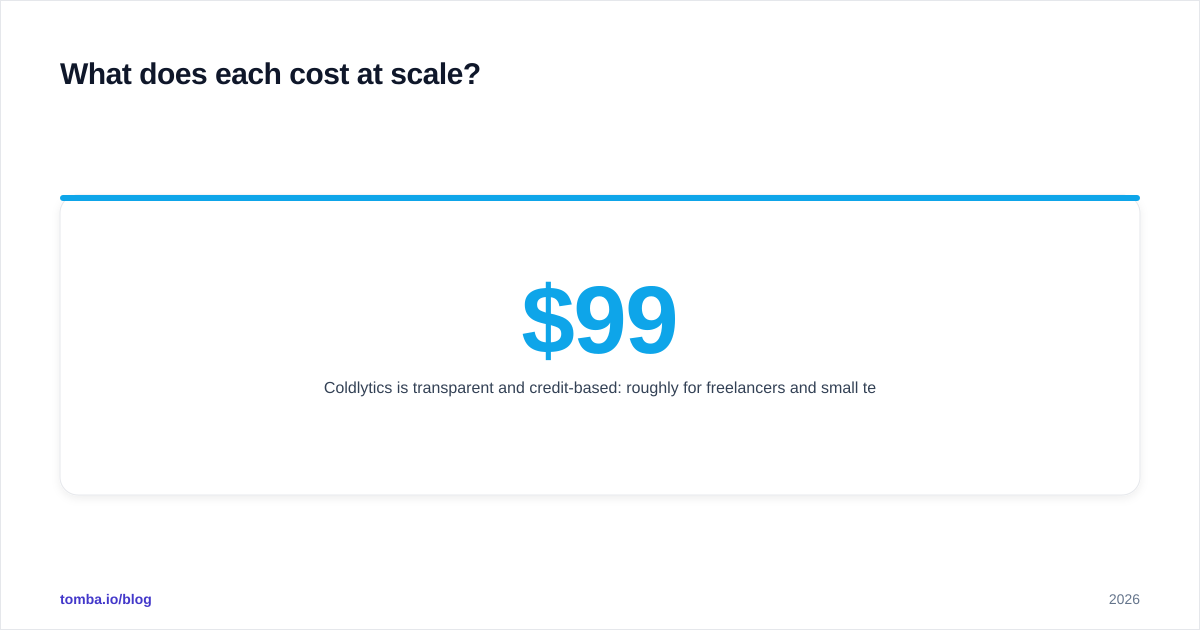
Coldlytics is transparent and credit-based: roughly $99/mo for freelancers and small teams, $299/mo for small businesses, and $599/mo for teams that need leads regularly, with custom annual deals above 10,000 leads/month. Because you pay per researched contact, cost scales linearly with volume — predictable, but it climbs fast if you need tens of thousands of contacts a month.
Adaptio's pricing is quote-based; you request it from sales, and it typically blends seats with credit allowances. That makes apples-to-apples comparison hard until you talk to them — verify current numbers on the Adapt.io pricing page and cross-check reviews on Capterra rather than trusting any single quote.
For high-volume teams, the math often favors a self-serve email finder with flat, published pricing. That's where Tomba fits the conversation.
Is there a third option — and where does Tomba fit?#
Yes. If your real need is "find and verify business emails reliably without a sales call or a 24-hour wait," a dedicated email-finder platform is a cleaner fit than either a sprawling intelligence suite or a done-for-you service.
Tomba publishes its pricing openly — a Free tier with 25 searches/month, Starter at $49/mo, Growth at $99/mo, Pro at $249/mo, and custom Enterprise — so you can budget without negotiating. Its email finder locates professional addresses by name, company, or domain; domain search pulls every public address at a company; and data enrichment fills gaps in records you already have. For teams processing large lists, the bulk email finder handles volume without per-researcher costs.
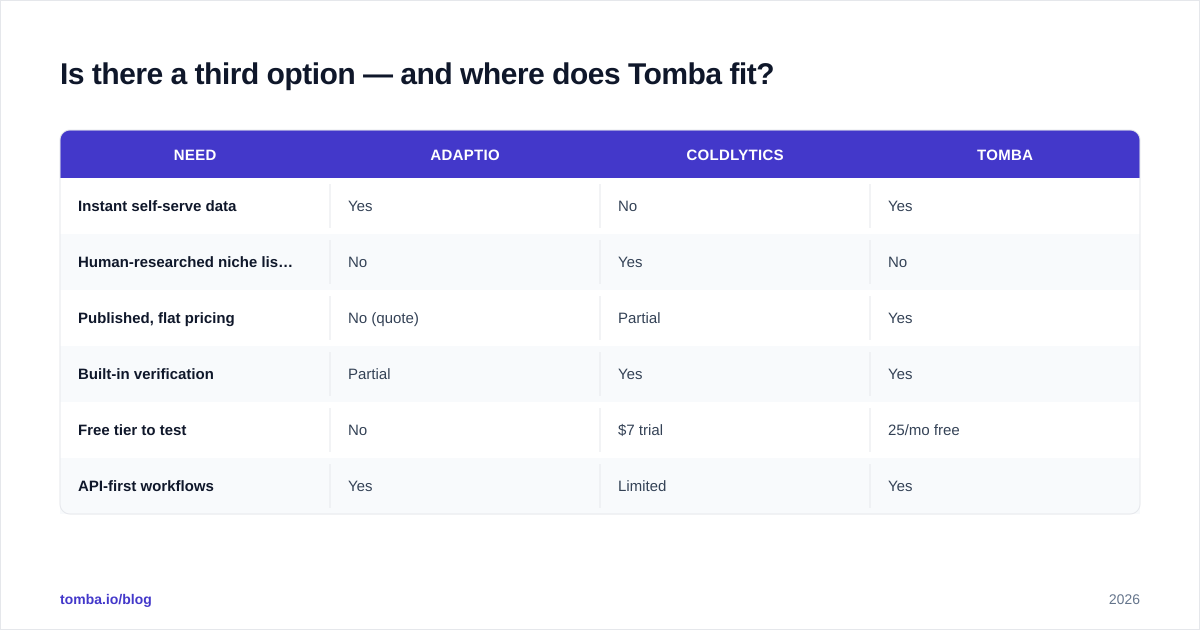
How the three approaches compare at a glance:
| Need | Adaptio | Coldlytics | Tomba |
|---|---|---|---|
| Instant self-serve data | Yes | No | Yes |
| Human-researched niche lists | No | Yes | No |
| Published, flat pricing | No (quote) | Partial | Yes |
| Built-in verification | Partial | Yes | Yes |
| Free tier to test | No | $7 trial | 25/mo free |
| API-first workflows | Yes | Limited | Yes |
The honest read: Adaptio and Coldlytics solve different problems, and the "winner" depends on whether you value scale or precision. But many teams overbuy — they sign up for a heavyweight intelligence suite or a managed service when what they actually do all day is find a verified email for a name they already have. If that's you, a focused finder is faster and cheaper than both.
Frequently asked questions#
Is Adaptio the same as Adapt.io? Yes — "Adaptio" is a common misspelling of Adapt.io, the B2B lead intelligence platform. They're the same product.
Does Coldlytics give you a database to search? No. Coldlytics doesn't sell database access; it researches a custom list per request and delivers it to you, typically within 24 hours.
Do I still need to verify emails from these tools? Yes. Even freshly researched data decays, and any large database carries stale records. Run every list through verification before sending to protect your sender reputation.
Which is cheaper for high volume? Per-contact research (Coldlytics) climbs with volume; a flat-rate self-serve finder is usually cheaper at scale. Compare published pricing before committing.
The bottom line#
Adaptio vs Coldlytics is really self-serve scale vs done-for-you precision. Choose Adaptio when you need broad, instant volume and have a team to QA it. Choose Coldlytics when your targets are hard to find and you'd rather pay for delivered results than build lists yourself. And if your day-to-day is simply finding and verifying business emails at a predictable price, skip the heavyweight options entirely.
Start with the Tomba Email Finder — try 25 searches free, then scale on flat pricing from $49/mo. Find the verified email, confirm it's deliverable, and get your sequence out the door today instead of waiting on a quote or a 24-hour queue.
Sources: Adapt.io, Coldlytics, Coldlytics reviews on G2, Adapt reviews on G2.
// get started
Find, verify and enrich your first contacts today
Start on the free plan with 25 searches a month, then scale when your team is ready.
Free plan · No credit card required · GDPR & CCPA
// about the author