Adaptio vs CompanyData.com BoldData: 2026 Comparison
A neutral 2026 breakdown of Adaptio, CompanyData.com, and BoldData — coverage, pricing models, delivery formats, and which B2B data provider fits your GTM motion.
Choosing a B2B data provider is less about who has "the most records." It is about whether the data arrives in a format your team can use. Adaptio vs CompanyData.com BoldData is really a choice between three buyers, not three record counts. All three sell company and contact data, but each aims at a different team. This guide shows where each one wins, where each one frustrates, and how to avoid paying for coverage you will never touch.
TL;DR#
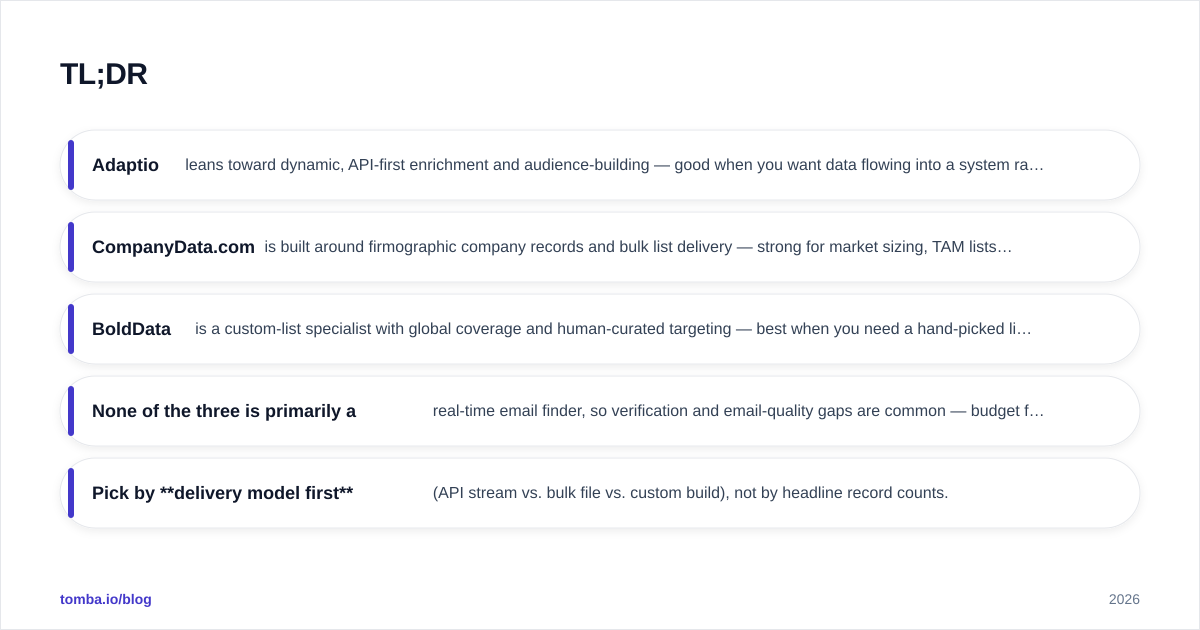
- Adaptio leans toward dynamic, API-first enrichment and audience-building — good when you want data flowing into a system rather than a one-time file.
- CompanyData.com is built around firmographic company records and bulk list delivery — strong for market sizing, TAM lists, and data appends.
- BoldData is a custom-list specialist with global coverage and human-curated targeting — best when you need a hand-picked list for a specific campaign or region.
- None of the three is primarily a real-time email finder, so verification and email-quality gaps are common — budget for a dedicated email verifier.
- Pick by delivery model first (API stream vs. bulk file vs. custom build), not by headline record counts.
What problem are these three tools actually solving?#
The short answer: they turn "I want to reach companies that look like X" into a usable list of firmographic and contact records. The longer answer: they solve it in very different ways.
Think of it like buying produce. CompanyData.com is the wholesale market — you order pallets of a known SKU and they ship. BoldData is the specialty grocer who hand-picks a basket to your recipe. Adaptio is the subscription box that keeps restocking your fridge through a pipe (an API). Same raw ingredient — company data — three very different buying experiences.
That distinction matters because the wrong model creates silent waste. Buy a static bulk file when you needed live enrichment, and your data rots at roughly 2–3% per month as people change jobs. Buy an API subscription when you needed one clean list for a single trade show, and you pay recurring fees for a one-time need.
If you want the textbook definition of the underlying data category, firmographics on Wikipedia is a clean primer — industry, size, revenue, location, and structure are the attributes all three vendors are ultimately selling.
Adaptio vs CompanyData.com BoldData: how do they compare?#
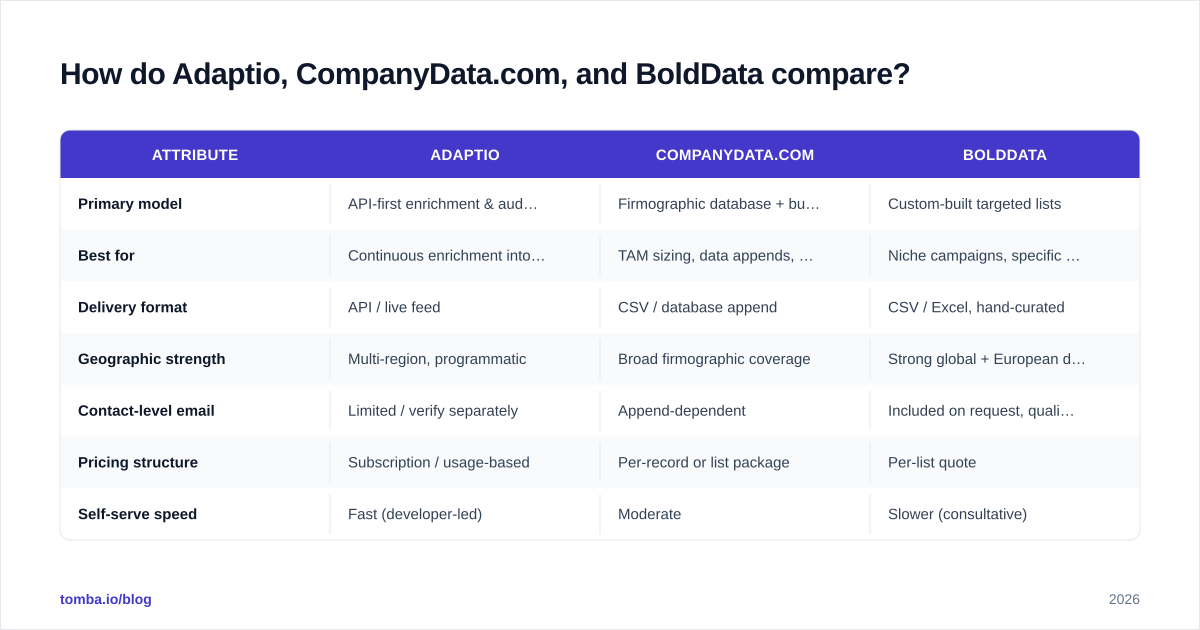
Here's the side-by-side. Pricing for these vendors is almost always quote-based. It shifts with volume, region, and contract terms. So the table focuses on model and fit, not made-up sticker prices. That is the factor that drives the real decision.
| Attribute | Adaptio | CompanyData.com | BoldData |
|---|---|---|---|
| Primary model | API-first enrichment & audiences | Firmographic database + bulk lists | Custom-built targeted lists |
| Best for | Continuous enrichment into a stack | TAM sizing, data appends, market lists | Niche campaigns, specific regions/verticals |
| Delivery format | API / live feed | CSV / database append | CSV / Excel, hand-curated |
| Geographic strength | Multi-region, programmatic | Broad firmographic coverage | Strong global + European depth |
| Contact-level email | Limited / verify separately | Append-dependent | Included on request, quality varies |
| Pricing structure | Subscription / usage-based | Per-record or list package | Per-list quote |
| Self-serve speed | Fast (developer-led) | Moderate | Slower (consultative) |
| Ideal buyer | RevOps / engineering | Marketing ops / analysts | Campaign owners / SMBs |
A few honest caveats. "Limited" on email does not mean useless. It means you should treat email as a separate quality problem, whichever vendor you pick. And "slower" for BoldData is a feature, not a bug. When your targeting is truly niche, a human will beat a self-serve filter on an odd ICP.
Is Adaptio better than CompanyData.com?#
It depends entirely on whether your data needs a heartbeat.
Adaptio's strength is simple: data arrives through an API and can be refreshed. That suits teams running continuous outbound, where records must stay current. Got an engineer or a RevOps person who can wire it into your CRM? The automation pays off fast.
CompanyData.com wins when you need a snapshot. Think a defined market, a clean append to records you hold, or a one-time pull for analysis. An analyst sizing a market or cleaning a stale database gets more from a bulk export than from a live feed with nowhere to plug in.
The trap is a mismatch. Do not buy Adaptio's recurring model for a snapshot job. Do not buy CompanyData.com's bulk file for an ongoing need. Match the model to the cadence of your work.

Where does BoldData fit?#
BoldData is the consultative option. Instead of filtering a self-serve UI, you describe the target — "manufacturing firms in the Benelux with 50–200 staff and a procurement contact" — and they build it. That human touch is valuable for hard niches and non-US markets, where automated filters fall apart.
You can confirm the positioning on BoldData's own site. Then cross-check buyer sentiment on G2. For all three vendors, read the 3-star reviews, not the 5-star ones. That is where the real limits surface.
The trade-off is speed and repeatability. A hand-built list is great once. It is awkward as the backbone of an always-on program. Re-ordering the same BoldData list every quarter? That is a sign you have outgrown the custom model. Move to an API or subscription instead.
What none of them solve well: email quality#
Here's the gap buyers underestimate. All three vendors sell records. But "a record with an email" is not the same as "a deliverable email." Contact data decays. Catch-all domains hide invalid addresses. Appended emails are often guessed patterns, not verified inboxes.
Send to an unverified list and you pay twice. Once for the data. Again in sender reputation damage that drags down every future campaign. The fix is a verification layer between your data provider and your sending tool.
This is where a dedicated tool earns its place. Run provider exports through an email verifier before you send. Use a catch-all verifier for the domains that will not confirm. This turns a noisy bulk file into something safe to mail. It is a small step that protects a much larger investment.

How should you actually choose between them?#
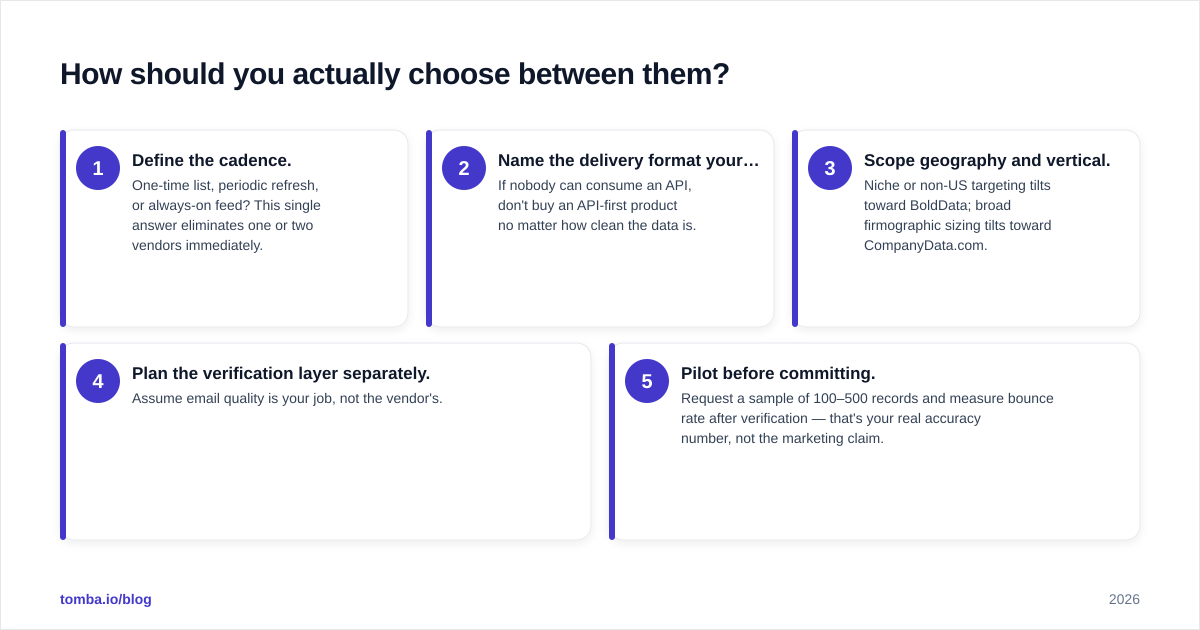
Work through it in this order. The sequence matters more than any single feature.
- Define the cadence. One-time list, periodic refresh, or always-on feed? This single answer eliminates one or two vendors immediately.
- Name the delivery format your team can use. If nobody can consume an API, do not buy an API-first product. The data quality will not matter.
- Scope geography and vertical. Niche or non-US targeting tilts toward BoldData. Broad market sizing tilts toward CompanyData.com.
- Plan the verification layer separately. Assume email quality is your job, not the vendor's.
- Pilot before committing. Ask for a sample of 100–500 records. Measure the bounce rate after verification. That is your real accuracy number, not the marketing claim.
A reality check on step 5: the only accuracy figure that matters is the one you measure on your ICP. When you weigh Adaptio vs CompanyData.com BoldData, a vendor's global accuracy claim tells you little about your niche — say, German SaaS founders. Sample, verify, count the bounces, then decide.
Can you replace all three with a self-serve finder?#
Sometimes — and this is worth testing before you sign a data contract.
Say your real need is "find verified emails for a known list of companies or people." A self-serve email finder is often faster and cheaper than a custom data project. Instead of commissioning a list, run a domain search to pull contacts company by company. Or push a spreadsheet of names through a bulk email finder and get verified results back.
That will not replace BoldData's curated niche lists or CompanyData.com's full-market appends. But many outbound teams just need "accurate emails for accounts we already want." For them, it merges the data buy and the verification step into one. The honest framing: data providers sell who exists. An email finder sells how to reach them. Many teams only need the second.
You can see how the sourcing differs by reviewing where the data comes from. Provenance and refresh rate are the quiet variables. They separate a list that converts from one that bounces.
Pricing reality: what you're really paying for#
Across all three vendors, the headline price is rarely the total cost. Budget for three line items, not one:
- Acquisition — the per-record or subscription fee the vendor quotes you.
- Verification — cleaning the email layer so you do not torch deliverability. It is non-negotiable and almost always a separate spend.
- Decay replacement — re-buying or re-enriching as records go stale. For a static file, that decay starts the day it ships.
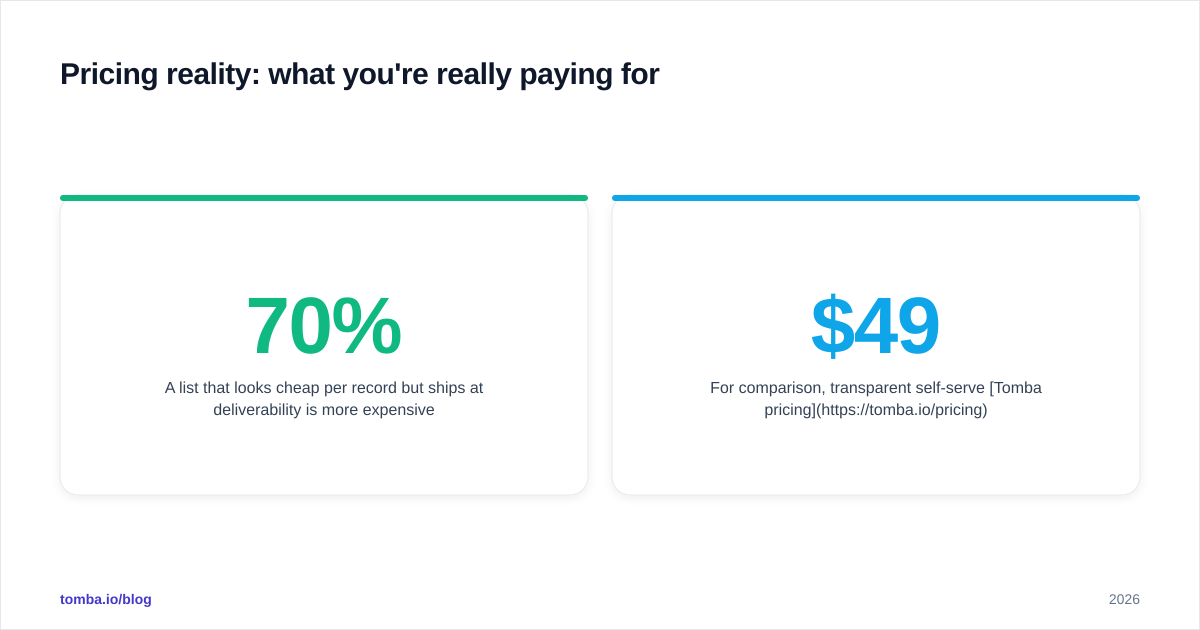
A list that looks cheap per record can ship at 70% deliverability. A pricier list at 95% is cheaper once you count wasted sends and reputation harm. Run the math on cost per usable, verified contact, not cost per raw record.
For comparison, self-serve Tomba pricing starts with a free tier (25 searches/month). Paid plans run Starter at $49/mo, Growth at $99/mo, and Pro at $249/mo. Finding and verification sit in one place. That removes the separate verification cost bulk-data buyers forget to budget.
Final verdict#
There's no universal winner in Adaptio vs CompanyData.com BoldData — there's a winner per job:
- Choose Adaptio if you need data flowing continuously into a system, and you can consume an API.
- Choose CompanyData.com if you need broad firmographic snapshots, market sizing, or database appends.
- Choose BoldData if your targeting is niche or regional, too specific for a self-serve filter, and you want a human building the list.
- Choose a self-serve finder if your real need is verified emails for accounts you've already identified — and you want sourcing plus verification in one step.
Whatever you pick, treat email verification as a separate, mandatory layer. The data is only as good as the inboxes it can actually reach.
Ready to skip the data-broker overhead?#
Is your bottleneck verified contact emails, not market-wide data? Start with the Tomba Email Finder. Drop in a domain or a name and get back professional emails that are already verified. No list commission. No separate cleaning step. No recurring decay bill on a static file. Pair it with the built-in verifier and the buy-then-clean cycle becomes one workflow. Try the free tier, measure the bounce rate on your own ICP, and let the numbers make the call.
// get started
Find, verify and enrich your first contacts today
Start on the free plan with 25 searches a month, then scale when your team is ready.
Free plan · No credit card required · GDPR & CCPA
// about the author