Adaptio vs Data Marketers Group: B2B Data Compared 2026
A neutral, hands-on breakdown of Adaptio vs Data Marketers Group — data coverage, pricing, accuracy, and which B2B data source actually fits your pipeline in 2026.
TL;DR
- Adaptio leans into platform-style B2B data and enrichment with self-serve access and API hooks — better when you want fresh, programmatic data inside your stack.
- Data Marketers Group (DMG) is closer to a list-and-services vendor — bulk B2B contact lists and managed data builds, better when you want a done-for-you file handed over.
- Neither is a pure email-finder; if your real need is verifying contacts before you send, you still want a dedicated verification layer.
- Pricing models differ sharply: platform/subscription (Adaptio) vs. per-list or per-record quoting (DMG). Cost-per-usable-contact matters more than sticker price.
- For most outbound teams in 2026, the winning move is "source data, then verify it yourself" — pair either provider with a real-time finder and verifier so you don't pay for bounces.
Who are Adaptio and Data Marketers Group?#
Short version: both sell B2B contact data, but they sell it in different shapes. Adaptio positions itself as a data and enrichment platform — you log in, query, and pull records, often with API access for automation. Data Marketers Group operates more like a data list provider and agency: you tell them the audience you want (industry, title, geography, technographics), and they assemble and deliver a list.
Think of it like buying produce. Adaptio is the supermarket where you walk the aisles and pick what you need on demand. DMG is the catering company that asks what you're serving and delivers boxes to your door. Both get you food; the experience, freshness control, and price structure are different.
That distinction drives almost every other difference in this comparison, so keep it in mind as we go.
How do Adaptio and Data Marketers Group compare at a glance?#
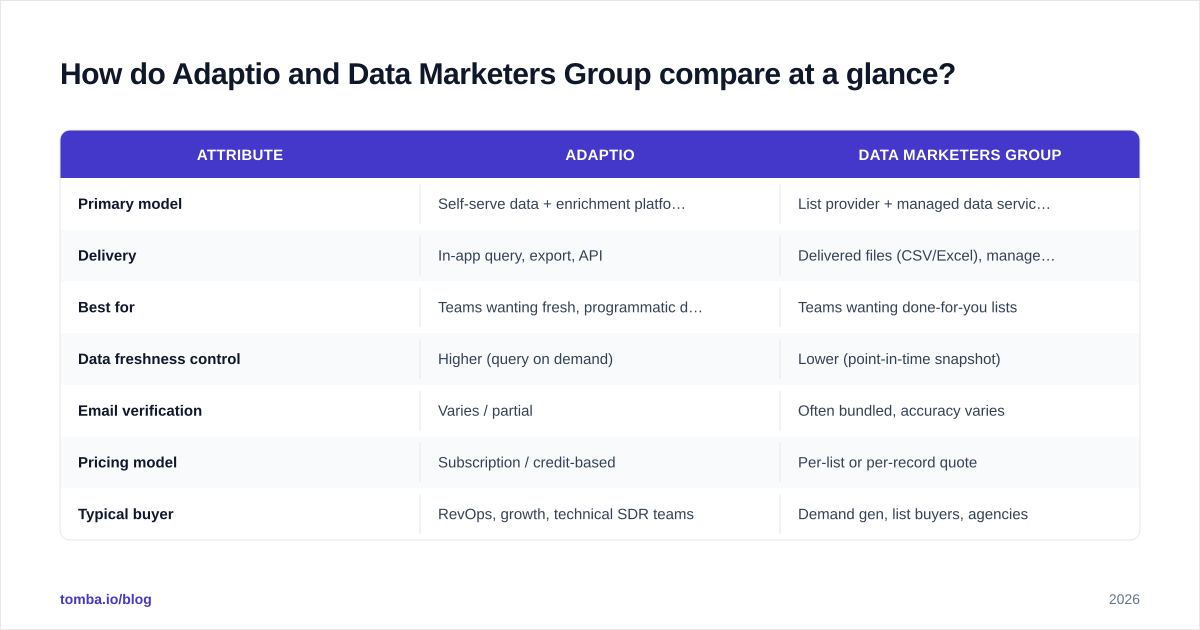
Here's the head-to-head on the attributes that actually change your results. Treat exact figures as directional — both vendors quote based on volume and contract, and you should confirm current numbers before signing.
| Attribute | Adaptio | Data Marketers Group |
|---|---|---|
| Primary model | Self-serve data + enrichment platform | List provider + managed data services |
| Delivery | In-app query, export, API | Delivered files (CSV/Excel), managed builds |
| Best for | Teams wanting fresh, programmatic data | Teams wanting done-for-you lists |
| Data freshness control | Higher (query on demand) | Lower (point-in-time snapshot) |
| Email verification | Varies / partial | Often bundled, accuracy varies |
| Pricing model | Subscription / credit-based | Per-list or per-record quote |
| Typical buyer | RevOps, growth, technical SDR teams | Demand gen, list buyers, agencies |
| Learning curve | Moderate (platform UI + API) | Low (you receive a file) |
The table makes the trade-off obvious: Adaptio asks you to do a bit more work in exchange for control and freshness; DMG does the work for you but hands you a snapshot that starts aging the moment it lands.

Which one has more accurate B2B data?#
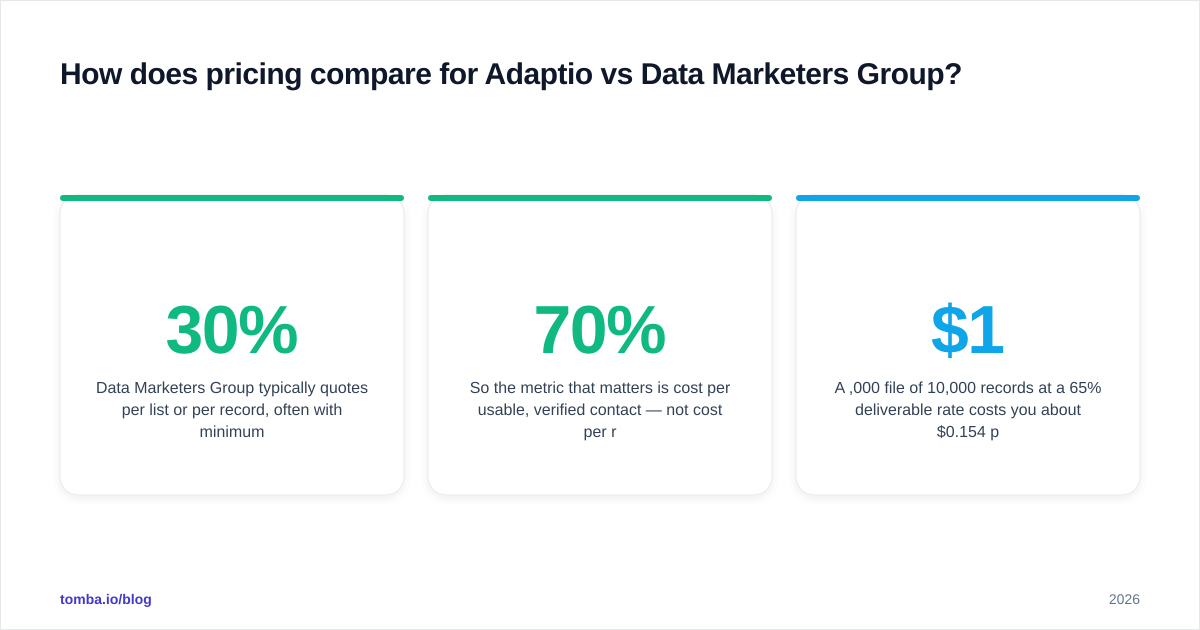
Conclusion first: accuracy depends less on the brand and more on how recently the record was confirmed — and neither vendor escapes data decay. B2B contact data degrades fast. Industry estimates and analyst commentary from firms like Gartner have long pegged B2B data decay at roughly 30% per year as people change jobs, titles, and companies. A list that was 95% accurate in January can be meaningfully stale by summer.
This is where the platform-vs-list distinction bites. Because Adaptio is queried on demand, the record you pull today reflects a more recent state than a list DMG compiled weeks ago and delivered as a one-time file. That doesn't make Adaptio automatically "more accurate" — it depends on their underlying sources — but it does reduce the lag between data capture and data use.
The practical takeaway: whichever provider you choose, do not trust raw deliverability. Run every address through an email verifier before your sequence sends. Catch-all domains are the classic trap — a server that accepts everything tells you nothing about whether the mailbox exists, which is exactly why a catch-all verifier exists as a separate check. Skipping verification is how you torch your sender reputation before your campaign even warms up.
How does pricing compare for Adaptio vs Data Marketers Group?#
The honest answer: you can't compare them on sticker price alone, because they price different things.
- Adaptio typically follows a platform model — a subscription or credit allotment that you draw down as you query and enrich. Your effective cost is "price per record I actually use," and unused credits or over-broad queries can quietly inflate it.
- Data Marketers Group typically quotes per list or per record, often with minimums. You pay for the file. If 30% of that file bounces, your real cost-per-usable-contact is ~43% higher than the quoted number.
So the metric that matters is cost per usable, verified contact — not cost per row. A cheaper list with a 70% hit rate can be more expensive than a pricier source with a 90% hit rate once you account for wasted sends, damaged domain reputation, and rep time chasing dead addresses.
Run the math like this:
Effective cost per usable contact =
  (total spend) / (records delivered × verified-deliverable rate)
A $1,000 file of 10,000 records at a 65% deliverable rate costs you about $0.154 per usable contact. The same $1,000 at 90% deliverable costs $0.111 — nearly 30% cheaper in reality despite the identical invoice.

When should you choose Adaptio?#
Pick Adaptio when control and freshness matter more than convenience:
- You have a technical or RevOps-savvy team. API access and on-demand querying pay off when someone can wire data into your CRM and enrichment flows. Tomba's own data enrichment workflows follow the same philosophy — pull current data at the moment you need it, not from a months-old export.
- You run continuous outbound. If you're always prospecting, a platform you can query repeatedly beats buying a new static list every month.
- You want to enrich, not just acquire. Filling gaps on existing CRM records (titles, company size, technographics) is a platform strength.
- You care about recency. On-demand pulls reduce the decay lag described above.
Adaptio is the weaker pick if you have no technical bandwidth and simply want a clean file to load and send.
When should you choose Data Marketers Group?#
Pick DMG when you want the work done for you and your use case is campaign-shaped, not always-on:
- One-off or seasonal campaigns. A defined ABM push or event invite list doesn't need a standing subscription.
- Highly custom audience builds. If you want a niche segment assembled to spec — specific SIC codes, install base, geography — a managed build can save hours.
- Low technical lift. You receive a file. No API, no query syntax, no integration project.
- Agencies running client lists. Per-list quoting maps cleanly to client billing.
DMG is the weaker pick if you need live data, programmatic access, or you're going to re-pull the same audience repeatedly — at which point a platform amortizes better.
What do both providers miss — and how do you fill the gap?#
Both share the same blind spot: they sell sourcing, not deliverability assurance. A record in a database or a row in a delivered file is a claim, not a guarantee. The mailbox might be closed. The person might have left. The domain might be a catch-all that swallows everything.
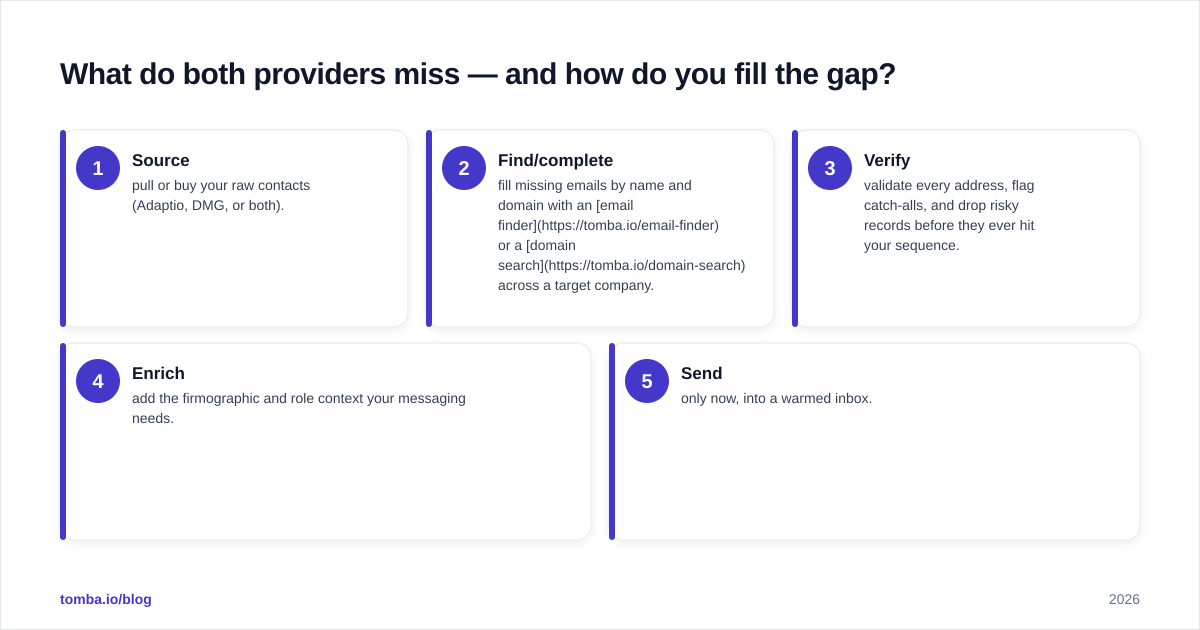
That's the layer you own regardless of vendor. A reliable outbound stack looks like this:
- Source — pull or buy your raw contacts (Adaptio, DMG, or both).
- Find/complete — fill missing emails by name and domain with an email finder or a domain search across a target company.
- Verify — validate every address, flag catch-alls, and drop risky records before they ever hit your sequence.
- Enrich — add the firmographic and role context your messaging needs.
- Send — only now, into a warmed inbox.
Skip step 3 and the quality of steps 1–2 barely matters; you'll bounce either way. This is why "which provider has better data" is the wrong first question. The right one is "what's my verified-deliverable rate after my own QA?"
Adaptio vs Data Marketers Group: which should you pick in 2026?#
Decision rule, stated plainly:
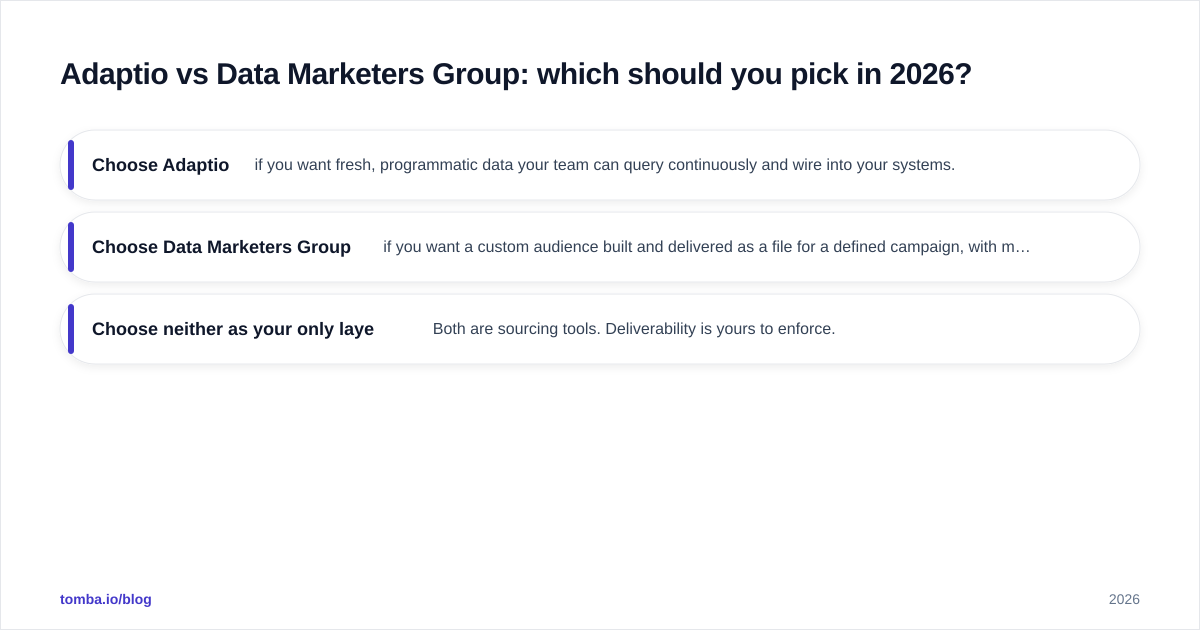
- Choose Adaptio if you want fresh, programmatic data your team can query continuously and wire into your systems.
- Choose Data Marketers Group if you want a custom audience built and delivered as a file for a defined campaign, with minimal technical lift.
- Choose neither as your only layer. Both are sourcing tools. Deliverability is yours to enforce.
If your buying committee is split, run a paired pilot: get a 500-record sample from each, run both through the same verification pass, and compare verified-deliverable rate and cost per usable contact. The vendor that wins on usable contacts — not raw rows — wins your budget. For broader context on evaluating data vendors, peer reviews on G2 and Capterra are useful sanity checks against vendor marketing claims.
One more practical note: whatever you source, dedupe and normalize before import. A clean pipeline beats a big one, and a bulk verify pass on a freshly purchased list routinely removes 15–35% of records that would have bounced.
The bottom line#
Adaptio and Data Marketers Group solve the same problem from opposite ends — platform freshness versus done-for-you delivery. Both are legitimate sourcing options. Neither replaces the verification and finding layer that actually protects your domain and your reply rate.
That's where Tomba fits. Source your audience wherever it makes sense, then use the Tomba Email Finder to find and complete professional email addresses by name, domain, or company — backed by real-time verification so you send to mailboxes that exist, not rows in a spreadsheet. Start free with 25 searches a month, then scale on the Starter plan at $49/mo; see full Tomba pricing when you're ready to run volume. Buy the data from whoever wins your pilot — but verify it before you press send.
Ready to find emails that actually work?
Join 150,000+ professionals who stopped guessing and started sending. Free credits on signup — no credit card required.
Get the Tomba newsletter
Practical outbound tactics and product updates — once every two weeks.
About the author