Adaptio vs Debounce: Which Email Verifier Wins in 2026?
DeBounce is a battle-tested email verifier; Adaptio is the newer challenger. We compare accuracy, pricing, and speed — and show where a unified finder-plus-verifier beats both.
TL;DR
- DeBounce is a mature, pay-as-you-go email verification service known for cheap bulk credits, a solid API, and good catch-all handling — best when verification is all you need.
- Adaptio is the newer, subscription-leaning challenger that bundles verification with enrichment and workflow automation — better if you want cleaning and data in one place.
- On raw accuracy the two are close; the real decision comes down to pricing model (per-email credits vs. flat subscription) and whether you also need to find emails, not just verify them.
- Neither tool finds new contacts. If your bottleneck is sourcing valid B2B emails in the first place, a combined finder + verifier like Tomba removes a step.
- Verify before you send: a clean list protects your sender reputation and keeps you out of spam folders regardless of which tool you pick.
What are Adaptio and Debounce?#
Both Adaptio and DeBounce solve the same core problem: your email list is dirtier than you think, and sending to it will hurt you.
Even a list collected six months ago decays. People change jobs, companies fold, typos slip in, and spam traps get seeded into scraped data. Send to that list as-is and you get hard bounces, a tanking email deliverability score, and eventually a blocked sending domain. An email verifier is the spell-check before you hit send — it pings each address through syntax, DNS/MX, and SMTP checks and tells you which ones are safe to mail.
DeBounce has been doing this since 2016. It is a focused, no-frills verification engine with a generous pay-as-you-go model, a bulk uploader, an email verification API, and integrations into the usual ESP suspects. It is the kind of tool you buy, run a list through, and forget about until next quarter.
Adaptio is the newer entrant. Rather than positioning itself as a pure verifier, it leans toward an all-in-one "data hygiene + enrichment + workflow" angle — verify the address, then append firmographic data and route it into your stack. Because it is younger, its public pricing and feature set move faster, so always confirm the current plan details on its own site before committing.
How does email verification actually work?#
Before comparing the two, it helps to know what either tool is doing under the hood. Every serious verifier runs an address through a pipeline, and the quality of each stage is where accuracy differences come from.
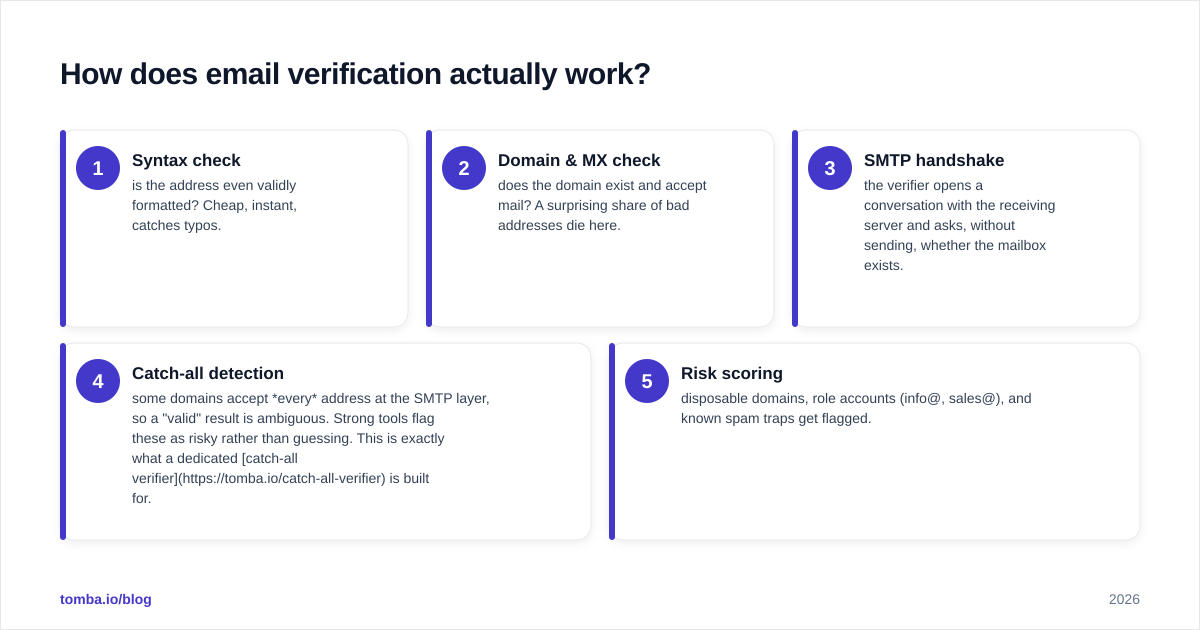
- Syntax check — is the address even validly formatted? Cheap, instant, catches typos.
- Domain & MX check — does the domain exist and accept mail? A surprising share of bad addresses die here.
- SMTP handshake — the verifier opens a conversation with the receiving server and asks, without sending, whether the mailbox exists.
- Catch-all detection — some domains accept every address at the SMTP layer, so a "valid" result is ambiguous. Strong tools flag these as risky rather than guessing. This is exactly what a dedicated catch-all verifier is built for.
- Risk scoring — disposable domains, role accounts (info@, sales@), and known spam traps get flagged.
The takeaway: any verifier can do steps 1–3 well. The separation happens at catch-all and risk handling, and at how aggressively the tool marks ambiguous addresses as "unknown" versus forcing a valid/invalid call. Both DeBounce and Adaptio do all five steps; they differ mainly in pricing and packaging, not in the fundamental method.

Adaptio vs Debounce: feature comparison#
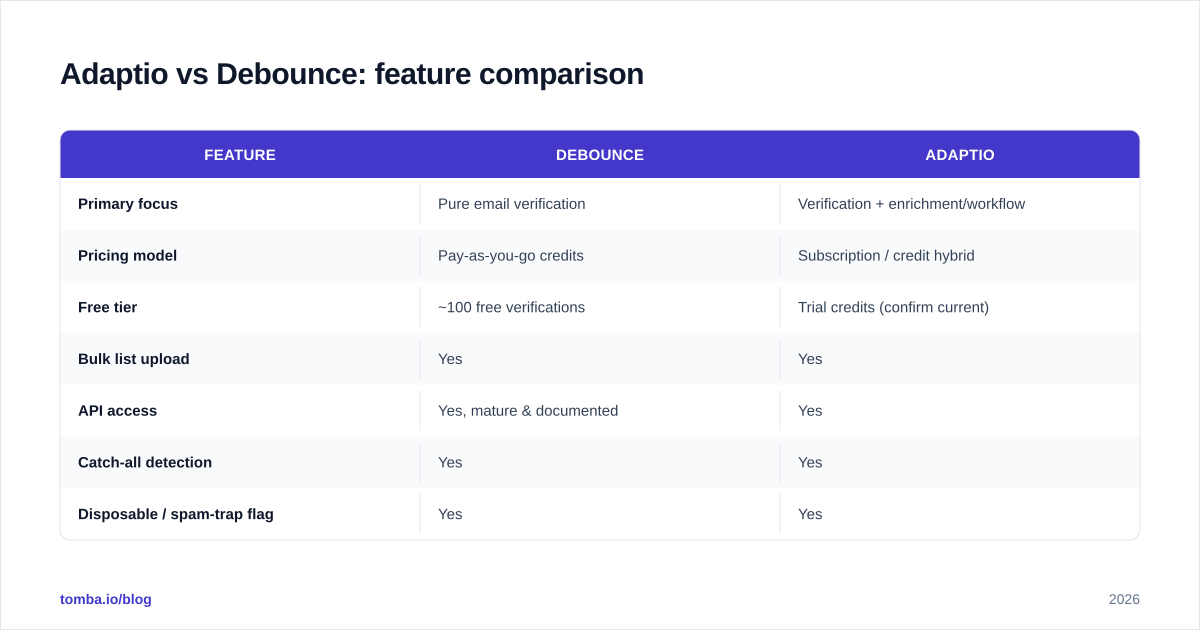
Here is the head-to-head on the attributes that actually change your buying decision. Treat Adaptio's figures as directional — verify current numbers on its site, since newer tools iterate quickly.
| Feature | DeBounce | Adaptio |
|---|---|---|
| Primary focus | Pure email verification | Verification + enrichment/workflow |
| Pricing model | Pay-as-you-go credits | Subscription / credit hybrid |
| Free tier | ~100 free verifications | Trial credits (confirm current) |
| Bulk list upload | Yes | Yes |
| API access | Yes, mature & documented | Yes |
| Catch-all detection | Yes | Yes |
| Disposable / spam-trap flag | Yes | Yes |
| Data enrichment | Limited | Built-in |
| Email finding (sourcing) | No | Limited |
| Best for | Cheap one-off list cleaning | Teams wanting clean + enriched data |
The pattern is clear. DeBounce wins on cost-efficiency and simplicity for pure verification. Adaptio wins if you want verification folded into a broader data workflow and are willing to pay a subscription for the convenience.
How do Adaptio and Debounce price compare?#
Pricing is where most people actually decide, so it deserves its own section.
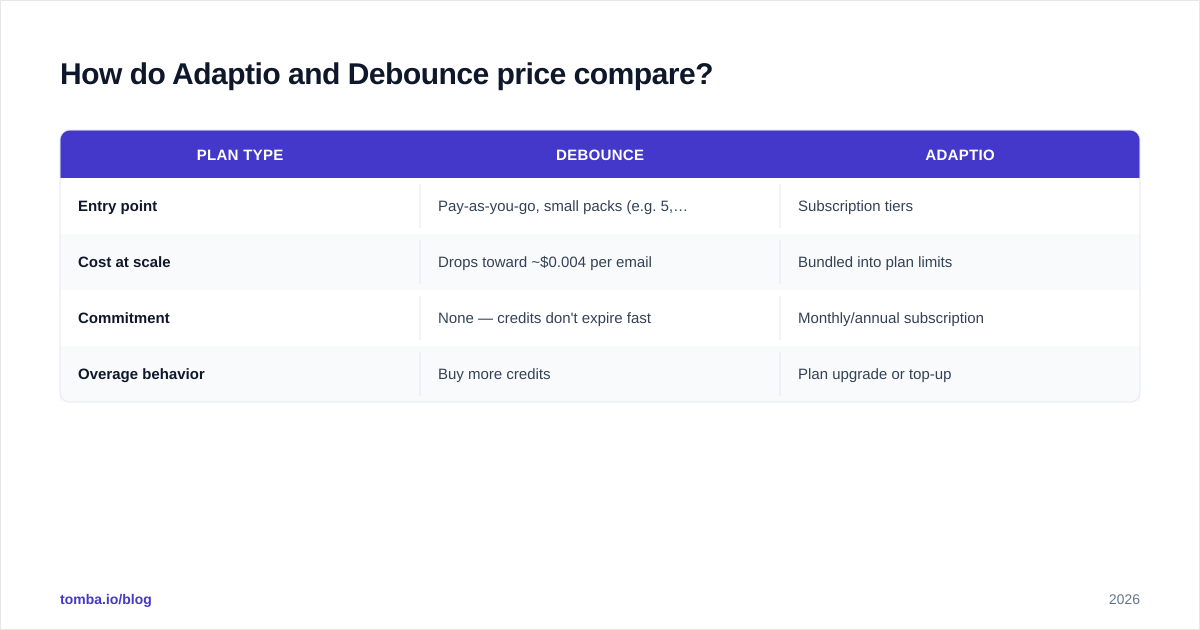
| Plan type | DeBounce | Adaptio |
|---|---|---|
| Entry point | Pay-as-you-go, small packs (e.g. 5,000 credits for ~$10) | Subscription tiers |
| Cost at scale | Drops toward ~$0.004 per email | Bundled into plan limits |
| Commitment | None — credits don't expire fast | Monthly/annual subscription |
| Overage behavior | Buy more credits | Plan upgrade or top-up |
If you verify infrequently — say, one big quarterly list scrub — DeBounce's pay-as-you-go model is hard to beat. You buy exactly what you need and nothing sits idle.
If you verify continuously and want enrichment alongside it, Adaptio's subscription can be more predictable, because per-email math stops mattering and you get the extra data layer.
But notice what both pricing models share: you pay per email you already have. Neither tool generates new contacts. If half your prospecting time goes into finding addresses before you can verify them, the verifier's price is only part of your real cost.

Which one is more accurate?#
Honest answer: close enough that accuracy alone shouldn't decide it. Both tools run the same fundamental SMTP + catch-all pipeline, and independent reviews on platforms like G2 put established verifiers within a few percentage points of each other on clean, mainstream domains.
Where you will see differences:
- Catch-all domains. This is the hardest category in the industry. A tool that marks too many catch-alls as "valid" inflates its accuracy on paper but bounces in reality. Both DeBounce and Adaptio flag these — test each on a sample of your own catch-all-heavy domains rather than trusting a marketing number.
- Greylisting and slow servers. Some mail servers deliberately delay responses. A verifier that times out and guesses will be less accurate than one that retries.
- Freshness of disposable/spam-trap lists. This is where newer tools sometimes lag and older ones sometimes coast on stale data — it cuts both ways.
The practical move: run the same 500-address sample through both, then send a real campaign and compare the actual bounce rate to each tool's prediction. That two-hour test tells you more than any vendor benchmark.
When should you use a finder instead of a verifier?#
This is the question most "X vs Y verifier" posts skip, and it is the one that saves you money.
A verifier only cleans addresses you already have. It is the wrong tool when your real problem is one of these:
- You have a list of companies but not the right contacts at them.
- You have names and companies but no email addresses.
- You are building a net-new prospect list from scratch.
In all three cases, you need an email finder or domain search first — to source the addresses — and then verification. Buying a standalone verifier here means you still have to find the emails somewhere else, paste lists between tools, and reconcile two billing relationships.
That's the structural weakness of the Adaptio-vs-DeBounce framing: it assumes verification is your bottleneck. For most outbound teams in 2026, sourcing valid contacts is the bottleneck, and verification is the easy last mile.
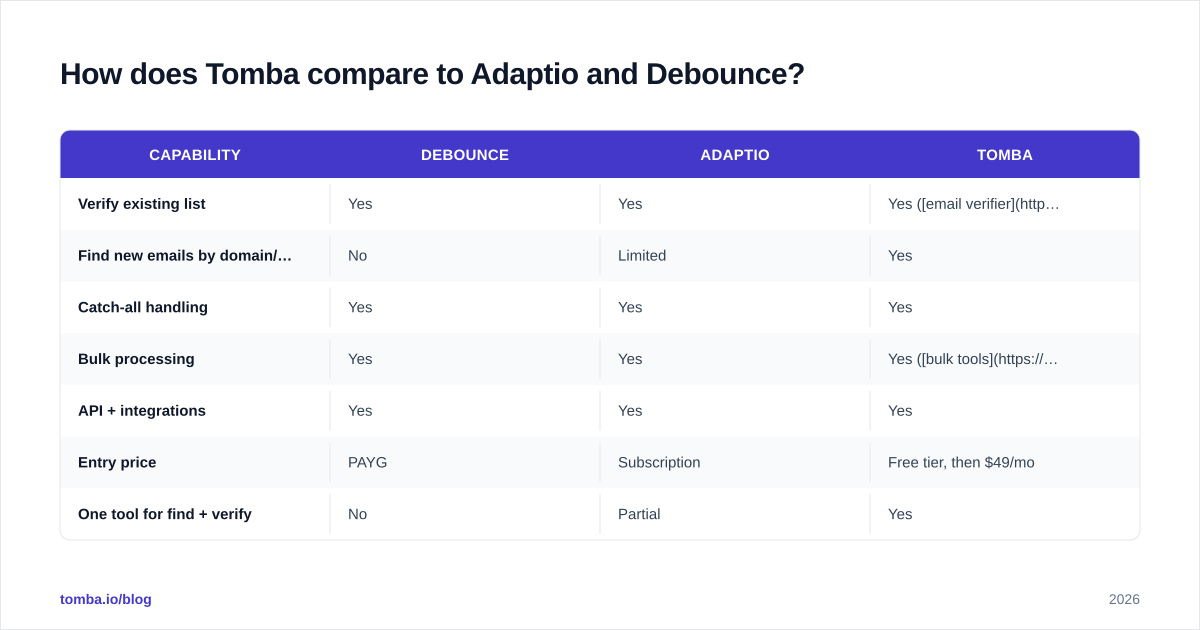
How does Tomba compare to Adaptio and Debounce?#
Tomba approaches the problem from the other end. Instead of being a verifier you bolt onto a finder, it is a finder with verification built in — so the address is checked the moment it is found, not in a separate batch later.
| Capability | DeBounce | Adaptio | Tomba |
|---|---|---|---|
| Verify existing list | Yes | Yes | Yes (email verifier) |
| Find new emails by domain/name | No | Limited | Yes |
| Catch-all handling | Yes | Yes | Yes |
| Bulk processing | Yes | Yes | Yes (bulk tools) |
| API + integrations | Yes | Yes | Yes |
| Entry price | PAYG | Subscription | Free tier, then $49/mo |
| One tool for find + verify | No | Partial | Yes |
Tomba's pricing starts with a free tier (25 searches/month), then Starter at $49/mo, Growth at $99/mo, and Pro at $249/mo, with enterprise pricing on request. The verifier, domain search, catch-all verifier, and enrichment all sit under the same plan — so you are not paying one vendor to find and another to verify.
If you are specifically evaluating DeBounce, it is also worth reading the dedicated DeBounce alternative breakdown, which goes deeper on the verification-only swap.
Which should you choose?#
Decide by what your pipeline is actually missing:
- Choose DeBounce if you already have lists, verify them occasionally, want the lowest possible per-email cost, and don't need enrichment. It is the lean, reliable, pay-only-for-what-you-use option.
- Choose Adaptio if you want verification and a built-in enrichment/workflow layer, prefer a predictable subscription, and your team is fine paying more for that convenience. Confirm its current pricing first.
- Choose Tomba if your real bottleneck is finding valid contacts, not just cleaning a list you already have — and you'd rather find and verify in one tool than stitch two together.
The mistake to avoid is buying a verifier to solve a sourcing problem. Verification is cheap and largely commoditized; the leverage in 2026 is in getting accurate, deliverable contacts into your funnel in the first place.
The bottom line#
Adaptio vs DeBounce is a real choice, but a narrow one: DeBounce is the cheaper, focused verifier, and Adaptio is the richer, subscription-based, enrichment-flavored alternative. Both clean lists competently. Neither builds them.
If you'd rather skip the two-tool dance, start with the Tomba Email Finder — find professional email addresses by domain, name, or company, with verification and catch-all detection built into the same workflow. Spin up the free tier, run your next prospect list through it, and see whether you still need a standalone verifier at all. Most teams find one tool does the job two were doing.
Ready to find emails that actually work?
Join 150,000+ professionals who stopped guessing and started sending. Free credits on signup — no credit card required.
Get the Tomba newsletter
Practical outbound tactics and product updates — once every two weeks.
About the author