Adaptio vs Emailvalidationio (2026): Which Email Verifier Wins?
A neutral, hands-on breakdown of Adaptio vs Emailvalidationio in 2026 — accuracy, catch-all handling, API speed, and pricing — so you pick the right email verifier.
TL;DR
- Adaptio leans toward an adaptive, signal-rich verification engine that scores risk rather than handing you a flat valid/invalid label — useful when you care about catch-all and role-based nuance.
- Emailvalidationio (emailvalidation.io) is a lightweight, developer-first REST API with a generous free tier and predictable per-check pricing — fast to wire up, lean on extras.
- For raw deliverability protection, both will catch the obvious junk; the gap shows up on catch-all domains, greylisting, and disposable detection.
- If you need verification and sourcing in one place, a combined finder-plus-verifier like Tomba usually beats stitching two single-purpose APIs together.
- Pick on three axes: accuracy on hard mailboxes, API ergonomics, and total cost at your real monthly volume — not the headline price.
What are Adaptio and Emailvalidationio?#
Both Adaptio and Emailvalidationio are email verification tools — they take an address and tell you whether sending to it is safe. The difference is philosophy.
Emailvalidationio (the API at emailvalidation.io) is a classic syntax-plus-SMTP checker exposed as a simple REST endpoint. You pass an email, you get back a JSON object: format valid, MX records found, SMTP check, disposable flag, free-provider flag, role flag, and a deliverability verdict. It is built to be dropped into a signup form or a batch job in an afternoon.
Adaptio positions itself around adaptive scoring — instead of a binary verdict, it weighs multiple signals (domain reputation, mailbox behavior, catch-all probability) into a confidence score. The pitch is that a score survives edge cases better than a hard label, especially on domains that accept everything.
If you are new to the space, our email verifier glossary and the email deliverability primer explain why this layer matters before you ever hit send.
How does email verification actually work?#
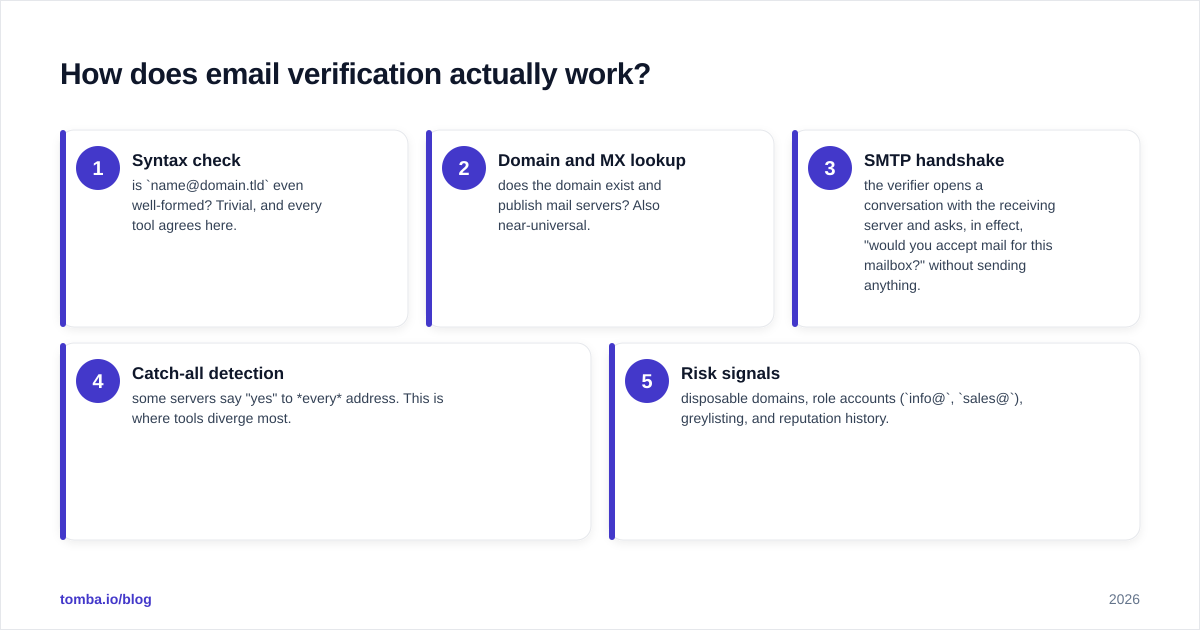
Every verifier — Adaptio, Emailvalidationio, or anyone else — runs the same core pipeline. Understanding it tells you where two tools can legitimately disagree.
- Syntax check — is
name@domain.tldeven well-formed? Trivial, and every tool agrees here. - Domain and MX lookup — does the domain exist and publish mail servers? Also near-universal.
- SMTP handshake — the verifier opens a conversation with the receiving server and asks, in effect, "would you accept mail for this mailbox?" without sending anything.
- Catch-all detection — some servers say "yes" to every address. This is where tools diverge most.
- Risk signals — disposable domains, role accounts (
info@,sales@), greylisting, and reputation history.
Think of it like a doorman checking a guest list. Steps 1–3 are reading the name off an ID. Step 4 is the building where the doorman waves everyone in — now your "valid" result is really a guess, and the quality of that guess is the entire ballgame.
This is why two verifiers can score the same address differently. Emailvalidationio tends to return a clear flag set and a verdict; Adaptio tends to return a graded probability. Neither is wrong — they answer slightly different questions.
Adaptio vs Emailvalidationio: the head-to-head table#
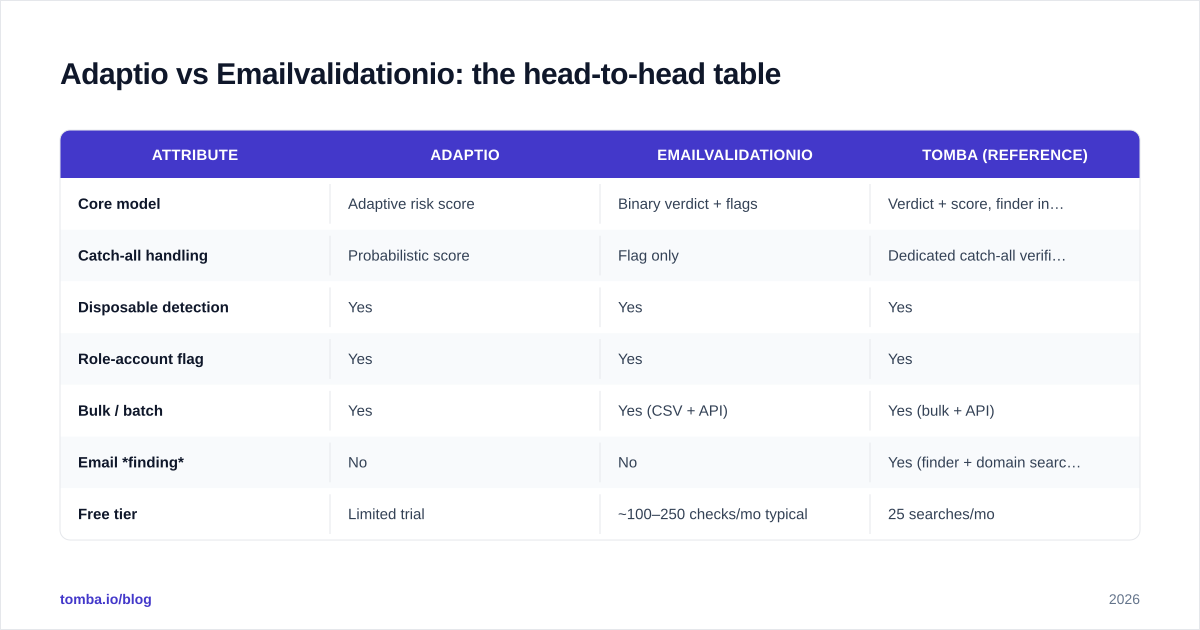
Here is the practical comparison. Treat vendor-specific pricing as a starting point and confirm on each provider's own page before you commit — verification pricing changes often.
| Attribute | Adaptio | Emailvalidationio | Tomba (reference) |
|---|---|---|---|
| Core model | Adaptive risk score | Binary verdict + flags | Verdict + score, finder included |
| Catch-all handling | Probabilistic score | Flag only | Dedicated catch-all verifier |
| Disposable detection | Yes | Yes | Yes |
| Role-account flag | Yes | Yes | Yes |
| Bulk / batch | Yes | Yes (CSV + API) | Yes (bulk + API) |
| Email finding | No | No | Yes (finder + domain search) |
| Free tier | Limited trial | ~100–250 checks/mo typical | 25 searches/mo |
| Entry paid plan | Volume-based | Per-check credit packs | $49/mo Starter |
| Best for | Risk-tolerant scoring | Lightweight API drop-in | Find + verify in one stack |
A few honest caveats. The exact free-tier counts and per-check costs above reflect typical positioning for tools in this class; verify the live numbers at emailvalidation.io and on Adaptio's pricing page. For Tomba the numbers are firm: a free tier of 25 searches per month, then Tomba pricing runs Starter at $49/mo, Growth at $99/mo, and Pro at $249/mo.
Which one is more accurate?#
Accuracy on the easy 80% of a list is effectively a tie — both reject malformed addresses, dead domains, and known disposables. The real test is the hard 20%: catch-all domains, freshly registered domains, greylisting servers that defer the first connection, and ESPs that hide mailbox existence on purpose.
On those cases, a scoring model (Adaptio) has an edge in expressiveness — a 0.62 confidence tells you "risky, segment this" instead of forcing a coin-flip. A binary verifier (Emailvalidationio) is easier to act on programmatically — deliverable: true either gates the send or it doesn't — but it can be over-confident on catch-all domains where no verifier can truly know.
The independent way to settle this for your data: take 1,000 addresses you already know the outcome for (from past sends), run both tools, and compare their verdicts against your real bounce log. Accuracy claims from any vendor mean nothing until they're tested on your list shape. Review platforms like G2 are useful for sentiment, but they are not a substitute for a controlled test.
For catch-all domains specifically — the single biggest source of "the tool said valid but it bounced" complaints — a dedicated catch-all verifier does deeper probing than a generic flag, and it's worth checking whether either Adaptio or Emailvalidationio matches that depth on the domains you actually email.

How do the APIs and integrations compare?#
If you're a developer, ergonomics matter as much as accuracy.
Emailvalidationio is intentionally minimal: one endpoint, an API key as a query parameter, and a flat JSON response. That simplicity is the feature — there's almost nothing to learn, and it slots into a form-validation flow or a nightly cron job without a wrapper library.
Adaptio exposes its scoring, which means a slightly richer response object and a small amount of logic on your side to map scores to actions (accept / review / reject thresholds). More power, marginally more integration work.
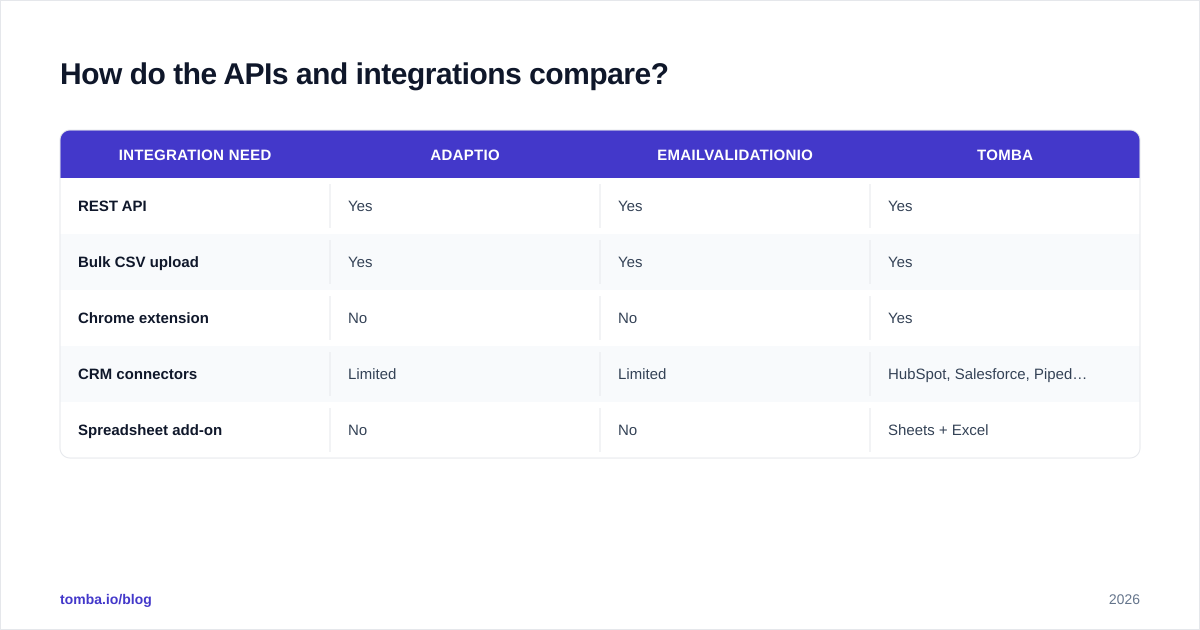
Where both single-purpose APIs fall short is the rest of the workflow. You still need somewhere to get the addresses, push verified contacts into a CRM, and dedupe. That's why teams often consolidate. Tomba ships a documented email verification API alongside the finder, plus native HubSpot integration and a Google Sheets add-on, so verification isn't a bolted-on island.
| Integration need | Adaptio | Emailvalidationio | Tomba |
|---|---|---|---|
| REST API | Yes | Yes | Yes |
| Bulk CSV upload | Yes | Yes | Yes |
| Chrome extension | No | No | Yes |
| CRM connectors | Limited | Limited | HubSpot, Salesforce, Pipedrive |
| Spreadsheet add-on | No | No | Sheets + Excel |
What does each one cost at real volume?#
Headline prices mislead because verification cost scales with volume, and the shape of your usage decides the winner.
- Spiky, low volume (a signup form verifying a few hundred emails a month): Emailvalidationio's free or small credit pack usually wins. You're paying for simplicity.
- Steady mid volume with a need to triage risk: Adaptio's scoring can reduce wasted sends, which offsets a higher per-check cost — but only if you actually use the scores to segment.
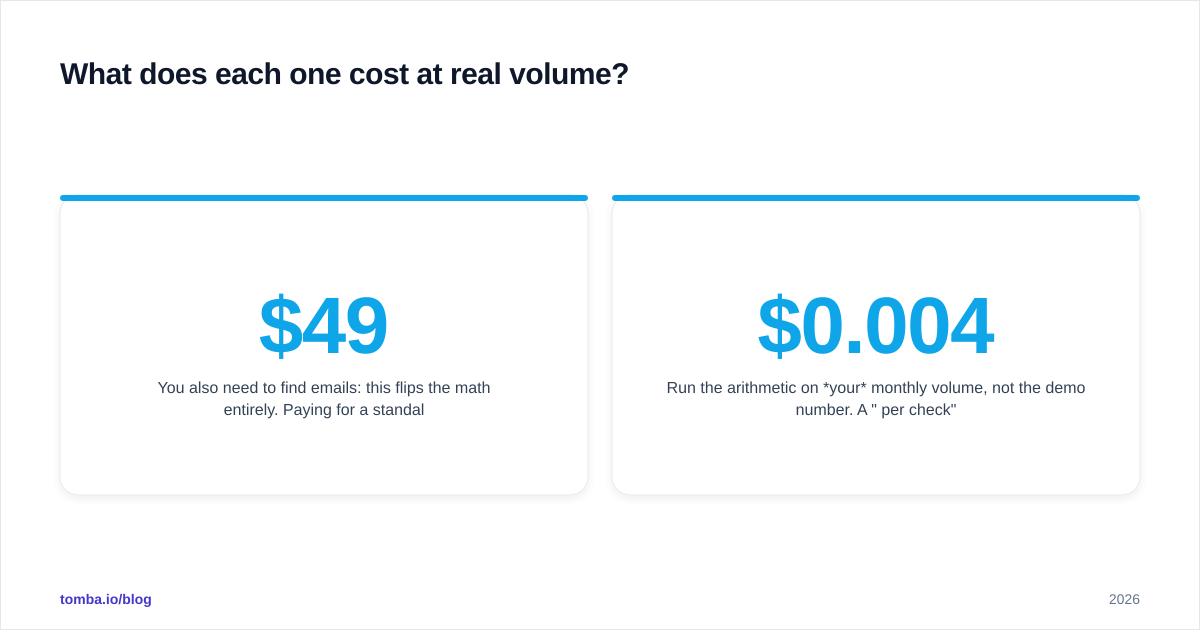
- You also need to find emails: this flips the math entirely. Paying for a standalone verifier and a separate finder is almost always more expensive than one tool that does both. At $49/mo, Tomba's Starter covers finding and verifying together; see the full pricing details.
Run the arithmetic on your monthly volume, not the demo number. A "$0.004 per check" tool sounds cheaper than "$49/mo" right up until you're checking 200,000 addresses a month.
When should you choose Adaptio vs Emailvalidationio?#
Choose Emailvalidationio if: you want the fastest possible API to drop into a form, you verify modest volumes, and a clean binary verdict is all your downstream logic needs. It's the no-friction pick for developers who want one endpoint and out.
Choose Adaptio if: you operate at enough volume that nuanced risk scoring saves real money, you're comfortable writing threshold logic, and catch-all-heavy lists are your norm. The scoring model earns its keep when you actually segment on it.
Choose a combined platform (like Tomba) if: your real job is building and cleaning a prospect list, not just rating addresses someone else gave you. If you find yourself reaching for a separate email finder or domain search anyway, you're already paying the integration tax that a unified tool removes. For broader context on the category, the ZeroBounce alternative breakdown compares verification-first players head to head.
One more honest note: no verifier replaces good list hygiene. Even a perfect verdict decays — people change jobs, domains lapse. Pair verification with sender reputation monitoring and regular re-verification, and you'll beat any single tool's score on its own.
Frequently asked questions#
Is Adaptio or Emailvalidationio better for cold email? For cold outreach the binary-vs-score difference matters less than catch-all depth and disposable detection. Test both on a known list; whichever produces a lower bounce rate on your sends wins. And remember you still need to source addresses first — neither finds emails.
Can either tool find email addresses? No. Both Adaptio and Emailvalidationio verify addresses you already have. To find them, you need a finder such as the Tomba Email Finder or a bulk email finder for lists.
Do verifiers guarantee zero bounces? No tool can. Catch-all domains and post-verification churn mean a small residual bounce rate is normal. Treat any "100% accuracy" claim with skepticism and verify against your own bounce data.
Which is cheaper? It depends entirely on volume. Per-check pricing favors low, spiky usage; subscription pricing favors steady high usage; a combined find-plus-verify tool wins when you'd otherwise buy two products.
The verdict#
Adaptio and Emailvalidationio are both competent at the core job, and on the easy majority of any list they'll perform indistinguishably. The decision comes down to how you want the answer: a graded risk score you'll act on programmatically (Adaptio), or a dead-simple binary verdict you can wire up in minutes (Emailvalidationio). On the hard 20% — catch-all, greylisting, disposables — neither is magic, so test both on your own data before committing budget.
But step back and ask what you're really trying to do. If the answer is "build a clean, reachable prospect list," verification is only half the workflow. Tomba combines finding and verifying in one platform — the email finder, domain search, and email verifier share the same data layer, so you find an address, confirm it's deliverable, and push it to your CRM without stitching two APIs together. Start free with 25 searches a month, and scale to the $49/mo Starter plan when you're ready. Try the Tomba Email Finder and skip the two-tool tax.
Ready to find emails that actually work?
Join 150,000+ professionals who stopped guessing and started sending. Free credits on signup — no credit card required.
Get the Tomba newsletter
Practical outbound tactics and product updates — once every two weeks.
About the author