Adaptio vs Findymail (2026): Which Prospecting Tool Wins?
Adaptio leans into AI LinkedIn outreach; Findymail focuses on verified B2B emails. Here's an honest, side-by-side look at which one earns a spot in your 2026 stack.
Picking between Adaptio and Findymail trips up a lot of sales teams because the two tools look similar on a feature list but solve different halves of the same problem. One wants to run your outreach. The other wants to feed it clean data. Confusing them leads to overpaying for overlap or, worse, building a workflow on the wrong foundation.
This is a neutral, side-by-side breakdown of where each tool actually earns its keep in 2026 — and where a dedicated data layer beats both.
TL;DR#
- Findymail is a focused B2B email-finding and verification tool. Its pitch is deliverability: verified emails, low bounce rates, and LinkedIn/Sales Navigator list exports.
- Adaptio is an AI-driven LinkedIn outreach and sequencing platform. Its pitch is automation: personalized messaging, multichannel cadences, and reply handling.
- They overlap less than the "vs" framing suggests — Findymail finds contacts, Adaptio works them. Many teams run both.
- If your bottleneck is bad data, neither replaces a dedicated finder-plus-verifier layer with transparent sourcing.
- Budget-conscious teams should map the workflow first (find → verify → enrich → send), then buy per stage instead of one bundled subscription.
What is Adaptio?#
Adaptio is an AI outreach platform built primarily around LinkedIn and email sequencing. Its core promise is taking a list of prospects and turning it into running, personalized campaigns with minimal manual writing. Think connection requests, follow-up messages, and email steps generated and timed by AI, then routed based on whether a prospect replies, opens, or ignores.
The analogy: Adaptio is the kitchen line that cooks and plates the meal. It assumes the ingredients — your prospect list and their contact details — already exist. It excels at activity: sending the right message to the right person at the right cadence, across channels, without a rep hand-typing each touch.
That makes Adaptio strongest for teams whose problem is throughput and personalization at scale, especially social-first sellers running heavy LinkedIn outreach. Where it's weaker: it is not a data vendor. The quality of contacts you load in determines everything downstream, and Adaptio doesn't pretend to be a sourcing-grade database.
What is Findymail?#
Findymail is a B2B email finder and verifier with a deliverability-first reputation. Its bread and butter is pulling verified email addresses from LinkedIn and Sales Navigator searches, then validating them so your bounce rate stays low. You can read its own positioning on the Findymail homepage.
The analogy: Findymail is the trusted grocer. It sources the ingredients and checks each one for freshness before it reaches your kitchen. It cares far less about cooking the meal — it has light list management and exports, but it isn't trying to run your multichannel cadence.
Findymail is strongest when your bottleneck is data quality and bounce rates. Reps love it for one-click list building off LinkedIn. Its limit is the same as its focus: it finds and verifies, but it won't sequence, personalize at scale, or manage replies. You pair it with a sending tool — which is exactly why people compare it to Adaptio in the first place.
Adaptio vs Findymail: the core difference#
The single most useful thing to internalize: these tools sit at opposite ends of the same pipeline.
- Findymail answers "who do I contact and is this email real?"
- Adaptio answers "how do I message them, across channels, at scale?"
A typical outbound motion runs four stages — find, verify, enrich, send. Findymail owns the first two well. Adaptio owns the last one well. Neither covers the full chain with the depth a specialist brings, which is why a clean data foundation underneath both tends to matter more than the Adaptio-vs-Findymail decision itself.
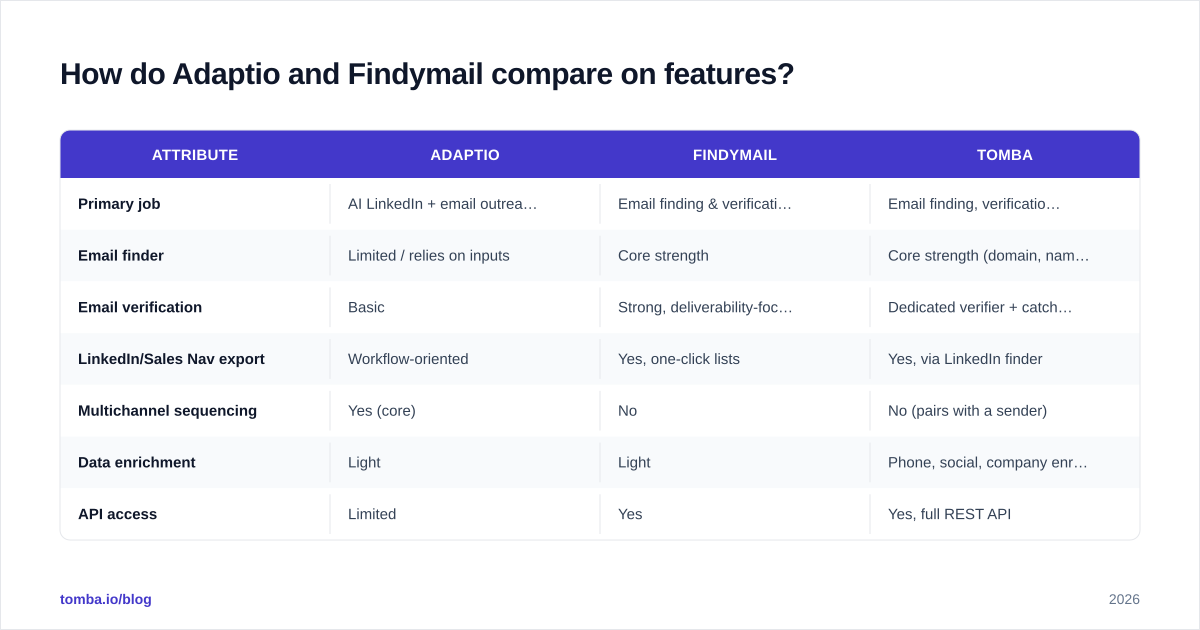
How do Adaptio and Findymail compare on features?#
| Attribute | Adaptio | Findymail | Tomba |
|---|---|---|---|
| Primary job | AI LinkedIn + email outreach | Email finding & verification | Email finding, verification & enrichment |
| Email finder | Limited / relies on inputs | Core strength | Core strength (domain, name, company) |
| Email verification | Basic | Strong, deliverability-focused | Dedicated verifier + catch-all checks |
| LinkedIn/Sales Nav export | Workflow-oriented | Yes, one-click lists | Yes, via LinkedIn finder |
| Multichannel sequencing | Yes (core) | No | No (pairs with a sender) |
| Data enrichment | Light | Light | Phone, social, company enrichment |
| API access | Limited | Yes | Yes, full REST API |
| Free tier | Trial-based | Limited free credits | 25 searches/mo free |
| Best for | Social-first SDR teams | Low-bounce list building | Accurate data at any scale |
The table makes the trap obvious: people frame this as Adaptio or Findymail, but the only column where they truly collide is "primary job," and even there they barely touch. The realistic question is whether you need a sender (Adaptio) or a data source (Findymail) — and whether one combined bill is worth it versus buying each stage from a specialist.
Which one is more accurate?#
Accuracy only applies to one of these tools in a meaningful way. Adaptio's quality is judged by reply rates and personalization — outputs of sending. Findymail's quality is judged by bounce rate and valid-email percentage — the only metric that matters for a data tool.
Findymail earns its deliverability-first reputation, but accuracy claims across the email-finder category vary a lot by domain type, region, and whether the provider re-verifies in real time. Catch-all domains are where most tools quietly fail: they return a syntactically valid address that no mailbox actually receives. If your lists are heavy on catch-all domains, a dedicated catch-all verifier and a real-time email verifier step matter more than any headline accuracy number on a pricing page.
A simple rule: never trust a finder's accuracy claim without a verification pass you control. Run a sample of 500 contacts, send through a verifier, and measure the actual valid rate. Whatever survives is your real number. For background on how address validity is determined at the protocol level, the email address standard (RFC syntax plus SMTP behavior) is the reference both finders and verifiers build on.
How does pricing compare?#
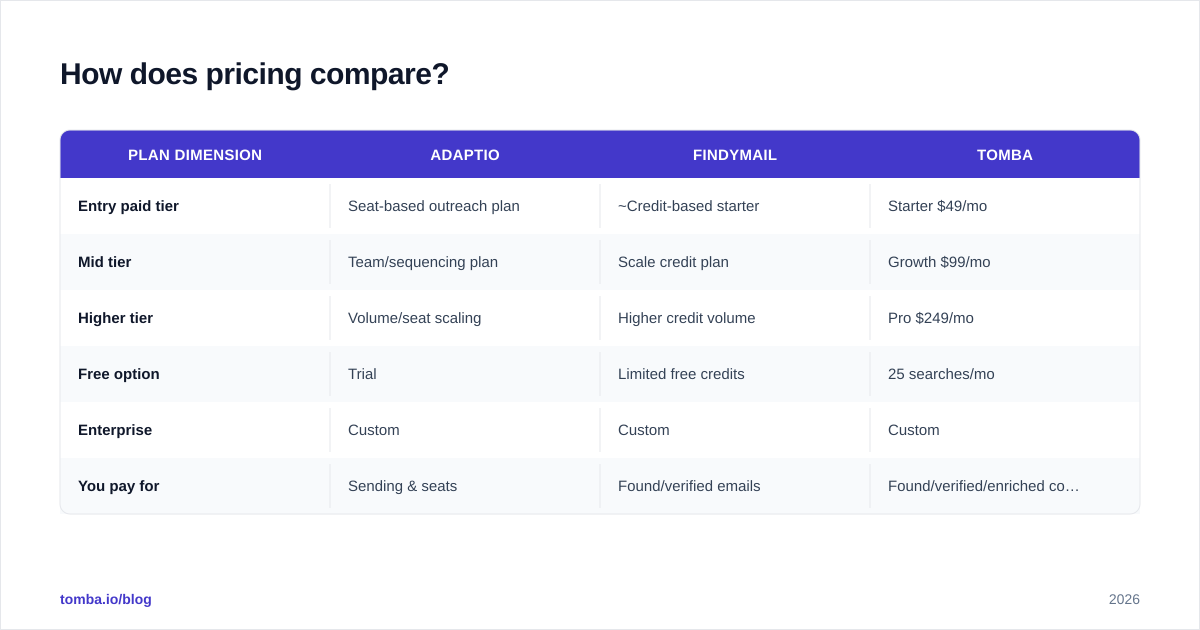
Pricing structures differ because the products differ. Adaptio prices around seats and sending volume (the cost of activity). Findymail prices around credits — emails found and verified (the cost of data). That makes a clean dollar-for-dollar comparison misleading; you're buying different units.
| Plan dimension | Adaptio | Findymail | Tomba |
|---|---|---|---|
| Entry paid tier | Seat-based outreach plan | ~Credit-based starter | Starter $49/mo |
| Mid tier | Team/sequencing plan | Scale credit plan | Growth $99/mo |
| Higher tier | Volume/seat scaling | Higher credit volume | Pro $249/mo |
| Free option | Trial | Limited free credits | 25 searches/mo |
| Enterprise | Custom | Custom | Custom |
| You pay for | Sending & seats | Found/verified emails | Found/verified/enriched contacts |
Always confirm live numbers on each vendor's own page before you buy — outreach and data tools both rev their pricing often. For Tomba's current published tiers, see the Tomba pricing page. The strategic point stands regardless of the exact figures: paying one bundled subscription rarely beats matching spend to your actual bottleneck. If bounce rate is your pain, more sending seats won't fix it. If reply volume is your pain, cleaner emails alone won't fix it either.
When should you choose Adaptio?#
Choose Adaptio when your contact data is already solid and your constraint is execution. Specifically:
- You run LinkedIn-led or multichannel outbound and want AI to draft and time touches.
- Your reps spend too long hand-personalizing and you want consistent cadence at volume.
- You already have a trusted source of verified emails feeding the top of funnel.
- Reply handling and sequence branching are where deals slip today.
Adaptio is a poor fit if your lists are stale or unverified. Automating outreach on bad data just scales your bounce problem and burns sender reputation faster. Sequencing tools amplify whatever data you give them — good or bad. Validate the input first or the AI personalization is wasted on dead inboxes. Check current user feedback on G2 to see how teams rate its sequencing depth against your specific use case.

When should you choose Findymail?#
Choose Findymail when your constraint is data quality, not sending. Specifically:
- You build prospect lists off LinkedIn or Sales Navigator and want one-click, verified exports.
- Bounce rate is hurting deliverability and you need a finder that re-verifies.
- You already have a sequencer (Adaptio, or another sender) and just need clean fuel for it.
- You want a focused tool rather than a broad platform you'll only half-use.
Findymail is a poor fit if you expected it to run campaigns — it doesn't, and pairing it with a sender is the intended design. It's also worth checking how it handles catch-all domains and non-US regions against your target market, since coverage varies across every provider in this space.
Is there a better alternative to both?#
Often, yes — because the real decision isn't Adaptio vs Findymail, it's where your pipeline actually breaks. If the break is in data (the most common case), a dedicated finder-and-verifier layer with transparent sourcing usually beats both a sequencer's light data features and a single-vendor lock-in.
That's where Tomba fits. It covers the find and verify stages that Adaptio depends on and that Findymail specializes in — then adds enrichment and an API so the data flows wherever your sender lives:
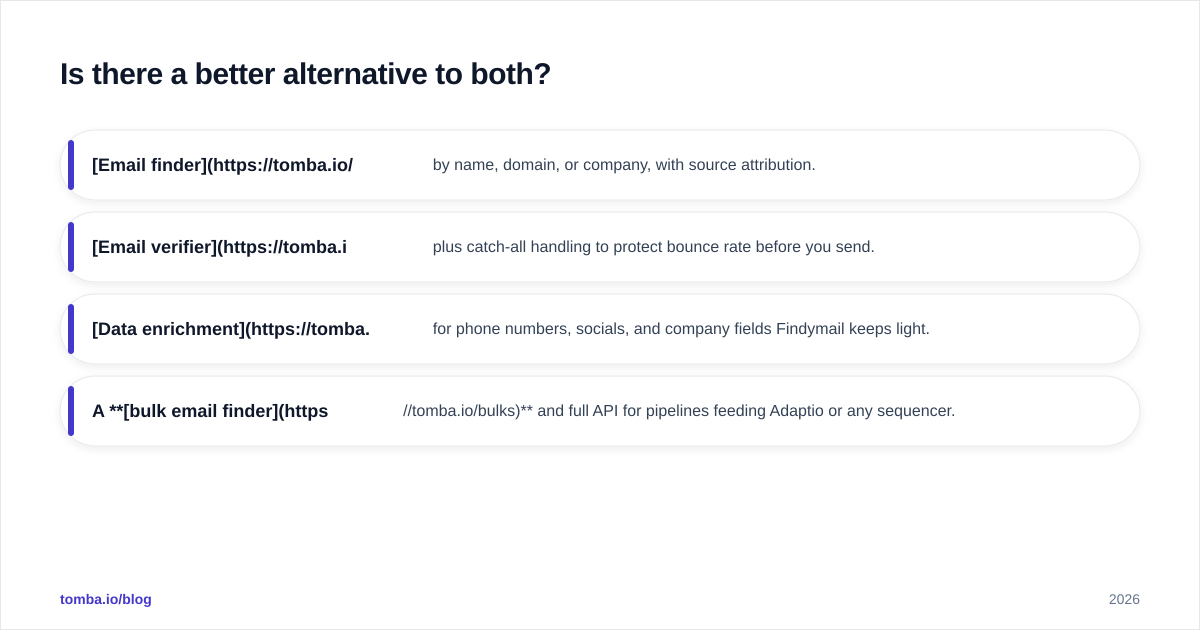
- Email finder by name, domain, or company, with source attribution.
- Email verifier plus catch-all handling to protect bounce rate before you send.
- Data enrichment for phone numbers, socials, and company fields Findymail keeps light.
- A bulk email finder and full API for pipelines feeding Adaptio or any sequencer.
| Decision | Pick |
|---|---|
| I need AI to run my outreach | Adaptio (+ a clean data source) |
| I need verified emails for an existing sender | Findymail or Tomba |
| I need find + verify + enrich + API in one data layer | Tomba |
| I'm a social-first SDR with good data | Adaptio |
| My bounce rate is wrecking deliverability | Tomba / Findymail verification |
If you're specifically evaluating a switch, the Findymail alternative breakdown goes deeper on data coverage and pricing trade-offs.
How do you actually decide?#
Run this in order — it takes an afternoon and saves a year of wrong-tool regret:
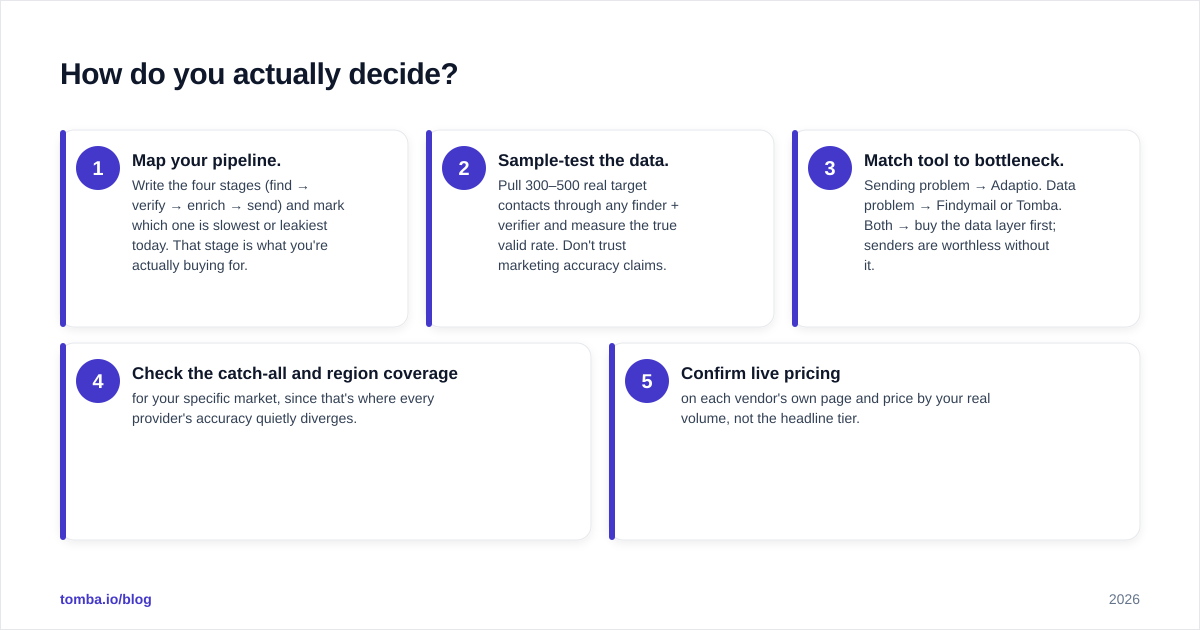
- Map your pipeline. Write the four stages (find → verify → enrich → send) and mark which one is slowest or leakiest today. That stage is what you're actually buying for.
- Sample-test the data. Pull 300–500 real target contacts through any finder + verifier and measure the true valid rate. Don't trust marketing accuracy claims.
- Match tool to bottleneck. Sending problem → Adaptio. Data problem → Findymail or Tomba. Both → buy the data layer first; senders are worthless without it.
- Check the catch-all and region coverage for your specific market, since that's where every provider's accuracy quietly diverges.
- Confirm live pricing on each vendor's own page and price by your real volume, not the headline tier.
The teams that get this right almost always separate the two jobs: one tool to source and verify accurate contacts, one tool to send. Bundling feels simpler but usually means overpaying for the half you don't need.
The bottom line#
Adaptio and Findymail aren't really competitors — they're neighbors. Adaptio wins if your data is clean and you need AI to run multichannel outreach. Findymail wins if your sequencer is set and you need low-bounce, verified emails feeding it. The mistake is treating either as a complete outbound stack.
If accurate, well-sourced contact data is the foundation everything else rests on, start there. Tomba's Email Finder gives you verified emails by name, domain, or company — with a free tier of 25 searches a month, a Starter plan at $49/mo, and a full API to push clean data straight into Adaptio, Findymail's exports, or whatever sender you already trust. Fix the data layer first, and the Adaptio-vs-Findymail question mostly answers itself.
Ready to find emails that actually work?
Join 150,000+ professionals who stopped guessing and started sending. Free credits on signup — no credit card required.
Get the Tomba newsletter
Practical outbound tactics and product updates — once every two weeks.
About the author