Adaptio vs LeadsGorilla 2026: Which Lead Tool Wins?
Adaptio vs LeadsGorilla: a neutral 2026 breakdown of data sources, pricing, ideal users, and where each lead-gen tool actually earns its seat in your stack.
Choosing between Adaptio and LeadsGorilla usually means you are solving two different problems and trying to use one budget line to do it. One leans toward AI-assisted B2B prospecting and outreach; the other was built to help agencies find and close local business clients. They overlap enough to confuse a buyer and differ enough to waste your money if you pick wrong.
This is a neutral teardown. No vendor here is paying for a verdict. Where Tomba is a better fit for a specific job, we say so — and where it is not, we say that too.
TL;DR — Adaptio vs LeadsGorilla in 30 seconds#
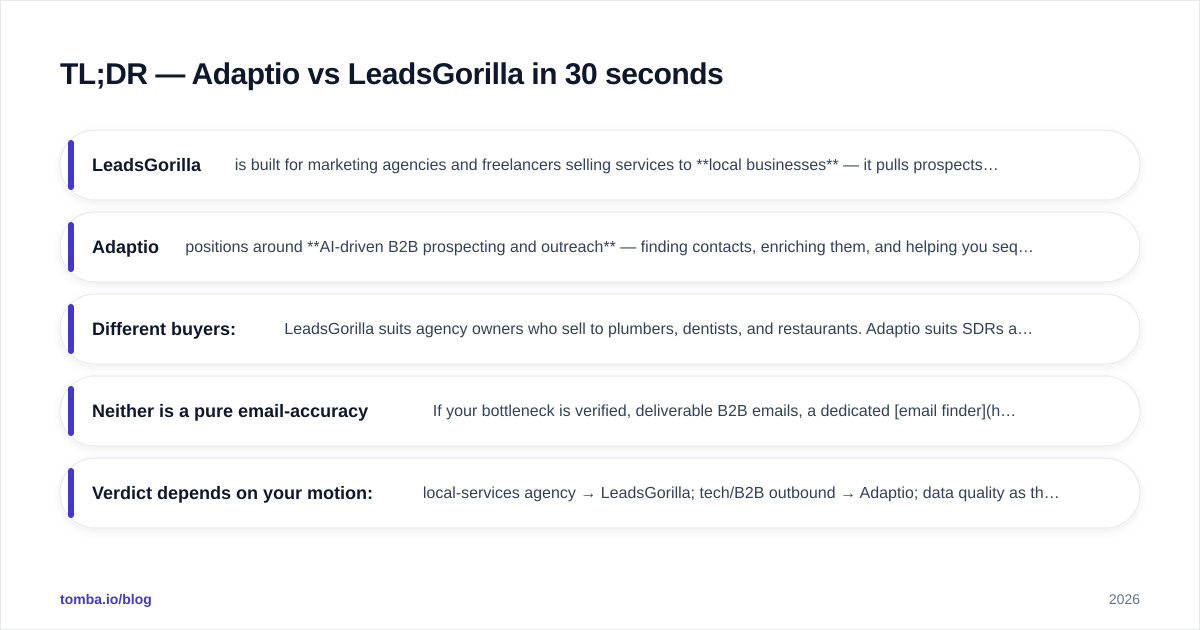
- LeadsGorilla is built for marketing agencies and freelancers selling services to local businesses — it pulls prospects from Google Maps and social platforms, scores them, and auto-generates audit reports you can use as a foot in the door.
- Adaptio positions around AI-driven B2B prospecting and outreach — finding contacts, enriching them, and helping you sequence messages at scale.
- Different buyers: LeadsGorilla suits agency owners who sell to plumbers, dentists, and restaurants. Adaptio suits SDRs and founders running outbound to other companies.
- Neither is a pure email-accuracy engine. If your bottleneck is verified, deliverable B2B emails, a dedicated email finder plus email verifier will out-perform a bundled lead tool on that one job.
- Verdict depends on your motion: local-services agency → LeadsGorilla; tech/B2B outbound → Adaptio; data quality as the priority → pair either with a specialist finder.
What is LeadsGorilla?#
LeadsGorilla is lead-generation software aimed squarely at agencies and consultants who sell marketing services to local businesses. You search a niche and location — say "dentists in Austin" — and it returns a list of businesses scraped from sources like Google Maps and Facebook, each with a proprietary "lead score."
The score is the hook. It estimates how much a business needs help (missing website, poor reviews, unclaimed listings, no Facebook pixel) so you can prioritize the prospects most likely to buy SEO, ads, or reputation management. LeadsGorilla then generates a branded audit/PDF report you can email or present as a pitch. That report-as-icebreaker workflow is the product's real differentiator.
It is a closing tool dressed as a lead tool. The leads are a means to the report, and the report is a means to the sales conversation.
What is Adaptio?#
Adaptio sits in the B2B prospecting and outreach category. The pitch is finding the right business contacts, enriching them with firmographic and contact data, and using AI to help you reach out — closer to the world of sales-engagement platforms and contact databases than to local-business audits.
Where LeadsGorilla cares about "which local business is failing at marketing," Adaptio cares about "which decision-maker at a target company should I email, and what do I say." That makes it relevant to SDR teams, founders doing their own outbound, and growth marketers running campaigns against a defined ICP.
Because the lead-intelligence space moves fast and feature sets change quarterly, confirm the current capabilities on the vendor's own site and cross-check user reviews on G2 and Capterra before you commit budget. Treat any feature list — including this one — as a starting point for your own trial, not gospel.
Adaptio vs LeadsGorilla: side-by-side comparison#
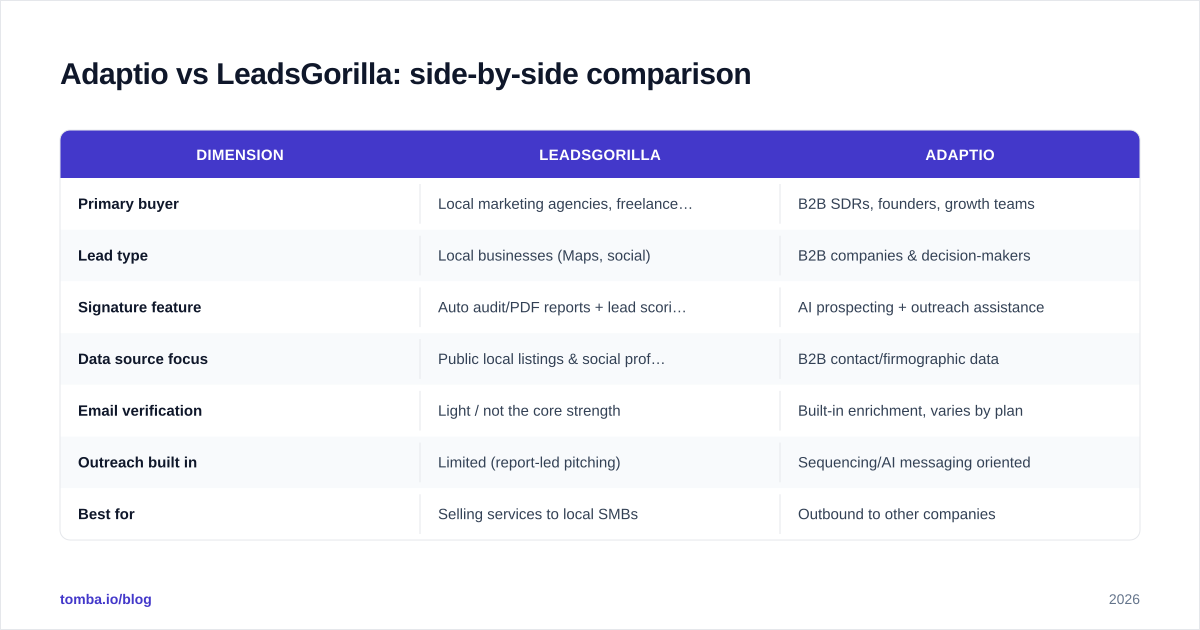
The table below maps the two tools on the dimensions that actually change a buying decision. Pricing tiers move often; the figures are representative of how each tool packages value, not a live quote — always verify on the vendor site.
| Dimension | LeadsGorilla | Adaptio |
|---|---|---|
| Primary buyer | Local marketing agencies, freelancers | B2B SDRs, founders, growth teams |
| Lead type | Local businesses (Maps, social) | B2B companies & decision-makers |
| Signature feature | Auto audit/PDF reports + lead scoring | AI prospecting + outreach assistance |
| Data source focus | Public local listings & social profiles | B2B contact/firmographic data |
| Email verification | Light / not the core strength | Built-in enrichment, varies by plan |
| Outreach built in | Limited (report-led pitching) | Sequencing/AI messaging oriented |
| Best for | Selling services to local SMBs | Outbound to other companies |
| Weak spot | Not built for B2B SaaS outbound | Overkill for local-services agencies |
Read the table as a fit test, not a scoreboard. A tool "losing" a row it was never designed for is irrelevant if that row is not your job.
How do I choose between them? A simple framework#
Pick based on who you sell to and what your bottleneck is — not on feature counts. The decision tree below is the one we'd actually use.
Work it in this order:
- Who is your customer? If you sell websites, SEO, or ads to local businesses, LeadsGorilla's audit-report motion is purpose-built for that pitch. If you sell to other companies, that motion is useless to you and Adaptio's B2B orientation wins.
- What breaks first in your funnel? If you have plenty of names but can't book meetings, you need a better pitch asset (LeadsGorilla's reports) or better messaging (Adaptio's AI outreach). If you have a great pitch but bad contact data, neither bundle fixes that as well as a dedicated finder.
- How much do you send? High-volume B2B outbound lives or dies on deliverability. That pushes you toward verified data and a real email verifier, regardless of which platform sources your list.
Which has better data quality?#
Honest answer: it depends on the segment, and you should verify before trusting either at scale. LeadsGorilla's strength is breadth of local business listings; its email data is a byproduct of scraping public profiles, so expect more generic addresses (info@, contact@) and some staleness. Adaptio focuses on B2B contacts, which tends to mean more role-based and named-person data — but every B2B database decays as people change jobs.
This is where a lot of buyers get burned. A bundled lead tool optimizes for coverage and workflow, not for the single metric that determines whether your email lands: a real, deliverable inbox. If your campaigns are bouncing above 3–4%, the tool that sourced the list is rarely the one that should clean it.
That is the gap a specialist closes. Running your sourced list through a dedicated email verifier — and using a catch-all verifier for the domains that always return "accept-all" — typically does more for reply rates than switching lead platforms. For larger lists, a bulk email finder and verifier pass is the cheapest insurance you can buy on your sender reputation.
Where does a dedicated email finder fit?#
A dedicated finder is the data layer; Adaptio and LeadsGorilla are the workflow layer. They are not mutually exclusive, and the strongest stacks treat them as complementary.
Consider the common pattern:
- You found the company but not the person. Use domain search to pull the email pattern and named contacts for a target domain, then narrow to the decision-maker.
- You have a name and company but no email. An email finder resolves the most likely address and returns a confidence score.
- You need everything appended to your CRM rows. Data enrichment fills firmographics and contact fields so your sequencing tool has something to send to.
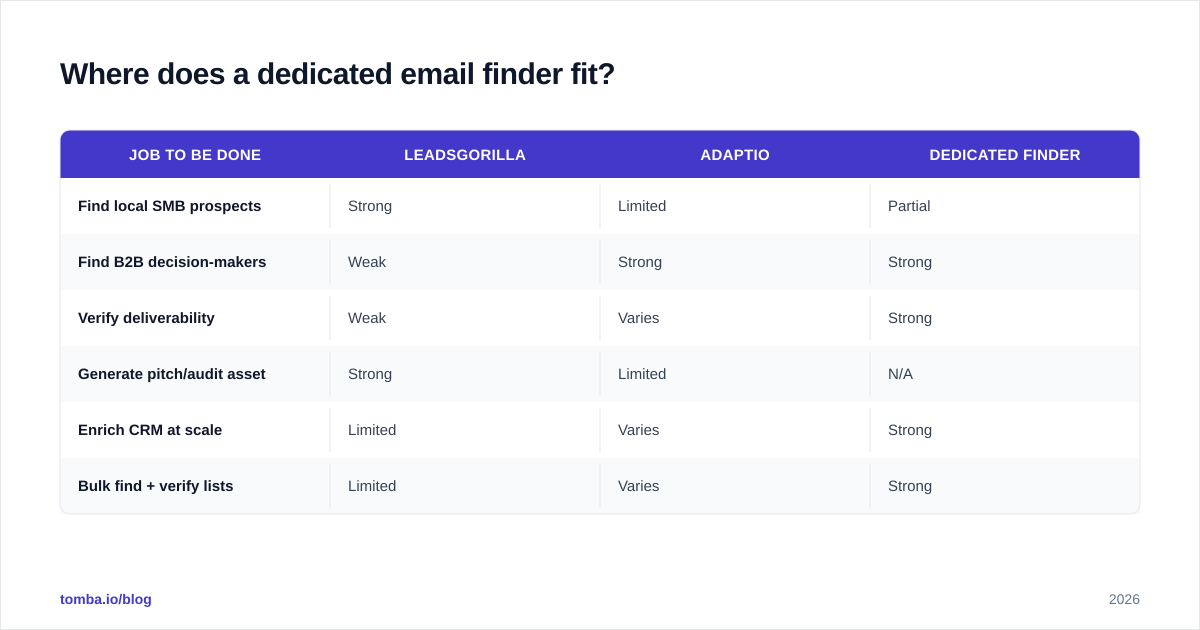
Here is how the three roles divide up, so you can see what overlaps and what does not:
| Job to be done | LeadsGorilla | Adaptio | Dedicated finder |
|---|---|---|---|
| Find local SMB prospects | Strong | Limited | Partial |
| Find B2B decision-makers | Weak | Strong | Strong |
| Verify deliverability | Weak | Varies | Strong |
| Generate pitch/audit asset | Strong | Limited | N/A |
| Enrich CRM at scale | Limited | Varies | Strong |
| Bulk find + verify lists | Limited | Varies | Strong |
The lesson is not "buy three tools." It is: don't expect your workflow tool to also be your accuracy tool. Most teams over-pay for overlapping features and still under-invest in the one layer — verified contact data — that gates every downstream metric.
Pricing: what should you actually expect to pay?#
Both vendors change packaging frequently, so anchor on structure rather than a number. LeadsGorilla has historically sold via tiered subscriptions (and at times one-time/launch deals) priced for solo agencies and small teams. Adaptio prices like a B2B prospecting platform, where cost scales with contact credits, seats, and enrichment volume. Confirm both directly: LeadsGorilla on its official site and Adaptio on its own pricing page.
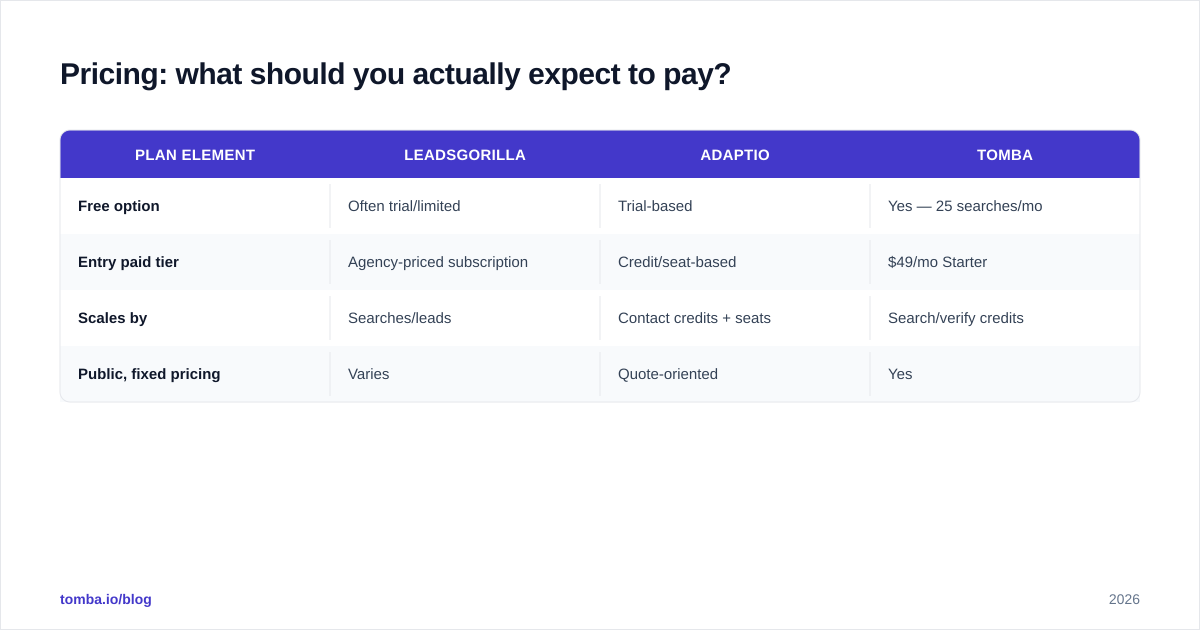
For comparison, Tomba's pricing is public and credit-based: a Free tier (25 searches/month), Starter at $49/mo, Growth at $99/mo, Pro at $249/mo, and custom Enterprise. You can see the full breakdown on the Tomba pricing page. The point of including it is not to claim Tomba replaces either tool's workflow — it is to show what the data layer should cost on its own, so you can judge whether a bundled tool's data premium is worth it.
| Plan element | LeadsGorilla | Adaptio | Tomba |
|---|---|---|---|
| Free option | Often trial/limited | Trial-based | Yes — 25 searches/mo |
| Entry paid tier | Agency-priced subscription | Credit/seat-based | $49/mo Starter |
| Scales by | Searches/leads | Contact credits + seats | Search/verify credits |
| Public, fixed pricing | Varies | Quote-oriented | Yes |
If transparent, predictable data costs matter to you, that column on the right is the relevant signal — not which logo has more dashboards.
Common mistakes when comparing Adaptio vs LeadsGorilla#
- Buying for the demo, not the motion. A slick audit report is irrelevant if you sell SaaS to enterprises. Match the tool to your buyer.
- Assuming bundled email data is deliverable. It frequently isn't. Always run a verification pass before a campaign — your sender reputation is harder to rebuild than to protect.
- Ignoring catch-all domains. A large share of B2B domains accept everything. Without a catch-all verifier, your "valid" count is inflated.
- Paying twice for the same layer. If two tools both claim enrichment, you don't need both — keep the one whose workflow you actually use and feed it from one clean data source.
So, who wins — Adaptio or LeadsGorilla?#
There is no universal winner, and any post that declares one is selling something. LeadsGorilla wins for local-business agencies that close deals with audit reports. Adaptio wins for B2B teams running outbound to other companies. The tiebreaker, for almost everyone, is data quality — and that is a job a dedicated finder does better than either bundle.
So the practical recommendation is a layered one: pick the workflow tool that matches your buyer, then feed it verified contacts from a specialist source instead of trusting whatever the bundle scrapes.
If verified, deliverable B2B email is your real bottleneck, start with the Tomba Email Finder — find professional addresses by name, company, or domain, verify them in the same flow, and enrich the rows before they ever hit your sequencer. Pair it with the free tier to test accuracy against your own list before you spend a dollar, then scale on a pricing plan that costs what data should cost — no agency markup, no quote-only games. Get the data layer right, and whichever workflow tool you choose will simply perform better.
// get started
Find, verify and enrich your first contacts today
Start on the free plan with 25 searches a month, then scale when your team is ready.
Free plan · No credit card required · GDPR & CCPA
// about the author