Adaptio vs Mattermark: B2B Data Platforms Compared 2026
A neutral, side-by-side breakdown of Adaptio vs Mattermark — features, pricing, data freshness, and where each fits in a 2026 GTM stack.
TL;DR
- Adaptio is the modern, signal-driven play: real-time intent and account scoring built for outbound teams that act on triggers, not static lists.
- Mattermark is the legacy market-intelligence brand — strong for company/funding research, weaker for live contact data and modern GTM workflows.
- Neither is a true contact-data tool. If your bottleneck is reaching the right person, you still need a dedicated email finder layered on top.
- Pick Adaptio for trigger-based outbound and RevOps scoring; pick Mattermark for investor-style company research and TAM mapping.
- Budget matters: both sit well above entry-level data tools, so smaller teams often pair a cheaper enrichment source with one of them.
What are Adaptio and Mattermark?#
Short version: both are B2B data platforms, but they solve different halves of the same problem. Adaptio focuses on who to act on right now using behavioral and intent signals. Mattermark focuses on what a company is — funding, headcount, growth metrics, and market positioning.
Think of it like the difference between a weather radar and an encyclopedia. Adaptio is the radar: it tells you a storm (a buying signal) is forming over a specific account so you can move. Mattermark is the encyclopedia: deep reference material on companies, useful when you sit down to research a market or build a target list.
Mattermark built its reputation in the mid-2010s as a quantitative company-intelligence database — the kind of tool VCs and growth teams used to rank startups by momentum. Adaptio is the newer entrant, designed around the way modern outbound and revenue operations teams actually work in 2026: signals first, accounts scored continuously, data pushed into the CRM instead of exported to a spreadsheet.
The framework above is the lens for this whole comparison: map each tool to the job you're hiring it for. Get that wrong and you'll pay enterprise prices for a tool your team never opens.

How do Adaptio and Mattermark compare on features?#
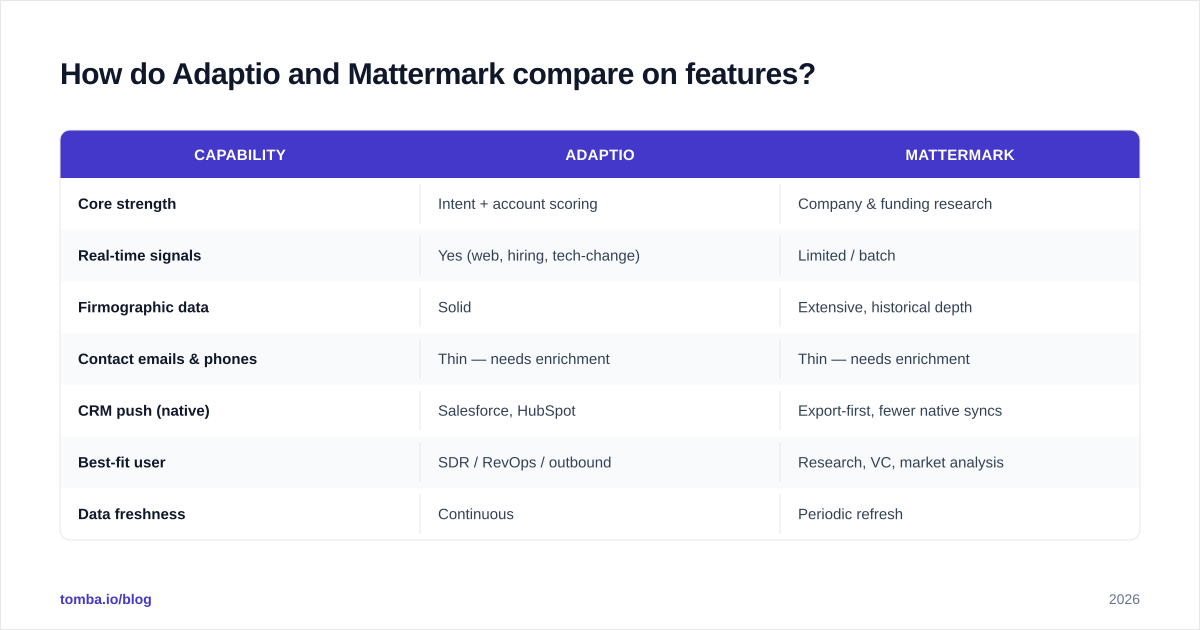
The honest answer is that they overlap less than their marketing suggests. Here's the side-by-side.
| Capability | Adaptio | Mattermark |
|---|---|---|
| Core strength | Intent + account scoring | Company & funding research |
| Real-time signals | Yes (web, hiring, tech-change) | Limited / batch |
| Firmographic data | Solid | Extensive, historical depth |
| Contact emails & phones | Thin — needs enrichment | Thin — needs enrichment |
| CRM push (native) | Salesforce, HubSpot | Export-first, fewer native syncs |
| Best-fit user | SDR / RevOps / outbound | Research, VC, market analysis |
| Data freshness | Continuous | Periodic refresh |
| Learning curve | Moderate | Low for research, steep for workflows |
Two things jump out. First, both tools are thin on actual contact data — verified emails and direct dials. That's not a knock; it's a category reality. Market-intelligence platforms tell you which account to chase, not the inbox of the VP who signs the check. You bridge that gap with a dedicated data enrichment or email finder step.
Second, Adaptio leans into workflow (push signals into the CRM, score accounts automatically) while Mattermark leans into reference (rich, browsable company profiles). If your reps live in Salesforce and never want to open another tab, Adaptio's model fits better. If you're an analyst building a market map in a spreadsheet, Mattermark's depth wins.
Is Adaptio better than Mattermark for outbound sales?#
For outbound, Adaptio is the stronger default — but with caveats.
Outbound in 2026 is a timing game. A generic list of 5,000 accounts converts poorly; the same list filtered to the 80 accounts showing a buying signal this week converts dramatically better. Adaptio is built around that thesis. It surfaces triggers — a new funding round, a key hire, a technology change, a spike in research activity — and scores accounts so your SDRs work the hottest ones first.
Mattermark can support outbound, but it was designed for a research-first era. You'll build a great target account list, then realize you still need to figure out who to contact, find their email, verify it, and load it into a sequencer. That's three or four tools downstream before a single email goes out.
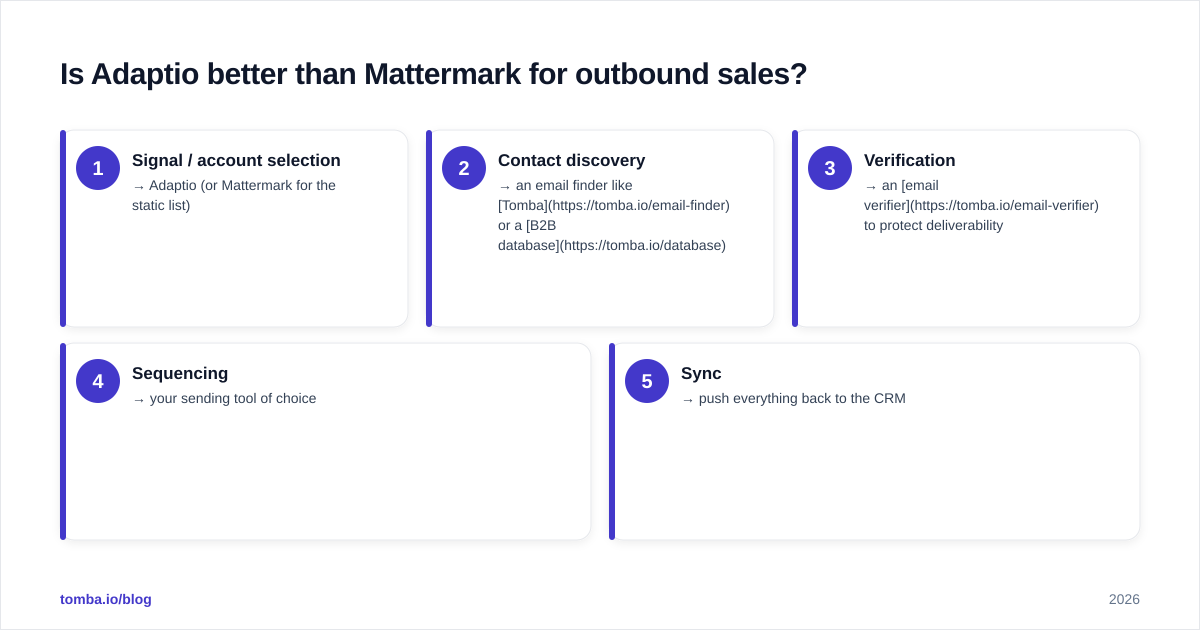
Here's the realistic outbound stack with either tool at the top:
- Signal / account selection → Adaptio (or Mattermark for the static list)
- Contact discovery → an email finder like Tomba or a B2B database
- Verification → an email verifier to protect deliverability
- Sequencing → your sending tool of choice
- Sync → push everything back to the CRM
Notice that steps 2 and 3 aren't optional. Even the best account signal is worthless if your email bounces. A 5% bounce rate quietly wrecks sender reputation, and once that happens your whole domain underperforms regardless of how good your targeting was.
How much do Adaptio and Mattermark cost?#
Both platforms sit in the mid-to-upper tier of the data market, and both publish little public pricing — a common pattern for sales-led B2B data vendors. Expect annual contracts and seat-based pricing, typically negotiated.
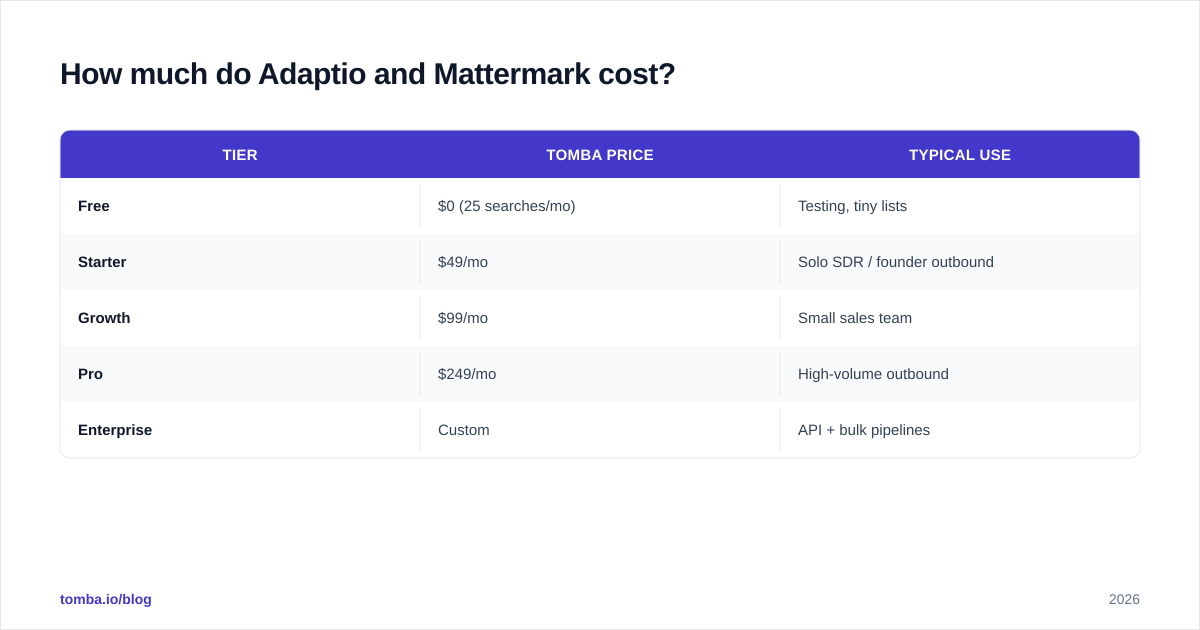
That pricing opacity is itself a decision factor. If you want predictable, self-serve, per-credit pricing, neither tool is built for you. This is where layering a transparent contact-data tool underneath makes budget sense. For reference, Tomba pricing is fully public and credit-based:
| Tier | Tomba price | Typical use |
|---|---|---|
| Free | $0 (25 searches/mo) | Testing, tiny lists |
| Starter | $49/mo | Solo SDR / founder outbound |
| Growth | $99/mo | Small sales team |
| Pro | $249/mo | High-volume outbound |
| Enterprise | Custom | API + bulk pipelines |
The practical pattern most teams land on: spend the big-ticket budget on one intelligence platform (Adaptio or Mattermark) for targeting, then add an affordable, transparent contact layer for the find-and-verify step rather than paying enterprise rates for thin contact coverage.
You can validate vendor pricing claims and read unfiltered user reviews on G2 and Capterra before signing anything — both have category pages for sales intelligence software with current verified reviews.
Which has more accurate and fresh data?#
Freshness goes to Adaptio; historical depth goes to Mattermark.
Adaptio's whole model depends on data being current — a buying signal from three months ago is noise, not a trigger. So its architecture refreshes continuously and weights recency. Mattermark's strength is the opposite: a deep, historical record of company momentum over time, which is exactly what you want for trend analysis but less useful for "who should I call today."
A note on the word "accuracy," because it gets abused in this category. Accuracy means different things for firmographics versus contacts:
- Firmographic accuracy (industry, size, funding) — both tools are reasonable; Mattermark's historical layer is richer.
- Contact accuracy (is this email deliverable right now) — neither tool is built for this, and you should not trust either as your verification source.
That second point is where teams get burned. They assume a premium intelligence platform also gives premium contact data. It doesn't. Email addresses decay roughly 22–30% per year as people change jobs, so any contact record needs live verification at send time. Run contacts through a real email verification step and check catch-all domains separately — those are the two failure modes that silently inflate bounce rates. You can read more on how providers source and refresh records on the Tomba data sources page.

What about integrations and workflow fit?#
Adaptio is the more "modern stack" citizen. Native pushes to Salesforce and HubSpot mean signals and scores land where reps already work, without a manual export step. Mattermark is more export-oriented — excellent for pulling a dataset into a spreadsheet or a research deck, less seamless for continuous CRM workflows.
If your team's daily surface is the CRM, weight integration depth heavily. A tool with brilliant data that requires a CSV round-trip every Monday gets abandoned by week three. The best data tool is the one your reps actually keep using.
For teams that build their own pipelines, also check whether you can hit the data programmatically. Tomba, for instance, exposes a full email finder API and bulk endpoints so you can enrich Adaptio or Mattermark exports automatically instead of by hand — a common way to glue a research platform to a live contact layer.
Adaptio vs Mattermark: which should you choose?#
Decision rule, stated plainly:
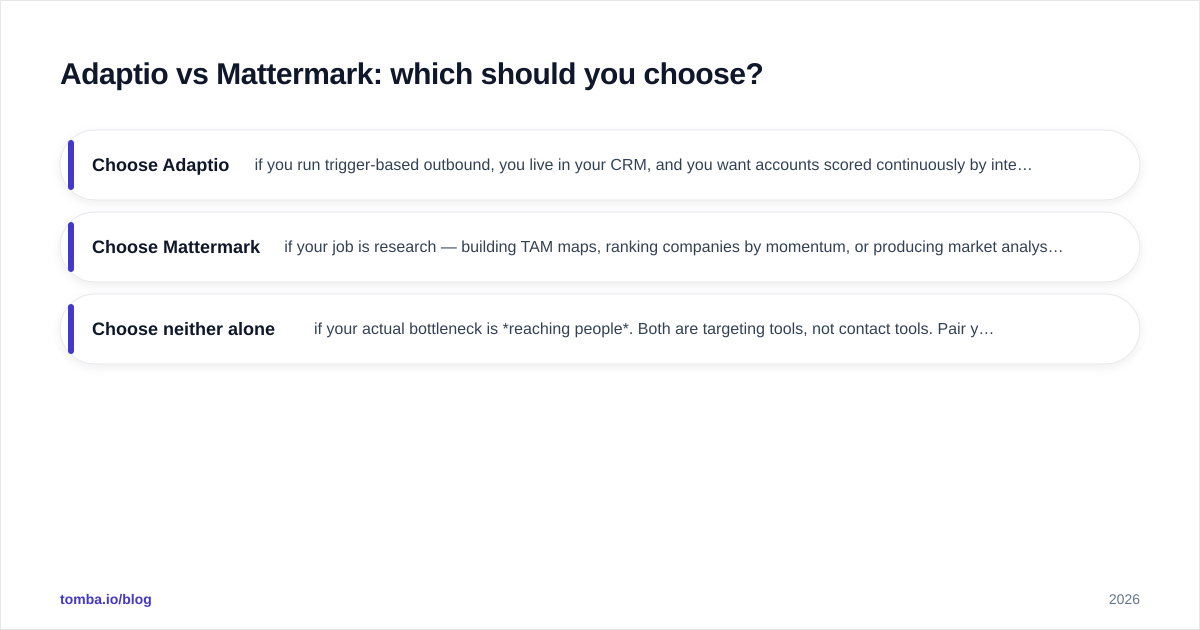
- Choose Adaptio if you run trigger-based outbound, you live in your CRM, and you want accounts scored continuously by intent. It rewards teams that act on signals fast.
- Choose Mattermark if your job is research — building TAM maps, ranking companies by momentum, or producing market analysis where historical depth matters more than real-time triggers.
- Choose neither alone if your actual bottleneck is reaching people. Both are targeting tools, not contact tools. Pair your pick with a dedicated finder and verifier.
| If your priority is… | Best pick |
|---|---|
| Real-time buying signals | Adaptio |
| Deep company/funding history | Mattermark |
| Native CRM workflow | Adaptio |
| Spreadsheet-based research | Mattermark |
| Verified emails & phones | Neither — add a finder/verifier |
| Transparent, low pricing | Neither — add a credit-based tool |
For context on where Mattermark sits historically in the market-intelligence space, its company background is a useful neutral reference. The category has shifted hard toward signal-based selling since then, which is the gap Adaptio targets.
The piece both tools leave out#
Here's the through-line: Adaptio and Mattermark both answer "which account?" — and neither reliably answers "which person, at which verified email, right now?" That second question is where outbound actually succeeds or fails.
If reaching the right contact is your real constraint, start there. The Tomba Email Finder finds professional email addresses by domain, name, or company, then verifies them so your bounce rate stays low and your sender reputation stays intact — whether you feed it accounts from Adaptio, Mattermark, or your own list. Try the free tier with 25 searches, layer it under whichever intelligence platform you pick, and turn good targeting into actual conversations. Targeting tells you where to aim; verified contact data is what lets you pull the trigger.
Ready to find emails that actually work?
Join 150,000+ professionals who stopped guessing and started sending. Free credits on signup — no credit card required.
Get the Tomba newsletter
Practical outbound tactics and product updates — once every two weeks.
About the author